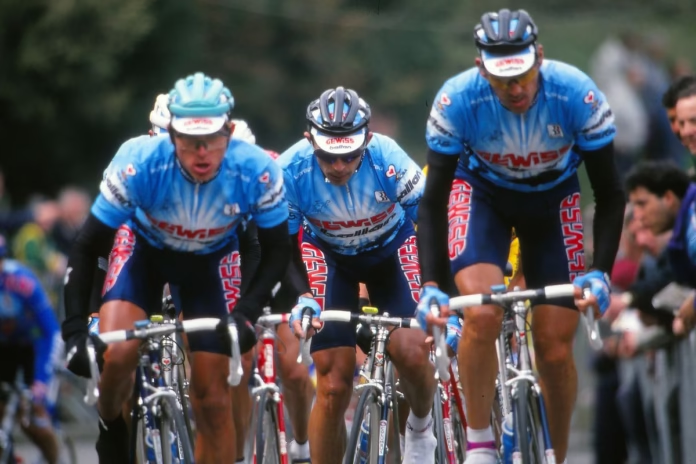
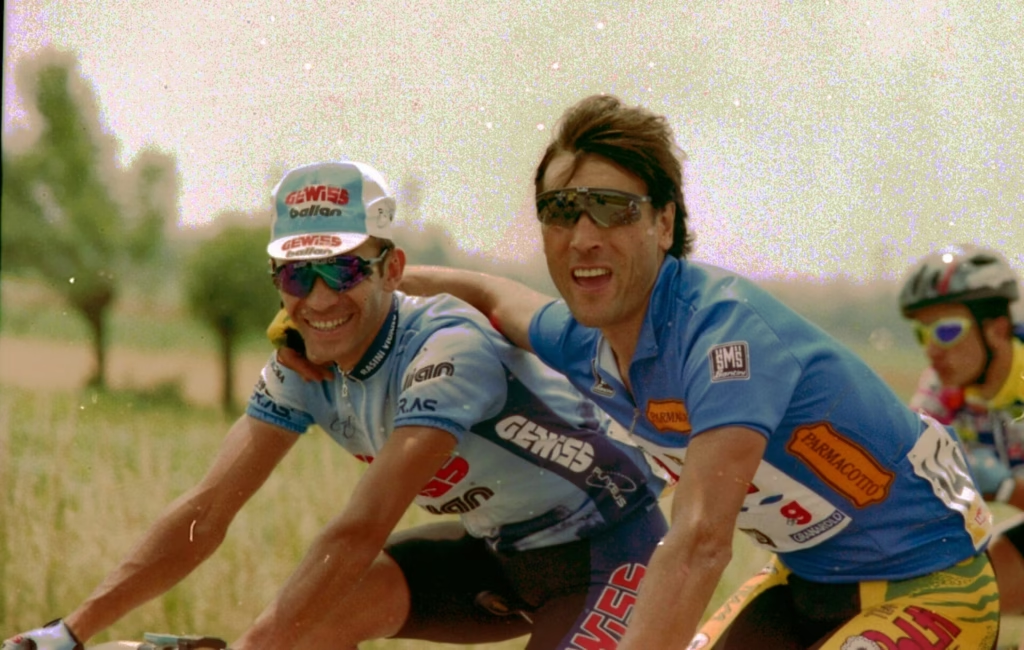
Few teams compress as much of 1990s professional cycling into such a short lifespan as Gewiss-Ballan. The Italian squad existed in recognisable form for only five seasons, beginning as Mecair-Ballan in 1993, becoming Gewiss-Ballan for 1994 and 1995, then Gewiss-Playbus in 1996 before a final year as Batik-Del Monte. In that period it won the Giro d’Italia, major Classics, Grand Tour stages and a Tour de France team time trial, while assembling a roster that included Moreno Argentin, Evgeni Berzin, Piotr Ugrumov, Bjarne Riis, Giorgio Furlan, Nicola Minali and Ivan Gotti.
The results alone make the team historically important. The circumstances around some of those results make it impossible to discuss in the uncomplicated language usually attached to a successful squad. Gewiss-Ballan became one of the defining teams of an era in which EPO changed professional cycling, and its most famous performance, the 1994 La Flèche Wallonne one-two-three, became inseparable from the wider questions surrounding the sport at the time.
From Mecair-Ballan to Gewiss
The project started in 1993 as Mecair-Ballan under manager Emanuele Bombini. It was not built like a conventional new team trying to accumulate modest results before moving upwards. Moreno Argentin arrived as an established Classics leader, while the squad also brought together riders from the former Soviet system, including Piotr Ugrumov, Evgeni Berzin and Vladislav Bobrik. Nicola Minali represented another strand, a young Italian sprinter who would develop into a prolific winner.
The first Giro d’Italia immediately showed the level of the project. Argentin won two stages and wore the maglia rosa through the opening part of the race, while Ugrumov won a stage and finished second overall behind Miguel Indurain. For a first-year professional team, it was an unusually strong foundation. It also established the basic shape of the squad: experienced Italian race knowledge mixed with powerful riders from eastern Europe and a management structure willing to organise around several leaders.
Gewiss, the Italian electrical company that had previously sponsored cycling, became title sponsor for 1994. That change coincided with the season that fixed the team in cycling history. The results arrived so quickly and across so many types of race that Gewiss-Ballan did not merely look competitive. For a period it looked capable of controlling the spring and then carrying that strength directly into the Giro.
The extraordinary spring of 1994
Giorgio Furlan opened the team’s major run by winning Tirreno-Adriatico, with Berzin second overall. Furlan then won Milano-Sanremo, giving Gewiss-Ballan one of the five Monuments before the cobbled and Ardennes Classics had fully developed. Argentin, already one of the outstanding one-day riders of his generation, remained a central figure, but this was no longer a team dependent on an ageing star.
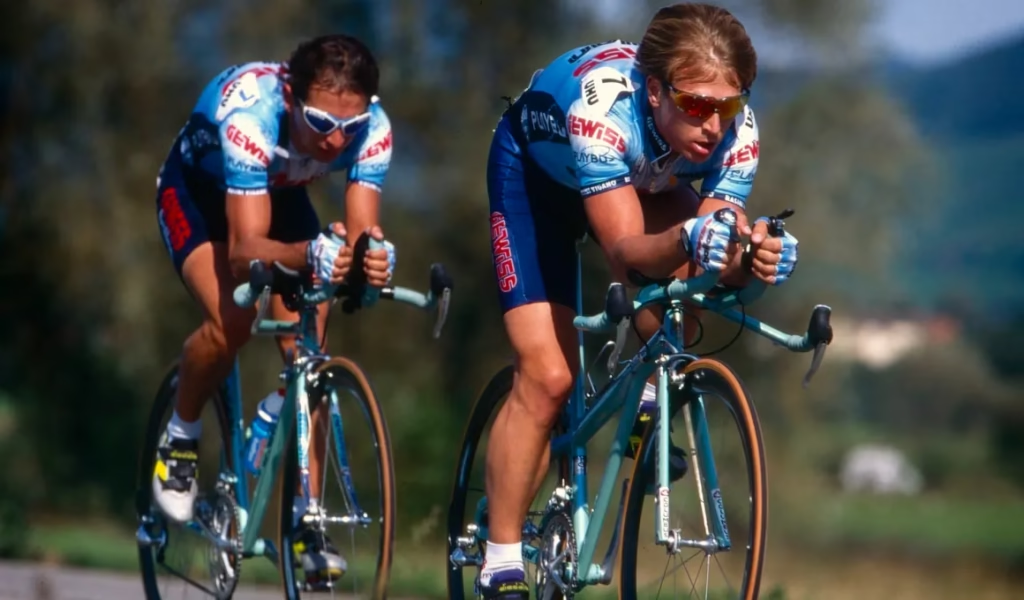
La Flèche Wallonne on 20 April became the image most closely associated with Gewiss-Ballan. Argentin, Furlan and Berzin escaped together with around 72 kilometres remaining and finished first, second and third. A team filling the entire podium in a major Classic is rare enough. Doing it after riding away together so far from the finish made the result look almost unreal, even by the standards of a dominant squad.
Argentin’s victory was his third at La Flèche Wallonne and the final major win of a career that had already included four Liège-Bastogne-Liège victories and three editions of the Tour of Flanders. For Gewiss-Ballan, however, the importance of the day extended far beyond another entry in a palmarès. The scale of the performance intensified scrutiny of the team and its medical methods, a subject that would follow the squad permanently.
Berzin then won Liège-Bastogne-Liège four days later. Gewiss-Ballan had therefore taken Milano-Sanremo, La Flèche Wallonne and Liège-Bastogne-Liège in the space of little more than a month, with three different riders capable of winning at the highest level. It was an unusually concentrated demonstration of strength and one that set up Berzin for an even bigger result in Italy.
Berzin beats Indurain at the Giro
Evgeni Berzin entered the 1994 Giro d’Italia as a 23-year-old whose spring had already announced his potential. The race turned him into a Grand Tour winner. He won the fourth stage at Campitello Matese, took the pink jersey and then defended it against Miguel Indurain, the rider who had won the previous two Giri and the previous three Tours de France.
Berzin’s ability against the clock made the difference particularly difficult for Indurain to reverse. He won the long time trial to Follonica and later the mountain time trial to Il Ciocco, combining climbing strength with the discipline in which Indurain normally imposed himself on rivals. Berzin reached Milan as the first Russian winner of the Giro, with Ugrumov also giving Gewiss-Ballan another high general-classification presence.
The victory was the team’s biggest stage-race result, but 1994 did not fade after the Giro. Vladislav Bobrik won the Giro di Lombardia later in the season, meaning Gewiss-Ballan had won three Monuments in the same year through Furlan, Berzin and Bobrik. The spread of winners mattered. This was a team able to move from a sprintier Milano-Sanremo finish to the Ardennes, a three-week Grand Tour and the autumn Classics without relying on a single dominant leader.
 Photo Credit: Pascal Rondeau/Allsport
The doping shadow around Gewiss-Ballan
Any history of Gewiss-Ballan that treats 1994 simply as an exceptional sporting season leaves out the central reason the team remains controversial. The early 1990s were the period in which EPO use transformed professional cycling. Gewiss-Ballan’s performances, its medical environment and comments made around the team placed it at the centre of the argument about what was happening.
Team doctor Michele Ferrari became particularly prominent after the Flèche Wallonne clean sweep. Asked about EPO and its dangers in the aftermath of the race, Ferrari made a comparison with the risks of drinking large quantities of orange juice. The remark became notorious because it appeared to reduce a serious medical and sporting issue to a question of dosage. Ferrari would later become one of the most controversial doctors in cycling, with his name attached to the doping history of the following decade as well.
It is important to separate documented results from retrospective assumptions about individual riders, but it is equally misleading to detach Gewiss-Ballan from the context in which those results occurred. The team’s reputation is not a modern attempt to impose a different era’s standards on old racing. Questions about blood values, EPO and medical preparation were already being asked while the team was winning.
That is why the 1994 Flèche Wallonne remains such a loaded image. Three team-mates riding away to occupy the entire podium can be read as a demonstration of collective strength, but it also became an emblem of a period when performances were increasingly difficult to separate from the pharmacological changes moving through the peloton.
A broader team in 1995
Gewiss-Ballan could not repeat the extraordinary concentration of victories from 1994, but the following season showed that the team had not disappeared after one peak year. Berzin returned to the Giro as defending champion and finished second to Tony Rominger, with Ugrumov third. Bjarne Riis, meanwhile, became increasingly important in stage races and gave the squad another route into the Tour de France general classification.
The team’s Tour de France included one of its clearest demonstrations of collective strength: victory in the team time trial. Gewiss-Ballan covered the stage at an average speed of 54.930 km/h, a Tour record at the time. Riis wore the yellow jersey during the race and eventually finished third overall behind Miguel Indurain and Alex Zülle.
Nicola Minali also developed into an important source of victories. His speed gave the team a different way to win from Berzin’s stage-race ability or the Classics strength that had defined 1994. That depth helps explain why Gewiss-Ballan cannot be reduced to one famous spring. The squad was structured to win across the calendar, and it continued to do so even as rivals adapted and individual leaders changed.
Gewiss-Playbus and the final transition
The title changed to Gewiss-Playbus for 1996. Berzin remained a central figure and briefly wore yellow at the Tour de France, while Ivan Gotti had developed into another Grand Tour option. Gabriele Colombo supplied one of the season’s biggest one-day victories at Milano-Sanremo, continuing the team’s remarkable relationship with the Italian Monument after Furlan’s win two years earlier.
By then, though, the balance of the squad was changing. The 1994 combination of Argentin, Furlan, Berzin and Ugrumov had already broken up, and Gewiss was approaching the end of its sponsorship. The project continued in 1997 as Batik-Del Monte, with Bombini’s structure surviving but without the Gewiss name that had become synonymous with its most successful and controversial period.
Ivan Gotti won the 1997 Giro d’Italia for the successor team, giving the organisation another Grand Tour victory in its final season. Batik-Del Monte nevertheless occupied a different place in the peloton from the Gewiss-Ballan squad of 1994. At the end of the year the team disappeared, closing a five-season sequence that had moved from Mecair-Ballan to one of the strongest teams in the world and then out of professional cycling almost as quickly.
How Gewiss-Ballan should be remembered
Gewiss-Ballan’s sporting record is unusually dense for such a short-lived team. Berzin’s Giro victory, the 1994 Flèche Wallonne podium sweep, Monument wins for Furlan, Berzin, Bobrik and Colombo, the Tour team time trial and the development of riders such as Minali and Gotti would be enough to make the project significant in any era.
Its historical importance is larger because the team sits directly inside one of professional cycling’s most difficult transitions. Gewiss-Ballan arrived as EPO was reshaping the physical limits of the peloton, produced performances that immediately generated suspicion, and employed a doctor whose public comments became part of the era’s doping story. Ignoring that context would make the history cleaner, but less accurate.
The result is a team that still resists a simple verdict. Its riders were tactically strong, its roster was exceptionally deep and its management built a squad capable of winning almost anywhere. At the same time, the scale and context of that dominance mean the results cannot be viewed in isolation. Gewiss-Ballan is remembered because it won so much, but also because its greatest season captured exactly why the mid-1990s remain one of cycling’s most contested periods.