
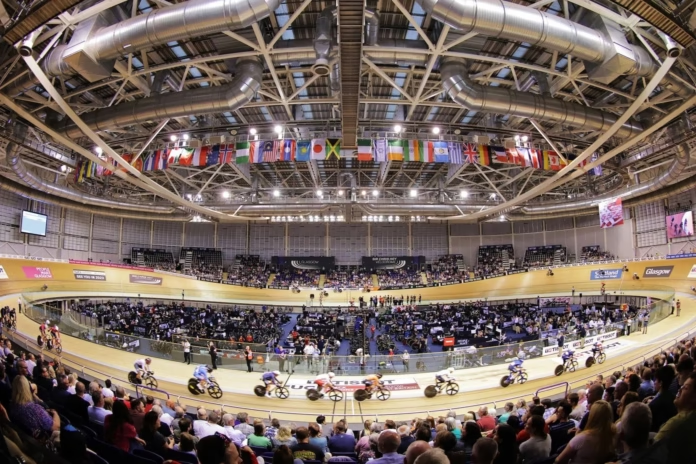
Great Britain will not compete as a single track cycling team at the Glasgow 2026 Commonwealth Games.
Instead, Britain’s Olympic and world champions will be divided between England, Scotland and Wales. Riders who spend most of the season training and racing together in Great Britain colours will become direct opponents inside the Sir Chris Hoy Velodrome.
That separation makes the British medal picture more complicated, but also more compelling.
England bring the deepest squad, including Matthew Richardson, Sophie Capewell, Katy Marchant, Josh Charlton and Josie Knight. Wales have arguably the strongest individual favourite in Emma Finucane, supported by Anna Morris and Jessica Roberts. Host nation Scotland will look towards Neah Evans, Mark Stewart and Lauren Bell, with several younger riders competing on a track where they learned and developed.
Across track and Para track cycling, the Home Nations should challenge for gold in sprint, team sprint, individual pursuit, team pursuit, bunch endurance races and several Para events.
Australia remain the strongest collective threat, while Canada, New Zealand, Malaysia and Trinidad and Tobago can also challenge in particular disciplines.
Glasgow should produce a substantial British medal total. The harder question is which Home Nation collects the largest share.
Glasgow 2026 track cycling at a glance
| Detail | Information |
|---|---|
| Competition dates | Thursday 30 July to Sunday 2 August 2026 |
| Venue | Sir Chris Hoy Velodrome, Glasgow |
| Total medal events | 26 across track and Para track cycling |
| British teams | England, Scotland and Wales |
| Strongest British disciplines | Sprint, pursuit and Para track cycling |
| Main international rival | Australia |
| UK live coverage | HBO Max and TNT Sports |
| Free-to-air coverage | Extended daily highlights on 5 |
Every session can be followed live through HBO Max, with additional television coverage on TNT Sports. Full viewing details and the daily event programme are available in our guide to watching track cycling at the Glasgow 2026 Commonwealth Games.
Is there a Great Britain cycling team at the Commonwealth Games?
There is no unified Great Britain team in Glasgow.
At the Olympics and World Championships, British Cycling selects riders from England, Scotland and Wales to represent Great Britain. At the Commonwealth Games, they compete for their individual Home Nations.
That means:
- Matthew Richardson represents England
- Emma Finucane represents Wales
- Neah Evans represents Scotland
- Sophie Capewell and Katy Marchant represent England
- Anna Morris and Jessica Roberts represent Wales
- Mark Stewart and Lewis Askey represent Scotland
The distinction is especially important in the team events.
A Great Britain women’s team sprint can combine Finucane, Capewell and Marchant. At Glasgow, Finucane must lead a Welsh combination while Capewell and Marchant ride together for England.
The same applies to the team pursuit. Riders who have won international medals alongside one another are divided into smaller national pools, making the Commonwealth combinations weaker than a complete British squad but creating more open and unpredictable competitions.
British supporters can still follow the riders collectively, but every medal is officially awarded to England, Scotland or Wales rather than Great Britain.
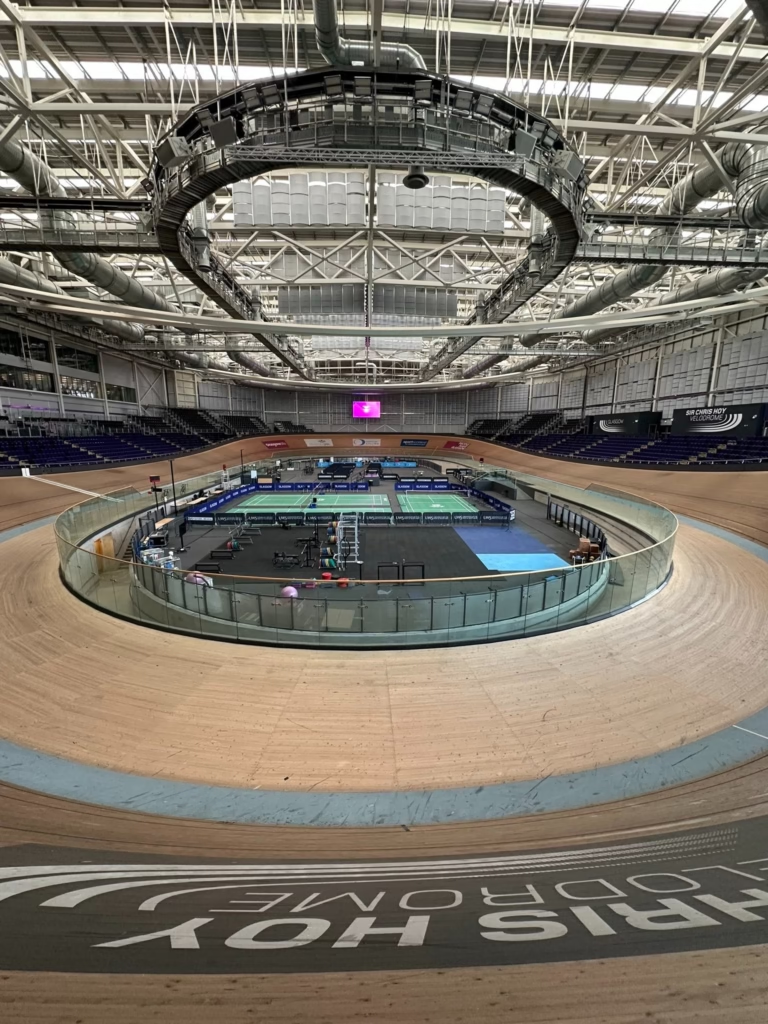
Why the Sir Chris Hoy Velodrome matters
The Glasgow venue is more than a neutral championship track.
It was built for the 2014 Commonwealth Games and later hosted the 2023 Cycling World Championships. Its 250-metre wooden track has been used for British championships, international racing and development programmes.
For many Scottish riders, it is where their track careers began.
Erin Boothman, Lauren Bell, Iona Moir and several other members of the home squad have trained or competed there from a young age. They know how the bends feel at speed, where they prefer to launch an effort and how the track responds during a crowded bunch race.
That familiarity does not replace raw speed, but it can remove uncertainty.
The home crowd should also give Scotland a particular lift during the tactical endurance events. A lap-gaining attack from Mark Stewart or Neah Evans will produce a response unlike anything they experience at a neutral World Championship.
England and Wales should still receive strong support when facing Australia or another international rival. The loudest reactions may come when established Great Britain teammates face one another directly for gold.
Team England’s track cycling squad
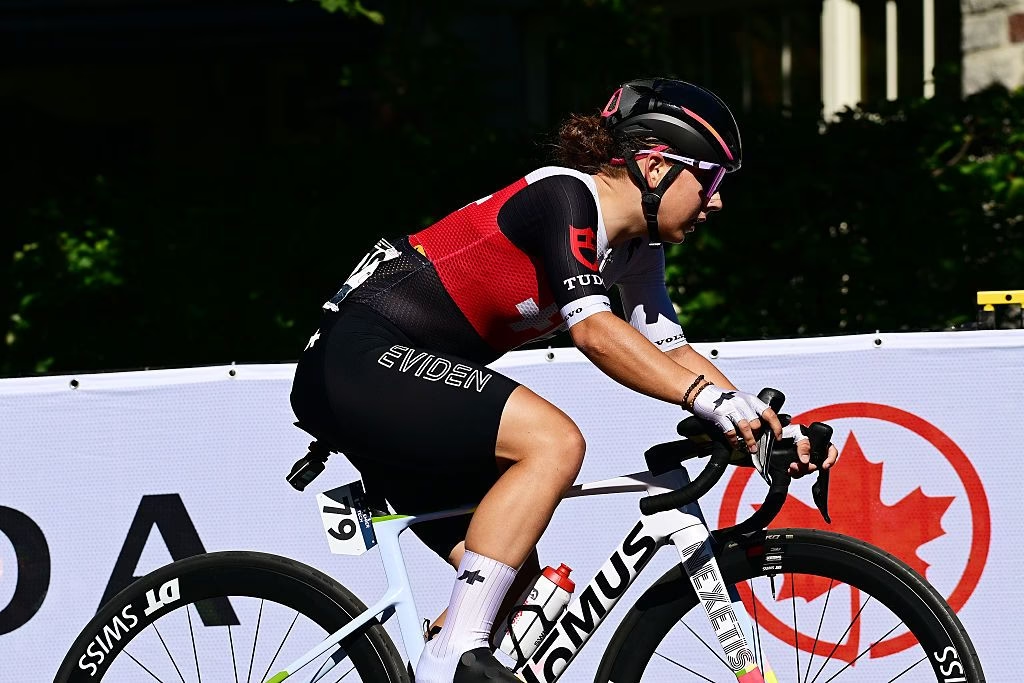
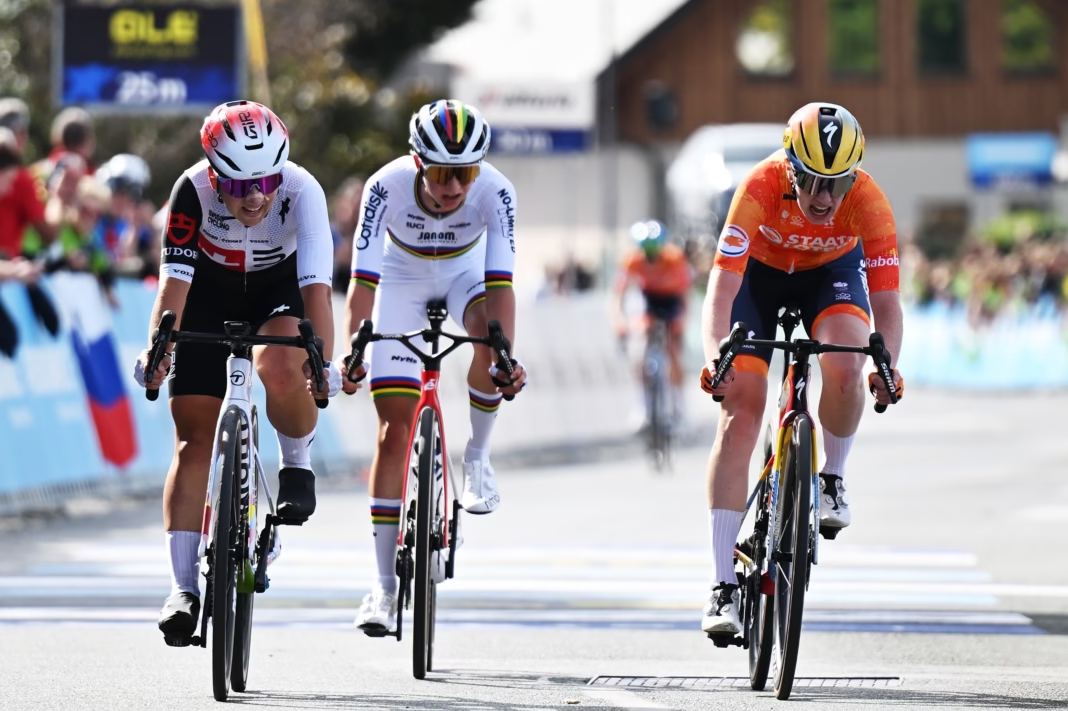
England have the largest and deepest British selection.
Men’s endurance
- Josh Charlton
- Henry Hobbs
- Charlie Tanfield
- Will Tidball
- Ethan Vernon
Women’s endurance
- Josie Knight
- Maddie Leech
- Sophie Lewis
- Grace Lister
- Abi Miller
Men’s sprint
- Harry Ledingham-Horn
- Matthew Richardson
- Joe Truman
- Hamish Turnbull
Women’s sprint
- Sophie Capewell
- Katy Marchant
- Rhianna Parris-Smith
- Georgette Rand
Para track cycling
- Kadeena Cox
- Lizzi Jordan
- Danni Khan
- Morgan Newberry
- Matt Robertson
- Sophie Unwin
- Sylvia Misztal
The squad contains Olympic champions, world champions, previous Commonwealth medallists and several Games debutants.
England should begin as the strongest Home Nation overall, particularly in the men’s sprint and both pursuit programmes.
Matthew Richardson is England’s leading individual favourite
Matthew Richardson enters Glasgow as one of the fastest sprint riders in the world.
He won the individual sprint and team sprint for Australia at Birmingham 2022 but now represents England. That creates the unusual possibility of a defending Commonwealth champion attempting to retain his titles against his former national teammates.
Richardson is a contender in four events:
- Individual sprint
- Keirin
- Team sprint
- Kilometre time trial
The individual sprint provides his clearest route to gold.
Richardson combines elite flying-lap speed with the tactical experience required for head-to-head rounds. He can win through a sharp acceleration from low speed or extend the effort if a rival attempts to launch early.
His endurance also makes him dangerous in the keirin and kilometre time trial.
Australia remain a major threat despite losing Richardson, while Malaysia and Trinidad and Tobago traditionally bring dangerous sprint riders. Richardson should nevertheless begin as England’s strongest individual gold favourite.
| Event | Richardson’s prospects |
|---|---|
| Individual sprint | Strong gold favourite |
| Team sprint | Strong gold chance |
| Keirin | Gold contender |
| Kilometre time trial | Medal contender |
England’s men’s team sprint has unusual depth
England can select from Richardson, Hamish Turnbull, Joe Truman and Harry Ledingham-Horn.
Turnbull is an Olympic team sprint silver medallist, while he and Truman formed part of England’s silver medal-winning combination at Birmingham 2022. Ledingham-Horn provides another explosive starter and gives the team flexibility over its order.
The event requires more than placing the three fastest riders together.
The opening rider must accelerate the team from a standing start. The second rider must maintain the speed after moving into the lead, while the final rider completes the last lap alone.
England’s depth allows them to select specialists for each role rather than asking riders to adapt around one fixed combination.
Australia should provide the strongest opposition, but England have a realistic chance of taking gold.
Sophie Capewell and Katy Marchant give England two sprint leaders
England’s women’s sprint group may be the deepest complete selection at the Games.
Sophie Capewell and Katy Marchant were members of Great Britain’s Olympic champion team sprint squad. Both can challenge individually as well as contribute to the team event, with Rhianna Parris-Smith and Georgette Rand providing further options.
Capewell can target the sprint, keirin and team sprint.
She already owns Commonwealth silver and bronze medals and arrives looking to complete the set with gold. Her starting power makes her important to the team sprint, while her ability to maintain speed gives her a strong chance in the individual events.
Marchant brings greater experience and remains particularly dangerous in the keirin.
The principal obstacle is Welsh teammate-turned-rival Emma Finucane.
Finucane, Capewell and Marchant normally cooperate in Great Britain colours. In Glasgow, the two English riders must find a way to defeat the woman who may be the fastest sprinter in the competition.
 Photo Credit: Olly Hassell/SWpix.com
Emma Finucane is Wales’ biggest gold-medal hope
Emma Finucane is the headline rider in the Welsh squad and may be the British cyclist most likely to win multiple individual medals.
Wales have selected:
- Anna Morris
- Carys Lloyd
- Ciara Oliva
- Emma Finucane
- Ioan Hepburn
- James Ball
- Jessica Roberts
- Jonah Jenkins
- Lewis Oliva
Finucane should challenge in:
- Individual sprint
- Keirin
- Team sprint
- Kilometre time trial
Her greatest advantage is outright speed.
Finucane has developed into the benchmark women’s sprinter in Britain and has already won Olympic and world titles. In qualifying, that speed can place her at the favourable end of the knockout draw. In match racing, it allows her to recover from a difficult tactical position.
The individual sprint is her strongest event.
The keirin is less predictable because six riders compete on the track together and positioning can decide the result. Finucane still has the power to win even if the race opens earlier than expected.
The kilometre time trial presents a different test. Sustaining an effort over four laps requires more endurance than the shorter women’s time trial previously used at major championships.
| Event | Finucane’s prospects |
|---|---|
| Individual sprint | Strong gold favourite |
| Keirin | Strong gold chance |
| Team sprint | Medal contender |
| Kilometre time trial | Medal contender |
Finucane previously formed part of the Great Britain cycling squad selected for the Paris Olympics. Glasgow places her in a very different situation, leading a smaller Welsh sprint programme against her regular international teammates.
England against Wales in the women’s team sprint
The women’s team sprint may provide the clearest example of how Commonwealth competition changes British track cycling.
A complete Great Britain squad could combine Finucane, Capewell and Marchant. Glasgow separates that Olympic-quality trio.
England can use Capewell and Marchant alongside Parris-Smith or Rand. Wales must build around Finucane and Ciara Oliva, with another rider completing the three-woman combination.
England possess greater depth across the full effort.
Wales possess the fastest likely final rider.
Australia will attempt to exploit any weakness created by the British split. England should begin with a slight advantage because each position can be filled by an experienced specialist, but Wales remain capable of winning if they reach Finucane’s lap within striking distance.
Anna Morris gives Wales an endurance gold chance
Finucane will attract most of the Welsh attention, but Anna Morris provides another realistic route to gold.
Morris has raced within Great Britain’s successful team pursuit programme and is also a leading individual pursuit rider. Her ability to maintain a controlled high pace makes the individual event particularly suitable.
The Commonwealth field is strong without containing every major European pursuit nation.
Italy, Germany, France and Denmark are absent. Australia, New Zealand, Canada and the British Home Nations still provide serious opposition, but the route to a medal is more open than at a World Championship.
Morris is also central to Welsh team pursuit hopes alongside Jessica Roberts, Carys Lloyd and the other endurance options.
Wales lack England’s depth, making qualification particularly important. They cannot afford to use their strongest riders unnecessarily if they want to reach the medal rounds with enough energy to challenge for gold.
England could dominate the men’s pursuit events
Josh Charlton is the individual pursuit world champion and one of England’s clearest gold-medal candidates.
He is joined by Charlie Tanfield, Ethan Vernon, Will Tidball and Henry Hobbs, creating an endurance group with several complementary strengths.
Charlton provides world-leading pursuit speed. Tanfield adds extensive team experience, Vernon brings finishing power, while Tidball is a former scratch race world champion.
England should challenge across:
- Individual pursuit
- Team pursuit
- Scratch race
- Points race
- Elimination race
Charlton is the clearest individual pursuit favourite.
The event removes much of the tactical uncertainty found in the bunch races. He needs to reproduce his controlled pacing and sustained speed rather than negotiate attacks or positioning battles.
Australia and New Zealand should challenge strongly, but England have a realistic opportunity to win both men’s pursuit titles.
Ethan Vernon has several routes to a medal
Ethan Vernon is difficult to assign to one event because his strengths extend across pursuit racing and bunch endurance competition.
He won Olympic team pursuit silver with Great Britain and possesses one of the fastest finishes among endurance riders.
That makes him particularly dangerous in the scratch race.
Unlike the points race, the result is decided by the first rider across the line after the full distance, provided no one has gained a lap. Vernon can allow more aggressive riders to spend energy attacking before using his road and track sprint late.
The danger comes if Scotland’s Stewart, Australia or another nation succeeds in gaining a lap.
England cannot simply assume that the race will remain together for Vernon’s finish. His team must follow dangerous moves while preserving him for the sprint.
Josie Knight leads England’s women’s endurance hopes
Josie Knight is one of the most important riders in the England squad.
She has won world and European medals and entered 2026 as one of Britain’s strongest pursuit riders.
Knight can target:
- Individual pursuit
- Team pursuit
- Points race
- Scratch race
The individual pursuit offers the clearest opportunity.
Her leading domestic rivals include Morris and Neah Evans, while Australia should again provide strong opposition.
England’s team pursuit group contains Knight, Maddie Leech, Sophie Lewis, Grace Lister and Abi Miller. Knight, Leech and Lewis already have Commonwealth team pursuit experience, giving the squad an established core around which to introduce newer riders.
Miller is the youngest cyclist in the English selection and may gain valuable experience even if she does not appear in every medal round.
Maddie Leech can transfer her Madison strengths
Maddie Leech arrives with elite Madison experience, but the two-rider relay event is not included in Glasgow.
She must transfer those qualities into the team pursuit and standalone bunch races.
Madison racing requires repeated accelerations, positioning, tactical awareness and the ability to make decisions while fatigued. All of those qualities apply to the points, scratch and elimination races.
The absence of the Olympic omnium and Madison gives riders such as Leech more individual opportunities.
Instead of combining several events into one omnium title, the Commonwealth Games award separate medals across the scratch, points and elimination disciplines. England can therefore divide responsibilities between Knight, Leech, Lewis, Lister and Miller.
Scotland begin a new era without Katie Archibald
Katie Archibald had been expected to become one of the central figures of the home Games.
She will not compete after announcing her retirement from professional cycling in May 2026.
The Olympic champion ended a career containing Olympic, world, European and Commonwealth titles after deciding that her mind and body were telling her it was time to stop.
Her absence removes Scotland’s most decorated endurance rider and changes the balance of the team.
The background to her decision is covered in Katie Archibald’s retirement from professional cycling.
Scotland must now rely more heavily on Evans, Stewart and its emerging riders.
Archibald will remain part of the wider story of the Glasgow velodrome. The venue is closely associated with her career, even though she will not receive the competitive home farewell that once appeared likely.
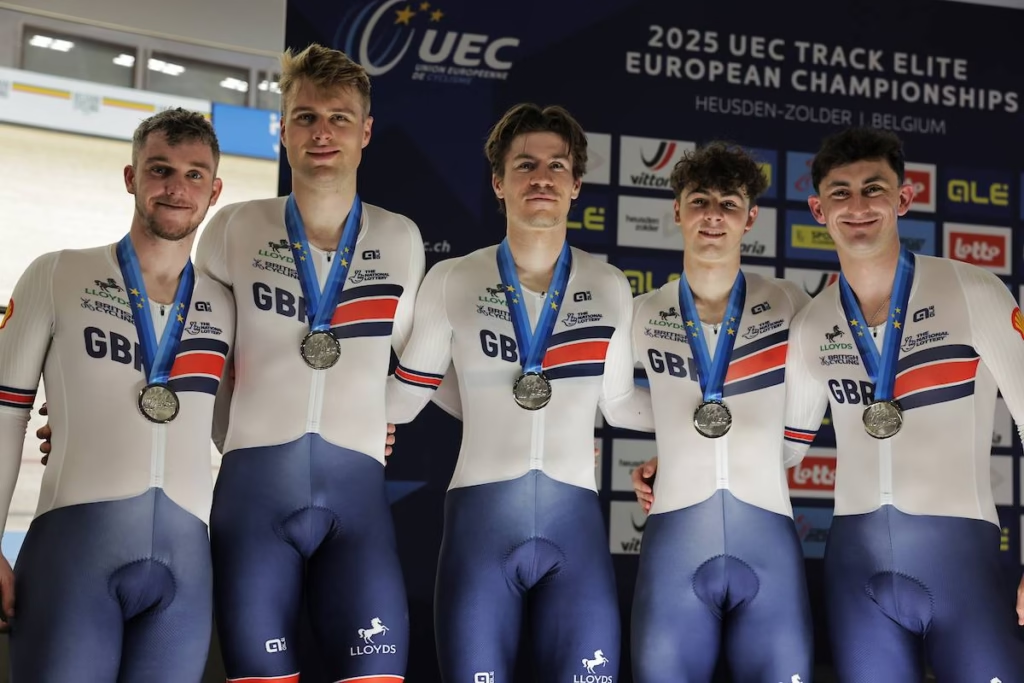
Team Scotland’s track cycling squad
Scotland’s selection includes:
- Lauren Bell
- Erin Boothman
- Lyall Craig
- Neah Evans
- Michael Gill
- Logan MacLean
- Pete Mitchell
- Iona Moir
- Niall Monks
- Kate Richardson
- Elliott Rowe
- Timothy Shoreman
- Mark Stewart
- Lewis Askey
Scotland’s Para selection includes Neil Fachie and Fin Graham alongside the relevant pilots and support combinations.
The host nation do not possess England’s depth, but they have medal chances across women’s endurance, men’s bunch racing, women’s sprint and Para track cycling.
Neah Evans carries Scotland’s main endurance hopes
Neah Evans is an Olympic medallist and former world champion with the power and tactical range to challenge in several disciplines.
Her likely opportunities include:
- Points race
- Scratch race
- Individual pursuit
- Team pursuit
- Elimination race
The points race may be her strongest event.
Evans can collect points through intermediate sprints, but her real threat comes through sustained attacks. Gaining a lap gives a rider a large points advantage and can immediately change the classification.
She is strong enough to initiate that move rather than waiting for someone else.
Her challenge will be managing the workload across four days. England can spread its endurance programme across a larger squad, while Scotland may depend heavily on Evans.
She remains a genuine gold contender, particularly in races where experience and tactical judgement can overcome a small difference in outright speed.
Mark Stewart will try to make the bunch races chaotic
Mark Stewart is Scotland’s most proven Commonwealth endurance specialist.
He won the points race at Gold Coast 2018 and remains one of the riders most willing to attack for laps.
Stewart is unlikely to want a conventional race.
In the scratch event, England may possess faster finishers. In the points race, waiting for every sprint could favour riders with a sharper acceleration.
His route to gold is to make the race harder and less predictable.
A successful lap gain can overturn the expected hierarchy. The Glasgow crowd may also help sustain an attack by creating urgency inside the velodrome and increasing the pressure on teams expected to chase.
Stewart should be treated as a genuine gold contender rather than simply a popular home rider.
Lewis Askey brings road strength back to the track
Lewis Askey will be one of the most recognisable Scottish riders for viewers arriving from the Tour de France.
The NSN Cycling Team rider has concentrated heavily on the road but retains a strong track endurance background.
His ability to sustain repeated efforts should transfer well to the scratch, points and team pursuit events. He can follow long moves, contribute to an attritional race and strengthen Scotland’s pursuit options.
Specialist track riders may possess a sharper acceleration or more recent technical preparation.
Askey’s advantage is his engine and race awareness. His most important contribution may be tactical rather than becoming the sole protected leader.
Lauren Bell leads Scotland’s women’s sprint challenge
Lauren Bell is Scotland’s strongest established women’s sprinter.
She has World Championship experience and can contest the sprint, keirin and team sprint.
The individual sprint contains two of the world’s leading riders in Finucane and Capewell. Bell’s realistic target may therefore be bronze unless the draw or tactical racing produces an upset.
The keirin creates more uncertainty.
Six-rider racing places greater emphasis on timing, position and avoiding traffic. The fastest qualifying rider does not automatically win, and Bell can use her experience to remain near the front when the decisive sprint begins.
Scotland’s team sprint prospects may be stronger.
Bell can combine with Iona Moir and Erin Boothman, giving the host nation a developing trio capable of challenging for the podium.
The younger Scottish riders with a home opportunity
Glasgow provides a major platform for riders still establishing themselves internationally.
Erin Boothman, Iona Moir, Michael Gill and Kate Richardson are among the Scots who can use the Games as a step towards future World Championships and Olympic selection.
Moir has already raced against Finucane in major domestic sprint finals. Boothman brings sprint and team-event potential, while Gill has experience within Britain’s developing pursuit programme.
Not every selected rider will be expected to win gold.
Part of the value of a home Commonwealth Games is giving younger competitors experience of qualification rounds, packed grandstands, media attention and a multi-sport environment before reaching an Olympic Games.
For several of Scotland’s current stars, the Sir Chris Hoy Velodrome is the track where that development began.
British Para track cycling should produce several medals
The Para events are integrated throughout the four-day programme rather than held as a separate competition.
England and Scotland bring several Paralympic and world champions.
Kadeena Cox
Kadeena Cox makes her Commonwealth Games debut for England after previous appearances were prevented by injury or eligibility issues.
The four-time Paralympic champion is a leading contender in the women’s C4-5 events. Her explosive power makes the kilometre time trial an obvious gold opportunity.
Sophie Unwin and Lizzi Jordan
England also bring two leading women’s tandem riders.
Sophie Unwin is a multiple Paralympic champion, while Lizzi Jordan arrives with her own Paralympic success. The final pilot combinations and event entries will determine which pairing begins as England’s strongest favourite.
Neil Fachie
Neil Fachie is one of Scotland’s most successful Commonwealth athletes.
The visually impaired rider competes on a tandem and has won repeatedly at Paralympic, world and Commonwealth level.
A home Games gives him another opportunity to add to that record inside the Glasgow velodrome.
Fin Graham
Fin Graham gives Scotland another major chance in the men’s C1-3 programme.
The events use factoring to account for the differences between eligible classifications, meaning medals are determined by adjusted performance rather than raw finishing time alone.
British Para riders should be expected to win several medals and may provide some of Scotland’s most reliable gold opportunities.
Jack Carlin is another major Scottish absentee
Scotland will also compete without Jack Carlin.
The Olympic and World Championship sprint medallist retired after more than a decade at the top level. His departure leaves a significant gap in Scotland’s sprint programme, particularly when England can select Richardson, Turnbull and Truman.
The story of his career and retirement is covered in Jack Carlin’s departure from track cycling.
Without Carlin, Scotland’s strongest gold chances move towards the endurance and Para events rather than the men’s sprint competition.
Which events do British riders traditionally dominate?
Britain’s international strength is concentrated around several disciplines.
Women’s sprint and team sprint
The Great Britain women’s sprint programme has become one of the strongest in the world.
Finucane, Capewell and Marchant provide three proven international champions. Splitting them between Wales and England weakens the combined team but creates several individual British medal opportunities.
Men’s team sprint
England inherit most of the Great Britain men’s sprint depth.
Richardson, Turnbull and Truman give them a combination capable of matching or beating Australia.
Team pursuit
British riders have a long history of Olympic, world and European success in both the men’s and women’s team pursuits.
England possess the deepest combinations, but Wales and Scotland also include riders drawn from the wider Great Britain programme.
Individual pursuit
The Commonwealth Games award medals in a discipline no longer included at the Olympics.
That particularly benefits Charlton, Knight, Morris and Evans. Britain’s pursuit strength makes this one of the events most likely to produce multiple Home Nation medallists.
Para track cycling
British Para cycling remains consistently strong across tandem and C-class events.
England and Scotland both bring established Paralympic champions, making several gold medals realistic.
The different event structures are explained further in our guide to how track cycling works and how to watch it at Glasgow 2026.
Where Australia can stop British domination
Australia have traditionally been the strongest overall Commonwealth track cycling nation.
Their biggest advantage in Glasgow is unity.
While Britain’s leading riders are divided between three teams, Australia can select from its entire national programme. That may allow them to defeat individually stronger British riders through a better-balanced pursuit or sprint combination.
The team events are their clearest opportunity.
Australia should also be dangerous in the scratch and points races. Their riders often combine extensive track experience with high-level road strength, making them difficult to control tactically.
A British rider may begin as the individual favourite without their Home Nation possessing enough teammates to dictate the race around them.
Canada and New Zealand add further endurance strength, while Malaysia and Trinidad and Tobago are capable of disrupting the sprint medals.
Realistic British gold-medal contenders
| Rider or team | Nation | Strongest gold opportunity |
|---|---|---|
| Emma Finucane | Wales | Individual sprint |
| Matthew Richardson | England | Individual sprint |
| England men | England | Team sprint |
| Sophie Capewell | England | Keirin or team sprint |
| Katy Marchant | England | Keirin or team sprint |
| Josh Charlton | England | Individual pursuit |
| Josie Knight | England | Individual pursuit |
| England men | England | Team pursuit |
| England women | England | Team pursuit |
| Anna Morris | Wales | Individual pursuit |
| Neah Evans | Scotland | Points race |
| Mark Stewart | Scotland | Points race |
| Kadeena Cox | England | C4-5 kilometre time trial |
| Neil Fachie and pilot | Scotland | Tandem event |
| Fin Graham | Scotland | C1-3 event |
This does not mean every rider listed should be expected to win.
Sprint tournaments can turn on one poorly timed move, while pursuit selections may change between qualifying and the medal rounds. Bunch races contain even greater tactical uncertainty.
These are riders and teams with a credible route to gold rather than guaranteed champions.
Which Home Nation will win the most cycling medals?
England should finish with the largest total.
Their squad is significantly deeper than those of Wales or Scotland and contains several riders capable of competing across multiple events. They can challenge for team medals without sacrificing every individual ambition.
Wales may achieve the best return relative to squad size.
Finucane can win several medals, while Morris and Roberts provide endurance opportunities. A Welsh women’s team sprint medal would significantly strengthen the total.
Scotland’s outcome will depend heavily on the bunch and Para races.
Evans, Stewart, Fachie and Graham represent realistic gold chances, while Bell and the younger team-event riders can add further medals.
Home support may help Scotland exceed expectations, but it cannot fully overcome England’s greater depth.
British track cycling medal prediction
A collective British total approaching 20 medals across track and Para track cycling is realistic, although the number of events in which several Home Nation riders can reach the same podium makes precise forecasting difficult.
The strongest gold predictions are:
- Emma Finucane in the women’s sprint
- Matthew Richardson in the men’s sprint
- England in the men’s team sprint
- Josh Charlton in the men’s individual pursuit
- Josie Knight in the women’s individual pursuit
- At least one additional British women’s sprint gold
- At least two British Para track cycling golds
- One Scottish endurance gold through Evans or Stewart
Australia should prevent complete British control of the team pursuits and bunch races. The split between the Home Nations will also cost medals in events where a unified Great Britain team would otherwise begin as the overwhelming favourite.
That division is also what makes the competition worth watching.
Finucane against Capewell and Marchant, Richardson against his former Australian teammates, Morris against Knight and Evans, and Stewart attempting to outmanoeuvre England’s faster finishers all create contests unavailable at the Olympics.
The Sir Chris Hoy Velodrome is where several of the home riders learned their discipline, progressed through the British system or produced their first important results.
At Glasgow 2026, that shared home becomes the place where they stop racing together and begin competing against one another.

