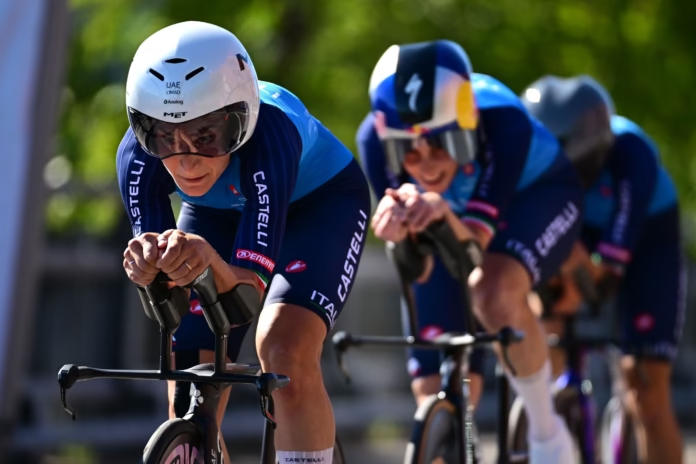
Italy won the 2026 World Championship Mixed Relay in Montréal after building the decisive advantage during the first half of the race and then holding off a late French challenge to take the rainbow jerseys by 8.63 seconds.
The winning time of 51:32.28 only tells part of the story. Italy were not the fastest team out of the blocks and sat fourth at the opening checkpoint, but moved into the lead before the relay and never gave it back. France came closest to changing the result, while Switzerland recovered from a difficult end to the opening half to take bronze.
Australia finished fourth after remaining firmly in the medal fight until the latter stages, with Germany fifth and Spain sixth.
How it unfolded
The mixed relay rewards something slightly different from an individual time trial. A fast opening section is useful, but the race is ultimately about balance across two separate efforts and getting both halves of the team through the course without giving away a decisive chunk of time.
That made the opening checkpoint interesting rather than conclusive. Switzerland were fastest there in 7:04.98, with Germany 1.89 seconds behind and Spain at three seconds. Italy were only fourth, 3.14 seconds down, while Australia and France were fifth and sixth.
For Italy, there was little reason to panic. The differences were small and the longer middle section offered much more opportunity to establish the true order.
That is exactly what happened.
Italy turn an ordinary start into control of the race
By the second intermediate checkpoint Italy had moved from fourth to first, reaching it in 16:53.65. Australia were now their closest challengers at 2.20 seconds, with France another 2.46 seconds further back.
The bigger change concerned Switzerland. The early leaders slipped to sixth and were already 19.43 seconds behind Italy. Germany and Spain had also lost the positions they held through the opening kilometres.
It showed why reading too much into the first split of a team time trial can be misleading. The opening kilometres measure speed, but they do not yet show which teams have paced the effort well enough to maintain it or how effectively three riders are sharing the work.
Italy continued to increase the pressure before the relay. By the time the first half of the team had completed its work, the advantage had grown substantially.
Italy reached the relay point in 24:23.86, with France now second at 11.30 seconds and Australia third at 12.21. Spain were more than 25 seconds behind, while Germany had slipped to 28.72 and Switzerland to 35.14.
That was the foundation of Italy’s victory. They had taken a race that was separated by just over five seconds across the leading six nations at the first checkpoint and turned it into an advantage of more than 11 seconds before the second half began.
France and Australia fight over the chase
The second half initially looked as though it might develop into a three-team contest for the podium rather than a direct challenge to Italy.
At the first checkpoint after the relay, Italy remained comfortably ahead in 32:05.66. Australia had moved back into second at 13.83 seconds, but France were only 0.46 seconds behind them.
That tiny difference between Australia and France mattered because the two teams were beginning to move in opposite directions. France strengthened as the second half developed, while Australia’s challenge began to fade.
By the next checkpoint France had reclaimed second and were 16.18 seconds behind Italy. Australia had fallen to 25.75 seconds, leaving them increasingly vulnerable to Switzerland behind.
Italy’s advantage had grown slightly rather than contracted, but there was still one final section remaining and France had enough speed to make the margin less comfortable than it appeared.
France close late but Italy have already done enough
France produced their strongest relative section on the run to the finish. Having been 16.18 seconds behind at the final intermediate checkpoint, they reduced the deficit to 8.63 seconds by the line.
It was an impressive finish, but the damage from the first half of the race proved decisive. France had begun the second part 11.30 seconds behind and, despite eventually taking time back from Italy, never managed to erase the buffer that had already been created.
Italy stopped the clock at 51:32.28, with France finishing in 51:40.91.
The winning margin therefore came down to less than nine seconds over more than 51 minutes of racing. It was close enough to make France’s late acceleration meaningful, but Italy had led from the second checkpoint onwards and had left themselves enough room to absorb it.
Switzerland rescue bronze with a strong second half
Switzerland’s route to the podium was almost the reverse of Italy’s.
They had started fastest but reached the relay point 35.14 seconds behind. At that stage they were only sixth and were closer to Germany and Spain than to the teams fighting over the first two places. They lost Stefan Kung early due to a broken handlebar, a setback that may have made all the difference.
From there, the gap began to come down. Switzerland were 32.61 seconds behind Italy at the first checkpoint of the second half and 31.56 seconds down at the next. Their strongest gains arrived over the final section, bringing them home at 19.90 seconds and lifting them onto the podium.
That recovery was enough to overhaul Australia, whose deficit moved in the opposite direction. The Australians had been only 12.21 seconds down at the relay and remained second at the next checkpoint, but slipped to 25.75 seconds and eventually finished fourth at 40.48.
It gave the race three very different patterns among the medal contenders. Italy built their victory before the relay and protected it. France stayed consistently close before producing a fast finish. Switzerland lost ground early and recovered it late.
A result decided by balance rather than one dominant split
That contrast is what made Italy’s victory more interesting than a simple reading of the final standings suggests.
They were never required to produce one huge, race-breaking split. Instead, after giving away three seconds at the opening checkpoint, they were fastest when the race began to stretch out and created enough separation before the relay to put every other nation on the defensive.
France were able to take time back at the end and Switzerland finished their race strongly, but neither could undo what Italy had gained through the middle of the opening half.
Further down the standings, Germany finished fifth at 48.74 seconds and Spain sixth at 1:10.77. The closest finish came between Norway and Poland, separated by just 0.08 seconds in seventh and eighth. Canada took ninth and Estonia completed the top 10.
For Italy, the rainbow jerseys came from the most complete ride across both sides of the relay. They were not quickest at the first opportunity to measure them, and France were faster relative to them over the closing kilometres. In between, however, Italy created the gap that mattered.
World Championships Mixed Relay 2026 result
| Pos. | Nation | Time/gap |
|---|---|---|
| 1 | Italy | 51:32.28 |
| 2 | France | +8.63 |
| 3 | Switzerland | +19.90 |
| 4 | Australia | +40.48 |
| 5 | Germany | +48.74 |
| 6 | Spain | +1:10.77 |
| 7 | Norway | +1:49.30 |
| 8 | Poland | +1:49.38 |
| 9 | Canada | +2:07.68 |
| 10 | Estonia | +3:25.87 |
Main photo credit: Getty