
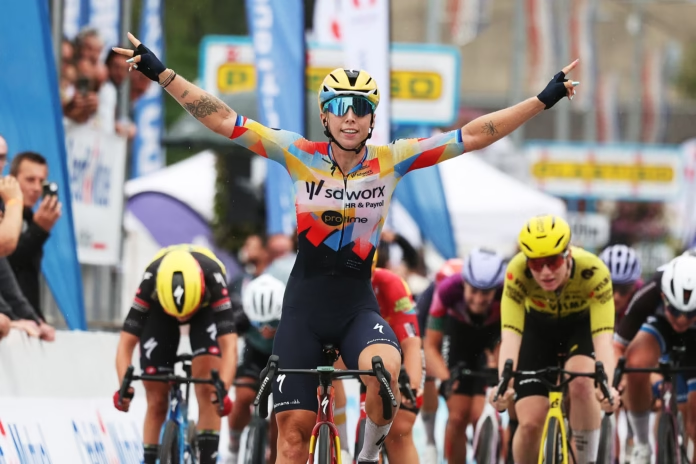
Lorena Wiebes winning La Choralis Fourmies Féminine again is not surprising. The more revealing part of the 2026 result is how little the order behind her changed. Lara Gillespie was second, Gladys Verhulst-Wild third, Nienke Veenhoven fourth and Kathrin Schweinberger fifth, reproducing the first five places from 2025 exactly despite a revised route and another year of development for the riders trying to close the gap.
That makes Fourmies useful as a late-season reference point. Wiebes remains the strongest benchmark in this type of race, Gillespie is becoming a remarkably consistent challenger, and the extra rolling terrain still did not fundamentally alter the advantage held by riders who can survive repeated accelerations and then sprint. With the World Championships approaching, those conclusions matter beyond one French ProSeries race.
Wiebes has made survival part of her sprinting advantage
The obvious way to beat Wiebes has always been to prevent her reaching a sprint. The difficulty in 2026 is that the range of races in which she can survive has continued to expand. Fourmies added another loop between Avesnes-sur-Helpe and Sains-du-Nord, extending the rolling middle section before the return to the local circuits, but the extra fatigue was not enough to separate her from the fastest riders.
That fits a season in which Wiebes has repeatedly shown that harder racing does not necessarily solve the problem. She has won when races stayed controlled and when they became selective, leaving rival teams with fewer obvious tactical routes. The Fourmies contenders preview framed the central problem before the start: opponents needed disorder, repeated attacks or crosswind pressure rather than simply hoping the additional climbing would remove her.
They did not create enough separation. Once Wiebes reached Fourmies in position to sprint, the result returned to the most familiar outcome in women’s cycling. That is important because it shows how complete the SD Worx-Protime rider has become. The sprint remains the final weapon, but surviving the road that leads to it is increasingly part of the same package.
Gillespie is no longer producing isolated breakthrough results
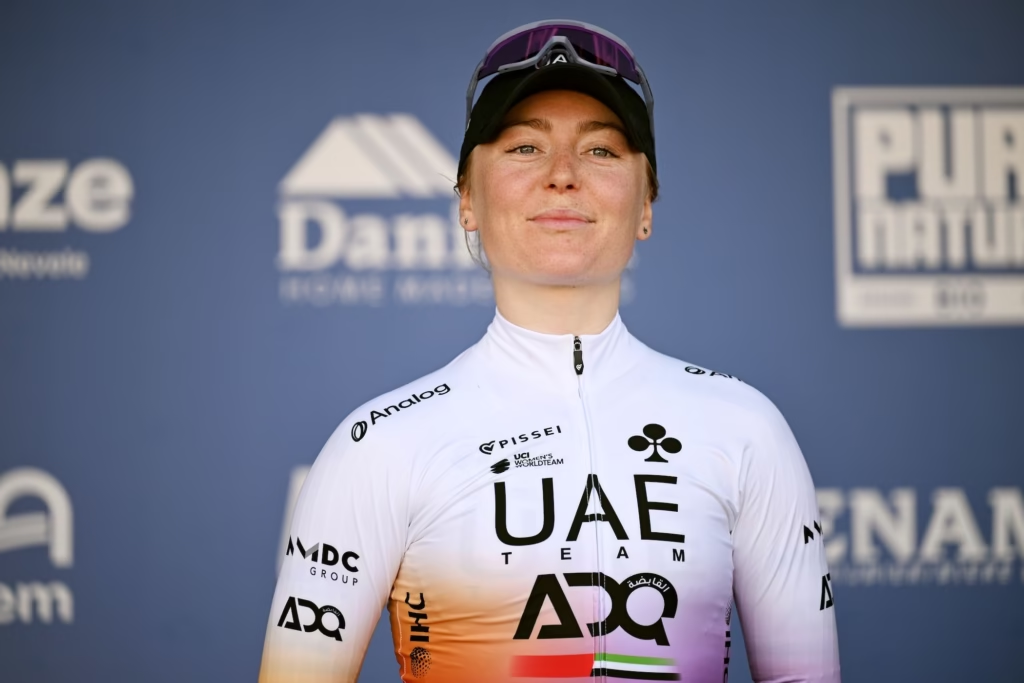
Lara Gillespie finishing second to Wiebes for a second consecutive year is a stronger result than another runner-up line might suggest. The Irish rider has spent 2026 moving from promising fast finisher towards a rider who can repeatedly contest important one-day races, and Fourmies reinforces that progression.
There is still a clear gap between challenging Wiebes and beating her. Gillespie did not find the speed required in the final metres, just as she could not in 2025. What has changed is the level of certainty around her own place in these finales. She can now enter sprint-heavy ProSeries races with a realistic expectation of making the podium rather than needing a perfect day to get there.
That matters for UAE Team L’IMAD because Gillespie provides a different tactical option from the team’s climbers and attacking all-rounders. The 2026 Fourmies start list contained considerable sprint depth, yet she again emerged as Wiebes’ closest rival. Repetition at that level is usually the point at which a rider’s status changes.
The identical top five exposes how stable this type of hierarchy can be
The most striking statistic from Fourmies is not Wiebes’ second victory. It is that Wiebes, Gillespie, Verhulst-Wild, Veenhoven and Schweinberger finished first through fifth in exactly the same order as they did twelve months earlier.
One-day racing is normally too volatile for that kind of repetition. Positioning, crashes, wind, team support and the timing of attacks can reorder a result even when the same riders arrive in similar form. Fourmies instead produced an unusually clean comparison between two editions and suggests that its particular demands continue to reward a very specific combination of durability and finishing speed.
The revised 2026 route was supposed to increase the opportunity for attackers. It did add fatigue, but not enough to rewrite the final hierarchy. That is useful information for organisers as well as teams. If Fourmies wants to remain a sprint Classic, the balance is working. If it wants a wider range of possible winners, a bigger structural change would probably be required.
Verhulst-Wild and Veenhoven remain valuable late-season references
Gladys Verhulst-Wild’s third place continued a strong season in which she has been able to convert sprint opportunities while also contributing in races that are too hard for pure specialists. Fourmies suits that profile and her second consecutive podium confirms that the 2025 result was not simply a product of one well-timed sprint.
Nienke Veenhoven’s fourth place carries a similar message. She remains one of the quickest riders outside the small group of established elite sprinters and continues to collect high finishes in races where positioning and resilience matter as much as outright top speed. The next step is converting more of those placings into victories when Wiebes, Kool or another first-line sprinter is present.
Schweinberger in fifth completes the picture. These are riders whose value extends beyond headline wins because they are consistently present when races reach their decisive phase. For teams building towards the final European one-day races, that reliability is important.
-
 Photo Credit: Luc Claessen/Getty Images
 -
 Photo Credit: Telenet Superprestige
 -
 Photo Credit: Nieuwsblad
Fourmies strengthens rather than changes Wiebes’ World Championships case
The World Championships in Montréal will be much harder than Fourmies, so this result should not be treated as a direct prediction. The women’s road race will involve substantially more climbing and a much longer test, placing greater emphasis on endurance and repeated climbing over several hours.
Even so, Wiebes’ performance matters because every race in which she survives extra difficulty forces national teams to take her more seriously. The tactical calculation changes if rivals cannot assume that hard racing will remove the fastest finisher. They may need to attack earlier and commit stronger climbers before the final laps rather than waiting for a late selection.
Fourmies does not prove Wiebes can win the rainbow jersey. It does reinforce the uncomfortable part of the problem for her opponents: the line between a course that suits Wiebes and one that is hard enough to eliminate her keeps moving.
The race itself has now established a clear identity
La Choralis Fourmies Féminine is only seven editions old, but it no longer feels like a race searching for a role. The event has developed from a 1.2 race into a Women’s ProSeries fixture and now closes the Coupe de France Femmes Professionnelles with a recognisable sporting profile.
Its history, covered in ProCyclingUK’s history of La Choralis Fourmies Féminine, already contains bunch sprints, late attacks and a steady rise in field quality. The 2026 edition did not produce a tactical surprise, but that is useful in itself. It confirmed which riders and teams currently control this kind of late-season race.
For Wiebes, the season moves on with another win and another example of her expanding survivability. For Gillespie and the riders immediately behind, the gap is now clear enough to measure. Fourmies did not transform the hierarchy. It showed just how firmly that hierarchy has settled.

