
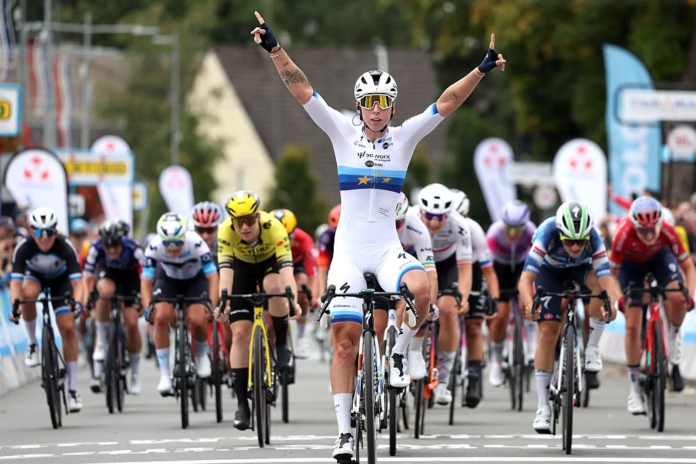
The La Choralis Fourmies Féminine 2026 takes place on Sunday 13 September, with the Women’s ProSeries race again starting and finishing in Fourmies before travelling across the rolling roads of the Avesnois.
The confirmed route covers 126.4km, although the organisers describe it more broadly as a 130km race, and the main change for 2026 is an additional loop between Avesnes-sur-Helpe and Sains-du-Nord. It does not fundamentally alter Fourmies’ identity as a race that normally gives the sprinters a major opportunity, but it adds another section of rolling terrain where their teams can be weakened before the return towards the finish.
That balance has defined the race throughout its short history. Lorena Wiebes dominated the bunch sprint in 2025, Silvia Zanardi won from the peloton a year earlier, while Marta Lach’s brilliantly timed attack in 2023 remains the clearest demonstration that Fourmies does not automatically end with the fastest rider winning.
The 2026 edition is also the seventh and final round of the Coupe de France Femmes Professionnelles FDJ United, giving the race additional importance for French teams and riders before the European one-day calendar begins winding towards the World Championships.
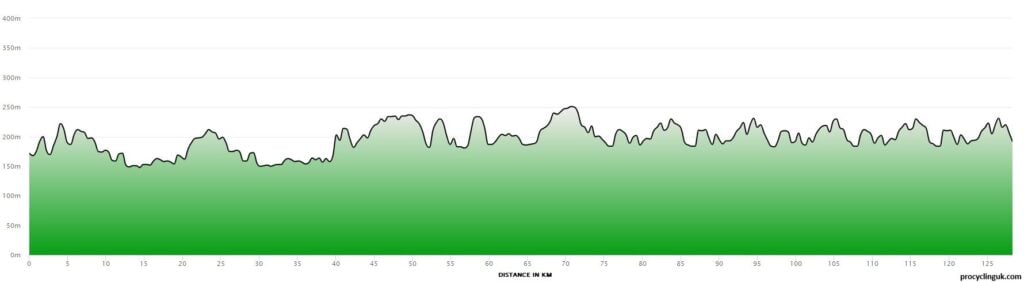
La Choralis Fourmies Féminine 2026 route at a glance
| Detail | 2026 race |
|---|---|
| Date | Sunday 13 September 2026 |
| Start | Fourmies |
| Finish | Fourmies |
| Distance | 126.4km |
| UCI classification | 1.Pro |
| Series | UCI Women’s ProSeries |
| Terrain | Rolling Avesnois roads |
| Main route change | Additional Avesnes-sur-Helpe to Sains-du-Nord loop |
| Start time | 14:30 CEST / 13:30 BST |
| Expected finish | Around 17:40 CEST / 16:40 BST |
| Defending champion | Lorena Wiebes |
| Coupe de France | Round 7 of 7 |
For readers new to the event, ProCyclingUK’s beginner’s guide to La Choralis Fourmies Féminine 2026 covers how the race developed from its first edition in 2019 into a Women’s ProSeries event.
What has changed on the 2026 Fourmies route?
The principal change comes in the middle of the race rather than around the finish.
Organisers have added another loop linking Avesnes-sur-Helpe and Sains-du-Nord, keeping the peloton on the rolling Avesnois roads for longer before the race turns back towards Fourmies. It is an important adjustment because this is the part of the course where repeated rises, narrow roads and changes of direction can gradually reduce the number of riders available to control the finale.
There is still no single climb capable of transforming Fourmies into a race for pure climbers. The difficulty is cumulative instead. Riders repeatedly have to accelerate out of villages, reposition before narrower sections and respond when teams increase the pace on short rises that rarely look decisive in isolation.
The extra loop gives attacking teams more time to exploit that terrain. A sprinter may still survive comfortably, but surviving with four or five team-mates available for the final chase is a different challenge.
Fourmies remains a race of accumulation rather than one decisive climb
There is no equivalent of the Mur de Huy, Cauberg or Côte de Ty Marrec waiting to make the selection at La Choralis Fourmies Féminine.
The race becomes difficult through repetition.
The Avesnois is rarely completely flat for long, with short rises followed by descents, village approaches and frequent changes in rhythm. That creates fatigue without necessarily producing obvious gaps, which is precisely why the race can remain open to several types of rider.
Pure climbers do not have enough sustained climbing to make their advantage decisive. The heaviest pure sprinters, meanwhile, can find the repeated accelerations just demanding enough to reduce their freshness or strip away their lead-out riders.
The ideal Fourmies rider therefore tends to sit somewhere between the two: fast enough to win a sprint, but robust enough to survive a race that has been made difficult beforehand.
The opening kilometres should encourage attacks
At only 126.4km, Fourmies is short enough that teams cannot afford to spend half the afternoon waiting for the race to develop.
That should encourage attacks relatively early. Smaller teams have little reason to sit behind squads with stronger sprinters, while the major teams do not necessarily want to commit several domestiques to chasing from the opening kilometres.
A breakaway does not need to build an enormous advantage to become tactically useful. A group of four or five riders forcing the bunch to maintain a steady pursuit through the first half of the race can begin removing the riders who would otherwise be available to control the closing kilometres.
The relatively short distance works both ways. The sprinters have fewer kilometres to survive, but there is also less time for the peloton to allow a breakaway six or seven minutes and gradually bring it back under control.
That should keep the race active from relatively early on.
Avesnes-sur-Helpe becomes more important in 2026
The additional loop gives Avesnes-sur-Helpe greater tactical significance than in recent editions.
The surrounding roads are not especially mountainous, but they provide exactly the sort of repeated rolling terrain on which an organised team can begin increasing the difficulty without committing to one all-or-nothing attack.
The objective for teams trying to beat the sprinters should not necessarily be to drop them immediately. It should be to make them work repeatedly and, more importantly, remove the riders around them.
A rider such as Wiebes becomes particularly difficult to beat when she reaches the final kilometres surrounded by a complete lead-out. The opposition’s more realistic objective is therefore to arrive back towards Fourmies with those numbers substantially reduced.
Another passage through the Avesnes area gives them more road on which to do it.
Sains-du-Nord extends the selective middle phase
The route then loops towards Sains-du-Nord, completing the main new section for 2026.
Again, the importance comes from accumulation rather than one headline climb. The extra loop delays the point at which the race settles into a straightforward chase towards Fourmies and gives aggressive teams another opportunity to put the peloton under pressure.
A single attack gaining 10 seconds is unlikely to decide the race here. A larger move containing riders from several strong teams can be much more dangerous because it changes who is willing to chase behind.
That distinction is important at Fourmies. The terrain usually allows the peloton to close gaps if enough teams cooperate, so the most successful attackers tend to create a tactical problem rather than simply relying on climbing strength.
If the right combination goes clear through the new loop, the sprint teams may find themselves chasing without the help they expected.
The route still gives the sprinters the advantage
For all the discussion of the additional loop, the central conclusion remains unchanged: La Choralis Fourmies Féminine is still a very good race for fast finishers.
Recent history makes that clear.
Lorena Wiebes won the 2025 edition with a dominant sprint after Team SD Worx-Protime controlled repeated attacks and delivered her into the finish. It was her 24th victory of an extraordinary season and reinforced what happens when the fastest rider reaches Fourmies with enough support around her.
A year earlier, Silvia Zanardi won the 2024 race after Human Powered Health helped close a dangerous late break containing Femke de Vries, Marta Lach and Emma Norsgaard. Zanardi then had the finishing speed to convert the chase into victory.
Those two editions show the basic Fourmies formula. The route encourages attacks, but if the peloton solves them before the final kilometres, the sprinters usually regain control.

Marta Lach showed how the sprint can be beaten
The most useful counter-example remains Marta Lach’s 2023 victory.
Lach attacked with three laps remaining and managed to hold off a rapidly closing bunch by a single second. Sofie van Rooijen led the peloton home behind her, but the hesitation and tactical confusion had already given Lach enough space.
ProCyclingUK’s report on Marta Lach’s 2023 Fourmies victory remains the clearest template for anyone trying to prevent another conventional sprint in 2026.
The important point is that Lach did not win because she suddenly became the strongest climber on a decisive ascent. She won by choosing the right moment, establishing enough separation and exploiting a situation where the sprint teams could not organise quickly enough.
That remains the best route to an upset.
The extra Avesnes-sur-Helpe and Sains-du-Nord loop should create more fatigue before those late tactical decisions have to be made.
Pfeiffer Georgi’s first professional win showed another route to victory
Fourmies has produced successful attacking racing before Lach as well.
In 2021, Pfeiffer Georgi took the first UCI professional victory of her career after Team DSM raced aggressively throughout the day. Georgi had already been represented in the early move before attacking again late and winning from the small group that emerged.
ProCyclingUK’s report on Pfeiffer Georgi’s 2021 La Choralis Fourmies Féminine victory provides another useful reminder that the race does not have to be decided by a full bunch.
Georgi’s performance also demonstrates the sort of rider Fourmies can reward when control disappears: a strong Classics rider with enough endurance to attack repeatedly but still enough finishing speed to beat a small group.
That profile may benefit most from the revised 2026 route.
The return towards Fourmies is where numbers matter
Once the race begins heading decisively back towards Fourmies, the tactical calculation becomes much simpler.
If a breakaway still holds a significant advantage and several major teams are represented, the attackers have a genuine chance of staying away. If the gap is small and multiple sprint teams still have three or four riders available, control shifts rapidly back towards the bunch.
That is why team numbers may matter more than whether the leading sprinter herself has been dropped.
A favourite can survive every rise comfortably and still be in trouble if her lead-out has been reduced to one rider. Every subsequent attack then requires her team to decide whether to chase immediately or trust another squad to do the work.
A race such as Fourmies can change during those few seconds of hesitation.
The additional loop increases the chance that the major sprint teams reach that point with fewer resources.

The final kilometres still reward positioning and speed
The finishing roads do not contain a climb hard enough to guarantee separation, so any sizeable group reaching Fourmies together will naturally begin reorganising for the sprint.
That makes positioning increasingly important.
Lead-outs are valuable not simply because they provide a final acceleration but because they keep the team’s sprinter away from the chaotic fight for wheels. If the race has already removed several domestiques, riders who can position themselves independently gain an advantage.
This is another reason Classics-style sprinters fit Fourmies particularly well. They are less dependent on a perfect train and can often move through a reduced group themselves after a difficult race.
Pure speed still matters in the last 200 metres, but the route tries to make sure riders have to earn the opportunity to use it.
What does the additional loop mean for Lorena Wiebes-style sprinters?
The extra distance should not be exaggerated.
A 126.4km race remains relatively short by professional one-day standards, and the additional rolling roads are unlikely to remove the world’s strongest sprinters simply through accumulated distance.
The more realistic effect is on the riders around them.
Wiebes’ 2025 Fourmies victory showed how difficult she is to beat when her team controls the race and delivers her into the final sprint. Teams trying to stop a similar outcome in 2026 need to attack the structure around the favourite rather than simply hoping to drop her.
If the additional loop costs a sprint team two or three domestiques, the race becomes harder to police. Late attackers then have a greater chance of forcing the sprinter herself to respond or of creating the hesitation that allowed Lach to win in 2023.
That is where the route change can have the biggest effect.
Wind could make the Avesnois much harder
The weather will be worth watching in the days before the race.
Northern France in September can produce very different versions of the same course. On a still and dry afternoon, the rolling profile should remain manageable enough for the major sprint teams to exercise considerable control.
Strong wind would make the route significantly more selective.
The Avesnois contains exposed sections and repeated changes of direction, meaning crosswinds can turn apparently innocuous roads into some of the most important kilometres of the race. Teams positioned badly when the road turns can suddenly find themselves chasing a split rather than simply managing the day’s breakaway.
Rain would create a different problem. Narrow roads, village furniture and descents become more demanding, increasing the premium on positioning and potentially reducing the number of riders available to organise a late chase.
The extra loop therefore has the potential to become considerably more important if the weather is poor.
The short distance should encourage aggressive racing
One of Fourmies’ distinctive characteristics is its relatively short race distance.
At 126.4km, there is less incentive to conserve energy for five hours. Riders can begin attacking earlier and teams can commit to making the race difficult without the same fear of paying for it deep into a 170km Classic.
That gives riders without a leading sprinter an obvious incentive to race positively.
The challenge is that the short distance helps the sprinters as well. They have fewer kilometres in which to accumulate fatigue and can afford to ride more aggressively over short rises knowing the finish will arrive relatively quickly.
That conflict is one of the reasons Fourmies tends to be more interesting than a simple examination of its profile might suggest.

The Coupe de France finale adds another tactical layer
La Choralis Fourmies Féminine is the seventh and final round of the 2026 Coupe de France Femmes Professionnelles FDJ United.
That gives French teams another reason to influence the race beyond the pursuit of the individual victory.
A team protecting a high position in the individual or teams classification may have reason to chase a breakaway that would otherwise pose little threat. Another team may need to race aggressively because simply finishing safely inside the peloton offers little value in the final round.
Those secondary objectives can influence which squads cooperate with the obvious sprint teams and which refuse.
That matters in a race where the success of the breakaway often depends as much on who is willing to chase as on the strength of the riders ahead.
Fourmies is also an important World Championships form check
The timing gives the race another layer of interest in 2026.
Fourmies takes place on 13 September, less than two weeks before the elite women’s World Championship road race in Montréal.
It is not a direct simulation of the World Championship course. Montréal contains more sustained climbing and will place much greater cumulative pressure on the riders.
But Fourmies provides a useful late-season test of several relevant qualities: repeated short efforts, positioning, one-day endurance and the ability to produce power after a selective race.
For riders targeting the rainbow jersey, it is also close enough to Montréal that form shown in Fourmies should be taken seriously rather than treated as an early-season indicator.
The race therefore sits at an interesting point between the end of the European trade-team programme and the switch towards national-team objectives.
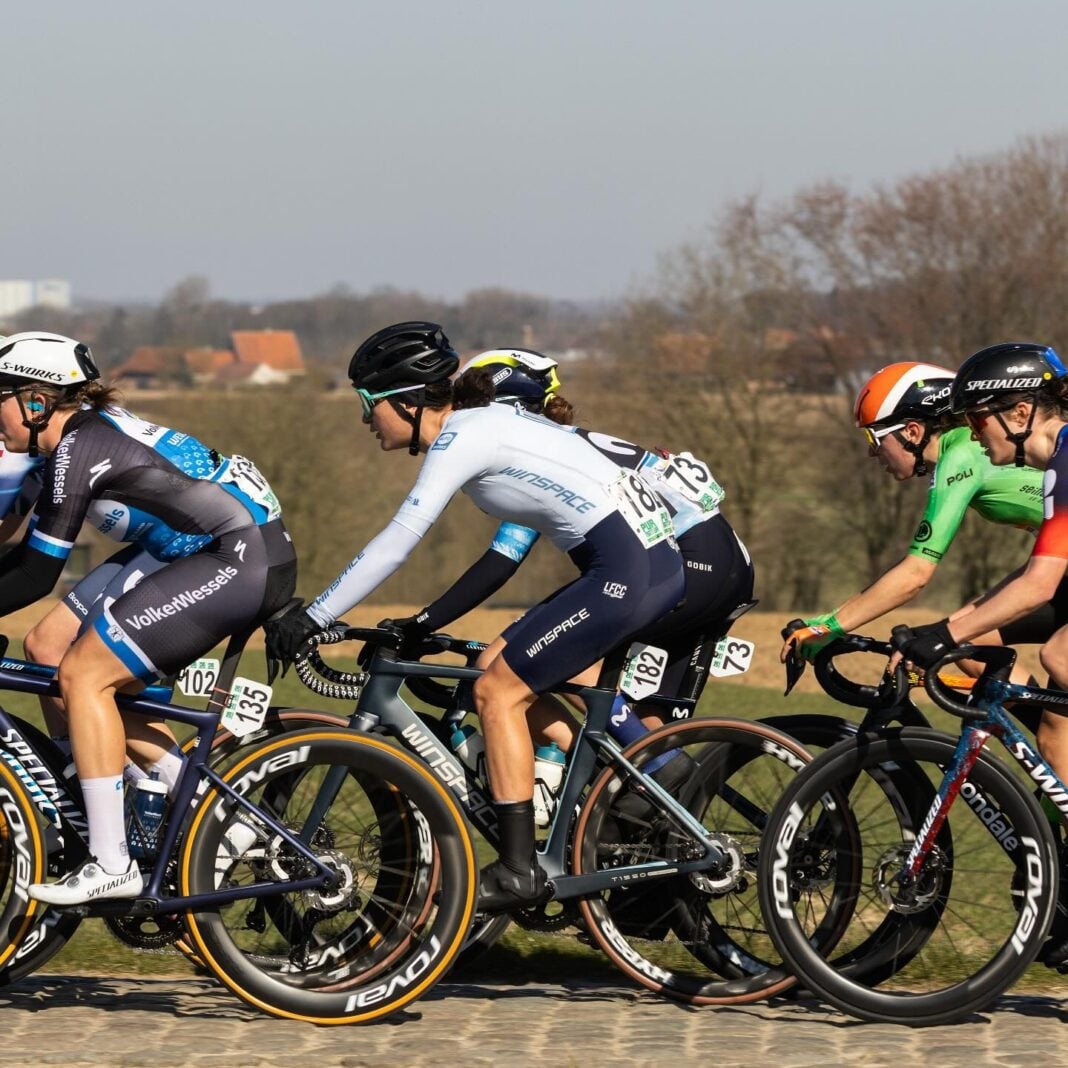
-
 Photo Credit: quentinphotographiebe
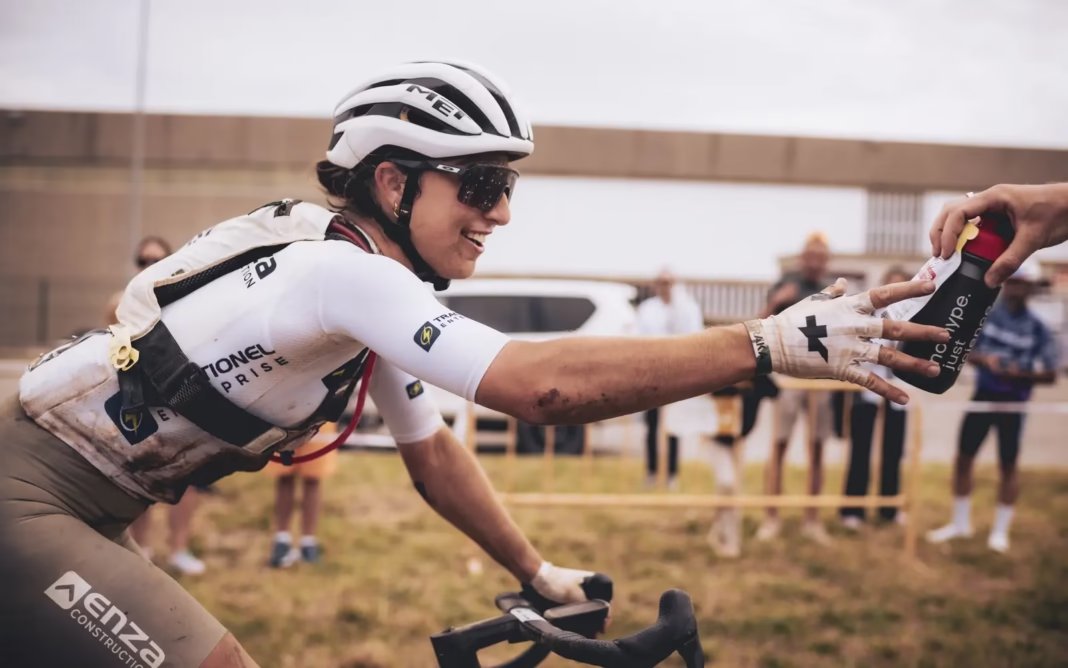
 -
 Photo Credit: Getty

Who does the La Choralis Fourmies Féminine route suit?
The strongest profile remains a fast rider who can cope with repeated rolling terrain.
Pure sprinters have a clear path to victory if their teams maintain control, but the revised route slightly increases the value of riders capable of racing in several different ways.
Elite sprinters remain the obvious favourites whenever a large group reaches Fourmies together.
Classics sprinters may benefit most from the additional Avesnois loop because they can handle a harder race while still carrying enough speed for the finish.
Puncheurs with a fast finish can follow attacks, contribute to making the race selective and still win from a smaller group.
Late attackers remain dangerous if the major teams reach Fourmies with too few domestiques to close every move.
Pure climbers have much less reason to expect the route to work for them. There is simply no sustained ascent steep or long enough to make climbing ability the decisive characteristic.
Can the attackers stop another bunch sprint?
That is the central question of the 2026 route.
The organisers have made the middle of the race more difficult to control without changing Fourmies into something it has never been.
The extra Avesnes-sur-Helpe to Sains-du-Nord loop provides additional rolling kilometres, more opportunities for attacks and another section in which the major sprint teams can lose riders. It should make the peloton work harder before the race enters its final phase.
But the finish remains in Fourmies, the total distance remains relatively short and there is still no late climb capable of automatically removing the leading sprinters.
That means the attackers need to create their own opportunity.
One acceleration is unlikely to be enough. A sustained sequence of attacks through the Avesnois and again on the return towards Fourmies could be.
The recent history of the race shows why both outcomes remain realistic. Zanardi’s 2024 victory and Wiebes’ win last year showed how difficult the sprinters are to stop once control is restored. Lach’s 2023 attack demonstrated how quickly that control can disappear.
La Choralis Fourmies Féminine 2026 route verdict
The 2026 route is an evolution rather than a reinvention.
La Choralis Fourmies Féminine remains one of the better late-season European opportunities for sprinters, but the additional loop between Avesnes-sur-Helpe and Sains-du-Nord should make reaching the expected bunch finish slightly more complicated.
The important question is not simply whether the leading sprinters survive the extra rolling terrain. Most of the strongest should. It is how many team-mates survive with them and how much chasing those riders have already been forced to do.
If several sprint teams return towards Fourmies with numbers, the result should look familiar and the fastest riders will control the finale.
If the additional loop produces fatigue, splits and repeated attacks, the race becomes much harder to organise. That opens the door to the sort of opportunistic move that has already beaten the peloton here before.
Fourmies has never needed one huge climb to make the race interesting.
The revised La Choralis Fourmies Féminine 2026 route simply gives the attackers a little more road on which to prove it.

