
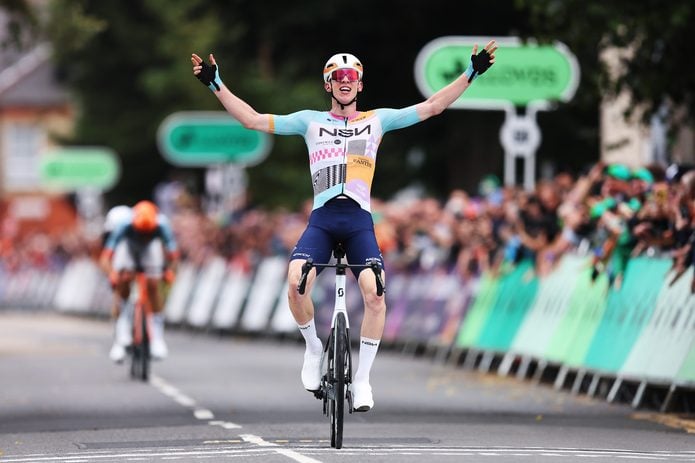
Lewis Askey won stage 1 of the 2026 Lloyds Tour of Britain Men, attacking on the final ascent of Michaelgate to take victory in Lincoln and claim the first leader’s jersey of the race.
The NSN Cycling Team rider timed his move perfectly on the cobbled climb, catching Florian Vermeersch after the UAE Team Emirates-XRG rider had attacked in the final 2 kilometres. Askey powered clear on the steepest section and held off Filippo Ganna, who finished second for Netcompany Ineos Cycling Team, 2 seconds down.
Tim Wellens completed the podium for UAE Team Emirates-XRG, with Jasper Stuyven fourth for Soudal Quick-Step and Daan Hoole fifth for Decathlon CMA CGM. Matteo Trentin finished sixth for Tudor Pro Cycling Team, ahead of Vermeersch, Elliot Rowe, Rick Pluimers and Paul Wright.
It was a Classics-style opening stage rather than a conventional Tour of Britain sprint. The repeated Michaelgate climbs shattered the race, removed the pure fast men, created a small front group, and gave Askey the perfect platform for one of the biggest wins of his career.
Michaelgate gives the race an immediate test
The opening stage started and finished in Lincoln, taking the peloton out through Lincolnshire before returning to the city for repeated laps of the Lincoln Grand Prix circuit.
That final detail mattered more than the day’s overall climbing figure. Michaelgate is short, steep, cobbled and awkward, with an average gradient listed at more than 11 per cent. One ascent is a sharp effort. Five late ascents, after several hours of racing, turned the opener into a selective one-day race.
This was not a stage built simply to put the first leader’s jersey on a sprinter. Olav Kooij, Tim Merlier, Ethan Vernon and Sam Welsford all had reasons to start the race with ambition, but Michaelgate changed the calculation. The longer the finale went on, the more it favoured riders with Classics power rather than pure finishing speed.
That brought Askey, Ganna, Wellens, Vermeersch, Stuyven, Trentin, Hoole and Pluimers directly into play.
A race carrying emotional weight
The race began with the memory of Finlay Tarling still close to the surface.
Tarling’s death during the Volta a Portugal had cast a shadow over the build-up to the Tour of Britain, and the opening stage in Lincoln carried a tribute before the racing properly began. It gave the day an emotional backdrop beyond the normal start of a home race.
Once the flag dropped, the mood shifted quickly into a hard and active first stage. There was no slow procession towards the finishing circuit. The field knew Michaelgate would decide the day, but that did not stop riders trying to shape the race early.
For the British riders in particular, the opening stage carried obvious significance. The Tour of Britain remains the biggest men’s stage race on home roads, and a Lincoln finish on one of the country’s most recognisable domestic climbs gave the day a very specific feel.
Askey would eventually turn that setting into a home victory.
Early breakaway sets the pattern
The early breakaway gave the stage its first structure.
A six-rider move formed with Michal Schuran, Adam Lewis, Simen Evertsen-Hegreberg, Jonah Killy, Oscar Schempp and Asger Røjbek Sørensen. It was a useful move for the race: big enough to force organisation behind, but not dangerous enough to make the peloton panic.
The break was allowed some freedom, but never enough to make the stage feel out of control. The bigger teams understood that the final circuit would do much of the selection for them. There was little need to burn through riders too early when the repeated climbs in Lincoln were waiting.
That made the middle phase relatively controlled, but not passive. The bunch kept the escape within reach, while teams with GC ambitions and puncheur options made sure their leaders stayed positioned before the return to Lincoln.
The stage was always heading towards Michaelgate.
The race changes on the Lincoln circuit
Once the riders reached the Lincoln finishing circuit, the character of the stage changed immediately.
The early breakaway was brought back as the pace lifted, and the repeated climbs began to pull the bunch apart. Netcompany Ineos Cycling Team were prominent in the chase and helped increase the pressure as the race approached its decisive phase.
The second ascent of Michaelgate helped create the selection that shaped the rest of the stage. A strong group formed with several of the day’s strongest riders, including Askey, Ganna, Wellens, Vermeersch, Stuyven, Trentin, Hoole, Pluimers, Paul Wright and Elliot Rowe.
That group quickly became the race. The pure sprinters were gone, the peloton was no longer in control, and the stage had become a tactical fight between powerful one-day riders.
The composition of the group made it difficult to manage. UAE Team Emirates-XRG had numbers through Wellens and Vermeersch. Tudor Pro Cycling Team had Trentin and Pluimers. Netcompany Ineos Cycling Team had Ganna. NSN Cycling Team had Askey. Almost everyone had a reason to attack before the final ascent rather than risk waiting.
UAE try to use their numbers
UAE Team Emirates-XRG were one of the most dangerous teams in the front group.
With Wellens and Vermeersch both present, they had two riders perfectly suited to the terrain. Wellens had the punch for Michaelgate and the experience for a tactical finale. Vermeersch had the strength to attack on the run-in and force the others to chase.
The team tried to use that advantage. Wellens was active on the climbs, and Vermeersch eventually became the rider who looked closest to winning before Askey’s final move.
That was the right strategy. Against a rider like Ganna, waiting for a straight power finish is risky. Against Askey, Stuyven, Trentin and Pluimers, a reduced sprint was also uncertain. UAE Team Emirates-XRG needed to make the others react.
For a while, it looked like they had done exactly that.
Ganna rides himself into contention
Ganna’s presence in the decisive group changed the finale.
On a short, steep cobbled climb, the Italian was not the obvious favourite in the same way he would be in a time-trial or a long power drag. But this Tour of Britain route is built around accumulation rather than one obvious mountain stage, and Ganna’s ability to survive Michaelgate immediately made him a GC threat.
He rode the finale like a rider who understood that stage 1 could matter for the whole race. Staying in the front group was already important. Following the late moves was more important still.
When Vermeersch attacked, Ganna did not immediately close him down, but he remained close enough to be a danger once the road kicked up. His final chase was strong, and he came within 2 seconds of Askey at the line.
That was not quite enough for the stage, but it was enough to put him into the early overall fight.

Vermeersch attacks before the final climb
The decisive move before the winning move came from Vermeersch.
The Belgian attacked around 2 kilometres from the finish, opening a small gap before the final passage of Michaelgate. It was the kind of attack that made perfect sense. He had a teammate behind in Wellens, he had the power to hold a gap on the approach, and he forced the others to start the climb under pressure.
For a few moments, Vermeersch looked like he might have stolen the stage. He reached the final climb with daylight and had enough of a gap to make the chase hesitate.
But Michaelgate is unforgiving. A lead at the bottom is useful, but it does not guarantee anything if the legs begin to fail on the cobbles.
As the gradient bit, Vermeersch started to fade. Behind him, Askey was about to make the decisive acceleration.
Askey launches on Michaelgate
Askey attacked on the final ascent of Michaelgate and immediately looked the strongest rider in the race.
The move was explosive but controlled. He came past Vermeersch on the cobbles, opened a gap, and continued over the top with Ganna and Wellens trying to close behind. It was exactly the kind of attack the climb invites: short enough to be launched at full commitment, hard enough to split the strongest group, and close enough to the finish that hesitation behind is fatal.
Wellens briefly looked capable of staying close, but Askey’s acceleration carried him clear. Ganna then began to close through sheer power, but the Italian had run out of road.
Askey held his effort to the line, winning in 4:02:44 and taking both the stage victory and the race lead.
It was a finish that suited him perfectly. Not a pure sprint, not a long climb, but a short, violent, cobbled effort after a hard day where positioning and timing mattered as much as raw speed.
Ganna and Wellens left chasing
Ganna finished second, 2 seconds behind Askey.
It was a strong ride from the Italian, even if it ended in frustration. He had made the decisive selection, survived the repeated Michaelgate ascents and produced the strongest chase after Askey’s move. On a route without a time-trial, he cannot rely on one obvious stage to build his GC challenge. Taking time on a day like this mattered.
Wellens finished third, giving UAE Team Emirates-XRG a podium after a finale they had helped animate. The result was good, but it may also feel like a missed chance. Vermeersch had gone clear before the climb, Wellens was still in position behind, and the team had two riders in the decisive phase.
Askey was simply stronger at the key moment.
Behind the podium, Stuyven took fourth at 9 seconds, with Hoole and Trentin in the same time group. Vermeersch finished seventh at 11 seconds, a harsh reward after coming so close to turning his late attack into the stage win.
Rowe gives Visma development a standout result
Elliot Rowe’s eighth place was one of the more notable results behind the established names.
Riding for Team Visma | Lease a Bike Development, the British rider stayed with the key selection deep into the finale and finished 19 seconds behind Askey. On a stage that put experienced WorldTour riders under pressure, that was a significant result.
It also underlined the selective nature of the stage. This was not a day where team status alone decided the front group. Michaelgate rewarded riders who could handle repeated accelerations, hold position on the cobbles and stay composed as the race became increasingly tactical.
Rowe did that well enough to finish ahead of several more familiar names and give the home crowd another British performance to follow behind the winner.
Sprinters lose their opening chance
The repeated climbs did exactly what they were supposed to do to the sprinters.
Kooij and Merlier had both started the day as potential winners if the race held together, but the Lincoln circuit made that increasingly unlikely. The final selection did not contain the fastest pure finishers in the race. Instead, it brought through riders who could combine climbing resistance, Classics experience and a sharp final acceleration.
That matters for the rest of the race. Stage 2 from Boston to Skegness should offer the sprinters a cleaner opportunity, but stage 1 has already put time between the overall contenders and shown that this race may be decided through small separations rather than one large GC moment.
For Kooij, Merlier and Vernon, the first sprint chance never really materialised. For Askey, Ganna, Wellens and the other hard-race finishers, Lincoln was exactly the opportunity they needed.
Askey turns home roads into a race lead
Askey’s win immediately changes the shape of the Tour of Britain.
He was already a rider suited to this kind of route: powerful enough for hard circuits, quick enough in reduced finishes and aggressive enough to attack rather than wait. Stage 1 confirmed all of that. He did not win because the race came back together for him. He won because he was present when the race split, then was strong enough to make the final climb his own.
The victory also gives NSN Cycling Team the first leader’s jersey and an early tactical advantage. They now have a rider others must chase, but the route still gives Askey reasons to believe. The race has no individual time-trial and no summit finish, so his ability to collect seconds on difficult rolling stages could remain valuable.
That does not make him the automatic favourite for the overall. Ganna, Wellens, Stuyven, Hoole, Trentin and others are close enough to keep the race open. But Askey has taken the first and most symbolic blow.
Michaelgate delivers the opener the race needed
The Tour of Britain needed stage 1 to do more than start the race.
It delivered. The Lincoln crowds got a home winner on a famous domestic climb. The route removed the sprinters, split the contenders, and created a front group full of riders who can shape the whole week. UAE Team Emirates-XRG tried to use numbers, Ganna rode himself into contention, Vermeersch almost stole it, and Askey produced the strongest final acceleration.
That is exactly what Michaelgate brings to a race. It is not long, but it forces a decision. Riders cannot hide on it, especially not after repeated ascents and a fast finishing circuit.
Stage 1 has already given the Tour of Britain a proper GC shape. Askey leads. Ganna is close. Wellens and UAE Team Emirates-XRG are dangerous. The sprinters have to wait. And the rest of the race now begins with time gaps already on the board.
Lloyds Tour of Britain Men 2026 stage 1 result
| Pos | Rider | Team | Time |
|---|---|---|---|
| 1 | Lewis Askey | NSN Cycling Team | 4:02:44 |
| 2 | Filippo Ganna | Netcompany Ineos Cycling Team | +0:02 |
| 3 | Tim Wellens | UAE Team Emirates-XRG | +0:02 |
| 4 | Jasper Stuyven | Soudal Quick-Step | +0:09 |
| 5 | Daan Hoole | Decathlon CMA CGM | +0:09 |
| 6 | Matteo Trentin | Tudor Pro Cycling Team | +0:09 |
| 7 | Florian Vermeersch | UAE Team Emirates-XRG | +0:11 |
| 8 | Elliot Rowe | Team Visma | Lease a Bike Development | +0:19 |
| 9 | Rick Pluimers | Tudor Pro Cycling Team | +0:19 |
| 10 | Paul Wright | Modern Adventure | +0:26 |
Main photo credit: Getty

