
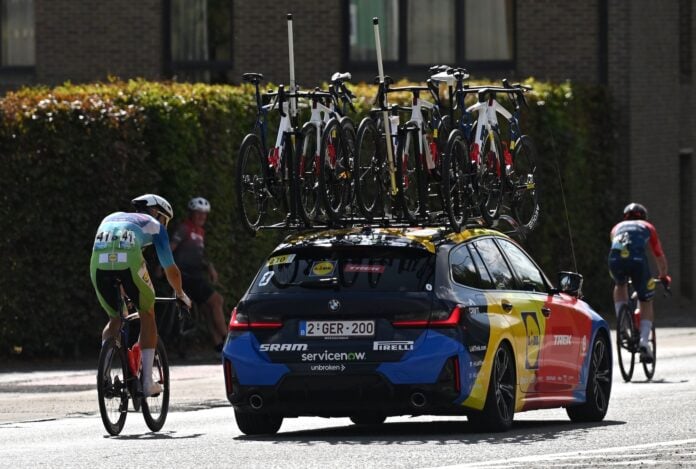
The Renewi Tour 2026 reaches its queen stage on Friday 21 August, with 184.6 kilometres from Celles to Geraardsbergen and the first terrain capable of creating serious general classification gaps.
After two sprint-oriented opening days, the character of the race changes completely. Jasper Philipsen carries the leader’s jersey into Stage 3 after winning in Ardooie, while Jonathan Milan’s hopes of defending the lead disappeared after a heavy Stage 2 crash left him many minutes down.
Friday is where the likes of Arnaud De Lie, Florian Vermeersch, Tiesj Benoot, Laurence Pithie, Mike Teunissen, Alberto Bettiol, Matej Mohorič and Kasper Asgreen need to make their move. There is no individual time trial in the 2026 Renewi Tour, making the short climbs, cobbles and bonus seconds around Geraardsbergen even more important than usual.
The Renewi Tour 2026 route guide identified the Celles to Geraardsbergen stage as the obvious queen stage and one of the two days most likely to decide the overall race.
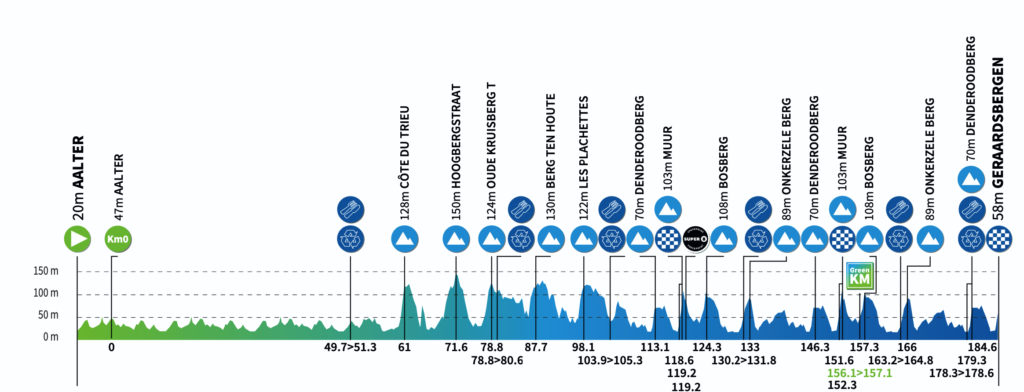
Renewi Tour Stage 3 route
Date: Friday 21 August 2026
Start: Celles
Finish: Geraardsbergen
Distance: 184.6km
Race start: 11:40 CEST / 10:40 BST
Stage type: Hilly and cobbled
Key climbs: Muur van Geraardsbergen and Bosberg
GC importance: Very high
Celles makes its debut as a Renewi Tour host before the race heads towards Geraardsbergen and terrain closely associated with the Flemish Classics.
The Muur van Geraardsbergen and Bosberg provide the headline difficulties, but the real challenge comes from the accumulation of short climbs, narrow roads, cobbles and repeated accelerations.
That structure makes Stage 3 fundamentally different from the opening two days.
There is no need for one enormous attack to create separation. Repeated efforts can gradually remove domestiques and sprinters until only the strongest Classics riders and GC contenders remain.
The beginner’s guide to the Renewi Tour 2026 explains why stages such as this are so important in a race without high mountains or a time trial. Small gaps and bonus seconds can decide the entire event.
The Muur and Bosberg should decide the shape of the race
Few combinations in Belgian cycling carry more tactical weight than the Muur van Geraardsbergen and Bosberg.
The Muur is short enough to be attacked explosively but steep and technical enough, particularly over the cobbled upper section, to create genuine separation after several hours of racing.
Positioning before the climb is almost as important as the effort itself.
A rider beginning the Muur 30 places too far back can already be in trouble before the favourites accelerate.
The Bosberg then creates another opportunity to attack before riders have completely recovered.
That makes the closing section much more about repeated efforts than one decisive climb.
With no individual time trial later in the race, nobody with serious GC ambitions can afford to treat those gaps as insignificant.
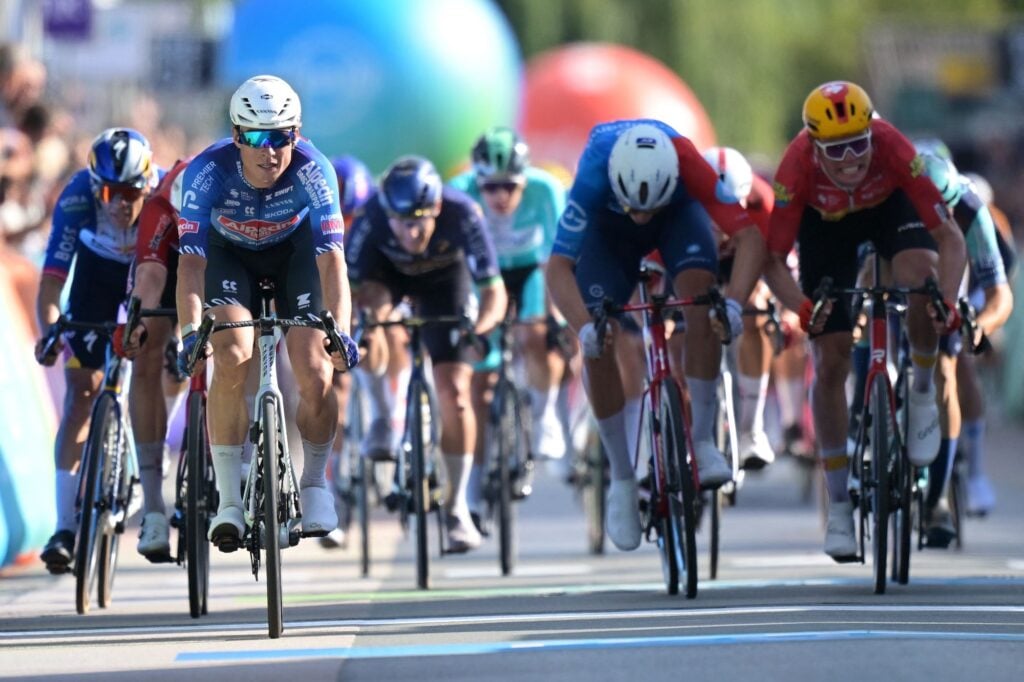 Photo Credit: Getty
Jasper Philipsen takes the race lead into much harder terrain
Jasper Philipsen starts Stage 3 in the leader’s jersey after an emphatic victory in Ardooie.
Stage 2 became increasingly chaotic as the race reached its finishing circuits. Milan crashed heavily while wearing the leader’s jersey, Tim Merlier and Olav Kooij were both compromised in the sprint, and Philipsen took advantage with a convincing victory.
Friday presents an entirely different problem.
Philipsen is far more versatile than a conventional pure sprinter and has repeatedly shown that he can handle cobbled Classics terrain. That makes simply assuming he will disappear on the Muur a mistake.
The difficulty is the accumulation.
One short climb is manageable. Repeated climbs, cobbles and attacks after almost 185 kilometres are much more likely to expose the difference between Philipsen and the strongest Classics specialists.
His tactical position is nevertheless excellent.
Philipsen does not need to attack. If he remains in the leading group, everyone else has to worry about taking one of the world’s fastest finishers to the line.
That means the responsibility is on the GC contenders to distance him.
Arnaud De Lie finally reaches the terrain that suits his GC ambitions
Arnaud De Lie should be one of the riders most motivated to make Stage 3 decisive.
The defending Renewi Tour champion won the 2025 edition through precisely the combination required again this year: the ability to survive the harder Classics stages while collecting valuable seconds through his finishing speed.
Geraardsbergen suits that profile.
De Lie can handle the Muur and Bosberg considerably better than most heavyweight sprinters, but still has enough speed to win from a reduced front group.
He therefore does not need an all-or-nothing attack.
A selective race that leaves 15 or 20 strong riders at the front could be close to ideal.
The main complication is Philipsen.
If De Lie cannot get rid of him, there is no guarantee that his own sprint will be enough to win the stage or take the maximum bonus seconds.
That creates a clear tactical objective: Lotto-Intermarché need to make the repeated climbs hard enough that Philipsen is no longer part of the conversation.
The Renewi Tour 2026 contenders preview explains why De Lie entered the race as one of the strongest overall candidates after winning the 2025 edition.

Florian Vermeersch needs attrition rather than a sprint
Florian Vermeersch has one of the clearest reasons to attack.
UAE Team Emirates-XRG do not want to tow Philipsen, De Lie or another fast finisher towards the line.
Vermeersch’s opportunity lies in making the race progressively smaller.
He is powerful over cobbles, comfortable when a race becomes an extended Classics battle and strong enough to continue pressing after the steepest climbing has ended.
The best scenario is therefore not one explosive attack on the Muur.
It is repeated pressure.
If UAE can force several selections, remove the fastest riders and leave Vermeersch with only a handful of opponents, his chances improve dramatically.
The Renewi Tour team-by-team guide sets out why UAE’s route to the overall classification depends far more on aggressive racing than finish-line bonuses.
Tiesj Benoot is almost built for this stage
Tiesj Benoot has one of the best pure course profiles in the field.
The Decathlon CMA CGM rider thrives when a race sits between a Flemish Classic and a short stage-race GC battle.
He can climb, handle cobbles, attack from distance and maintain power across repeated short climbs.
His weakness relative to De Lie or Philipsen is obvious: sprint speed.
That means Benoot needs to use the terrain rather than wait for the finish.
The repeated Muur and Bosberg efforts give him several opportunities to increase the pressure instead of relying on one decisive move.
If the race becomes a succession of attacks rather than a controlled ride towards a reduced sprint, Benoot should move much closer to the top of the hierarchy.
 Photo Credit: Getty
Laurence Pithie has an excellent all-round profile
Laurence Pithie has the right balance for a stage like this.
He combines genuine finishing speed with the ability to survive difficult Classics terrain, which means he does not need the race to develop in only one specific way.
Pithie can follow attacks on the short climbs but still remain dangerous if the front group stays relatively large.
That creates a similar tactical advantage to De Lie.
He can afford to wait slightly longer than riders such as Benoot or Vermeersch because the sprint is not something he necessarily needs to avoid.
This is also the kind of terrain where positioning matters constantly, an area where Pithie’s Classics experience should help.
If he emerges from Geraardsbergen near the top of the GC, it would be no surprise.
Mike Teunissen has both the terrain and the finishing speed
Mike Teunissen deserves serious attention.
He has the experience required for Geraardsbergen, strong finishing speed from a reduced group and enough Classics ability to remain present when the race becomes selective.
XDS Astana also have Alberto Bettiol, which gives them a useful tactical pairing.
Teunissen can wait.
Bettiol can attack.
That creates exactly the type of problem that becomes difficult to solve late in a Classics-style stage.
If Bettiol goes clear, rival teams have to decide whether they want to spend riders bringing him back while Teunissen remains sheltered behind.
Teunissen’s own route is straightforward: survive the hardest passages and arrive at the finish with as small a group as possible.
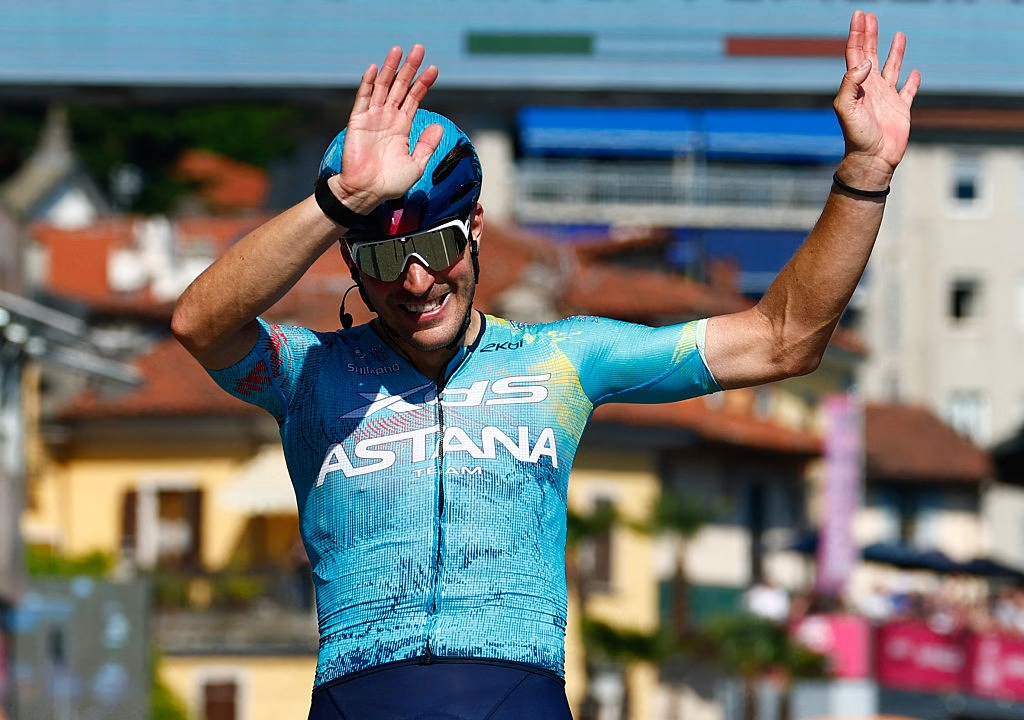
Alberto Bettiol should try to decide the race before the sprint
Alberto Bettiol is one of the most obvious attacking threats.
He has the power required for the cobbled climbs and is especially dangerous once a race begins fragmenting rather than following a predictable pattern.
Bettiol’s problem is what happens if he waits.
A finish containing Philipsen, De Lie, Pithie or Teunissen is not the situation he wants.
That means his best chance comes from attacking before the fastest riders can use their advantage.
The Muur is an obvious launch point, but the roads after the climbs may be just as important.
A powerful rider attacking while everyone else is recovering can sometimes create a gap more effectively than on the climb itself.
Matej Mohorič will look for the moment everyone hesitates
Matej Mohorič rarely needs encouragement to race aggressively on terrain like this.
The Bahrain Victorious rider becomes particularly dangerous when the race loses its structure.
Once teams are reduced and the leading contenders begin watching one another, Mohorič has the tactical instincts and descending ability to exploit even a small hesitation.
He is unlikely to want to wait for the final sprint.
That makes the question not whether he attacks, but where.
The closing Geraardsbergen circuits should give him several opportunities to anticipate the favourites rather than simply trying to follow their accelerations.

Kasper Asgreen can use the fatigue after the climbs
Kasper Asgreen is another rider who should avoid turning Stage 3 into an uphill sprint contest.
The EF Education-EasyPost rider’s biggest weapon is sustained power.
That means the decisive move does not necessarily need to happen on the steepest part of the Muur.
Asgreen can use the fatigue created by the climbs and attack once the road becomes faster, forcing riders who have just gone deep to immediately begin chasing.
That type of move is often especially difficult to control late in a stage.
For Asgreen, getting the timing right matters more than trying to match the fastest riders in the final 200 metres.
Søren Wærenskjold can survive longer than the pure sprinters
Søren Wærenskjold remains another interesting option if Stage 3 is selective without completely exploding.
His speed was evident again on Stage 2, and his size should not disguise how well he can handle rolling northern European terrain.
The Muur is obviously a much harder test than Ardooie.
But if Wærenskjold survives with the leading group, he immediately becomes one of the fastest riders left.
Uno-X Mobility can also use more aggressive riders earlier in the stage, allowing Wærenskjold to conserve energy rather than trying to respond to every attack personally.
He needs a less selective race than Benoot or Vermeersch, but not necessarily a completely controlled one.
Jonathan Milan’s GC challenge is effectively gone after Stage 2
Jonathan Milan started Thursday in the race lead after winning Stage 1 in Diest, but a heavy crash on the finishing circuit in Ardooie completely changed his Renewi Tour.
Milan spent much of the final part of Stage 2 riding several minutes behind the peloton and was eventually lapped by the front of the race on the local circuit.
That means Stage 3 is no longer about defending a GC position.
The more immediate question is how well he has recovered physically from the crash.
Even before Thursday, Geraardsbergen looked like the stage most likely to expose Milan’s limits as an overall contender. The time loss now removes that tactical pressure entirely.
Lidl-Trek can instead reassess their objectives around stage opportunities and the condition of their remaining riders.
Bonus seconds could be just as important as the cobbles
The Muur and Bosberg attract most of the attention, but the Green Kilometre remains an important part of the GC equation.
The Renewi Tour often produces overall gaps of only a few seconds.
That makes intermediate bonuses disproportionately valuable.
A rider who gains seconds through the Green Kilometre and then finishes with the leading group can make meaningful progress without ever physically dropping a rival.
This is particularly useful to riders such as De Lie and Pithie, who have enough acceleration to contest bonuses while still preserving themselves for the final climbs.
With no time trial this year, there is no obvious later stage where stronger riders can simply recover 20 or 30 seconds.
Every bonus therefore matters.
The beginner’s guide to the Renewi Tour explains how the Green Kilometre works and why it can decide the overall classification.
Can Philipsen really keep the leader’s jersey?
Yes.
That possibility is important because it determines how everyone else has to race.
Philipsen has the Classics pedigree to survive much harder terrain than a conventional sprinter.
If the pace is controlled through the first passages and the strongest teams wait until late, he can absolutely remain in the front group.
At that point, his sprint becomes an enormous tactical weapon.
The riders trying to win the Renewi Tour cannot therefore afford to simply follow wheels until the final kilometres.
They need to make the race difficult enough that Philipsen is repeatedly forced to respond.
One attack may not remove him.
Five or six hard accelerations might.
That is the central tactical problem of Stage 3.
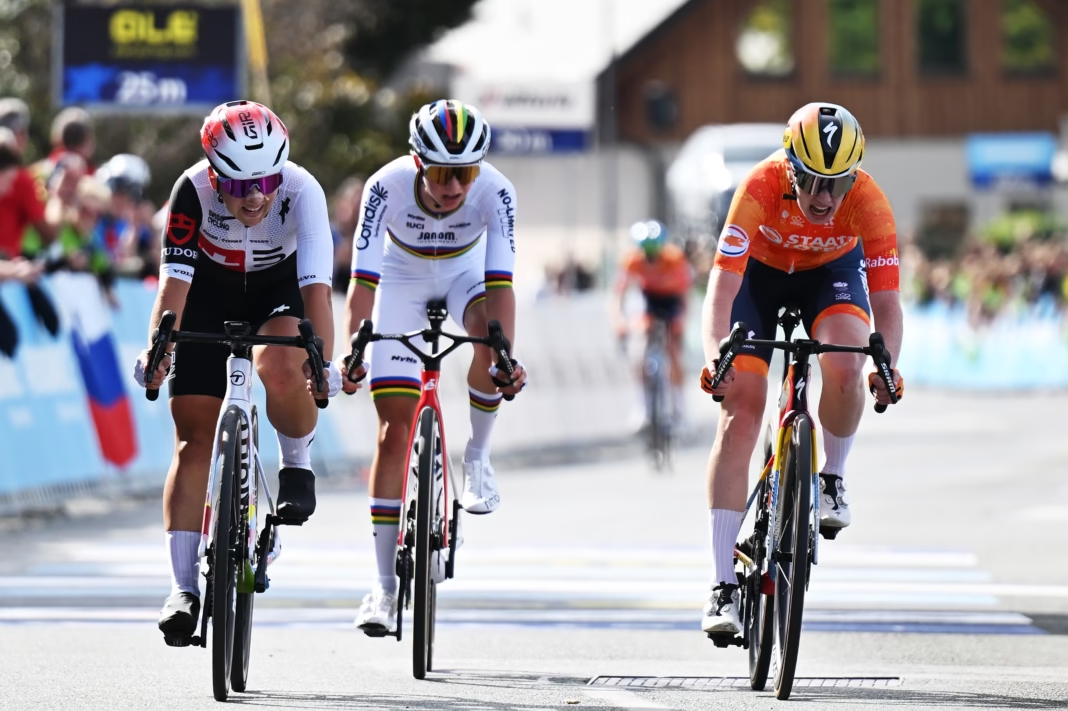
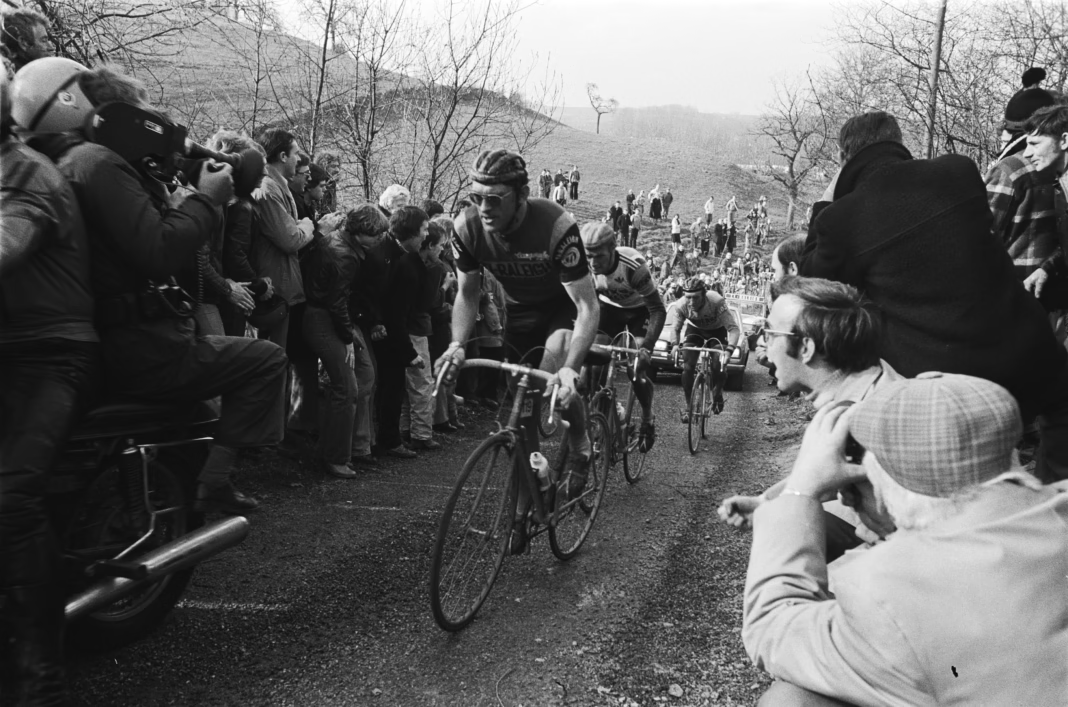
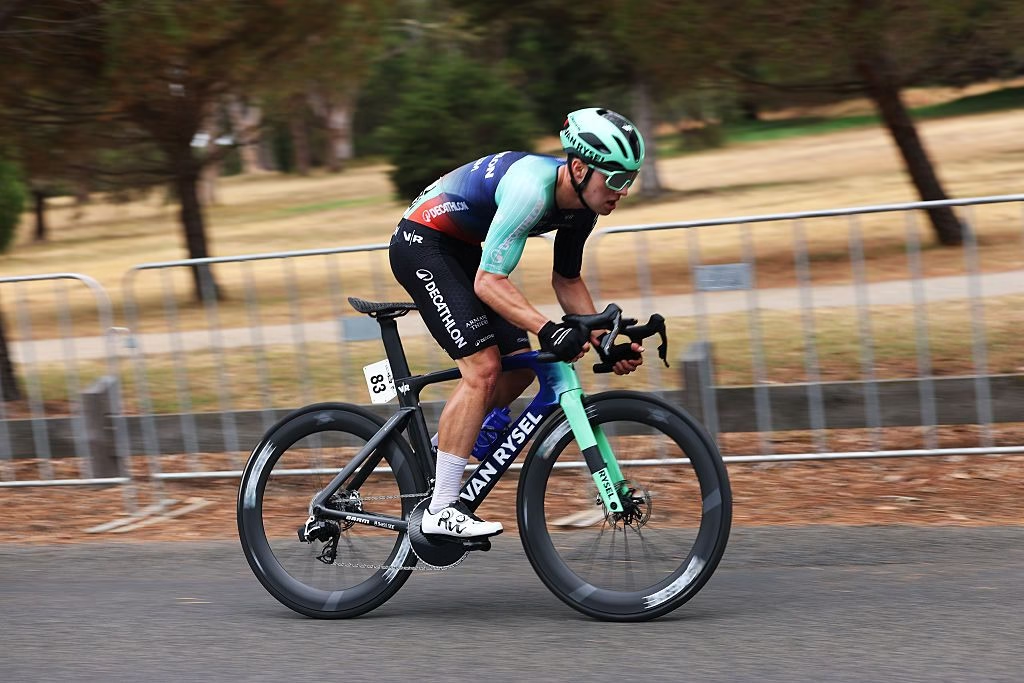
Stage 3 should finally establish the GC hierarchy
The opening two stages have rewarded speed, positioning and avoiding trouble.
Friday asks a different question.
Who can repeatedly produce power on cobbles and short climbs without losing position or making tactical mistakes?
The lack of an individual time trial makes the answer particularly important.
There is no predictable GC reset later in the week.
Whatever gaps appear in Geraardsbergen remain relevant all the way through Saturday’s stage to Bilzen-Hoeselt and Sunday’s final Classics-style showdown in Leuven.
That is why the Renewi Tour 2026 route guide places such importance on both Stage 3 and the final day.
Who wins Renewi Tour 2026 Stage 3?
Arnaud De Lie has perhaps the best balance for the expected race.
He can survive a genuinely hard day, has enough power for the Muur and Bosberg and remains one of the fastest riders if a reduced group contests the finish.
Tiesj Benoot and Florian Vermeersch need a more aggressive race and should be among the riders most motivated to attack before the sprint becomes relevant.
Laurence Pithie and Mike Teunissen have the speed to benefit from a moderately selective finish, while Alberto Bettiol, Matej Mohorič and Kasper Asgreen are among the obvious riders to watch once the race starts fragmenting.
Philipsen remains the complication.
If the GC contenders fail to make the race hard enough, the current leader has every chance of surviving and turning the queen stage into another opportunity to use his sprint.
The most likely outcome is a small, high-quality group contesting the finish after repeated selections over the Muur and Bosberg.
De Lie looks the strongest option from that scenario.
More importantly, Friday should finally tell us who is genuinely capable of winning the 2026 Renewi Tour overall.
For UK viewers, the Renewi Tour 2026 viewing guide has the TNT Sports and HBO Max details for following the stage live.

