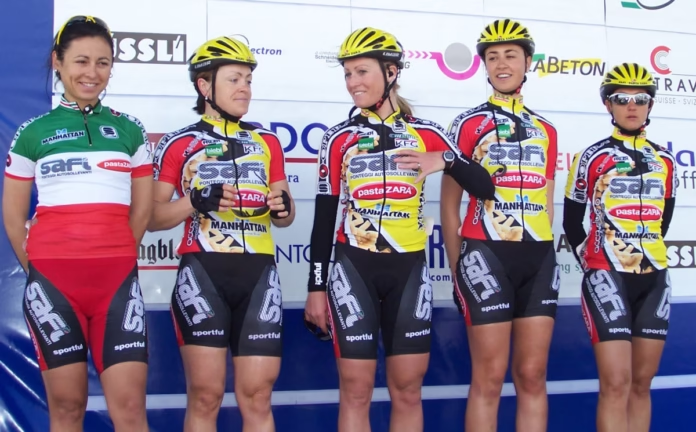
Safi-Pasta Zara-Manhattan occupied a distinctive place in women’s professional cycling during the mid-2000s. It was Italian in its management and commercial identity, international in its rider recruitment and ambitious enough to attract some of the strongest women in the sport at a time when the professional structure around them was still far less secure than it is today.
The name itself was only one phase of a much longer project. The team developed through the Acca Due O and Pasta Zara lineage before racing as Safi-Pasta Zara-Manhattan from 2004, then continued under further Pasta Zara-backed identities after the Manhattan name disappeared. That continuity is important because several generations of leading riders passed through the same organisation.
Nicole Cooke, Rochelle Gilmore, Diana Žiliūtė and Marta Bastianelli all wore versions of the team’s colours. The results included World Cup wins, national titles, a Giro d’Italia Femminile victory and a world road title, while the team’s occasional clashes with the institutions around women’s cycling also exposed how fragile the sport’s professional foundations could be.

Safi-Pasta Zara-Manhattan at a glance
Country: Italian-run international women’s team
Project founded: 1996
Safi-Pasta Zara-Manhattan name: 2004-2008
Team manager: Maurizio Fabretto
Discipline: Women’s road cycling
Notable riders: Nicole Cooke, Rochelle Gilmore, Diana Žiliūtė, Marta Bastianelli
Later identities: Safi-Pasta Zara-Titanedi, Safi-Pasta Zara, Diadora-Pasta Zara and Pasta Zara-Cogeas
The project before the Safi-Pasta Zara name
The team traced its roots to 1996 and spent its early years under Acca Due O-backed names. By the end of the 1990s and early 2000s, the organisation had already established itself as a serious international presence, often combining Italian infrastructure with riders from Lithuania and elsewhere in Europe.
Pasta Zara became increasingly central to the team’s identity. The food company’s long involvement helped give the project something women’s cycling frequently lacked in that period: continuity. Team names shifted as secondary sponsors came and went, but the same underlying structure survived.
Diana Žiliūtė was one of the riders who embodied that continuity. The Lithuanian star raced for the project across several title changes and remained one of its most recognisable names. ProCyclingUK’s profile of Diana Žiliūtė covers a rider whose Classics speed and durability made her particularly valuable to a team targeting a broad international calendar.
The Safi-Pasta Zara-Manhattan era begins
From 2004 the team became Safi-Pasta Zara-Manhattan. Maurizio Fabretto remained the central management figure, and the squad continued to recruit beyond Italy rather than functioning as a narrowly national project.
That approach mattered in an era before the Women’s WorldTour and before today’s minimum standards for top-level teams. A strong women’s squad needed to assemble sponsorship from several sources, operate across national boundaries and persuade leading riders that it could provide a reliable enough platform to build a season around.
Safi-Pasta Zara-Manhattan managed that well enough to attract riders who could win the biggest races in the sport. Its roster was rarely built around one nationality or one type of rider. Stage racers, sprinters, Classics specialists and track riders all passed through the team.
Nicole Cooke gives the team its biggest stage-race result
Nicole Cooke was the defining rider of the team’s early Safi years. Already one of the sport’s outstanding young talents, she brought the ability to win hilly one-day races, national championships and stage races.
In 2004 Cooke won the Giro d’Italia Femminile overall while racing for the team. That result gave the organisation one of the biggest general classification victories available in women’s cycling at the time. She also won the British road title that season.
Cooke remained with Safi-Pasta Zara-Manhattan in 2005 and won La Flèche Wallonne Féminine, the Geelong-era World Cup calendar providing another arena in which the team could show itself against the strongest squads in the sport. Her results made Safi more than an established team. For a period, it was one of the places where a genuine world-beating rider could pursue the biggest objectives.
Rochelle Gilmore adds sprinting power
Australian sprinter Rochelle Gilmore joined for 2005 after leaving Team SATS. Her arrival gave the squad another major attacking option and strengthened its reach beyond continental Europe.
Gilmore won the Geelong World Cup in 2005 and remained with the team in 2006. Her presence alongside Cooke in 2005 showed how ambitious the roster had become: one of Britain’s best all-round riders and one of Australia’s fastest finishers operating within the same Italian-managed structure.
The team was not trying to dominate races through one formula. Cooke could win on steep finishes and across stage races, Gilmore could target sprints and fast one-day races, while Žiliūtė offered a different mixture of speed and Classics experience.
The 2005 Giro dispute exposed a more difficult side of the era
One of the most revealing episodes in the team’s history came in 2005, when Safi-Pasta Zara-Manhattan withdrew from the Giro d’Italia Femminile despite Cooke being the defending champion.
The decision was not made for sporting reasons. Fabretto withdrew the team from racing in Italy amid a dispute with part of the Italian cycling federation. For the riders, it meant losing one of the biggest objectives of the season after months of preparation.
The episode illustrates the less stable environment in which elite women raced at the time. Even one of the strongest teams in the world, carrying the defending Giro winner, could find its season reshaped by organisational politics. The modern women’s peloton has its own structural problems, but top-level racing now sits within a much more formalised system than the one Safi navigated.
A new generation arrives for 2006
Cooke left after 2005, but the team did not simply retreat. For 2006 Fabretto refreshed the Italian core and added several riders who would go on to have significant careers. Marta Bastianelli, Daniela Fusar Poli, Silvia Parietti and Luisa Tamanini were among the additions, while Gilmore and Žiliūtė remained important names.
Bastianelli was still developing when she joined. Within two seasons she would produce the result that ensured the Safi name appeared on one of cycling’s most important jerseys.

Marta Bastianelli becomes world champion
In 2007 Marta Bastianelli won the elite women’s road world championship in Stuttgart while riding for Safi-Pasta Zara-Manhattan. It was the biggest one-day victory associated with this phase of the team and immediately changed Bastianelli’s status within the sport.
The result also underlined the team’s role as a bridge between established stars and emerging riders. Cooke and Žiliūtė had arrived with major international reputations. Bastianelli developed into a world champion while inside the project.
Her later career lasted well beyond the Safi years, eventually taking in major Classics success and a return to the top level after difficult periods. ProCyclingUK covered Marta Bastianelli’s retirement in 2023, sixteen years after that world title.
Why the roster always looked so international
The Safi project was shaped by the economics of women’s cycling as much as by sporting preference. With fewer well-funded professional teams available, riders were more likely to cross national boundaries in search of a stable programme. Italian teams could contain British, Australian, Lithuanian, Swedish and Japanese riders alongside the home contingent.
Safi-Pasta Zara-Manhattan embraced that reality. Gilmore, Cooke and Žiliūtė were not token international signings. They were leaders or major race winners. The team built its credibility by finding strong riders wherever they were available rather than relying on a single domestic pipeline.
The Manhattan name disappears, but the project continues
The Safi-Pasta Zara-Manhattan title continued through 2008. After that, the team changed names again, first becoming Safi-Pasta Zara-Titanedi and then Safi-Pasta Zara. The wider organisation survived into the following decade under Diadora-Pasta Zara and later Pasta Zara-Cogeas identities.
That long tail is part of the reason the team deserves to be remembered as more than one sponsor combination. Women’s teams of the period often vanished entirely when a backer left. This project repeatedly found another naming arrangement and carried on.
The riders who define Safi-Pasta Zara-Manhattan
Nicole Cooke supplied the biggest stage-race success and a run of major one-day victories.
Rochelle Gilmore brought international sprinting strength and a World Cup win.
Diana Žiliūtė linked several eras of the project and remained one of its most accomplished Classics riders.
Marta Bastianelli emerged from the squad to become world road champion in 2007.
Those four names alone show the breadth of the operation. They represent Britain, Australia, Lithuania and Italy, and their strengths ranged from Grand Tour climbing to bunch sprinting.

Why Safi-Pasta Zara-Manhattan still matters
The team belongs to a period that can easily be flattened into a list of old sponsor names. Safi-Pasta Zara-Manhattan is more useful than that. It shows how elite women’s teams had to operate before the modern WorldTour structure: several sponsors, shifting registrations, international rosters and constant pressure to keep the project financially alive.
It also produced results that stand up without qualification. A Giro overall win, World Cup victories and a world championship are not historical curiosities. They place the team directly in the sporting story of an era that included some of the strongest riders of the early 21st century.
Safi-Pasta Zara-Manhattan FAQ
When did Safi-Pasta Zara-Manhattan race?
The team used the Safi-Pasta Zara-Manhattan name from 2004 to 2008. It was part of a longer project that began in 1996 and continued under several other sponsor names.
Did Nicole Cooke ride for Safi-Pasta Zara-Manhattan?
Yes. Cooke raced for the project during the Safi era and won the 2004 Giro d’Italia Femminile overall. She also won La Flèche Wallonne Féminine in 2005.
Which world champion rode for the team?
Marta Bastianelli became elite women’s road world champion in 2007 while riding for Safi-Pasta Zara-Manhattan.
What happened to the team after 2008?
The organisation continued under new names including Safi-Pasta Zara-Titanedi, Safi-Pasta Zara, Diadora-Pasta Zara and Pasta Zara-Cogeas.
-
 Photo Credit: quentinphotographiebe
 -
 Photo Credit: Getty