Team SD Worx-Protime have questioned the process that led to Lorena Wiebes’ disqualification from the Giro d’Italia Women, saying they are “astonished” by the commissaires’ decision and pointing to a reported discrepancy of more than 50 grams between two post-stage weighings of her bike.
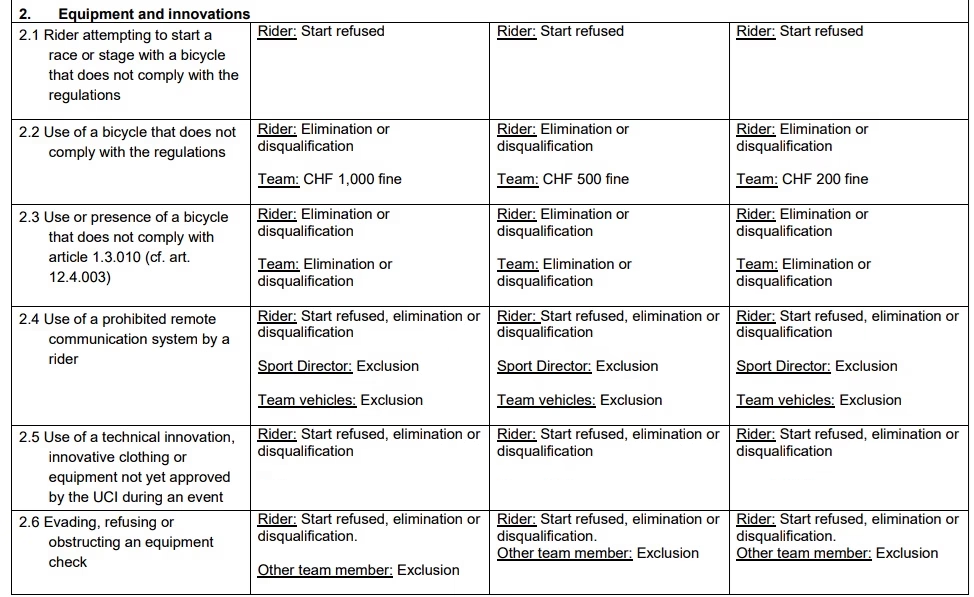
Wiebes had crossed the line first on stage 1 in Ravenna, but was later disqualified under UCI article 2.12.007 – 2.2 after commissaires ruled that her bike did not meet the minimum weight requirement. According to SD Worx-Protime, the jury recorded the bike at 6.78kg, 20 grams below the UCI’s 6.8kg limit.
Elisa Balsamo has therefore been awarded the stage victory and will wear the maglia rosa on stage 2.
SD Worx-Protime raise questions over post-stage checks
The key update is not just the disqualification itself, but the strength of SD Worx-Protime’s response. The team said it has “serious questions” about the bicycle-weighing procedures used at the Giro d’Italia Women, particularly because the margin involved was so small.
“Team SD Worx-Protime is astonished by the decision of the UCI commissaires’ panel that Lorena Wiebes’ bicycle did not comply with the minimum weight limit after the first stage of the Giro d’Italia Women,” the team said.
The most significant part of the statement concerns the team’s claim that two checks did not produce the same reading.
“For example, there was a weight difference of more than 50 grams between the first and second weighing of Wiebes’ bicycle after the finish of the stage in Ravenna,” SD Worx-Protime said.
That is the detail that gives the team’s objection its force. If the bike was ruled 20 grams under the limit, but two weighings differed by more than 50 grams, SD Worx-Protime believe the reliability of the process deserves scrutiny.
Team says the same bike had passed earlier UCI checks
SD Worx-Protime also said Wiebes had used the same bike, with the same setup, on multiple occasions earlier this season.
According to the team, the bike had previously been checked by UCI officials after several races in which Wiebes won sprint finishes. On those occasions, SD Worx-Protime said the bike was found to be “comfortably above” the 6.8kg minimum.
“Wiebes has ridden this bicycle on multiple occasions this season, always with the same setup,” the team said. “She achieved numerous victories on this bike. Moreover, earlier this year, the bicycle was weighed by UCI officials after several races in which Wiebes won sprint finishes convincingly. On each occasion, the bicycle’s weight was found to be comfortably above the 6.8-kilogram limit.”
The team added that it had “no explanation” for why the same bike would now suddenly be measured below the minimum weight requirement.
That does not change the result as it stands, but it sharpens the issue. SD Worx-Protime are not simply arguing that the penalty was harsh. They are questioning how the bike could have passed previous checks, then failed this one by a margin smaller than the discrepancy they say existed between two weighings.
Team call disqualification an exceptionally severe sanction
SD Worx-Protime also challenged the proportionality of the punishment. The team described the disqualification as an “exceptionally severe sanction”, especially given that the stage was a flat sprint finish rather than a mountain stage.
“In a flat sprint stage, unlike a mountain stage, a small reduction in weight provides virtually no advantage,” the team said. “This is certainly true for a rider like Wiebes, who won the sprint in Ravenna by three bicycle lengths.”
The argument is clear: even if the bike was judged to be 20 grams under the limit, SD Worx-Protime do not believe that could reasonably explain the performance difference in a flat bunch sprint. Their position is that Wiebes won decisively on the road and that the sanction removed both the stage victory and her place in the race for a technical breach with no meaningful sporting advantage in that context. The rulebook however does not apply this conditional aspect.
Balsamo inherits stage win and maglia rosa
The official result now promotes Elisa Balsamo to the stage victory. The Italian will start stage 2 in the maglia rosa, giving Lidl-Trek control of the first leader’s jersey of the race.
For Balsamo, it is still a major result on home roads, even if it arrived after a post-stage decision rather than the original finish-line order. For Wiebes and SD Worx-Protime, the consequences are far heavier: the stage win is gone, Wiebes is out of the Giro, and sports director Danny Stam has also been fined CHF 500.
The dispute now leaves the Giro d’Italia Women with a major off-road storyline before stage 2 has even begun. The classification has changed, the first leader’s jersey has switched hands, and SD Worx-Protime have made clear they do not accept the weighing process at face value.