
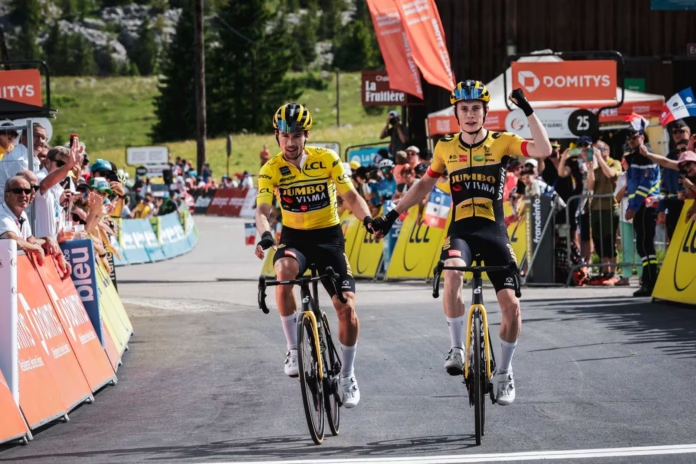
Plateau de Solaison is about to become a household name for anyone watching the Tour de France on Sunday afternoon, and most fans have never heard of it before this week.
Stage 15 of the Tour de France 2026 runs 183.9km from Champagnole to Plateau de Solaison, with 3,950m of climbing on the way. It is the last stage before the second rest day, and it finishes on a climb hard enough to end the second week of the race with real damage rather than a gentle wind-down. For the wider context around this part of the route, see our Tour de France 2026 Vosges and Jura guide and our Tour de France 2026 summit finishes guide.
Quick answer: what is Plateau de Solaison?
Plateau de Solaison is a mountain plateau in the Bornes massif in Haute-Savoie, reached by an 11.3km climb averaging around 9%. It is the final climb of stage 15 of the Tour de France 2026, rated hors catégorie, and it is making its debut in the race this year after previously featuring in the Critérium du Dauphiné and its 2026 successor, the Tour Auvergne-Rhône-Alpes.
| Detail | Plateau de Solaison |
|---|---|
| Stage | Stage 15, Champagnole to Plateau de Solaison |
| Distance | 183.9km, 3,950m of climbing |
| Final climb length | 11.3km |
| Average gradient | Around 9% |
| Category | Hors catégorie |
| Preceded by | Col de la Croisette, 4.7km at 11.2%, category 1 |
| Tour de France history | First appearance in 2026 |
| Comes before | The second rest day |
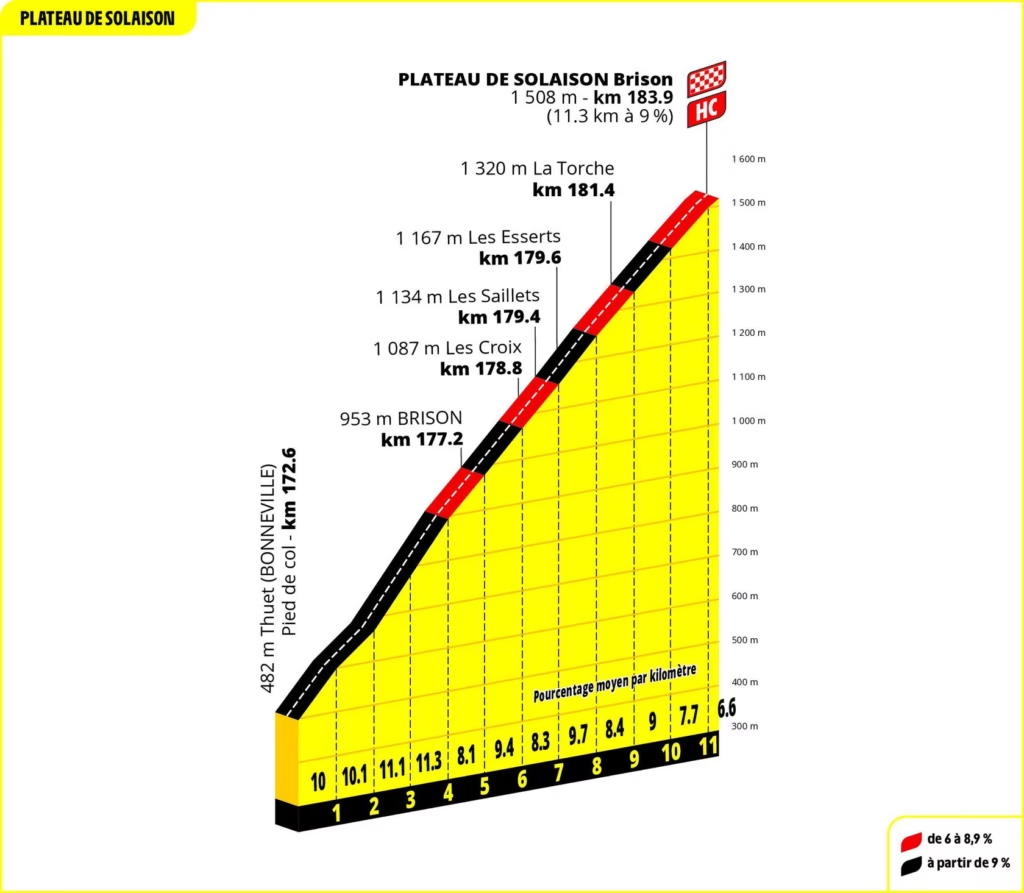
It is not an old Tour climb, even though it feels like one
This is the first thing to clear up.
Plateau de Solaison has never featured in the Tour de France before 2026. It is not a rediscovered classic like the Tourmalet or a modern addition with a long Tour history like Alpe d’Huez. It is a genuine debutant, and the only reason it feels familiar to some fans is that it has been used at a smaller level for years.
The climb has appeared in the Critérium du Dauphiné, and more recently in that race’s 2026 successor, the Tour Auvergne-Rhône-Alpes, where it was used as the summit finish of the final stage. Isaac del Toro won there after soloing the closing kilometres, a result that now matters again because he arrives at the Tour de France having already climbed Solaison at race pace.
That gives Solaison an unusual profile for a Tour debutant: completely new to the world’s biggest race, but not new to the peloton.
Why is everyone searching for it this weekend?
The short answer is timing. Stage 15 falls immediately after a hard Vosges stage to Le Markstein Fellering, and it is the last stage before the Tour’s second rest day. For the build-up to this weekend, see our Tour de France 2026 stage 14 report and our Tour de France 2026 stage 15 preview.
Commentators will use the name repeatedly through Sunday’s broadcast, and it is exactly the kind of unfamiliar French place name that sends fans searching mid-race. Most people asking “what is Plateau de Solaison” are not looking for a geography lesson. They want to know how hard the climb is, why it matters for the general classification, and why it has been built up as a potential race-changer.
Where is Plateau de Solaison?
Plateau de Solaison sits at around 1,947m in the Bornes massif, part of the pre-Alps in Haute-Savoie, south of Lake Geneva. It marks the point where the Tour de France 2026 route properly enters the Alps after a long approach through the Jura.
The stage itself starts a long way from the mountains. The opening kilometres out of Champagnole are gently uphill rather than genuinely hard, and the middle of the stage is dominated by a long descent down towards the valley floor near Bellegarde-sur-Valserine. The serious climbing is saved for the closing stages of the day.
 Photo Credit: A.S.O./Aurélien Vialatte
How hard is the climb to Plateau de Solaison?
The final ascent is 11.3km long at an average gradient of around 9%, and it does not offer much relief along the way. Multiple sources describing the climb note that the gradient rarely drops much below 6% at any point, which is what turns a long climb into a genuinely punishing one.
It is preceded by the Col de la Croisette, also known locally as the climb to Le Salève, which adds another 4.7km at an average of 11.2%. That climb alone is rated category 1, and it comes late enough in the stage to soften legs before the final ascent even begins.
| Climb | Length | Gradient | Category |
|---|---|---|---|
| Col de la Croisette | 4.7km | 11.2% | Category 1 |
| Plateau de Solaison | 11.3km | Around 9% | Hors catégorie |
That combination, a category 1 climb followed almost immediately by an hors catégorie summit finish, is what separates Solaison from a normal medium-mountain stage.
Why does Plateau de Solaison come before a rest day?
Race organisers frequently place a hard mountain stage immediately before a rest day, and stage 15 fits that pattern.
The logic works both ways. Riders know they have a full day of recovery afterwards, which can encourage more aggressive racing than a stage buried in the middle of a block of consecutive mountain days. At the same time, the stage arrives after stage 14 to Le Markstein Fellering, so nobody reaches the final climb fresh. Our Tour de France 2026 transfer days explained guide covers how this rest-day placement fits into the wider route structure.
That mix of accumulated fatigue and permission to empty the tank is exactly why this stage is rated among the most dangerous of the race. Our Tour de France 2026 mountain stages ranked by difficulty guide places Solaison second only to the Alpe d’Huez queen stage in terms of the size of time gaps it could produce.
Why is Solaison seen as such a dangerous GC stage?
Because the gradient itself does the work, without needing a long, complicated tactical build-up.
Many mountain stages create separation through positioning, team tactics or repeated smaller climbs wearing riders down gradually. Solaison is more direct. The final 11.3km is steep and sustained enough that a rider who is even slightly below their best can lose real time through pace alone, with no tactical excuse available.
That is a significant shift from some of the race’s earlier mountain stages. Our Tadej Pogačar Tour de France 2026 preview flagged Solaison months ago as one of the days where Pogačar could hurt his rivals without needing to wait for the final Alpine weekend.
Where does the GC stand heading into stage 15?
After stage 14 to Le Markstein Fellering, Tadej Pogačar leads the race outright, with Jonas Vingegaard, Remco Evenepoel and Paul Seixas making up the rest of the top four.
| Rank | Rider | Gap |
|---|---|---|
| 1 | Tadej Pogačar | Leader |
| 2 | Jonas Vingegaard | +4:30 |
| 3 | Remco Evenepoel | +5:04 |
| 4 | Paul Seixas | +5:19 |
That gap is already substantial by the standards of a Tour that was tightly contested through its opening week. A climb like Solaison, capable of creating time gaps through gradient alone, gives Pogačar another obvious opportunity to extend that lead rather than simply defend it.
-
 Photo Credit: Getty

What should fans watch for next?
Stage 15 leads straight into the second rest day in Haute-Savoie, before the race resumes with its only individual time trial, a 26.1km test from Évian-les-Bains to Thonon-les-Bains. For live details on how Sunday’s stage unfolds, see our Tour de France 2026 stage 15 live viewing and start time update.
Whatever happens on Solaison will shape how that rest day is spent. A rider defending a big loss will have one day to recover before a time trial that rewards freshness as much as raw power.
Plateau de Solaison FAQs
Where is Plateau de Solaison?
Plateau de Solaison is in the Bornes massif in Haute-Savoie, France, at an altitude of around 1,947m, south of Lake Geneva.
How long is the climb to Plateau de Solaison?
The final climb is 11.3km long, with an average gradient of around 9% and sections that rarely ease below 6%.
Has Plateau de Solaison been used in the Tour de France before?
No. 2026 is the first time Plateau de Solaison has featured in the Tour de France, though it has previously been used in the Critérium du Dauphiné and the Tour Auvergne-Rhône-Alpes.
Why is the Col de la Croisette important on stage 15?
The Col de la Croisette is a category 1 climb of 4.7km at 11.2% that comes shortly before the final ascent to Plateau de Solaison, softening riders’ legs before the decisive climb.
Is Plateau de Solaison harder than other Tour de France 2026 summit finishes?
It is rated among the hardest, with a steeper and more sustained finish than the race’s earlier summit finish at Gavarnie-Gèdre, though the Alpe d’Huez stages later in the race are considered the toughest overall.
Why does stage 15 matter so much for the general classification?
Its steep, sustained finish can create time gaps through gradient alone, and it arrives with accumulated fatigue from the previous day’s mountain stage to Le Markstein Fellering, making it hard for any weakness to stay hidden.

