The Tour de France 2026 route is shaped by its climbs as much as by its time trials, sprint stages and opening weekend in Barcelona. Across 21 stages, the race moves through the Pyrenees, Massif Central, Vosges, Jura and Alps, with five summit finishes and a final mountain weekend built around back-to-back finishes on Alpe d’Huez.
Alpe d’Huez and the Col du Galibier will take most of the attention, and rightly so. Alpe d’Huez is the Tour’s most recognisable summit finish, while the Galibier remains one of the race’s great high-altitude tests. Yet the climbing story of the 2026 Tour is broader than those two names. Gavarnie-Gèdre comes early in the Pyrenees, Le Lioran brings repeated Cantal climbs after the first rest day, Le Markstein anchors a difficult Vosges weekend, Plateau de Solaison makes its Tour debut, and Orcières-Merlette begins the final Alpine block.
That spread is what gives the race its shape. As covered in our Tour de France 2026 route analysis, this is not a route that waits until the final weekend before asking serious questions. The first major mountain finish arrives on stage 6, before the peloton has even reached the end of week one. The hardest Alpine stage then comes on stage 20, when fatigue, team depth and recovery will matter as much as raw climbing speed.
The Tour de France 2026 mountain stages also create an intriguing polka-dot jersey race. With so many summit finishes and high-value climbs late in stages, the Tour de France 2026 climbers guide shows why the mountains competition could be shaped by GC riders as much as breakaway specialists. The best climber in the race may also be one of the riders fighting for yellow.
 Photo Credit: ASO-Charly Lopez
What are the biggest climbs in the Tour de France 2026?
The biggest climbs in the Tour de France 2026 include the Col du Tourmalet, Gavarnie-Gèdre, Grand Ballon, Col du Haag, Plateau de Solaison, Orcières-Merlette, Alpe d’Huez, Col de la Croix de Fer, Col du Télégraphe, Col du Galibier and Col de Sarenne.
They will not all shape the race in the same way. Some are long and famous. Others are shorter, steeper and more awkward. The Galibier is the highest point of the race at 2,642m, while Alpe d’Huez appears on both stage 19 and stage 20. Plateau de Solaison may not carry the same history, but its 11.3km at 9 per cent comes at the end of stage 15 and looks capable of producing major GC gaps before the final rest day.
The difficulty also comes from sequencing. Stage 20 is the obvious queen stage, but it follows Orcières-Merlette on stage 18 and the first Alpe d’Huez finish on stage 19. By the time the race reaches the Galibier, the contenders will already have dealt with the Pyrenees, Cantal, Vosges, Jura, an individual time trial and two Alpine stages.
How hard is the first mountain stage to Les Angles?
Stage 3 from Granollers to Les Angles is the first mountain stage of the race and gives the Tour an early high-altitude feel. It is not the hardest day of the 2026 route, but it arrives before the race has settled into its usual rhythm. After the Barcelona Grand Départ and the opening weekend pressure, the GC riders will need to climb properly almost immediately.
The key ascent is the Col de Toses, a category 1 climb of 9.3km at 6.5 per cent. Later, the route also includes the Col du Calvaire, 11.4km at 4.1 per cent, before the final 1.8km kick to Les Angles at 6.5 per cent. The finish itself is not long enough to be one of the race’s defining summit finishes, but the stage includes 3,850m of climbing and comes early enough to expose anyone short of form.
Its importance is mainly tactical. Teams with strong GC leaders will want to avoid chaos, while riders who have already lost time in the opening team time trial may see an early chance to apply pressure. This is the kind of stage where the Tour may not be won, but where the first weaknesses can appear.
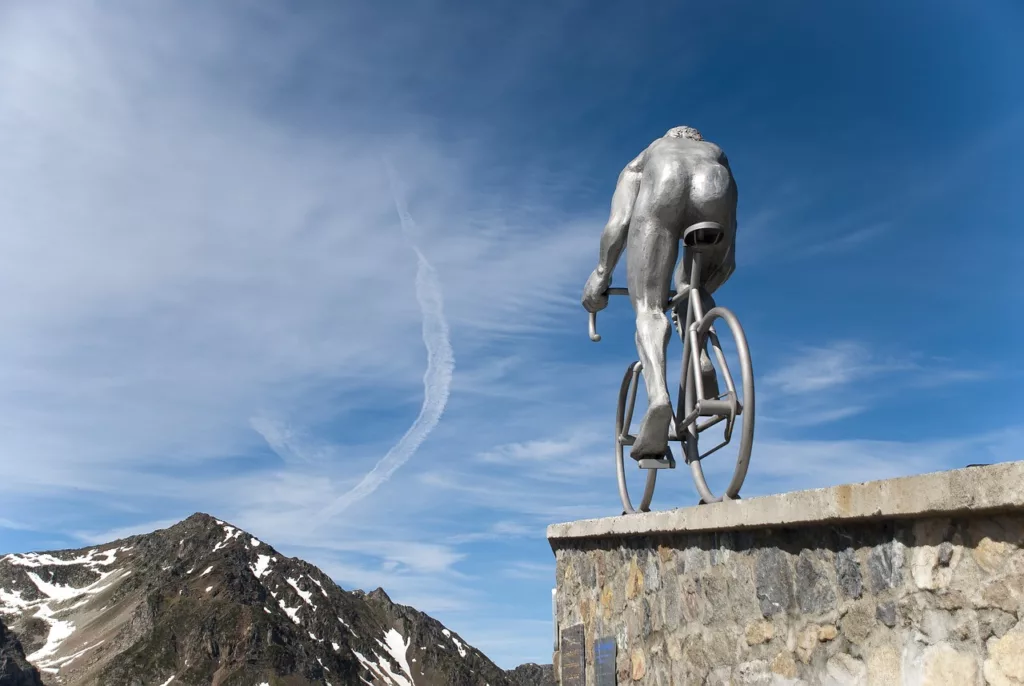
Why the Tourmalet and Gavarnie-Gèdre matter in week one
Stage 6 from Pau to Gavarnie-Gèdre is the first mountain stage that looks capable of changing the overall standings properly. It is 186.2km long and builds through the Côte de Loucrup, Côte de Mauvezin, Col d’Aspin, Col du Tourmalet and the final climb to Gavarnie-Gèdre.
The Col d’Aspin is the first major test, climbing for 12km at 6.5 per cent. It is followed by the Col du Tourmalet, 17.1km at 7.3 per cent. The Tourmalet is too far from the finish to guarantee a direct GC explosion, but it should reduce support, test climbing depth and place weaker teams under pressure before the final ascent.
Gavarnie-Gèdre is a different kind of climb. Officially, it is 18.7km at 3.7 per cent, which looks gentle compared with the Tourmalet, Galibier or Alpe d’Huez. The difficulty comes from the timing and the accumulated fatigue. After a long day over major Pyrenean terrain, the final drag to the finish gives strong climbers a platform to test whether rivals are already paying for the route’s early demands.
This stage also matters because it arrives before many GC riders would ideally want to reveal themselves. A rider who loses a minute here will have time to recover later in the race, but they will spend the next two weeks chasing rather than controlling.
Why Le Lioran could be the Massif Central trap
Stage 10 to Le Lioran is not the most famous mountain day of the 2026 Tour, but it is one of the most awkward. The stage is 166.6km from Aurillac to Le Lioran, includes 3,800m of climbing and comes immediately after the first rest day.
The route includes the Côte de Pailherols, Col de la Griffoul, Col de Prat de Bouc, Côte de Murat, Puy Mary – Pas de Peyrol, Col de Pertus and Col de Font de Cère. None of those climbs carries the same status as the Galibier or Tourmalet, but the sequence is difficult to control. The gradients repeatedly bite, the roads are less predictable than a broad Alpine pass, and the changes of rhythm can quickly expose riders who have not restarted well after the rest day.
The Puy Mary – Pas de Peyrol is the first category climb of the day, with 7.8km at 6 per cent. The Col de Pertus then follows late, with 4.4km at 8.5 per cent. Those two climbs should make the final hour dangerous, especially for riders who struggle when the pace rises and falls rather than settling into one steady tempo.
This is a stage for opportunists, but not only for opportunists. GC riders who want to test a rival’s recovery may find the terrain ideal. The climbs are close enough together to make chasing difficult, and the final approach to Le Lioran gives attackers enough road to make a move stick.
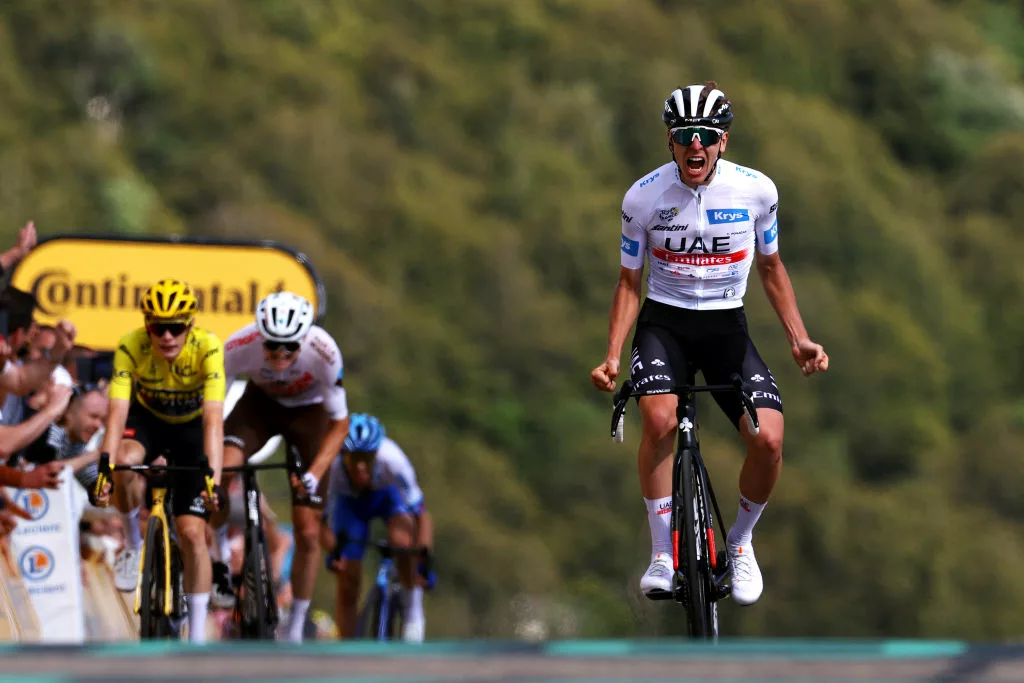 Photo Credit: Getty
How Le Markstein and Col du Haag shape the Vosges weekend
Stage 14 from Mulhouse to Le Markstein Fellering brings the Tour into the Vosges with a 155.3km mountain stage and 3,800m of climbing. It is not a summit finish in the same category as Alpe d’Huez or Plateau de Solaison, but the route is still designed to be selective.
The day begins with the Grand Ballon, a 21.6km climb at 4.7 per cent. That long opening ascent should help form a strong breakaway and start reducing the race early. The Col du Page then adds 9.8km at 4.7 per cent before the Ballon d’Alsace, 8.9km at 6.9 per cent, brings a more sustained test.
The decisive climb may be the Col du Haag. It is 11.2km at 7.3 per cent, crests just 5.9km from the finish, and is new to the Tour de France. That combination makes it tactically interesting. Riders will not have the same Tour history to rely on, and because it comes so close to the finish, any gap over the top could be difficult to close.
Le Markstein is less famous than the Alps, but this stage could become a genuine second-week sorting point. It is placed after the Jura approach and before Plateau de Solaison. Any rider already beginning to fade here may find the following day even harder to survive.
Could Plateau de Solaison be the hardest climb of the 2026 Tour?
Stage 15 from Champagnole to Plateau de Solaison is one of the most important climbing days of the 2026 Tour. It is 183.9km long and comes on the eve of the second rest day, which often encourages aggressive racing. Riders know they can empty themselves before a day off, and teams chasing time will understand that the route gives them a clear opportunity.
The headline climb is Plateau de Solaison, 11.3km at 9 per cent and hors catégorie. Those numbers are severe on their own, but the lead-in makes the stage more complicated. The route first includes the Côte des Rousses, then Le Salève – Col de la Croisette, a brutally steep 4.7km climb at 11.2 per cent, before the Côte du Mont and the final ascent.
The Col de la Croisette could be the launch point. It is too steep to ride through comfortably and comes late enough to strip away teammates before the final climb. If the race is hard there, Plateau de Solaison could become less about tactics and more about survival.
This is also where the Tour de France 2026 GC favourites may start to divide into genuine contenders and riders clinging to a top-10 place. A bad day on Plateau de Solaison will be hard to repair, because the individual time trial follows after the rest day and the Alps arrive shortly afterwards.
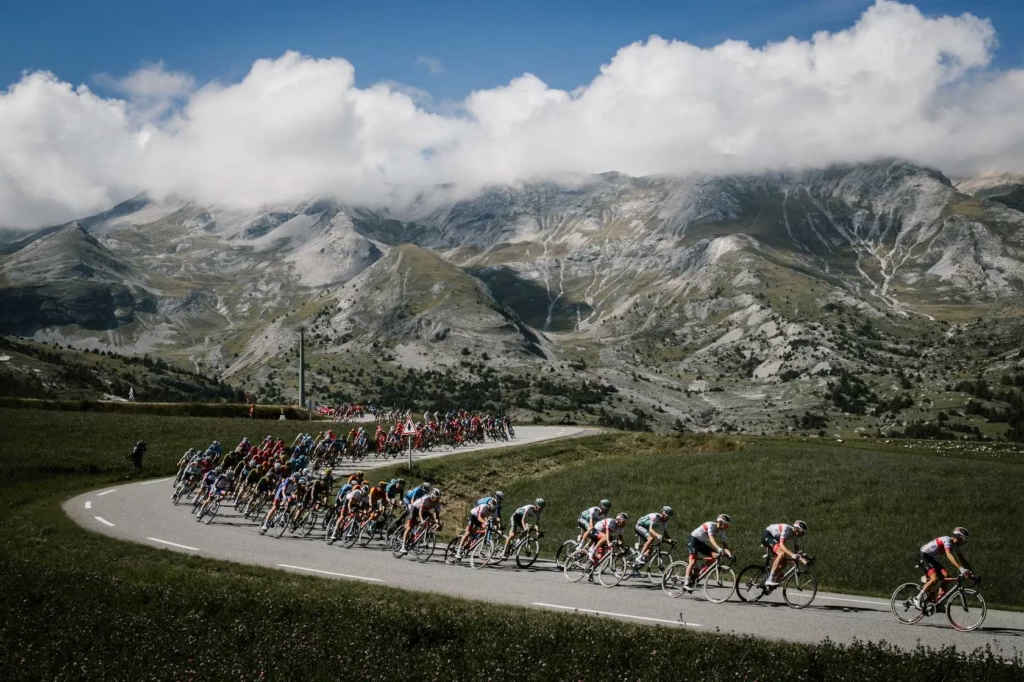 Photo Credit: A.S.O./Pauline Ballet
Why Orcières-Merlette starts the final Alpine block
Stage 18 from Voiron to Orcières-Merlette begins the final Alpine phase. It is 185.2km long, with 3,900m of climbing, and it comes after the individual time trial. Riders who lose time against the clock will arrive here needing to attack, while those who gain time may be forced into a defensive posture before the double Alpe d’Huez weekend.
The stage includes the Côte d’Engins, 11.5km at 5.4 per cent, the Côte de Monteynard, 9.7km at 5 per cent, the Côte des Terrasses, 3.4km at 6.6 per cent, and the Côte de Saint-Léger-les-Mélèzes, 2.5km at 6.9 per cent. The final climb to Orcières-Merlette is 7.1km at 6.7 per cent.
On paper, this is not as brutal as stage 20. In practice, it could still be important. The final climb is short enough for explosive riders, but long enough to punish anyone who has not recovered from the time trial. It also comes before two harder Alpine stages, so some GC teams may treat it as a pressure test rather than a full-scale mountain offensive.
The risk for the yellow jersey group is that everyone tries to save something for Alpe d’Huez, allowing a dangerous rider to gain time. Orcières-Merlette may not decide the Tour by itself, but it can change who is under pressure before the race reaches its most famous climb.
What makes Alpe d’Huez stage 19 dangerous?
The first Alpe d’Huez finish comes on stage 19 from Gap. At 127.9km, it is one of the shorter mountain stages of the race, but that makes it more explosive rather than easier. The stage includes the Col Bayard, Col du Noyer, Col d’Ornon and the final climb to Alpe d’Huez.
The Col Bayard arrives almost immediately, with 4.8km at 7.2 per cent. The Col du Noyer follows soon after, and at 7.2km at 8.5 per cent it is hard enough to make the opening phase selective. After a long middle section, the Col d’Ornon gives the race a final transition into Bourg d’Oisans before the main event.
Alpe d’Huez is officially 13.7km at 8.1 per cent on stage 19. The climb’s difficulty is familiar, but familiarity does not make it easy. The 21 hairpins create a stage built for attacks, crowds and psychological pressure. Every rider knows what an Alpe d’Huez collapse looks like, and every team knows the images can define the race.
The key point is that stage 19 is not the final mountain stage. That changes the calculation. Some riders may attack because they cannot wait. Others may hesitate because stage 20 is harder. The result could be a tense climb where the first serious acceleration forces everyone else to decide how much they are willing to risk.

Why Galibier, Sarenne and Alpe d’Huez make stage 20 the queen stage
Stage 20 from Le Bourg d’Oisans to Alpe d’Huez is the queen stage of the Tour de France 2026. It is 170.9km long, with 5,450m of elevation gain, and it comes on Saturday, 25th July, the penultimate day of the race. If the yellow jersey battle is still close, this is the stage that should decide it.
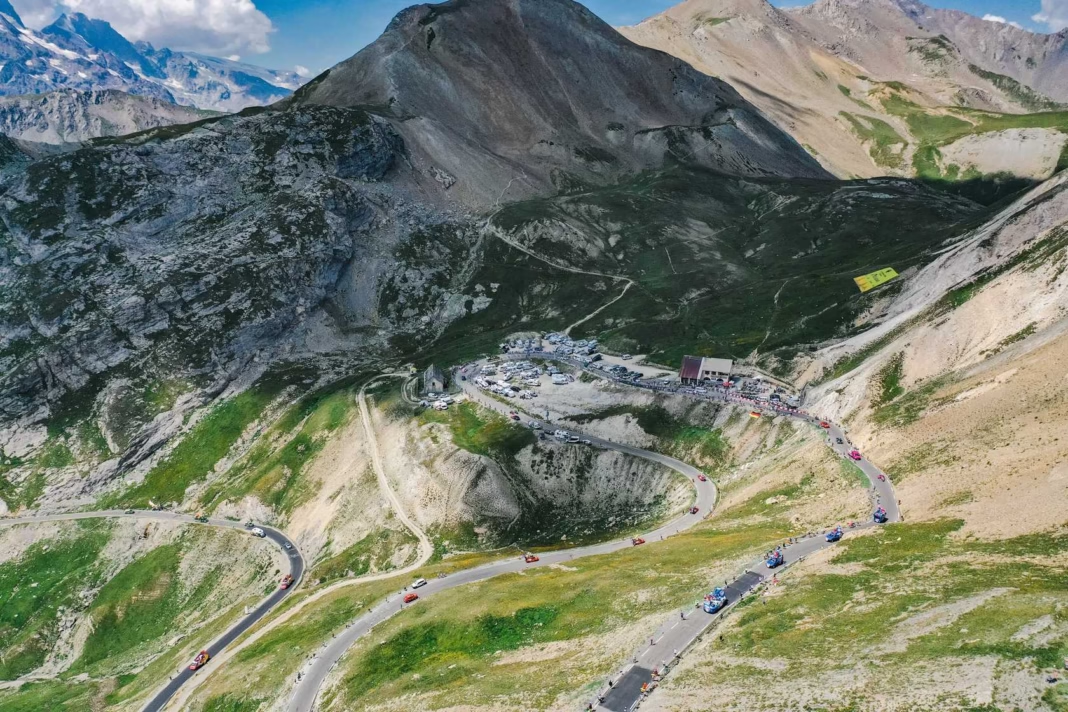
The route begins with the Col de la Croix de Fer, a 24km hors catégorie climb at 5.2 per cent. It then moves towards the Col du Télégraphe, 11.9km at 7.1 per cent, before continuing to the Col du Galibier. The Galibier is 17.7km at 6.9 per cent and reaches 2,642m, making it the highest point of the 2026 Tour.
The Galibier’s place in the stage is crucial. It is not the finish, but it is hard enough and high enough to expose riders before the final hour. Anyone already struggling there may face a long, damaging descent and then another major climb before reaching Alpe d’Huez.
The Col de Sarenne follows late, with 12.8km at 7.3 per cent. It is a rare Tour climb and will be tackled from its south-eastern side. That stops stage 20 from feeling like a simple repeat of the previous day. The race does not just roll into Bourg d’Oisans and climb the classic road. It adds another hors catégorie ascent first, then approaches Alpe d’Huez through a more complicated and draining route.
By the time the riders reach the final climb to Alpe d’Huez, there may be no hiding place left. The stage contains altitude, length, repeated climbing and the pressure of the penultimate day. For a rider chasing yellow, it offers multiple launch points. For a rider defending yellow, it offers almost constant danger.
The back-to-back Alpe d’Huez finishes are not just a nostalgic route choice. Stage 19 gives the climb its classic summit-finish drama. Stage 20 turns it into the end point of a brutal Alpine chain. Together, they make the final mountain weekend the obvious centrepiece of the race.
Which Tour de France 2026 climb is the hardest?
The hardest single climb of the Tour de France 2026 may be Plateau de Solaison if judged by sustained gradient. At 11.3km at 9 per cent, it is steeper than Alpe d’Huez and comes at the end of a long, difficult stage. It does not have the same history, but it may produce some of the biggest pure climbing gaps.
The most famous climb is Alpe d’Huez. It appears twice, on stages 19 and 20, and its position in the final weekend gives it enormous weight. The first ascent should create classic summit-finish racing, while the second comes after the Croix de Fer, Télégraphe, Galibier and Sarenne.
The most prestigious high mountain pass is the Galibier. Its altitude, history and status as the highest point of the race make it one of the defining climbs of the route. It may not be the final climb of stage 20, but it could be where the stage begins to break.
The most tactically awkward climb may be the Col du Haag. It is new to the Tour, comes late on stage 14, and sits close enough to Le Markstein to create decisive racing. Unknown climbs can change the tone of a stage because teams have fewer historical reference points and riders cannot rely on the rhythm of previous Tour visits.
The most dangerous stage sequence is probably stages 18, 19 and 20. Orcières-Merlette, Alpe d’Huez and Alpe d’Huez again create a final Alpine block where recovery becomes central. The best climber on one day may not be the best climber across all three.
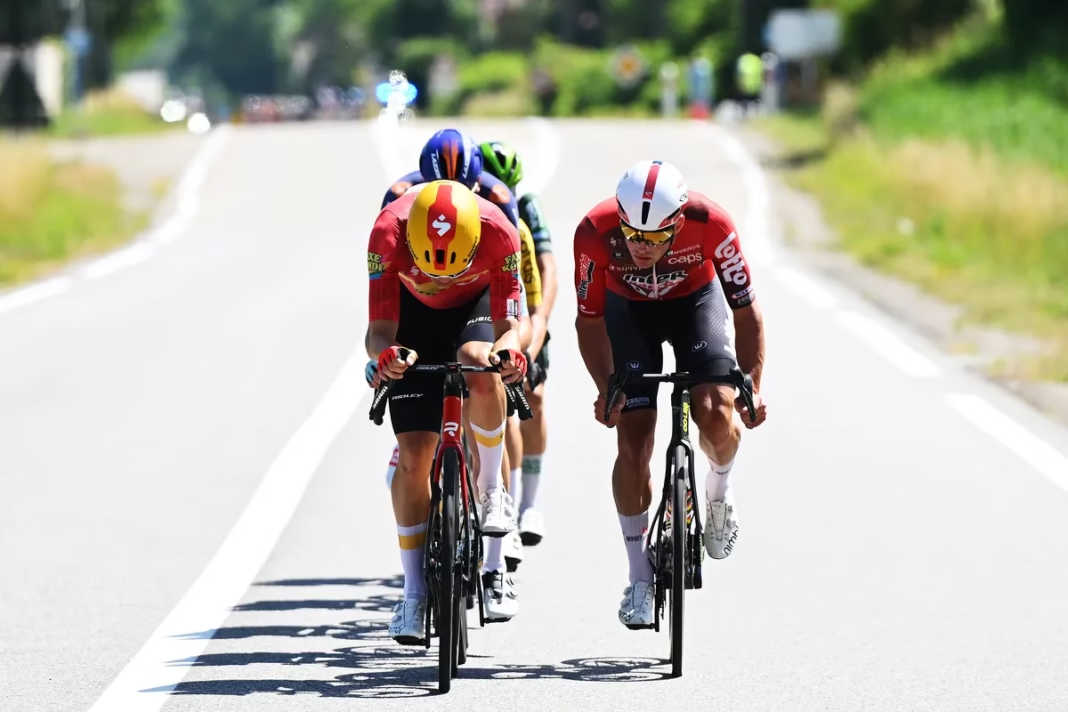
How will the climbs shape the yellow jersey?
The 2026 Tour climbs should shape the yellow jersey in phases. The early mountains around Les Angles and Gavarnie-Gèdre will identify who is ready. Le Lioran will test recovery and race craft after the first rest day. Le Markstein and Plateau de Solaison will separate the second-week contenders from those beginning to fade. Orcières-Merlette and Alpe d’Huez will decide who still has the legs to win.
This is a route where time gaps may build gradually before exploding late. A rider who loses 30 seconds at Gavarnie-Gèdre, another 40 seconds at Plateau de Solaison and more time in the stage 16 individual time trial could arrive in the Alps needing a long-range attack. Stage 20 gives the chasers enough terrain to do something bold.
For defending teams, the climb distribution is a problem. There are too many mountain days to control the entire race through one block of strength. A team may manage the Pyrenees well, then find the Vosges and Jura more awkward. Another may look strong at Plateau de Solaison, then run out of support on the Galibier.
The race may also reward riders who climb well in different ways. Gavarnie-Gèdre is long and relatively gentle. Plateau de Solaison is steep and direct. Le Lioran is rhythm-breaking. Le Markstein is tactical. Alpe d’Huez is emotional and physical. The Galibier is altitude and endurance. The winner will need more than one type of climbing strength.
Why the 2026 Tour climbs suit complete GC riders
The Tour de France 2026 is not a pure climbers’ route in the narrowest sense. The team time trial, individual time trial, hilly stages and flat days all matter. But the climbs are frequent enough and varied enough that the best GC rider will still need to be one of the strongest riders uphill.
The route favours riders who can repeat climbing efforts rather than simply produce one huge mountain performance. Stage 15 into Plateau de Solaison, stage 18 to Orcières-Merlette, stage 19 to Alpe d’Huez and stage 20 back to Alpe d’Huez all ask different questions. The rider who wins the Tour may not win all of them, but they will need to avoid a major crack on each.
It also favours teams with climbing depth. The Col du Tourmalet, Le Lioran, Col du Haag, Plateau de Solaison, Galibier and Sarenne are all places where isolated leaders can be placed under pressure. The best mountain domestiques may be as important as the leaders themselves, especially on stage 20 when the race could split long before Alpe d’Huez.
The most memorable images may come on the 21 hairpins, but the full climbing story is broader. The Tour de France 2026 climbs are not just a final-week spectacle. They are the structure of the race itself, from Les Angles in week one to the Galibier and Alpe d’Huez on the penultimate day.