
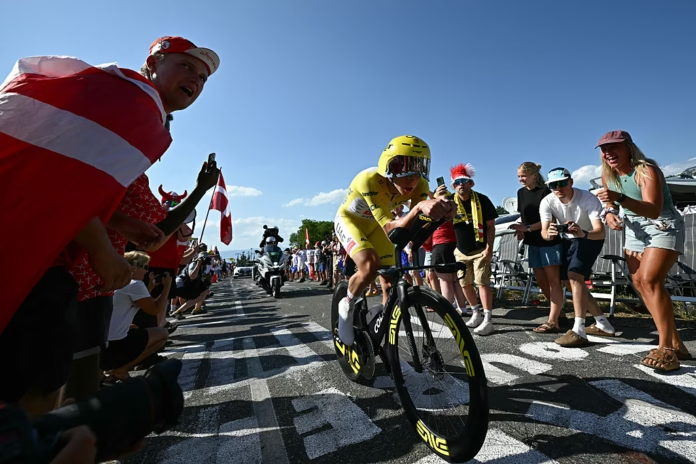
Remco Evenepoel won stage 16 of the 2026 Tour de France with a dominant ride in the individual time trial from Évian-les-Bains to Thonon-les-Bains, beating Tadej Pogačar by 28 seconds and taking his second stage win in three days.
The Red Bull-Bora-Hansgrohe rider covered the 26.1-kilometre course in 32:19, averaging 48.45km/h on a route that began with the Côte de Larringes, then dropped towards Lake Geneva before a fast final run-in. It was his 26th career time-trial victory and another reminder that, even in a Tour controlled by Pogačar, Evenepoel remains the best pure time-trialist in the race.
Pogačar finished second and retained a commanding overall lead. Mattias Skjelmose was third at 1:04 after a superb ride for Lidl-Trek, with Paul Seixas fourth at 1:16 and Isaac del Toro fifth at 1:21. Del Toro retained the white jersey by limiting his loss to Seixas to only 5 seconds.
A rare time trial in the final week
Stage 16 was the only individual time trial of the 2026 Tour, a 26.1-kilometre test between Évian-les-Bains and Thonon-les-Bains. It came immediately after the second rest day and after a dramatic stage 15, where Evenepoel won on Plateau de Solaison and Jonas Vingegaard abandoned following a crash.
The route was awkward enough to complicate the usual time-trial hierarchy. The Côte de Larringes began almost immediately, rising for 9.7 kilometres at 4.3 per cent, before a fast descent and a flatter final section towards Thonon-les-Bains. It was not a pure climber’s time trial, but it was not a straightforward power course either.
Most riders were expected to use time-trial bikes throughout. The opening climb was long, but not steep enough to justify a bike change, especially with a descent and flat run-in still to come.
That balance made the stage especially interesting. Pogačar had won the more mountainous Tour time trials in recent years, while Evenepoel had dominated the flatter ones. This course sat somewhere between the two, giving both riders reason to believe they could win.
Tarling sets the early marker
Kamil Gradek was the first rider down the start ramp, but the day’s first serious benchmark came from Josh Tarling. The British time-trial specialist was one of the earliest big names to ride and immediately set the provisional fastest time.
Tarling finished in 34:21, putting himself comfortably ahead of the early starters. Filippo Ganna, riding later for Netcompany INEOS, came close but could not beat him, finishing just under 5 seconds slower.
It was a strong early reference from Tarling, especially on a course that did not perfectly suit the biggest flatland specialists. He lost time to some riders on the climb, but his descent and final flat section were strong enough to hold the lead for a long spell.
Ganna matched Tarling almost exactly on the final flat kilometres, but the Italian had already lost time earlier, particularly on the descent from the Côte de Larringes. That left Tarling in the hot seat as the middle of the start list began to roll through.
Armirail lifts the standard
Bruno Armirail was the first rider to seriously move the benchmark. The Team Visma | Lease a Bike rider climbed strongly, descended at high speed and then held enough power to beat Tarling at the finish.
Armirail stopped the clock in 34:14, going 7 seconds faster than Tarling and 11 seconds quicker than Ganna. His ride briefly looked like one that might survive deep into the afternoon, especially after he had opened a significant gap at the summit of the Côte de Larringes.
The Frenchman’s performance was a good response for Visma after the previous day’s emotional blow of losing Vingegaard. With the team now searching for stage opportunities rather than defending a podium leader, Armirail gave them one of the day’s first notable results.
But the strongest riders were still to come. Mattia Cattaneo was next to change the race.
Cattaneo takes over for Red Bull
Cattaneo produced the first sub-34:10 ride, finishing in 34:01 to go 13 seconds quicker than Armirail. The Red Bull-Bora-Hansgrohe rider was particularly strong on the climb and held his advantage through the final section.
His time moved him into the provisional lead and also gave a useful preview of what Red Bull-Bora-Hansgrohe might do later. Evenepoel was still waiting to start, and Cattaneo’s effort confirmed that the course could reward the team’s time-trial specialists.
Felix Großschartner then came close to challenging, riding strongly for UAE Team Emirates-XRG, while Pablo Castrillo also impressed for Movistar. Thymen Arensman produced one of the stranger rides of the day, starting late and then missing Cattaneo’s time by only 5 seconds. Without that delay at the start, he would have been in contention for the provisional lead.
Arensman’s ride underlined how tight the fight below the top favourites was, even if the stage win still looked likely to come from Evenepoel or Pogačar.
Skjelmose storms into the hot seat
The GC riders began to reshape the standings once they entered the course. Tom Pidcock made a strong start, briefly going quickest at the first checkpoint, but Skjelmose then beat him by 15 seconds at the same point.
The Dane kept building from there. He was quickest at the top of the climb, then fastest again at the third checkpoint, before finishing in 33:23. That was 38 seconds faster than Cattaneo and a major ride from a rider better known for punchy climbing and stage-race consistency than pure time-trial dominance.
Skjelmose’s performance was one of the day’s best outside the top two. It also strengthened Lidl-Trek’s Tour after a race where Mads Pedersen has been fighting for green and Juan Ayuso has been part of the young rider and GC picture.
For a while, Skjelmose’s time looked good enough to hold the podium and perhaps even challenge the best. But the final two riders were still on the road, and Evenepoel was already operating on another level.
Lipowitz crashes while chasing a strong time
Florian Lipowitz had been riding well before his race was disrupted by a crash. The German was second at the third checkpoint, only 3 seconds behind Skjelmose, and looked set for a strong result in the battle behind Pogačar and Evenepoel.
Then he slid out in a corner and hit the kerb. The crash cost him heavily, both in the stage result and potentially in the wider GC fight. He eventually got back to his feet but was visibly in pain and holding his collarbone.
It was a cruel moment on a day where margins between the podium contenders mattered. Lipowitz had entered the stage fifth overall, close enough to Seixas and Del Toro for the time trial to carry real weight. Instead, the crash turned a promising ride into damage limitation.
The incident was also a reminder of how technical the course was. The climb was the obvious difficulty, but the descent and corners carried their own risk, especially for riders trying to take every possible second.
Seixas pushes Del Toro close
The white jersey battle remained one of the key subplots of the stage. Del Toro started with a 25-second advantage over Seixas, but the French teenager had the chance to put pressure on the Mexican in a discipline where pacing and confidence could make a difference.
Seixas rode a strong time trial. He was close to Del Toro through the early checkpoints, then finished fourth on the stage at 1:16 behind Evenepoel. Del Toro came in fifth at 1:21, meaning Seixas took back only 5 seconds.
That was not enough to change the white jersey. Del Toro retained the young rider lead, and with it UAE Team Emirates-XRG kept control of both yellow and white. For Del Toro, it was an important recovery after the crash and difficult final climb on stage 15.
For Seixas, the ride was still impressive. He confirmed again that his Tour is not built only on climbing instinct. He can also handle a technical time trial under pressure in the final week, even if Del Toro did enough to hold him off.
Evenepoel starts like a beast
Evenepoel was the penultimate rider to start, with Pogačar following 2 minutes later. The Belgian immediately made the race his own.
At the first checkpoint after 4.8 kilometres, he was 7 seconds quicker than Pogačar and 22 seconds faster than anyone else. At the top of the Côte de Larringes, he was even more dominant, reaching the 9.7-kilometre mark in 15:42. Pogačar was 14 seconds down, while Skjelmose was already 56 seconds behind.
That was the decisive section. Evenepoel did not simply outpace the specialists on the flat. He put time into Pogačar on the climb, where many expected the yellow jersey to be closest.
By the third checkpoint, Evenepoel was 16 seconds ahead of Pogačar and 57 seconds up on Skjelmose. The stage win was all but decided, barring a mistake in the final kilometres.
Pogačar limits the loss
Pogačar still rode a strong time trial. He had a 5-minute overall cushion over Evenepoel at the start and no need to take unnecessary risks, especially after the chaos of the previous mountain stage.
Even so, he was second at the finish, 28 seconds down. That meant Evenepoel gained time, but not nearly enough to create any real threat to yellow. Pogačar remains firmly in control of the Tour, with his advantage still measured in minutes rather than seconds.
The more telling point was that Pogačar did not have an answer to Evenepoel in this specific discipline. He has won Tour time trials before, including on mountainous routes, but this course suited the world time-trial champion’s combination of climbing speed, aerodynamics and descending control.
For UAE, the day was still a success. Pogačar kept yellow comfortably, Del Toro retained white and placed fifth, and the team avoided any significant damage despite Brandon McNulty having been knocked off his bike by a car driver during pre-stage recon. UAE confirmed McNulty was able to race and had escaped serious injury.
-
 Photo Credit: Getty
Evenepoel confirms second place momentum
Evenepoel’s win was his second stage victory in three days and another major shift in the tone of his Tour. On Plateau de Solaison, he had outwitted UAE and won from the leading GC trio. In Thonon-les-Bains, he won in the cleanest way possible: fastest from start to finish, against the clock.
He now looks firmly established as the rider most likely to finish second overall behind Pogačar. Vingegaard’s abandon opened that position, but Evenepoel has taken it through performance rather than circumstance alone.
The final week still holds more climbing, and his ability to respond to repeated attacks will be tested again. But the time trial gave him valuable confirmation. He is not just surviving the mountains and relying on the clock. He is actively shaping the podium fight.
Red Bull-Bora-Hansgrohe will also take encouragement from the day, despite Lipowitz’s crash. Cattaneo was strong, Evenepoel won, and the team now has a clear leader for the final podium push.
Stage 16 belongs to the specialists
There had been a question before the stage over whether the course was too hilly for the pure time-trial specialists or too fast for the climbers. The answer was that it still rewarded the specialists, but only those who could climb with power.
Evenepoel was in a different class. Skjelmose produced a superb ride. Cattaneo, Armirail, Tarling and Ganna all helped shape the leaderboard through the day, while Seixas and Del Toro turned in strong rides for young climbers under GC pressure.
The stage did not create a revolution in yellow, but it did sharpen the race behind Pogačar. Evenepoel strengthened second overall. Del Toro kept white. Seixas stayed close. Lipowitz lost an opportunity through a crash. Ayuso had a poor ride and slipped further away from the young rider fight.
After the mountains had changed the Tour through attack, abandonment and survival, stage 16 changed it through the clock. Evenepoel was the quickest by a long way, and nobody could argue with the result.
Tour de France 2026 stage 16 result
| Position | Rider | Team | Time/gap |
|---|---|---|---|
| 1 | Remco Evenepoel | Red Bull-BORA-hansgrohe | 32:19 |
| 2 | Tadej Pogačar | UAE Team Emirates-XRG | +0:28 |
| 3 | Mattias Skjelmose | Lidl-Trek | +1:04 |
| 4 | Paul Seixas | Decathlon CMA CGM Team | +1:16 |
| 5 | Isaac del Toro | UAE Team Emirates-XRG | +1:21 |
| 6 | Mattia Cattaneo | Red Bull-BORA-hansgrohe | +1:42 |
| 7 | Thymen Arensman | Netcompany INEOS Cycling Team | +1:47 |
| 8 | Bruno Armirail | Visma | Lease a Bike | +1:55 |
| 9 | Pablo Castrillo | Movistar Team | +2:00 |
| 10 | Joshua Tarling | Netcompany INEOS Cycling Team | +2:02 |
Main photo credit: Getty

