
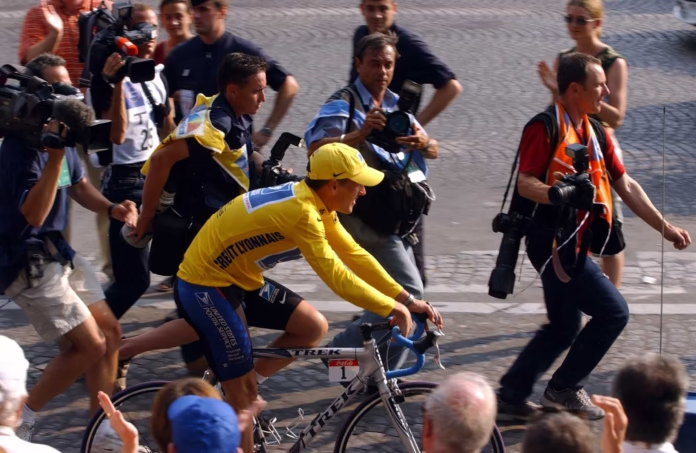
The US Postal Service Pro Cycling Team became one of the most recognisable teams in cycling history because it seemed to represent a new kind of order. It was American, methodical, commercially polished and built around a single dominant leader. At the centre was Lance Armstrong, the cancer survivor who turned the Tour de France into a yearly act of control between 1999 and 2005.
For a time, the story looked irresistible. An American team, backed by a public institution, using discipline and science to beat Europe at its own sport. Armstrong’s recovery from cancer gave the project emotional weight. Johan Bruyneel’s race management gave it tactical clarity. The blue train on the front of mountain stages gave it a visual identity. The team did not just win. It made its victories look planned.
That was the myth.
The reality, exposed years later by USADA, former teammates, investigators and the collapse of Armstrong’s public defence, was far darker. The US Postal project became inseparable from one of the most organised doping systems in cycling history. The team’s dominance, once presented as proof of marginal superiority, was later reframed as evidence of a programme built on EPO, blood transfusions, intimidation, silence and institutional failure.
The cost of that era was not only the stripping of Armstrong’s Tour de France titles. It was the damage to trust, the ruined careers around him, the hollowing-out of a sporting story that had inspired millions, and the reminder that cycling’s most marketable comeback narrative had been built on a lie.
For broader Tour context, see our brief history of the Men’s Tour de France and Tour de France winners list, both of which show how the Armstrong years now sit as a vacant, unresolved block in the race’s modern record.
 Photo Credit: A.S.O./J.C. Moreau
Where did the US Postal team come from?
The team that became US Postal did not arrive fully formed as a Tour de France superpower. Its roots were more modest, coming through the American professional scene before the United States Postal Service became title sponsor in 1996.
At first, the project was not the all-conquering machine remembered from the Armstrong years. It was a US-backed team trying to earn a place in European road racing, with riders such as Viatcheslav Ekimov and George Hincapie helping it build credibility. The team gained access to bigger races, learned the rhythms of the European calendar, and gradually shifted from American ambition to Tour de France obsession.
That American presence in European cycling had earlier foundations. The 7-Eleven team had already forced open the door for US squads at the Tour de France and Giro d’Italia, a story explored in our 7-Eleven team history. US Postal inherited some of that sense of American disruption, but used it in a very different way.
Armstrong joined the team after returning from cancer treatment, initially as a risk as much as a potential leader. He had been a world champion before illness, but his future as a Grand Tour contender was not obvious. What followed changed the team and the sport around it.
From 1999, the US Postal team became structured almost entirely around Armstrong’s Tour ambitions. Other races mattered, but July was the centre of everything. Riders were recruited, trained and deployed with one objective: deliver Armstrong to the mountains, control his rivals and win the Tour.
That focus became the team’s greatest sporting strength and, later, one of the clearest signs of how narrow and controlled the system had become.
The birth of the blue train
The phrase “blue train” became shorthand for the team’s dominance. It described the way US Postal would take command at the front of the peloton, especially in the mountains, with riders setting a suffocating tempo before Armstrong launched or simply rode his rivals into submission.
It was an image of control. Hincapie, Ekimov, José Luis Rubiera, Roberto Heras, Floyd Landis, Christian Vande Velde, Tyler Hamilton, Levi Leipheimer and others all became part of the machine at different points. The names changed, but the pattern remained familiar: Postal on the front, rivals thinning out, Armstrong waiting until the moment he wanted the race to change.
This was not the romantic version of cycling built around chaos and improvisation. US Postal made the Tour look like a controlled operation. Reconnaissance, altitude preparation, equipment, team discipline, nutrition, pacing and radio control all fed into the impression that the team had modernised Grand Tour racing.
That was partly true. The team was tactically advanced, highly organised and ruthlessly focused. But the later doping revelations make it impossible to separate that tactical superiority from the pharmacological system sitting behind it.
The blue train was both a sporting structure and a symbol. It showed how far an organised team could control the Tour. It also became the visual signature of an era where control extended beyond racing and into secrecy.
 Photo Credit: A.S.O./Bruno Bade
Lance Armstrong and the comeback story
Armstrong’s return from testicular cancer was the emotional centre of the US Postal story. It was what made the wins feel bigger than cycling. The 1999 Tour de France victory was sold, and widely received, as a story of survival, discipline and human will.
That first Tour win came at exactly the right cultural moment. Cycling was trying to recover from the Festina scandal of 1998, which had exposed the scale of doping in the peloton. Armstrong arrived as a new kind of champion, one whose story seemed to offer renewal. The sport needed a clean break. Sponsors needed belief. Fans needed a reason to trust the race again.
US Postal and Armstrong supplied that story.
The myth was powerful because it was not only about winning. It was about transformation. Armstrong was presented as a rider remade by illness, a champion whose body and mindset had been rebuilt, a man who trained harder, prepared better and wanted it more. The team around him became part of that myth: loyal, efficient, disciplined, American in its clarity of purpose.
That story travelled far beyond cycling. Armstrong became a celebrity, a foundation figure, a sponsor’s dream and a symbol for people dealing with cancer. US Postal became the team behind one of sport’s most compelling redemption narratives.
The later collapse was so damaging because the myth had reached so far outside the sport. It was not just cycling fans who felt deceived.
The Tour de France years
From 1999 to 2004, while the team was sponsored by the US Postal Service, Armstrong appeared to win six straight editions of the Tour de France. In 2005, after the team became Discovery Channel, he added what was then presented as a seventh.
On the road, the pattern was brutally consistent. Armstrong and US Postal would keep the early race controlled, survive the danger days, then use the mountains and time-trials to create decisive gaps. Some Tours were more dramatic than others, but the general architecture was stable.
In 1999, Armstrong’s win looked like a shock and a resurrection. By 2001 and 2002, it looked like domination. By 2004, it had become routine. The team had turned the Tour into a project rather than a race, one that seemed to begin months before the Grand Départ and end with Armstrong in yellow in Paris.
ProCyclingUK’s flashback to the 1999 Tour de France captures how that first victory was framed at the time: Armstrong’s return, the scale of the margin and the sense that the sport had found a new centre after the chaos of the previous year.
There were iconic performances: Sestriere in 1999, Hautacam in 2000, the Alpe d’Huez look in 2001, the recovery from crisis in 2003, and the crushing consistency of 2004. Each was folded into the mythology. Each was later re-read through the evidence of doping.
That is one of the strange afterlives of the US Postal era. The images remain famous, but their meaning has changed. They are no longer simply moments of sporting greatness. They are evidence in a larger story of manipulation, denial and control.
 Photo Credit: A.S.O./Paolo Pellizzari
Johan Bruyneel and the architecture of control
Johan Bruyneel was central to the US Postal system. As directeur sportif, he gave the team its tactical identity: controlled tempo, clear hierarchy, strict loyalty and a cold understanding of how to win the Tour.
Bruyneel’s strength was his ability to simplify racing around Armstrong’s objective. The team did not waste energy chasing every stage. It did not ride emotionally. It controlled the moments that mattered and ignored the ones that did not. That approach changed how many fans understood Grand Tour tactics.
The team’s organisation was often praised as revolutionary. In some ways, it was. US Postal made the Tour feel more planned, more data-led and more team-driven than the older model of loosely controlled alliances and individual flair. That kind of control later became a reference point for other Grand Tour machines, even if the ethical context of US Postal made its legacy uniquely compromised.
But Bruyneel’s legacy cannot be separated from the doping system later described by investigators. The same culture of control that produced tactical dominance also helped enforce silence. Riders understood the hierarchy. They understood the expectations. They understood who mattered and who did not.
USADA’s findings later placed Bruyneel among the central figures in the conspiracy. The sporting brain of the team became part of the ethical failure that defined it.
Why the myth worked
The US Postal myth worked because it joined several powerful stories together.
There was the comeback story: Armstrong surviving cancer and returning stronger than before.
There was the American story: a US team taking on and beating European cycling.
There was the science story: training, equipment, physiology and preparation replacing old-world intuition.
There was the team story: disciplined domestiques giving everything for a single leader.
There was the moral story: cycling emerging from the 1998 doping crisis with a new champion who claimed to represent a cleaner future.
Those stories reinforced each other. Doubt could be dismissed as cynicism. Critics could be framed as jealous, bitter or anti-American. Suspicious performances could be explained through preparation, weight loss, cancer survival, altitude work and superior professionalism.
The media environment helped too. Armstrong was not only a cyclist. He was a brand. He had powerful sponsors, a foundation, celebrity supporters and a public image that made direct criticism difficult. To question the performances was often treated as questioning the cancer story itself, even though those were not the same thing.
That was one of the most damaging parts of the era. The mythology protected the system. The better the story became, the harder it was to challenge.
 Photo Credit: A.S.O./Bruno Bade
The riders around Armstrong
The US Postal story is often reduced to Armstrong, but the team’s history is full of riders whose careers became entangled with the project.
George Hincapie became the loyal road captain and one of the most visible constants of the era. Tyler Hamilton and Floyd Landis left the team and later became central to the unraveling of the story. Christian Vande Velde, Levi Leipheimer, Dave Zabriskie and others eventually gave testimony or admissions that helped reveal how the system worked.
Roberto Heras was one of the most important climbing domestiques and later won the Vuelta a España while at US Postal. José Luis Rubiera, Manuel Beltrán and Viatcheslav Ekimov gave the team durability and mountain structure. The squad was never just Armstrong plus extras. It was a carefully built machine.
That matters because the doping revelations were not simply about one rider cheating. They exposed a team culture. USADA’s evidence was built in large part on testimony from former teammates and staff, showing that the system was understood internally and sustained over years.
Some riders later expressed remorse. Some gave detailed testimony. Some rebuilt parts of their lives in cycling or outside it. But the shadow remains. The US Postal era made careers, then forced many of those same careers to be reinterpreted through confession, sanction or silence.
The business of dominance
The US Postal project was also a business story.
The United States Postal Service sponsored the team from 1996 through 2004, paying for visibility, international branding and association with an American success story. Armstrong’s Tour victories made that sponsorship famous far beyond what a normal cycling team deal could have achieved.
The problem was that the sponsorship agreements required compliance with cycling’s rules, including anti-doping rules. Once the doping system was exposed, the issue was no longer only sporting fraud. It became a question of public money, contractual promises and false claims.
The US government later joined a civil lawsuit alleging that Armstrong, Bruyneel and Tailwind caused false claims to be submitted to the USPS because the team had taken sponsorship money while violating the rules. Armstrong eventually settled the case for $5 million in 2018.
That legal aftermath matters because it showed how wide the damage ran. This was not just a cyclist losing medals. A public sponsor had been used to build a brand around performances later stripped from the record. Taxpayer-funded sponsorship had become tied to one of sport’s most notorious doping programmes.
The cost of the era was financial as well as reputational.
 Photo Credit: A.S.O./Bruno Bade
How the doping system was exposed
The collapse of the US Postal myth was not sudden, even if the final fall felt dramatic. Allegations had followed Armstrong for years. Journalists, former staff, former riders and anti-doping officials had raised questions long before the official reckoning.
The problem was proof, power and fear. Armstrong repeatedly denied doping. He attacked critics. He benefited from a culture where omertà still mattered and where many riders had their own reasons not to speak. Cycling’s wider doping environment also made the truth complicated. If much of the peloton was compromised, it was harder to isolate one team’s wrongdoing without exposing the sport more broadly.
The break came through accumulated testimony and investigation rather than a single positive test. Floyd Landis’ admissions in 2010 helped push the case forward. Former teammates eventually provided sworn evidence. USADA assembled a detailed case that described not only doping use but a system of trafficking, administration, encouragement and concealment.
In 2012, Armstrong chose not to contest USADA’s charges. He was banned for life and stripped of results from August 1998 onwards. The UCI accepted the sanctions, and the seven Tour de France wins were removed from his record.
In 2013, Armstrong admitted in an interview with Oprah Winfrey that he had doped. The public confession confirmed what the evidence had already established.
What USADA revealed
USADA’s reasoned decision did not just say Armstrong doped. It described the US Postal programme as organised, professional and successful in its deception.
The evidence included more than 1,000 pages and sworn testimony from 26 people, including 15 riders with knowledge of the team’s doping activities. It detailed EPO use, blood transfusions, testosterone, corticosteroids, trafficking, administration and efforts to avoid detection.
That level of documentation changed the public understanding of the era. The issue was not a few hidden injections or isolated bad decisions. It was a team-supported system that helped create sustained Tour de France dominance.
The report also reframed Armstrong’s power. He was not simply a rider participating in a compromised peloton. He was described as a central figure in a system that encouraged, enforced and protected doping.
That distinction matters. Cycling in the late 1990s and early 2000s had a widespread doping problem. The US Postal case stood out because of the level of organisation, the public myth around the team, and the way the system was defended for so long.
 Photo Credit: A.S.O./Bruno Bade
The cost to cycling
The US Postal era damaged cycling because it turned one of the sport’s most marketable stories into a warning.
Armstrong’s victories had helped grow cycling’s audience in the United States and beyond. They brought new fans, new sponsors and new cultural visibility. Many people first encountered the Tour de France through Armstrong and US Postal. For some, that connection became a lifelong interest in cycling. For others, the collapse created permanent cynicism.
The damage was not only external. Inside the sport, the case reinforced the sense that cycling had spent years rewarding deception. Riders who doped prospered. Riders who refused faced a distorted playing field. Journalists who asked questions were attacked. Fans were asked to believe in performances that many insiders knew were not credible.
The aftermath also created a complicated legacy for anti-doping. The USADA case showed that non-analytical evidence, testimony and long-term investigation could succeed where testing alone had failed. But it also exposed how late the reckoning came. By the time Armstrong was stripped, the results had shaped careers, contracts, sponsorships and memories for more than a decade.
The truth arrived, but not in time to protect the era.
The cost to clean riders
One of the hardest questions around US Postal is what it did to riders who wanted to race clean.
Cycling in that period was not a simple world of one cheating team and one clean peloton. Doping was widespread, and many of Armstrong’s rivals were also implicated in their own scandals. That complexity is why the Tour de France titles from 1999 to 2005 were left vacant rather than handed down to the next rider on the road.
But the existence of a wider doping culture does not erase the cost to clean riders. Anyone trying to compete without EPO or blood manipulation was racing against a system that changed the physical terms of the sport. They were not just losing to talent, tactics or training. They were losing to an arms race.
The cost was not only results. It was contracts, confidence, selection, opportunity and health. Clean riders could be pushed out, pressured to conform or made to feel naïve. Young riders entering the sport learned that success might require compromise before they had fully understood the consequences.
The US Postal system did not create cycling’s doping culture on its own. But it became one of its clearest and most powerful expressions.
 Photo Credit: A.S.O./Bruno Bade
The cost to belief
The deepest cost of the US Postal era was the collapse of belief.
Sport depends on a basic agreement between rider and viewer. The viewer knows that training, tactics, genetics, luck and suffering all shape the result. The viewer also knows that sport is never perfectly fair. But there has to be enough trust for the performance to mean something.
US Postal broke that agreement on a massive scale. The team did not merely win while doping. It wrapped those wins in morality, inspiration and defiance. Armstrong did not simply deny. He attacked. He turned doubt into an enemy. He used the emotional power of his cancer survival story to reinforce a sporting lie.
That is why the era still provokes such strong reactions. Many fans did not only feel that a cyclist cheated. They felt that a story they had been invited to believe in had been used against them.
The myth-making made the eventual truth harder to absorb. It also made the lesson more lasting.
Discovery Channel and the afterlife of the team
The US Postal sponsorship ended after 2004, and the team continued as Discovery Channel from 2005 to 2007. Armstrong won the 2005 Tour under that new name, before retiring for the first time. The structure, many of the people and the wider culture remained connected to the Postal years.
Discovery’s continuation showed how much commercial value the Armstrong project still had before the collapse. Even as allegations persisted, the brand remained powerful. The team still represented American success, modern professionalism and Tour-winning expertise.
After Armstrong’s retirement, the team struggled to retain the same identity. It had strong riders, including Alberto Contador in 2007, but the central myth had always been Armstrong. Without him, the structure lost its defining purpose. Discovery Channel ended its sponsorship and the team folded after 2007.
In hindsight, that ending feels symbolic. The team had been built around a singular project. Once that project ended, and before the full truth emerged, it disappeared. What remained was not an ongoing institution, but a legacy waiting to be reinterpreted.
 Photo Credit: Collection Athletes No athletes detected. Sponsors No sponsors detected. Tags Credits A.S.O./Bruno Bade
Why US Postal still matters
The US Postal team still matters because it sits at the intersection of performance, money, media and truth.
It showed how a team could dominate the Tour through total focus and collective structure. It helped accelerate the idea that Grand Tours are won by systems as much as individuals. Modern teams still use some of the race-management principles that US Postal made famous: controlled pacing, dedicated domestiques, recon, data, equipment optimisation and year-round Tour planning.
Its influence also shaped how later teams were discussed. When ProCyclingUK’s Euskaltel-Euskadi team history contrasts the Basque team’s attacking identity with Grand Tour machines such as US Postal, Discovery, Sky and Jumbo-Visma, it shows how Postal became a benchmark for a particular kind of control. Even teams with very different cultures were measured against that model.
But US Postal also showed the danger of systems without accountability. Organisation can produce excellence, but it can also hide abuse. Loyalty can create team unity, but it can also enforce silence. Myth can inspire, but it can also protect wrongdoing.
That is why the US Postal legacy cannot be reduced to “everyone was doping” or “Armstrong was just the best of a dirty era.” Those lines are too easy. The real story is more specific and more useful. US Postal became the most successful and most damaging symbol of a broken period because it combined sporting dominance with industrial-scale deception and an almost unmatched public narrative.
It mattered because it worked so well, until it collapsed.
How should the team be remembered?
The honest answer is with discomfort.
US Postal cannot be remembered only as a fraud because the team did change the sport tactically and commercially. It helped bring new audiences into cycling, especially in the United States. It made the Tour de France feel accessible to people who had never watched it before. It professionalised parts of preparation and team control that remain part of modern racing.
But it cannot be remembered as a great team in the uncomplicated sporting sense either. Its central achievements were stripped. Its dominance was inseparable from doping. Its public story was aggressively defended long after it had become false.
The best way to remember US Postal is as a warning about the power of a perfect story. The cancer survivor. The American team. The disciplined blue train. The scientific preparation. The clean new champion after Festina. Each piece made the myth stronger. Each piece made the truth harder to accept.
Cycling has moved on, but it has not escaped the need to understand that era. The lesson is not only that doping is wrong. It is that dominance always needs scrutiny, especially when the story around it becomes too useful, too profitable and too emotionally powerful to question.
-
 Photo Credit: Cor Vos (via Radsport-News)
 -
 Photo Credit: Chris Auld
What it means for American cycling
US Postal’s collapse also complicates the wider story of American cycling.
Before Armstrong, Greg LeMond remained the defining US Tour champion, and after Armstrong’s results were removed, that became true again in the official record. ProCyclingUK’s feature on Americans at the 2025 Tour de France sets out how large that shadow still is: no American rider has officially won the Tour since LeMond in 1989.
That matters because Armstrong and US Postal created enormous interest in cycling in the United States, but they also distorted its memory. For a generation of American fans, the sport’s most visible story became both a doorway and a betrayal. It created cyclists, viewers, sponsors and ambition. It also left a gap in trust that newer American riders have had to race beneath.
The US Postal era should not erase the achievements of LeMond, 7-Eleven, Hampsten, Phinney or later American riders trying to build careers in a very different cycling world. But it does sit in the middle of that history as both explosion and contamination: the moment American cycling became globally unavoidable, and the moment its most famous success became impossible to defend.
Verdict
The US Postal team dominated cycling because it built one of the most focused Tour de France machines the sport had ever seen. It turned Armstrong’s comeback into a global story, made the blue train a symbol of control, and changed how Grand Tour teams thought about preparation and hierarchy.
But the cost was enormous. The wins were stripped. The sponsor was dragged into a legal reckoning. Teammates confessed. Fans were deceived. Clean riders were denied fair opportunity. Cycling’s credibility suffered another deep wound just when it had been trying to recover from the Festina era.
US Postal’s history is not only the story of a team that cheated. It is the story of how cheating was made believable, marketable and inspirational. That is why the era still matters. The greatest damage was not that the myth ended. It was how long the myth was allowed to win.

