
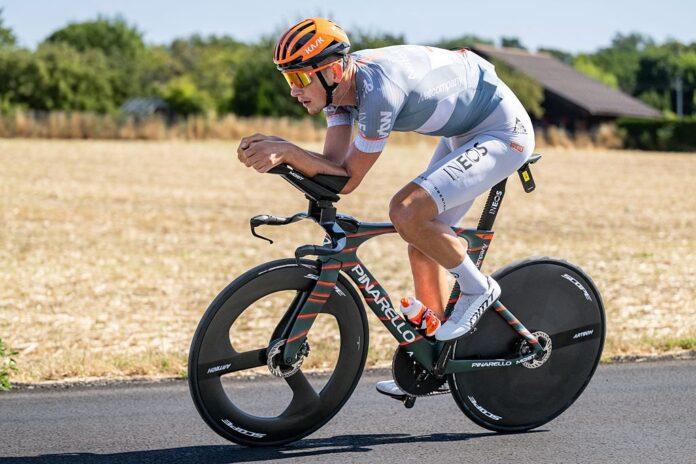
The Vuelta a España 2026 begins on Saturday 22 August with a 9.4-kilometre individual time trial through Monaco, immediately creating a battle for both the opening stage victory and the first red jersey of the race.
The course is short enough that the gaps between the main general classification contenders should remain relatively small, but technical enough that one mistake could decide the stage. The riders face repeated changes of direction, tunnels, roundabouts and accelerations on roads closely associated with the Monaco Grand Prix, making this much more than a straightforward test of aerodynamic power.
Joshua Tarling starts as the rider to beat, with Wout van Aert the clearest challenger and Tadej Pogačar capable of winning outright while also taking the first seconds from his GC rivals. Stefan Küng, Ethan Hayter and Jay Vine belong in the next group of serious stage contenders, while riders such as Iván Romeo and João Almeida could also produce very strong times.
The wider Vuelta a España 2026 route guide shows why the opening time trial matters despite its short distance. The race reaches Font-Romeu on Stage 3 and Andorra a day later, so anyone losing 15 or 20 seconds in Monaco has almost no gentle introductory period in which to recover.

Vuelta a España Stage 1 route
Date: Saturday 22 August 2026
Start and finish: Monaco
Distance: 9.4km
Stage type: Individual time trial
Prize: Stage victory and first red jersey
GC importance: Medium
The Vuelta begins around Casino Square before moving onto the streets of Monaco and sections familiar from Formula 1. The riders repeatedly have to brake, corner and accelerate rather than simply settle into a long aerodynamic effort.
That distinction is central to understanding the stage.
At 9.4 kilometres, there is not enough distance for a conventional specialist to recover substantial time after a mistake. Losing momentum through one hairpin or being too cautious through a technical sequence could cost several seconds, which may be enough to separate first from fifth.
The beginner’s guide to the Vuelta a España 2026 also highlights the Monaco opener as a particularly technical Grand Départ, with course knowledge and precision likely to matter almost as much as sustained power.
Monaco is not a conventional specialist’s time trial
The basic numbers make Stage 1 look simple. It is short, largely urban and unlikely to create anything approaching decisive GC gaps.
The actual racing should be much more complicated.
There are few prolonged sections where the best time triallists can simply sit at threshold and let their aerodynamics do the work. Riders need to repeatedly accelerate back to speed after corners, carry momentum through tunnels and judge braking points accurately on a course where taking slightly too much risk can be as damaging as taking too little.
That opens the contest beyond the conventional long-distance time trial specialists.
Raw power still matters, but so do bike handling, acceleration and the ability to produce repeated short bursts without allowing the overall effort to fall apart.
Wout van Aert is the most obvious example. Over a long, flat 40-kilometre time trial, Tarling or Küng might expect their specialist qualities to become increasingly important. Over nine technical kilometres in Monaco, Van Aert’s ability to corner and accelerate becomes much more valuable.
Joshua Tarling starts as the clear favourite
Joshua Tarling has the strongest overall profile for the opening stage.
The British specialist combines enormous sustained power with enough technical ability and acceleration to make a short course like Monaco especially attractive. At only 22, he already has a European elite time trial title and a Grand Tour stage victory against the clock from the 2025 Giro d’Italia.
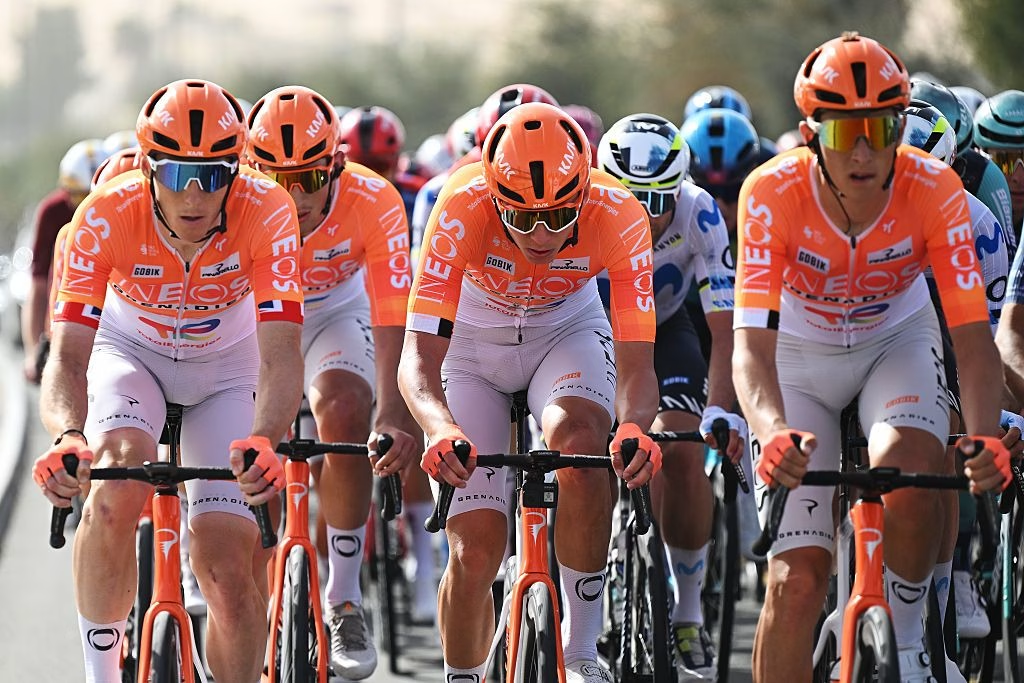
Netcompany INEOS also have no reason to restrict him on Saturday. Oscar Onley begins the race with the team’s main GC ambitions, but an individual time trial allows Tarling to ride entirely for himself while Onley focuses on limiting losses to Pogačar and the other overall favourites.
Victory would give Tarling more than another Grand Tour stage. It would also put him into the first red jersey of the 2026 Vuelta, immediately making him one of the central figures of the Monaco Grand Départ.
The circumstances surrounding his participation, however, make this much more than an ordinary sporting target. Tarling is starting the Vuelta shortly after the death of his younger brother Finlay Tarling, and the opening time trial will inevitably carry enormous personal significance for him and his family.
There is no sensible way to predict how grief of that scale affects a rider physically or emotionally, and it should not be turned into a sporting narrative about motivation. Tarling starts as favourite because of his ability against the clock and the nature of the course. The wider context simply makes Saturday a profoundly difficult day beyond the stopwatch.
Tarling is also part of a particularly strong British presence at this Vuelta, with Netcompany INEOS selecting Onley and Ben Turner alongside him and Ethan Hayter providing another major British time trial threat elsewhere in the field.
Wout van Aert is Tarling’s biggest threat
Wout van Aert looks like the strongest direct challenger.
The Monaco course rewards precisely the qualities that make Van Aert difficult to classify purely as a time triallist. He has the aerodynamic power required for the faster sections, but also possesses elite bike handling and repeated acceleration.
Over such a short distance, that combination can be decisive.
Van Aert does not need to match Tarling kilometre for kilometre through a long sustained effort. He needs to minimise any power disadvantage while gaining fractions of a second through technical sections and faster corner exits.
Team Visma | Lease a Bike also begin the Vuelta with several possible stage-winning routes, including Matthew Brennan for the sprint and selective days and Ben Tulett as a potential GC outsider. Stage 1 is much simpler tactically: Van Aert can ride entirely for the win.
If Tarling makes one significant technical mistake, Van Aert is the rider best positioned to exploit it.
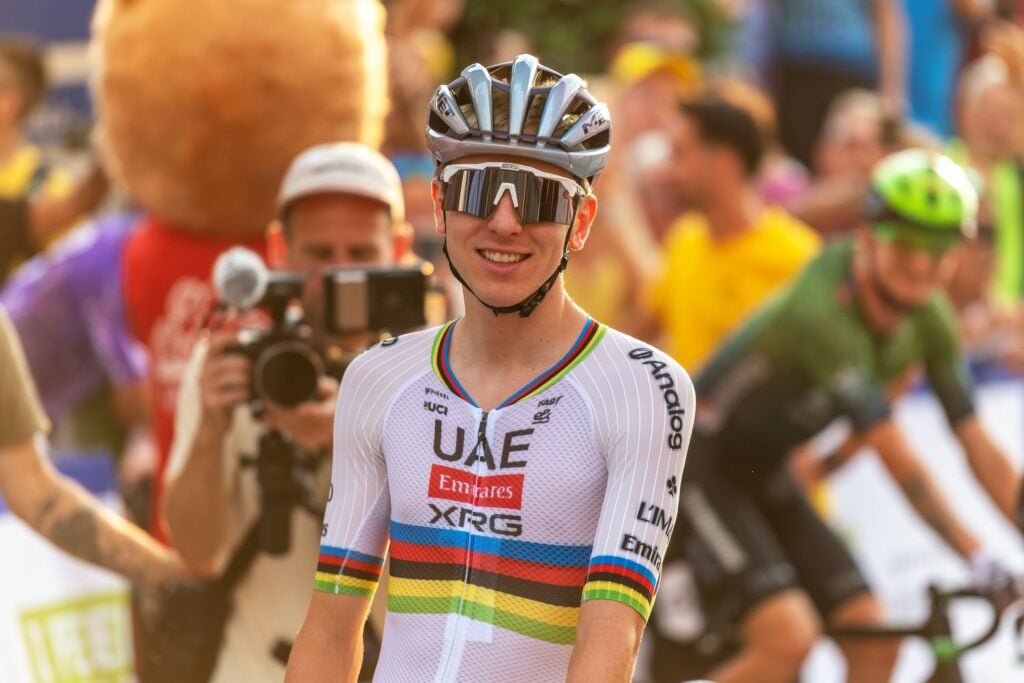
Tadej Pogačar can start winning the Vuelta immediately
Tadej Pogačar does not need to win Stage 1 for Saturday to become an excellent day.
The UAE Team Emirates-XRG leader begins the Vuelta as the clear overall reference after winning his fifth Tour de France and now has the opportunity to complete his set of Grand Tour victories.
The Vuelta a España 2026 contenders preview explains why the route suits him so well, and Monaco provides the first example. Pogačar is now one of the strongest GC time triallists in the sport and the short, technical course should reward his acceleration more than a completely flat specialist’s test would.
The stage win is therefore realistic.
More important are the riders around him.
Pogačar will be interested in the times of João Almeida, Primož Roglič, Mattias Skjelmose, Oscar Onley and every other rider harbouring serious GC ambitions. A handful of seconds here will not decide the Vuelta, but those seconds become immediately useful with Font-Romeu and Andorra arriving within the opening four stages.
For the riders trying to beat him overall, the ideal result is not necessarily winning the stage. It is preventing Pogačar from already establishing another advantage before the mountains begin.
Stefan Küng remains a major stage-winning threat
Stefan Küng belongs in any serious discussion of an opening time trial like this.
His sustained power and aerodynamic efficiency make him one of the most accomplished specialists in the field, although Monaco is not the perfect version of a Küng course.
The distance is short and the technical sections reduce the amount of time available for him to use his greatest strength: holding enormous power in a stable aerodynamic position.
That does not make him a secondary contender.
Küng still has enough technical ability to produce an excellent ride, and if he can carry momentum effectively through the Monaco corners he has the raw speed required to challenge Tarling and Van Aert.
This should be one of his clearest opportunities for a Vuelta stage victory.
 Photo Credit: Getty
Ethan Hayter gives Britain another genuine chance
Ethan Hayter gives Britain another realistic route towards the Stage 1 podium.
The Soudal Quick-Step rider has the time trial pedigree and raw power required for a short test, while his track background makes repeated accelerations particularly relevant.
Monaco arguably suits him better than a much longer Grand Tour time trial would.
Hayter does not need to sustain a specialist effort for 35 or 40 kilometres. Instead, he needs to combine power with technical accuracy for little more than ten minutes.
That places him much closer to the strongest riders.
His broader Vuelta opportunities will also extend beyond the time trials because he can sprint from reduced groups and contribute on selective terrain, but Saturday is one of the stages where his physical profile gives him a genuine chance of winning rather than simply supporting others.
Jay Vine can no longer be treated as only a climber
Jay Vine is another rider whose ability against the clock has developed enough that his presence near the front of the Stage 1 results would not be a surprise.
The Australian is still primarily associated with climbing, but his time trialling has improved substantially and the slight changes in gradient around Monaco should suit him better than a perfectly flat power course.
The short distance may limit one of his advantages because there is less time to settle into a sustained high-threshold effort, but he still has the power and aerodynamic position required for a strong result.
Within UAE, there is no tactical conflict. Pogačar and Almeida have GC priorities, but the individual format allows Vine to chase his own result.
A top-five ride is entirely realistic.

Iván Romeo is one of the most interesting outsiders
Iván Romeo deserves attention as one of the riders capable of disrupting the obvious hierarchy.
The Movistar rider has developed into an excellent young time triallist and possesses exactly the type of power required for a short, technical test.
Romeo does not carry the same Grand Tour reputation as Tarling, Van Aert or Küng, but his progression against the clock means a very high placing should not be considered a surprise.
There is also an early tactical benefit for Movistar if he rides well.
A strong Stage 1 can place Romeo high in the overall classification before the road stages begin, potentially giving the team another option alongside its primary GC plans during the opening week.
João Almeida has an important GC test
João Almeida is one of the riders for whom Stage 1 matters more in GC terms than as a realistic all-or-nothing stage target.
The UAE rider is an excellent time triallist and should be capable of producing one of the strongest performances among the overall contenders.
That matters because his role behind Pogačar does not necessarily mean sacrificing his own classification immediately.
A strong ride in Monaco keeps Almeida high in the standings and gives UAE another rider rivals need to respect when the race reaches the mountains.
The Vuelta contenders preview explains why UAE’s depth can become tactically important across three weeks. Keeping Almeida close after the opening time trial only strengthens that position.
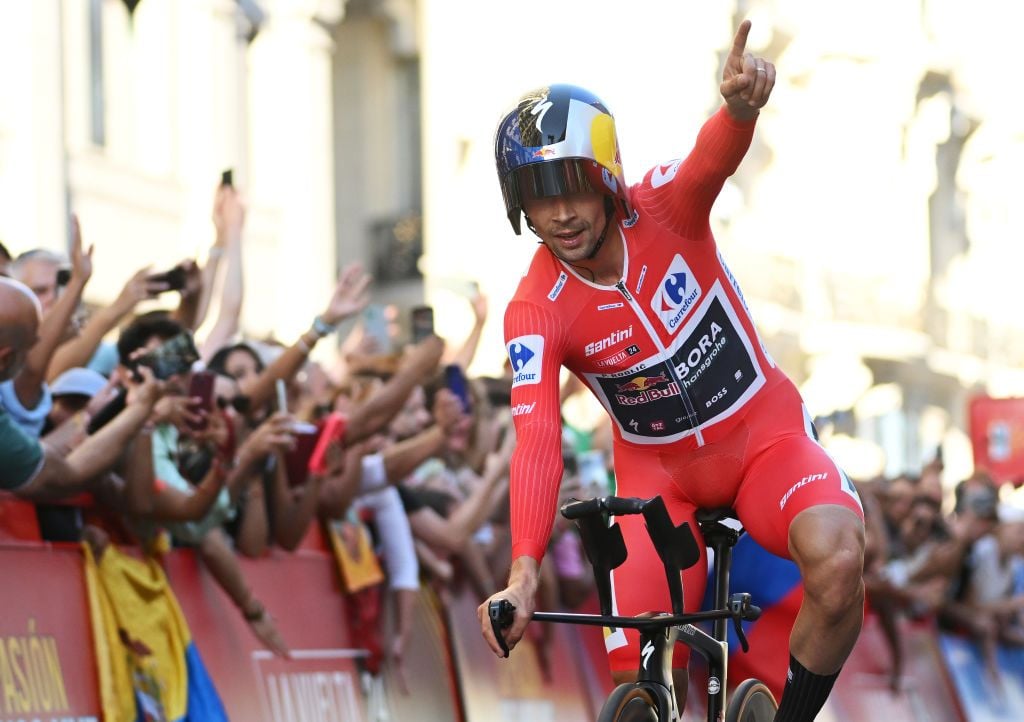
Primož Roglič is still dangerous over nine kilometres
Primož Roglič remains difficult to ignore despite the uncertainty surrounding his wider Vuelta ambitions.
Red Bull-BORA-hansgrohe have downplayed the idea that Roglič begins the race with a conventional red-jersey campaign, but that does not remove his ability against the clock.
The short Monaco test may actually suit him well.
Roglič has always combined excellent time trialling with explosive power, and the repeated accelerations are more favourable than a long, completely flat specialist’s course would be.
The bigger question is how aggressively he wants to take the technical sections after a season interrupted by physical setbacks.
A strong result would still immediately place him prominently in the early classification and provide one of the first indications of his actual condition.
Mads Pedersen has the power to challenge the specialists
Mads Pedersen is not a rider who would normally appear near the very top of a long Grand Tour time trial preview, but Monaco changes the calculation.
Nine kilometres places a much greater premium on raw power and acceleration.
Pedersen has both.
The Lidl-Trek rider can produce enormous short-duration power and recover from repeated accelerations better than many heavier sprinters, making him a legitimate contender for a high placing.
He still needs to be technically precise enough to avoid giving away too much through the corners, but the course is short enough that his Classics and sprinting attributes become highly relevant.
Ben Turner could give INEOS another strong result
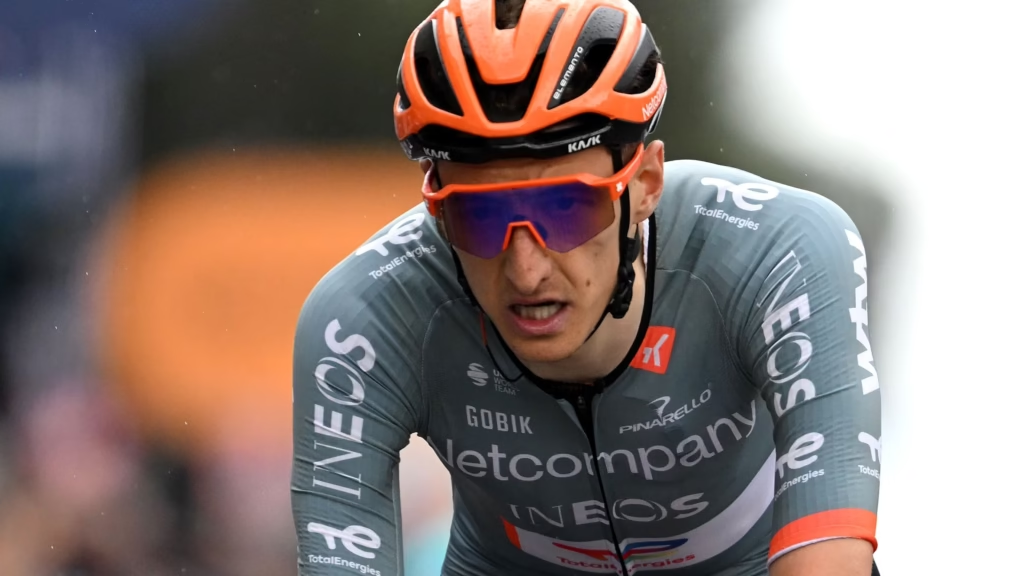
Ben Turner adds another British name to the wider Stage 1 picture.
He does not possess Tarling’s specialist pedigree, but his Classics power and repeated acceleration make Monaco considerably more suitable than a conventional long time trial.
Turner’s primary role during the Vuelta will revolve around supporting Oscar Onley’s GC challenge and taking opportunities on rolling stages. Saturday therefore provides a relatively rare moment where he can simply ride for his own result without conflicting with the team’s broader strategy.
A top-10 ride would represent an excellent start.
More importantly for INEOS, Tarling, Turner and Onley give the team three different reasons to approach the opening stage seriously: Tarling for victory, Turner for a strong individual result and Onley for the GC clock.
Oscar Onley has to limit the damage
For Oscar Onley, Stage 1 is not about beating Tarling.
It is about starting his GC campaign cleanly.
Onley enters the Vuelta as Netcompany INEOS’ principal overall leader after rebuilding his season following the shoulder injury that kept him out of the Tour de France.
His climbing form heading into Spain has been encouraging, but the Monaco time trial represents the first place where he can either gain confidence or create unnecessary work for himself.
Losing a handful of seconds to Pogačar is manageable.
Losing 20 or 30 would immediately increase the pressure before the first mountain stages.
The short distance should help him, while the technical course gives a strong bike handler the chance to limit the advantage enjoyed by the pure specialists.
The first red jersey could be decided by less than a second
Everything about Stage 1 points towards extremely small margins.
Nine kilometres provides very little opportunity to compensate for an error. A poor line through one hairpin, slightly excessive braking or one slow acceleration can decide several positions.
That makes reconnaissance particularly important.
Teams will have studied where riders can remain in the aerodynamic position, where they need to brake and which corners reward aggression rather than caution.
The first red jersey may therefore be decided by something almost invisible on television.
A rider does not need to be dramatically faster.
They need to make fewer tiny mistakes.
What Stage 1 means for the GC
The time gaps should remain relatively small, but that does not make them irrelevant.
Pogačar has an opportunity to take time from several mountain specialists immediately, while riders such as Almeida, Skjelmose and Onley need to make sure he does not gain a meaningful advantage before the race has even left Monaco.
The full Vuelta a España 2026 route guide makes the sequencing especially important. The peloton reaches Font-Romeu on Stage 3, Andorra on Stage 4 and Valdelinares later in the opening week.
There is very little room for a GC contender to slowly ride themselves into the race.
Stage 1 therefore provides the first information about form even if it does not decide anything by itself.
Who wins Vuelta a España 2026 Stage 1?
Joshua Tarling starts as the favourite. His combination of specialist time trial power, technical ability and short-course speed gives him the strongest sporting case for victory and the first red jersey.
Wout van Aert is the clearest challenger because the twisting Monaco route plays directly towards his bike handling and repeated acceleration.
Tadej Pogačar is the most dangerous rider beyond that pair. He can win the stage outright, but even finishing a few seconds behind the specialists while taking time from his GC rivals would represent an ideal beginning to the Vuelta.
Stefan Küng remains one of the strongest pure specialists, while Ethan Hayter and Jay Vine have realistic podium ambitions. Iván Romeo, Mads Pedersen, João Almeida and Primož Roglič belong in the next group, with Ben Turner, Ivo Oliveira, Mattias Skjelmose, Christophe Laporte and Bruno Armirail all capable of producing strong times.
The hierarchy can change quickly over such a short course, but Tarling is the rider everyone else needs to beat.
For him, the significance of Saturday inevitably extends beyond the stage result. He arrives at the Vuelta as one of the best young time triallists in the world and the favourite for the opening red jersey, while also racing only a short time after the death of his younger brother Finlay.
Whatever happens on the clock, that context will make Tarling’s ride one of the most closely watched and deeply personal moments of the opening day.

