Stage 13 of the 2026 Vuelta a España could be one of the most difficult days of the race to predict. It contains more than 3,200 metres of climbing and a Category 1 ascent inside the opening 32km, yet the final classified climb is over with 37km still remaining and the approach to Loja becomes progressively easier.
That combination gives almost everybody a reason to race. Strong climbers and rouleurs can target the breakaway, riders such as Wout van Aert, Thibau Nys and Magnus Cort can believe they are capable of surviving the climbing, while teams with more conventional fast finishers have to decide whether spending several hours controlling such an aggressive stage is worth the effort.
The timing matters too. Friday’s 192.8km stage follows the major Calar Alto mountain finish and comes immediately before another general classification battle on Sierra de La Pandera. Riders fighting for the Vuelta are unlikely to want an unnecessary war on the road to Loja unless somebody dangerous forces one upon them.
Race director Fernando Escartín’s assessment neatly captures the problem: “Será difícil de controlar”. It will be difficult to control. The first half provides ideal terrain for creating a strong breakaway and the second gives the peloton just enough opportunity to bring it back.
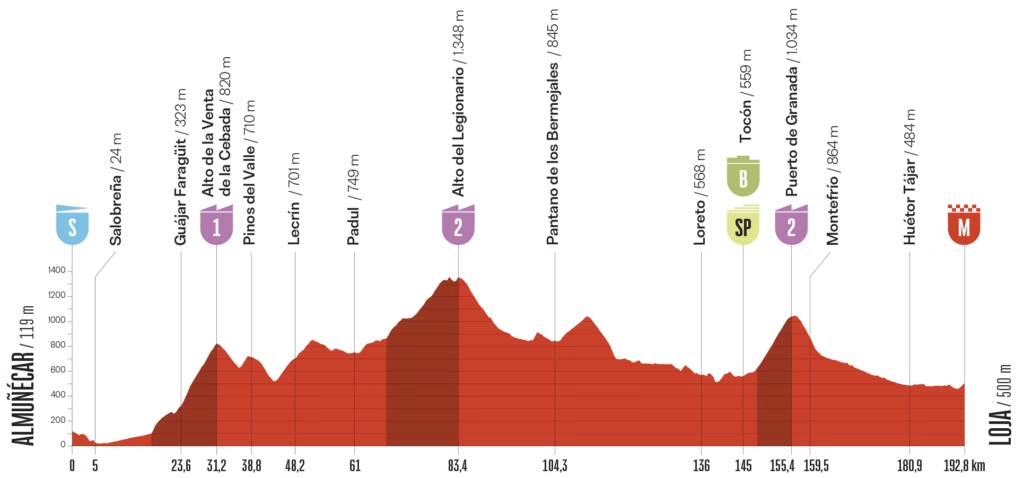
Vuelta a España 2026 Stage 13 at a glance
| Detail | Stage 13 |
|---|---|
| Date | Friday 4 September 2026 |
| Start | Almuñécar |
| Finish | Loja |
| Distance | 192.8km |
| Stage type | Medium mountain |
| Elevation gain | Around 3,277m |
| Categorised climbs | 3 |
| Venta de la Cebada | 14.1km at 5.1%, Category 1 |
| Alto del Legionario | 15.4km at 3.1%, Category 3 |
| Puerto de Granada | 7.4km at 5.6%, Category 2 |
| Final climb summit | 37.4km from finish |
| Neutralised start | 11:20 BST |
| Racing start | Around 11:41 BST |
| Expected finish | Around 16:16-16:45 BST |
The official route starts on the Mediterranean coast in Almuñécar before turning inland after approximately 16km. The Venta de la Cebada immediately changes the character of the race, followed by a succession of rolling roads, the long Alto del Legionario and finally the Puerto de Granada. From there, the riders descend towards Loja before approximately 12km of much flatter roads complete the stage.
The first 30km could decide the entire stage
There is a short opportunity to settle after leaving Almuñécar.
It probably will not last.
The race follows the coast through Salobreña before turning north towards Los Guájares after 16.6km. Just 500 metres later, the first major ascent begins.
That positioning is almost perfect for producing an extremely aggressive breakaway fight. Riders can attack on relatively fast roads beforehand, but anybody who fails to establish a meaningful gap immediately reaches a Category 1 climb.
The important point is that there are numerous riders for whom Stage 13 represents an obvious opportunity. The pure climbers know they can use the difficult opening to eliminate faster riders. Classics specialists know there is enough easier terrain later to make the finish achievable. Teams without a stage victory will see one of the best remaining chances to attack without having to beat the GC favourites on a summit finish.
The result could be an opening hour where the first break, second break and perhaps several more attempts are all brought back.
Venta de la Cebada gives the breakaway its launchpad
The Venta de la Cebada measures 14.1km at 5.1%, beginning after 17.1km and reaching its summit after 31.2km.
It gains 722 metres in altitude before topping out at 820 metres.
A 5.1% average is not frightening enough to separate the main GC contenders, but that is almost irrelevant here. The climb’s significance comes from its position.
If 20 riders attack onto the lower slopes, the peloton cannot simply allow everyone to ride away without checking the composition. A rider sitting six or seven minutes down overall could immediately make Movistar or another GC team uncomfortable, while Visma | Lease a Bike, Lidl-Trek, Uno-X Mobility and several stage-hunting teams may all want somebody represented.
That creates the classic Grand Tour breakaway problem. Every strong team wants a rider ahead, but once almost every strong team has one there is nobody left with an incentive to chase.
Should that happen on Venta de la Cebada, Stage 13 could effectively become two separate races before the first third of the route is complete.
The road never really becomes easy after the first climb
There is a danger in looking only at the three officially categorised ascents.
Venta de la Cebada is followed by more climbing around Pinos del Valle and Albuñuelas before the race eventually reaches Padul. The profile repeatedly rises and falls rather than providing a long valley where the peloton can settle into a predictable chase.
That matters enormously for riders such as Matthew Brennan or Jordi Meeus.
Neither needs to be completely dropped on one official climb to lose the opportunity to contest the finish. Repeated accelerations, small uncategorised climbs and a high pace across the rolling sections can gradually make the stage too expensive.
For Van Aert, Nys and Cort, those same roads are considerably more manageable.
They do not need a flat transition to survive. In fact, a harder first half can improve their chances by removing the fastest riders while leaving them capable of contesting the finish themselves.
Alto del Legionario continues the attrition
The second classified ascent begins after 67.8km.
Alto del Legionario measures 15.4km at an average of only 3.1%, reaching 1,348 metres at kilometre 83.4. It gains around 490 metres in altitude.
Again, the average disguises its tactical value.
A climb lasting more than 15km creates plenty of opportunity for the breakaway to fragment, especially if somebody is dissatisfied with the size of the group. Riders who have spent the opening 60km repeatedly attacking may also discover that a relatively moderate gradient suddenly feels considerably harder.
For the peloton, Legionario creates a difficult decision.
Controlling a breakaway here means asking domestiques to ride for kilometres uphill, potentially after already working hard to keep the opening attacks under control. Letting the gap expand makes the later chase much more difficult.
It is exactly the type of terrain where a break that held two minutes can suddenly have five.
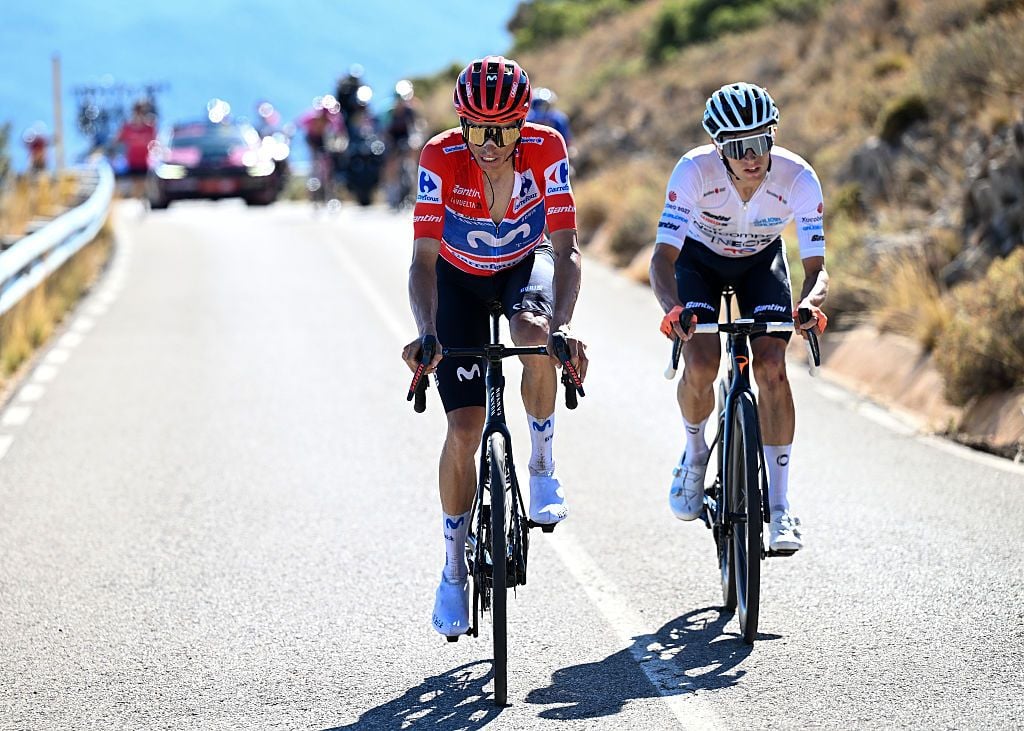 Photo Credit: Getty
The GC teams have very little reason to control for the stage win
Stage 13 comes between Calar Alto and Sierra de La Pandera.
That may ultimately prove more important than any individual gradient.
Enric Mas, Primož Roglič, Felix Gall, Oscar Onley and the other overall contenders have another major summit finish waiting on Saturday. None gains much from spending Friday asking their teams to chase a group of riders already well outside the general classification.
If a harmless break gets six minutes, the obvious response is to let it go.
Movistar’s main responsibility is protecting the red jersey from anybody close enough to become dangerous. Once the escape contains only riders a comfortable distance down overall, forcing teammates to defend a stage victory makes little strategic sense.
The same applies to Red Bull-Bora-Hansgrohe, Decathlon CMA CGM and Netcompany INEOS.
Their resources are more valuable on La Pandera.
That significantly increases the probability that Stage 13 goes to the breakaway.
Puerto de Granada is the final opportunity to get rid of the fast men
The last classified climb begins after 148km.
Puerto de Granada measures 7.4km at 5.6%, gaining 415 metres before reaching its summit at kilometre 155.4. There are still 37.4km remaining.
For riders trying to beat Van Aert, Nys or Cort, this is the obvious attacking point.
Taking those riders to Loja is dangerous. Even if they have already spent much of the day in a breakaway, relatively few climbers or rouleurs will want to arrive in a group of ten containing one of the race’s strongest finishers.
The climbing specialists therefore need to use Puerto de Granada properly.
One attack near the summit may not be enough. A sustained sequence of moves from the lower slopes could force the faster riders to repeatedly close gaps, gradually reducing their ability to sprint even if they survive.
The problem is what happens afterwards.
Nearly 40km remain after the final climb
Puerto de Granada tops out with 37.4km left.
That gives dropped riders a substantial route back into the race.
There is an initial descent through Montefrío before the route continues gradually downhill towards Huétor-Tájar. The final 12km are substantially flatter, meaning a coordinated chase can regain significant time.
This changes the calculation on the final climb.
A rider who attacks and gains 15 seconds cannot assume the stage has been won. A group containing Van Aert, Cort or Nys may have every reason to cooperate behind.
Equally, somebody who is briefly distanced on Puerto de Granada should not immediately abandon the chase. If they can limit the deficit over the summit, the terrain begins favouring them almost immediately.
Stage 13 could therefore produce one of those unusual Vuelta finales where the decisive question is not who climbs fastest but who can preserve enough cooperation once the climbing has finished.
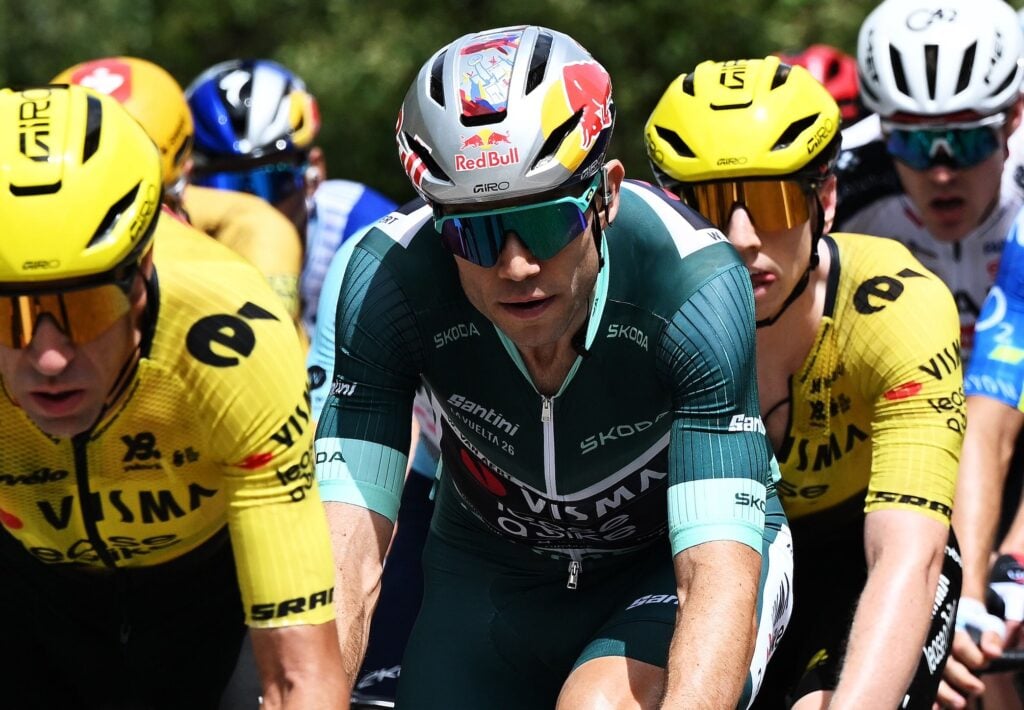 Photo Credit: Getty
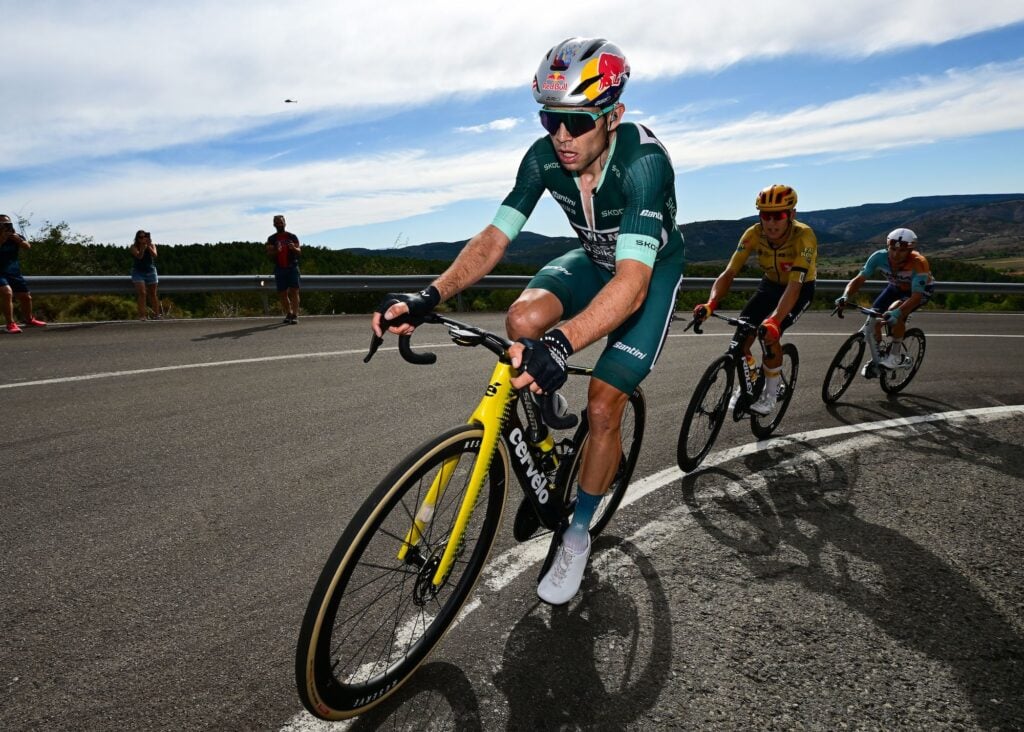
Wout van Aert has another very good opportunity
Few riders fit Stage 13 as naturally as Wout van Aert.
The Belgian has already demonstrated throughout this Vuelta that he can remain involved deep into difficult stages. He finished fourth behind Bastien Tronchon, Magnus Cort and Thibau Nys on the uphill Stage 10 finish and has subsequently continued strengthening his position in the points classification.
The route to Loja gives him options.
Visma do not necessarily need to control the entire stage for him. Van Aert can try to infiltrate the break himself, particularly if the opening fight continues onto Venta de la Cebada. Christophe Laporte gives the team another strong rider capable of entering moves, while Matthew Brennan provides an alternative if the race unexpectedly remains more controlled.
Van Aert’s greatest problem may actually be his reputation.
Nobody wants to tow him for 30km towards a sprint.
If he reaches the top of Puerto de Granada with the leading group, he can expect almost every other rider to attack him.
Thibau Nys has exactly the finish required
Thibau Nys is another rider who should immediately recognise Stage 13 as an opportunity.
His third place on Stage 10 demonstrated that his climbing and finishing combination is already working well in this Vuelta.
Nys does not need the route to become easy. Quite the opposite.
A hard opening improves his position relative to most sprinters. If Venta de la Cebada and Alto del Legionario remove the riders who are faster than him on completely flat roads, the Belgian becomes one of the quickest riders left.
His challenge is reaching the correct race.
If the winning break leaves without Lidl-Trek representation, chasing it back may require more work than the team wants to invest before La Pandera.
Getting Nys into the break could therefore be considerably more valuable than trying to manufacture a reduced bunch sprint.
Magnus Cort has already shown his condition
Magnus Cort finished second on Stage 10 and remains one of the most dangerous riders whenever a Grand Tour stage sits somewhere between a mountain day and a sprint.
Stage 13 sits firmly in that territory.
Cort can climb well enough to survive the moderate gradients, descend effectively and finish quickly from a reduced group. Uno-X Mobility have already enjoyed a hugely successful Vuelta with Andreas Leknessund’s victory on Valdelinares, meaning the team can race aggressively rather than feeling obliged to protect one particular outcome.
Cort does not need a group of 50 reaching Loja.
A break of eight or ten may suit him even better.
Axel Laurance and Ethan Hayter suit an unpredictable race
Axel Laurance is particularly dangerous if the breakaway is large.
His punch and fast finish mean he does not require a conventional sprint, while the opening climbing is unlikely to discourage him from attacking.
Ethan Hayter offers a similar combination from a slightly different direction. He has enough speed to punish a hesitant group but is also comfortable spending a stage on the attack rather than waiting for a perfectly organised finish.
Both riders benefit if the race becomes complicated.
The more obvious Van Aert, Nys and Cort become as favourites, the more opportunities there are for somebody else to use them tactically.
If three major favourites spend the final 25km looking at one another, a rider such as Laurance needs only one moment of hesitation.
Christophe Laporte gives Visma another route towards victory
Christophe Laporte is perhaps one of the most interesting tactical riders on the stage.
Visma | Lease a Bike already have Van Aert and three-time stage winner Matthew Brennan available, but Laporte provides an entirely different option.
Instead of committing the team to chasing, Visma can place Laporte in the break.
That immediately shifts responsibility elsewhere. Rival teams cannot simply force Van Aert’s teammates to work all afternoon if one of Visma’s strongest Classics riders is already at the front.
It could also create a difficult situation late in the race.
If Laporte remains ahead while Van Aert sits in a chasing group behind, Visma have no reason to contribute. Everyone else then has to decide which of the two they would rather race against.
That depth makes Visma particularly difficult to handle on Friday.
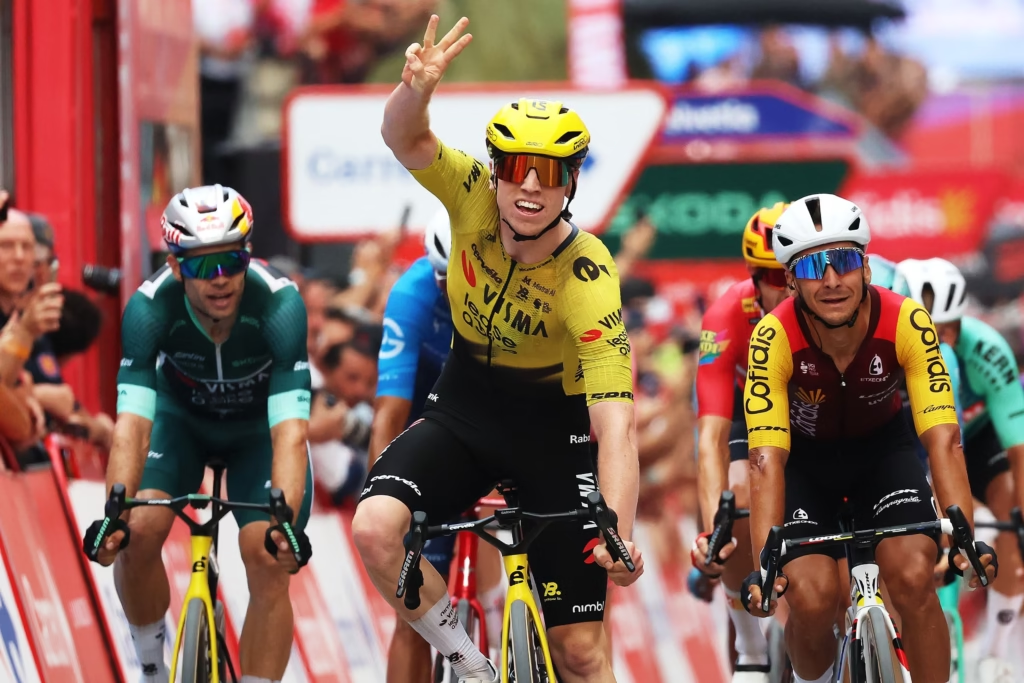 Photo Credit: Getty
Matthew Brennan’s three wins change how Visma can approach the stage
Matthew Brennan has already won three stages on his Grand Tour debut, including Stage 11 in Lorca after another lead-out from Van Aert.
Stage 13 is considerably harder.
The opening Category 1 climb and more than 3,000 metres of climbing make Brennan surviving with the main group far from guaranteed.
Yet his presence still matters.
Other teams cannot automatically assume Van Aert will attack from the start. If Visma believe Brennan can survive, they could instead keep Van Aert and Laporte around him and attempt to control the escape.
That possibility alone complicates the breakaway fight.
The likely outcome, however, is that the terrain proves too demanding for the purest sprint approach. Asking Brennan to survive the entire first half before another 7.4km climb with 45km remaining is substantially different from shepherding him over one moderate ascent before a sprint.
Mads Pedersen is no longer part of the Stage 13 equation
Some early Stage 13 previews understandably listed Mads Pedersen among the leading favourites.
That changed before Stage 11 when Pedersen abandoned the Vuelta after struggling with illness.
His absence significantly alters the tactical balance.
Pedersen would have been one of the few riders capable of making Lidl-Trek commit seriously to chasing almost regardless of how difficult the opening became. Without him, the team can race much more aggressively around Nys rather than spending the entire afternoon defending a conventional sprint scenario.
Ben Tulett is another rider who appeared on some pre-race contender lists but will not start Stage 13 after Visma confirmed he was unable to continue because of lingering problems from an earlier crash.
The heat could make controlling the break even harder
Conditions are expected to become significantly hotter as the race moves inland.
The current forecast has temperatures rising from around 25°C near the coast to potentially close to 38°C around Loja, with sunshine throughout the stage.
That is another argument against a long organised chase.
Stage 12 already subjected the peloton to more than 4,400 metres of climbing before the high-altitude finish on Calar Alto. Friday then asks riders to cover almost 193km in increasing heat.
Domestiques asked to chase from the opening Category 1 climb could pay heavily later.
It also increases the importance of hydration for riders in the break. A group that spends the first hour attacking before riding another four hours through increasingly hot conditions can disappear remarkably quickly if somebody gets fuelling or cooling wrong.
Stage 13 should favour the breakaway
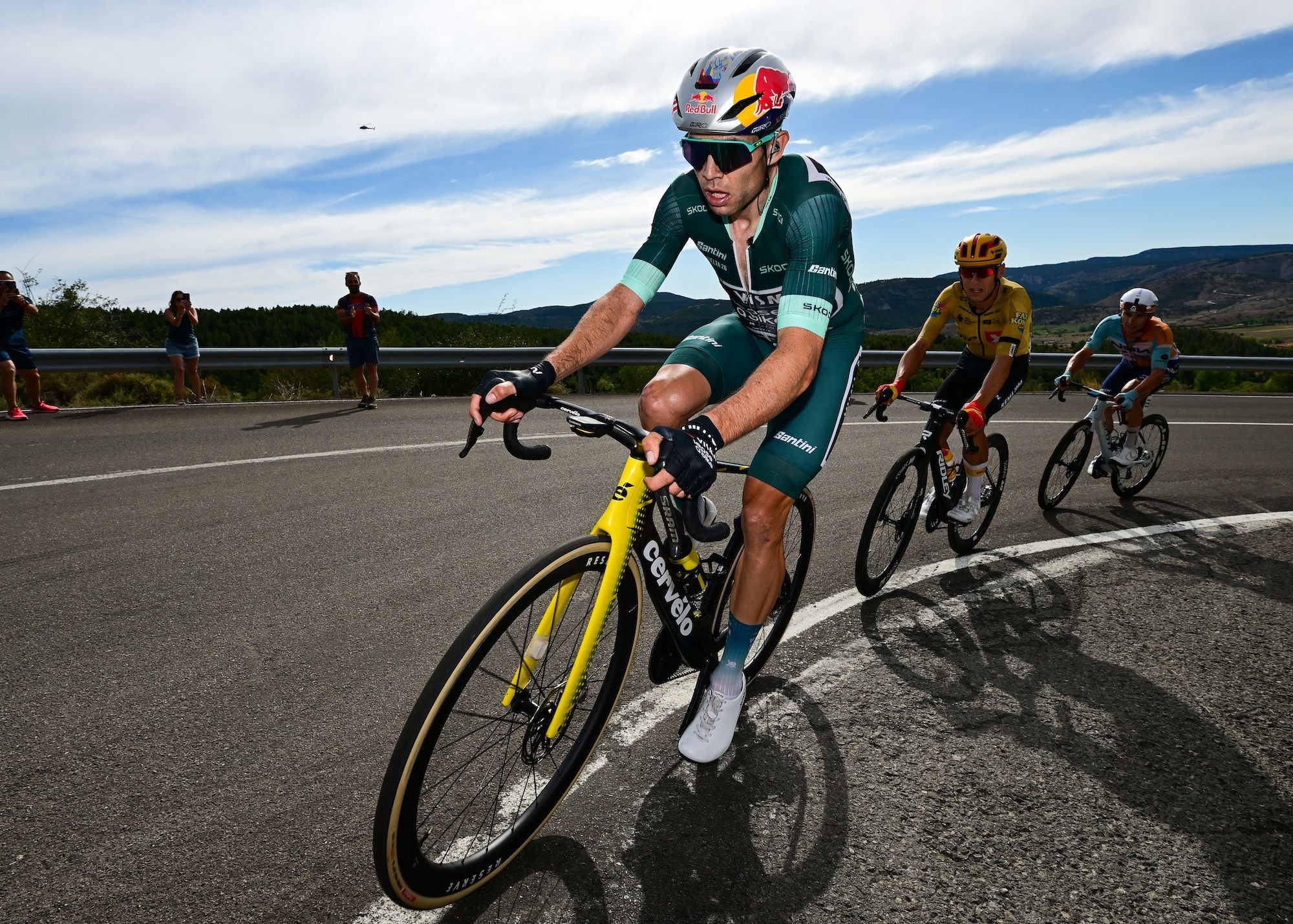
Everything about the stage points towards a large and extremely competitive breakaway.
The first major selection should begin as soon as the road turns inland after Salobreña. Venta de la Cebada provides enough climbing to prevent a weak group simply riding away, so expect several waves of attacks before the eventual escape is established.
Once the right riders are ahead, the GC teams should be happy to let the advantage increase.
The next question belongs to the teams of Van Aert, Nys and Cort.
Do they have their preferred rider in the break?
If yes, there is very little reason to chase.
If not, somebody has to accept responsibility for controlling a group that could contain ten, 15 or even 20 strong riders across terrain that constantly rises and falls.
That is not an attractive job.
Puerto de Granada should then trigger the decisive attacks. Climbers and rouleurs need to distance the fastest finishers before its summit, while Van Aert, Nys and Cort know that staying within a manageable gap gives them more than 37km to repair the damage.
The final run towards Loja could consequently become a pursuit rather than a conventional sprint preparation.
A lone rider may try to hold 20 seconds through the descent. Several attackers may refuse to cooperate because Van Aert is sitting behind them. A second group could return during the final 12km and completely reset the race.
Stage 13 does not contain the spectacular summit finish of Calar Alto or La Pandera.
That may be precisely why it becomes one of the most entertaining stages of the week.
The GC contenders have reason to conserve energy, the breakaway specialists have every reason to attack and some of the best fast-finishing all-rounders in the race know that surviving the opening mountains could leave them with a rare opportunity in Loja.
The route does not clearly favour one type of rider.
It rewards whoever reads the race best.