
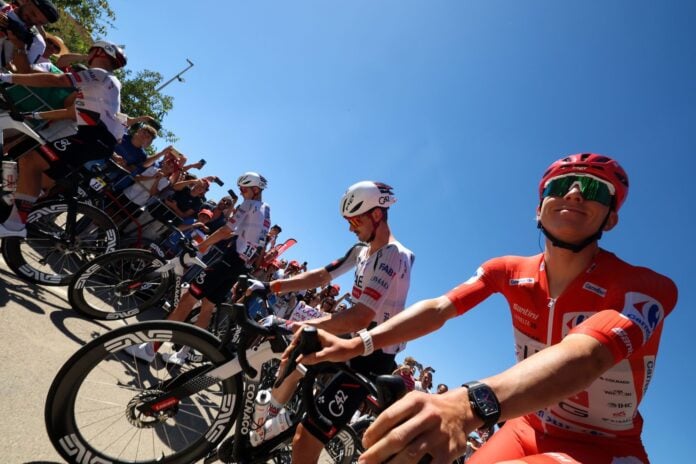
Tadej Pogačar’s 2026 season is not officially over, but the crash that ended his Vuelta a España on Stage 8 has placed serious doubt over everything that was supposed to follow. His agent Alex Carera has pushed back against suggestions that Pogačar will definitely not race again this year, with the next meaningful point in his recovery coming when he undergoes surgery on his fractured left collarbone in Barcelona on Monday 31 August.
A proper recovery timetable will only be established after that operation. Nobody in Pogačar’s camp is promising a rapid comeback, but equally they are not yet prepared to close his season. The immediate question is whether the combination of a displaced left clavicle fracture, concussion and stable C7 cervical vertebra fracture leaves enough recovery time for any of his three major remaining objectives: defending the rainbow jersey at the World Championships in Montréal on 27 September, racing the European Championships on home roads in Slovenia on 4 October and attempting to win Il Lombardia for a sixth consecutive year on 10 October.
Montréal now looks highly unlikely, while Il Lombardia is far enough away that it cannot yet be dismissed. Everything in between depends on what doctors learn after Monday’s operation and, crucially, how Pogačar responds during the first stages of his rehabilitation.
 Photo Credit: Getty
What injuries did Pogačar suffer in the Vuelta crash?
Pogačar crashed with around 32km remaining on Stage 8 from Puçol to Xeraco while leading the Vuelta by 3:50. He initially stood up and attempted to return to his bike before sitting back down as the seriousness of the situation became clearer. ProCyclingUK’s original report on Pogačar abandoning the Vuelta followed the incident from his attempted remount through to the moment he left in an ambulance.
Subsequent examinations confirmed injuries considerably more serious than the damaged shoulder visible on television.
| Injury | Confirmed position |
|---|---|
| Left clavicle | Displaced fracture |
| Neck | Stable C7 cervical vertebra fracture |
| Head | Concussion |
| Other injuries | Multiple abrasions |
The description of the C7 fracture as stable is important because there has been no indication of neurological damage, but it remains a fracture of the lowest cervical vertebra and means the recovery cannot simply be assessed through the usual timetable for a broken collarbone. The concussion adds another complication, particularly because return-to-sport decisions after a head injury are based on symptoms and neurological recovery rather than a fixed number of days.
Pogačar was initially taken to hospital in Gandia before being transferred by road to Barcelona. The clavicle operation has been scheduled for Monday once doctors are satisfied with his condition following the concussion. That combination is why any simple prediction of four weeks, six weeks or another standard clavicle recovery period would be premature.
Monday’s surgery is when the picture should become clearer
Carera’s intervention has added some precision to a story that understandably produced immediate speculation that Pogačar’s season was finished. His position is effectively that the surgery comes first and the calendar comes later. Doctors can only begin establishing a realistic recovery timetable once the clavicle has been stabilised and they have a clearer view of how the concussion and C7 fracture are progressing.
Even a completely successful operation would not automatically place the remaining races back on Pogačar’s programme. The collarbone is only one part of the recovery, with the concussion and cervical fracture carrying their own medical requirements. Pogačar then has to move through the normal progression from healing to indoor training, outdoor riding and finally the intensity and duration required for competition.
For now, Monday is not a comeback deadline. It is the point from which a comeback timetable can begin to be discussed.
Pogačar’s remaining 2026 targets
Before the crash, the final part of Pogačar’s season was unusually clear.
| Race | Date | Time from Stage 8 crash | Current outlook |
|---|---|---|---|
| UCI World Championships road race, Montréal | 27 September | 29 days | Highly unlikely |
| European Championships road race, Slovenia | 4 October | 36 days | Major doubt |
| Il Lombardia | 10 October | 42 days | Possible, but uncertain |
All three carried significance beyond simply adding another race to the programme. Montréal offered the opportunity to win a third consecutive elite men’s road world title, the European Championships are being staged in Slovenia, and Il Lombardia carries perhaps the most unusual historical target of all after Pogačar won the Monument five consecutive times from 2021 through 2025.
The compressed dates are the biggest problem. There are fewer than four weeks between the scheduled operation and the World Championship road race, barely another week to the Europeans and only six weeks from the original crash to Lombardia.
The World Championships now look extremely difficult
The elite men’s World Championship road race takes place in Montréal on Sunday 27 September, only four weeks after Pogačar’s crash and fewer than four weeks after the scheduled collarbone operation. Even without the C7 fracture and concussion, that would represent an extremely aggressive return.
The nature of the race makes the challenge larger. Montréal covers 273.7km with 3,803 metres of climbing, with 12 laps of the Mount Royal circuit after the long approach into the city. The circuit repeatedly uses Voie Camillien-Houde, the steep Chemin de la Polytechnique and the rising finish on Avenue du Parc. It is exactly the sort of course Pogačar would normally enter as one of the overwhelming favourites, but it is also almost the worst possible type of event to use as a comeback race.
There is an enormous difference between being medically cleared to ride and being ready for nearly 274km of Championship racing after a month disrupted by surgery, concussion recovery and a cervical fracture. Pogačar would need to rebuild training volume, regain confidence riding outdoors, tolerate prolonged time in an aggressive race position and recover enough high-end condition to compete against riders who have spent September preparing specifically for Montréal.
That is why the World Championships can remain technically unruled-out while still looking extremely unlikely in practice.
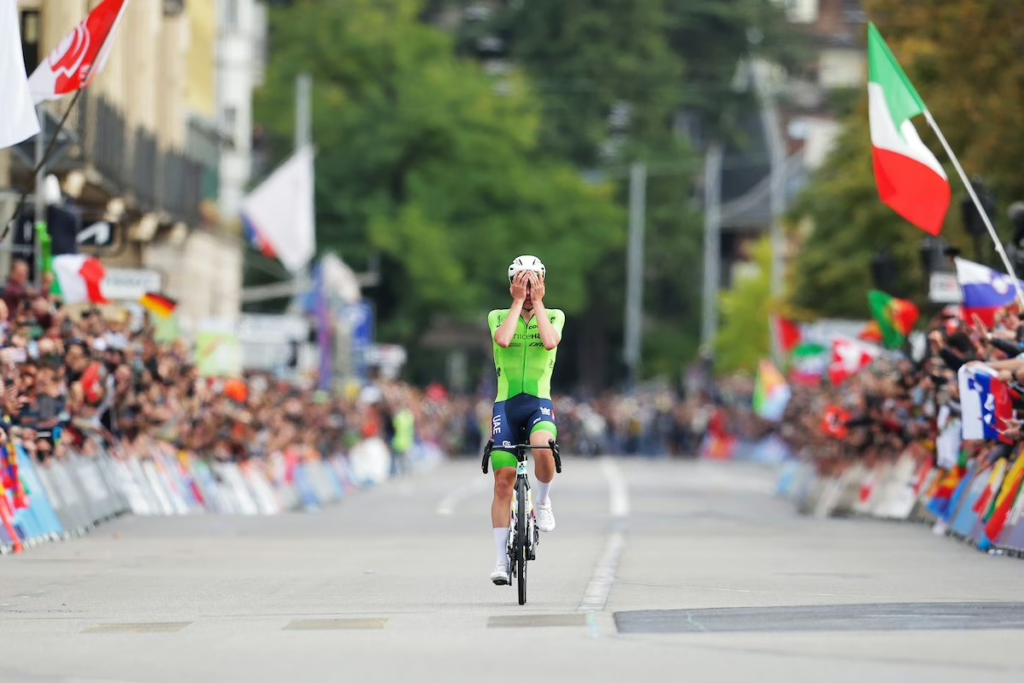
A third consecutive rainbow jersey was one of Pogačar’s biggest remaining targets
Missing Montréal would carry more weight than simply losing one race from the calendar. Pogačar has worn the rainbow jersey since winning the 2024 World Championships in Zürich and successfully defended it in Kigali in 2025, attacking from more than 100km out before riding the final 66km alone to become world champion for a second consecutive year.
Montréal offered the opportunity to make it three. The course also appeared exceptionally favourable, with much of the final circuit familiar from the Grand Prix Cycliste de Montréal, a race Pogačar has already won, while the additional Championship distance makes the repeated climbing even more significant.
If he is unable to start on 27 September, his two-year spell in the rainbow jersey will end without him having the opportunity to defend it for a third time. There are much bigger medical considerations after the crash, but in purely sporting terms that would be one of its most significant consequences.
The European Championships provide only one extra week
If Montréal comes too soon, the next target is hardly distant. The elite men’s European Championship road race takes place in Slovenia on Sunday 4 October, only seven days later, and the home setting gives the event obvious personal importance for Pogačar.
Five weeks from the crash is more recovery time than four, but it still may not be enough to fundamentally change the situation. The crucial question will not simply be whether Pogačar can physically turn the pedals by early October. It will be whether the concussion symptoms have completely resolved, the cervical fracture has healed sufficiently, the collarbone is stable and he has completed enough proper training to race at the level expected of him.
There would also be little reason to accelerate rehabilitation purely to make a championship seven days after another race he may already be forced to miss. The Europeans therefore remain a serious doubt even if Montréal becomes the first target formally removed from his programme.
Il Lombardia is where a comeback begins to look more plausible
Il Lombardia takes place on Saturday 10 October, giving Pogačar six weeks from the crash. That is still an ambitious recovery window given the combination of injuries, but it is long enough for Carera’s refusal to declare the season finished to carry much more substance.
Lombardia also matters enormously to Pogačar. He has won every edition since 2021, giving him five consecutive victories and one of the most remarkable one-race records in modern cycling. A sixth in 2026 would extend a sequence that has become one of the defining parts of his career.
That creates an obvious target if Monday’s surgery goes well and the concussion and cervical fracture recover without complications. The possibility is real, but it is still far too early to call it likely.
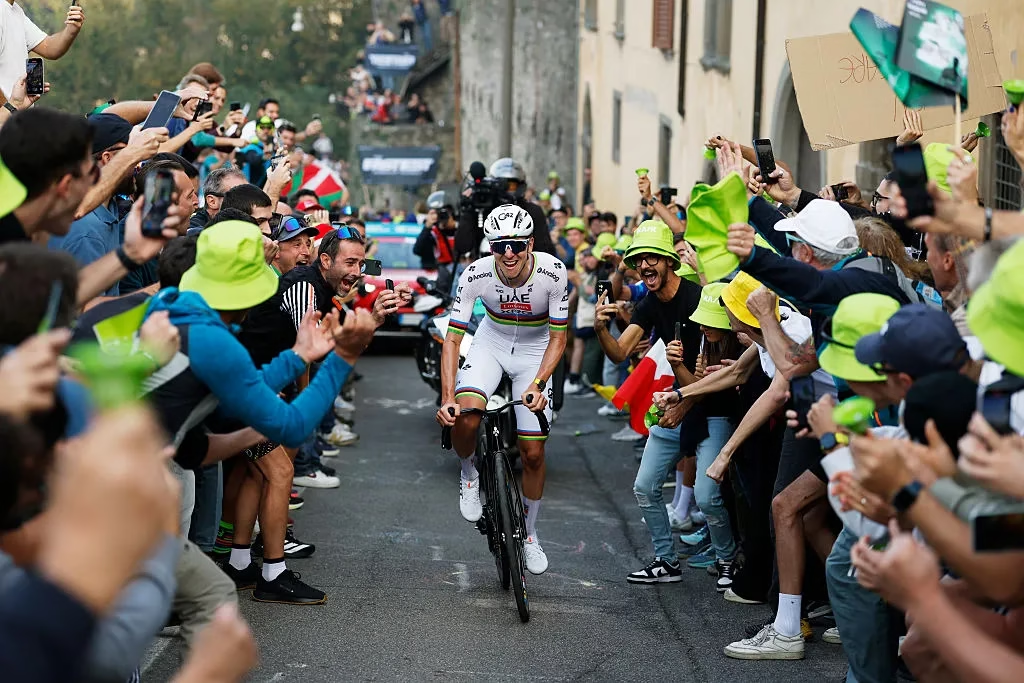 Photo Credit: Getty
Six weeks does not automatically make Lombardia realistic
Professional cyclists can return remarkably quickly from clavicle fractures, but that comparison should be used carefully here because Pogačar is not recovering from an isolated collarbone injury. The concussion and C7 fracture are potentially more important in determining when he can return to serious outdoor training and racing.
Even if the clavicle operation is completely successful, Pogačar still has to progress through several stages of rehabilitation. Indoor riding can preserve a substantial amount of aerobic fitness, but it cannot reproduce descending, handling the bike in a peloton or absorbing road vibration through the shoulders and neck for five or six hours.
Nor does simply being fit enough to start Lombardia mean being ready to win it. Pogačar’s dominance at the race has been built around reaching October capable of attacking some of the world’s best climbers from distance and then sustaining an enormous solo effort. For him, making the start would not be the target. He would want to race for victory, and that raises the level he needs to reach before UAE decide a comeback is worthwhile.
The five-year Lombardia streak makes the decision unusually interesting
Few riders ever reach a position where missing one edition of a race carries historical implications, but Pogačar has. He won Lombardia in 2021, successfully defended in 2022, then extended the run through 2023, 2024 and 2025.
If he does not race in 2026, the streak ends without another rider actually beating him. If he returns, he has the opportunity to stretch it to six. That creates an emotional and historical incentive to keep 10 October somewhere in the recovery conversation, even if it cannot be allowed to dictate the medical decision.
Pogačar has already completed another enormous season, including a record-equalling fifth Tour de France victory before starting the Vuelta less than a month later. UAE have little reason to compromise his long-term recovery for one final result, however significant the race. If he is ready, Lombardia becomes fascinating. If he is not, five consecutive victories already speak for themselves.
Pogačar’s own update suggests the focus has moved towards recovery
Pogačar posted his first public update from hospital on Sunday, showing himself wearing a soft neck brace with dressings visible on his face and hand. He accompanied the photograph with the Bee Gees’ Stayin’ Alive, retaining some of the humour that has often accompanied him even during difficult moments.
There was no detailed medical statement and no promise about when he would return, which was probably appropriate. The image showed the reality of a serious crash without pretending that the recovery picture was already clear.
It should not be treated as evidence that Pogačar is ready to race again soon. What it does show is that the story has already moved beyond the immediate drama of the crash and towards the process of rehabilitation.
The Vuelta is the one target that definitely cannot be recovered
Whatever happens after Monday, one part of Pogačar’s season has definitively disappeared. He will not win the 2026 Vuelta a España, and that matters because Spain was not simply another Grand Tour start on his calendar.
It was the one major stage race missing from his collection. Pogačar returned for the first time since his breakthrough third place in 2019 with the opportunity to add the Vuelta to his Giro and Tour victories. ProCyclingUK examined the historical significance before the start in what winning the Vuelta would mean for Pogačar’s Grand Tour record.
For most of the opening week, completing that set looked increasingly likely. He won the Monaco time trial and immediately took red, then produced the extraordinary 50km solo victory in Andorra, the longest solo Grand Tour win of his career.
He won again on Stage 6 in Castelló, although that day also provided the first significant resistance when Enric Mas rode back to him on Puerto El Bartolo. By the end of Stage 7, Pogačar led Mas by 3:50. Twenty-four hours later he was out of the race.
The crash has completely changed the Vuelta without him
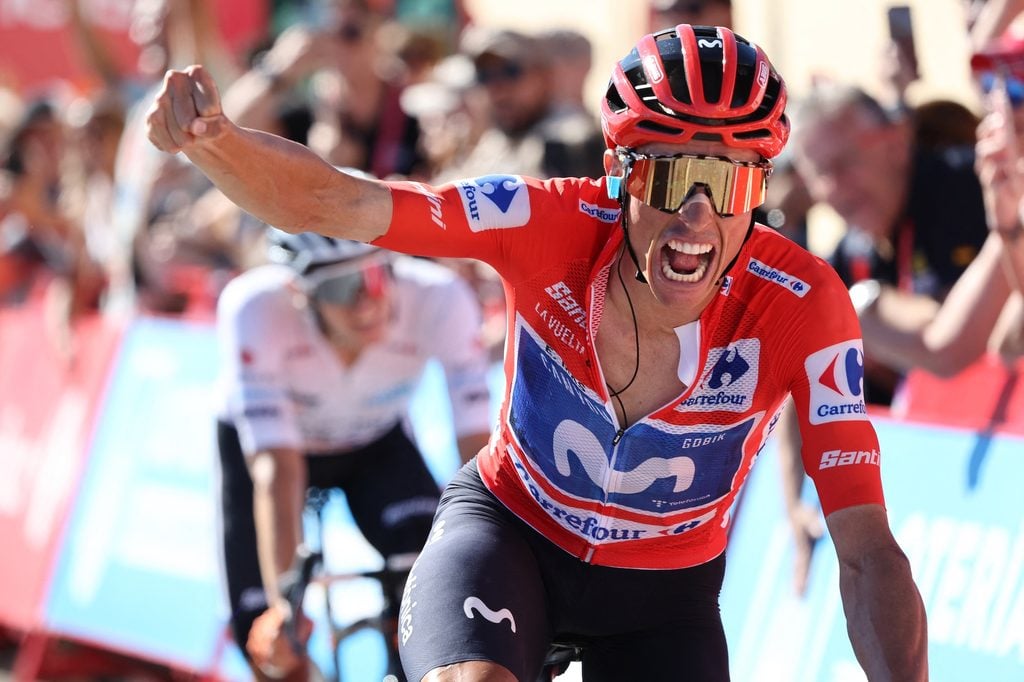
The race Pogačar left behind barely resembles the one he had been controlling. Mas won Stage 9 on Alto de Aitana and now leads Primož Roglič by 1:18, with Felix Gall at 1:39 and Oscar Onley at 2:20.
ProCyclingUK’s updated Vuelta GC contenders analysis after Stage 9 shows how quickly a race that appeared to be heading towards another Pogačar victory has become genuinely open. The podium contenders spent the first week trying to work out how to regain several minutes on a rider who seemed to be getting stronger. They now have an entirely different race.
For Pogačar, the focus has moved elsewhere. His next meaningful result will not be measured in seconds gained on Mas or Roglič, but in the outcome of Monday’s operation and the medical assessments that follow.
The Grand Tour set will have to wait
The Vuelta crash also postpones one of the few major achievements Pogačar has not yet completed. He won the Giro d’Italia in 2024 and has won the Tour de France in 2020, 2021, 2024, 2025 and 2026, but the Vuelta remains missing.
His best result in Spain is still third from his extraordinary debut in 2019. At 27, there should be plenty of time to return, so the historical question examined before this Vuelta has not disappeared. It has simply been moved into another season.
That makes the Vuelta very different from Montréal or Lombardia. A Spanish Grand Tour can be targeted again in 2027, 2028 or beyond. The opportunity to win a third consecutive world title or a sixth consecutive Lombardia belongs specifically to this autumn.
-
 Photo Credit: quentinphotographiebe
 -
 Photo Credit: Getty

What is the most realistic scenario now?
Before Pogačar has undergone surgery, there is too much uncertainty to reduce his recovery to one predicted return date. There are nevertheless three broad possibilities, and the middle one currently looks the most plausible.
The first is that the combination of concussion, cervical fracture and clavicle injury requires a longer recovery and his 2026 season ends with the Vuelta crash. Given the nature of the injuries, that remains entirely realistic.
The second is that Montréal comes too soon but recovery progresses well enough for Pogačar to consider the European Championships or, more plausibly, Il Lombardia. The additional time before 10 October gives that scenario much more substance than a World Championship return only four weeks after the crash.
The third is the outcome Carera has deliberately refused to dismiss: Pogačar recovers exceptionally quickly and manages to return in time for Montréal. Until the doctors rule it out, it remains technically possible, but going from surgery on 31 August to trying to defend the rainbow jersey over 273.7km on 27 September would be an extraordinary turnaround.
What happens next with Pogačar?
Monday should provide the first useful answer. Pogačar will undergo surgery in Barcelona and his doctors will then be in a better position to estimate how long the recovery should take, although even that is unlikely to produce an immediate definitive calendar.
Concussion recovery is individual, the C7 fracture will need monitoring and the clavicle must heal sufficiently before training can progress from simply riding to preparing for some of the hardest one-day races in professional cycling. Pogačar may theoretically be medically capable of starting a race before he is physically prepared to win one, and that distinction matters when the only targets left are the World Championships, European Championships and Il Lombardia.
That is why Carera’s message is important without being especially optimistic. Pogačar’s season may be over, but nobody treating him is prepared to say that it definitely is.
Before the crash, his autumn followed a simple sequence: complete the Vuelta, defend the rainbow jersey in Montréal, race a home European Championships and try to win Lombardia for the sixth year in succession. That plan no longer exists. The World Championships now look highly unlikely, the Europeans remain doubtful and Il Lombardia has become the most plausible major target if there is to be a Pogačar comeback at all in 2026.
Monday’s surgery will tell us whether that possibility can begin turning into a plan.

