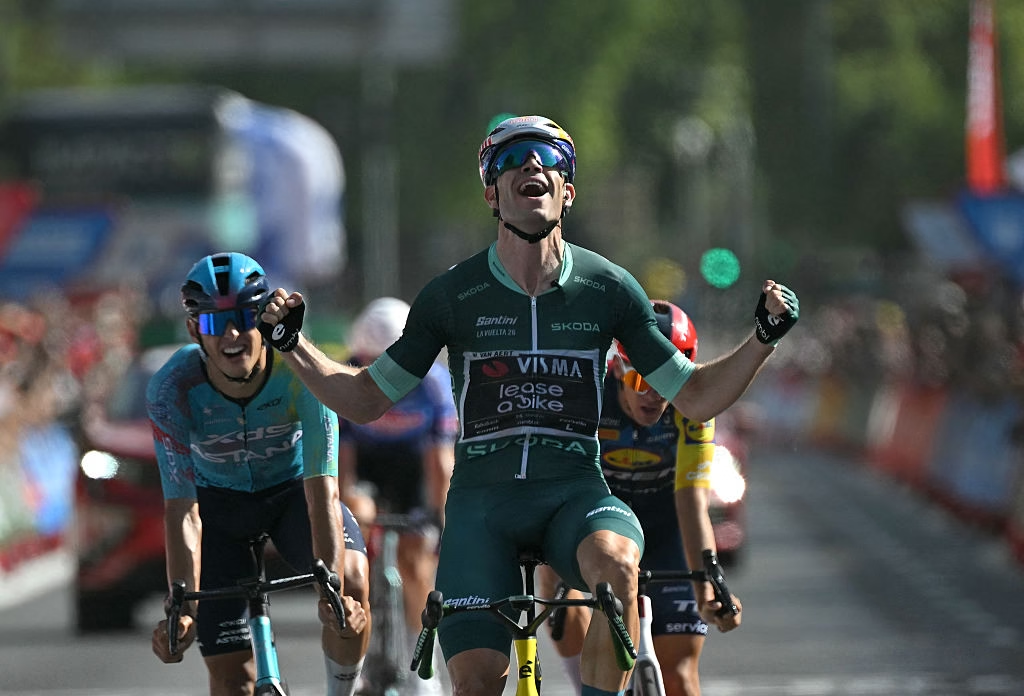
Wout van Aert won stage 15 of the 2026 Vuelta a España in Córdoba after turning Visma | Lease a Bike’s day-long control of the peloton into an attack of his own with 30 kilometres remaining.
The Belgian accelerated through the intermediate sprint at Santa María de Trassierra and bridged to Andreas Leknessund and Ramses Debruyne. Alessandro Romele and Thibau Nys followed, creating the five-rider group that stayed clear to contest the stage.
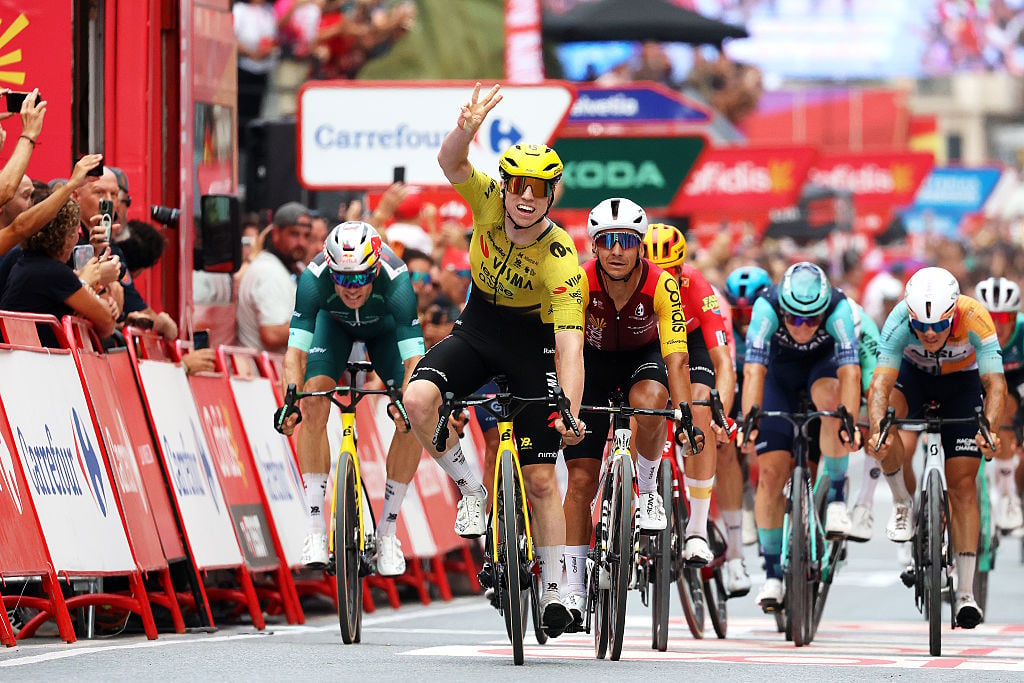
Van Aert then took responsibility for closing the attacks in the final kilometres before beating Romele and Nys in the sprint. It was his second victory in three days following his stage 13 win in Loja and a second Vuelta victory in Córdoba after also winning there in 2024.
Enric Mas finished safely with his general classification rivals and takes a 2:06 advantage over Felix Gall into Monday’s second rest day.
Extreme heat cuts stage 15 to 110 kilometres
The stage had already changed considerably before racing began.
La Vuelta activated its extreme temperature protocol on Saturday evening and reduced the route from 189.7 kilometres to 110.2 kilometres. The neutralised and official starts were also pushed back into the afternoon, with the Alto de Villaviciosa section removed from the original course.
The revised stage 15 route still retained Puerto de la Forestal and Puerto Artafi, but compressing the climbing into a much shorter race made controlling the break more difficult rather than easier.
Conditions remained severe. Matthew Brennan said afterwards that temperatures had reached 44°C while he was climbing, despite the decision to shorten the stage.
The stage 15 live viewing update reflected the late changes to both the course and timetable, but the broad tactical question remained the same. Visma had Van Aert and Brennan, while several teams still wanted to put riders into the break.
The result was an aggressive opening rather than a controlled transition towards the first climb.
Visma keeps the early break close
After repeated attacks, 11 riders established the first significant move.
Ivo Oliveira, Xabier Mikel Azparren, Enzo Paleni, Ethan Hayter, Leknessund, Rudy Porter, Alastair Mackellar, Fabian Weiss, Reuben Thompson, Gijs Leemreize and Frederik Wandahl went clear, but Visma had missed the move.
That immediately limited how much freedom it would receive.
Visma joined Cofidis at the front of the peloton, with Cofidis working towards a possible reduced sprint for Bryan Coquard. The break’s advantage was held at around a minute rather than being allowed to stretch towards the three or four minutes normally expected at this stage of a Grand Tour.
Leemreize led over Puerto de la Forestal ahead of Porter and Leknessund, while Georg Steinhauser attacked from the peloton and attempted to bridge.
The important point was the gap. Even after the first climb, the race had not settled. Visma continued keeping the attackers within reach and the front of the race was repeatedly reshuffled as the riders moved through the Sierra de Hornachuelos.
Leknessund attacks on Puerto Artafi
Puerto Artafi provided the first real selection.
Weiss, Azparren and Thompson moved ahead before Leknessund bridged across. The Norwegian then increased the pace again and went alone as the climb began separating both the breakaway and the peloton.
Coquard was dropped, removing one of the riders whose team had spent much of the stage helping Visma control the race.
Leknessund crossed the summit first, with Debruyne closing rapidly behind. The peloton remained only around 20 seconds away.
At that point it still appeared possible that everything would come back together for a reduced sprint.
Instead, the intermediate sprint shortly afterwards produced the decisive move.
Van Aert attacks through the intermediate sprint
Debruyne joined Leknessund before Santa María de Trassierra and took maximum points and six bonus seconds at the intermediate sprint.
Romele crossed third.
Van Aert was fourth, but rather than sitting up after the line, he kept accelerating.
He quickly crossed to Debruyne and Leknessund. Romele recognised what was happening and followed, with Nys also making the junction.
Within a short distance, the race had been transformed from Visma chasing a breakaway into Van Aert riding in one.
It was not an improvised response to losing control. The team still had Brennan in the peloton, which meant Van Aert could attack without leaving Visma committed to a single outcome.
“We tried to surprise the bunch, we took control the whole day, and we were still there with a few strong guys to help us,” Van Aert said afterwards.
“I knew people would not expect that we would choose the attack and I smelled the moment there on the intermediate sprint. With Matthew behind there was no risk at all to give it a try because we always had a good option in the bunch.”
The five riders immediately began opening a more useful advantage.
The chase never reaches the leading five
Several riders tried to get across.
A nine-man chase containing Kevin Vermaerke, Ivo Oliveira, Tobias Halland Johannessen, Stefan Küng, Urko Berrade, Alessandro Covi, Ed Dunbar, Henok Mulubrhan and Leemreize formed behind.
Paleni and Bastien Tronchon also attacked from the peloton.
None of them reached Van Aert’s group.
With 21 kilometres remaining, the nine chasers were around 45 seconds behind and the peloton had slipped beyond a minute. The gap continued to grow as the five leaders crossed the final rolling terrain and began the descent towards Córdoba.
By 15 kilometres to go, the chasers were still around 45 seconds back. The peloton had fallen far enough behind that the stage was effectively decided between Van Aert, Romele, Nys, Debruyne and Leknessund.
The question was now whether Van Aert could control a group containing two other fast finishers and a rider in Leknessund who had little interest in waiting for the sprint.
Van Aert refuses to let anyone escape
The cooperation at the front inevitably disappeared.
Debruyne tested the group before being caught. Nys then attacked with around three kilometres remaining and Debruyne followed him.
Van Aert closed it.
Leknessund countered shortly afterwards. Again, Van Aert went after him.
The Norwegian tried more than once, but Van Aert was willing to spend energy defending the sprint rather than waiting for Romele or Nys to do the chasing.
“My Belgian companions, they were really strong and helped very well, also Romele from Astana,” Van Aert said.
“But I think Leknessund gambled a bit for his teammate that was in the back, so we expected an attack from him. They started quite late, in the last few kilometres. I just wanted to keep it together and make sure it was a sprint.”
That left all five together beneath the kilometre banner.
Van Aert led, with Romele directly behind.
Nys goes early but Van Aert waits
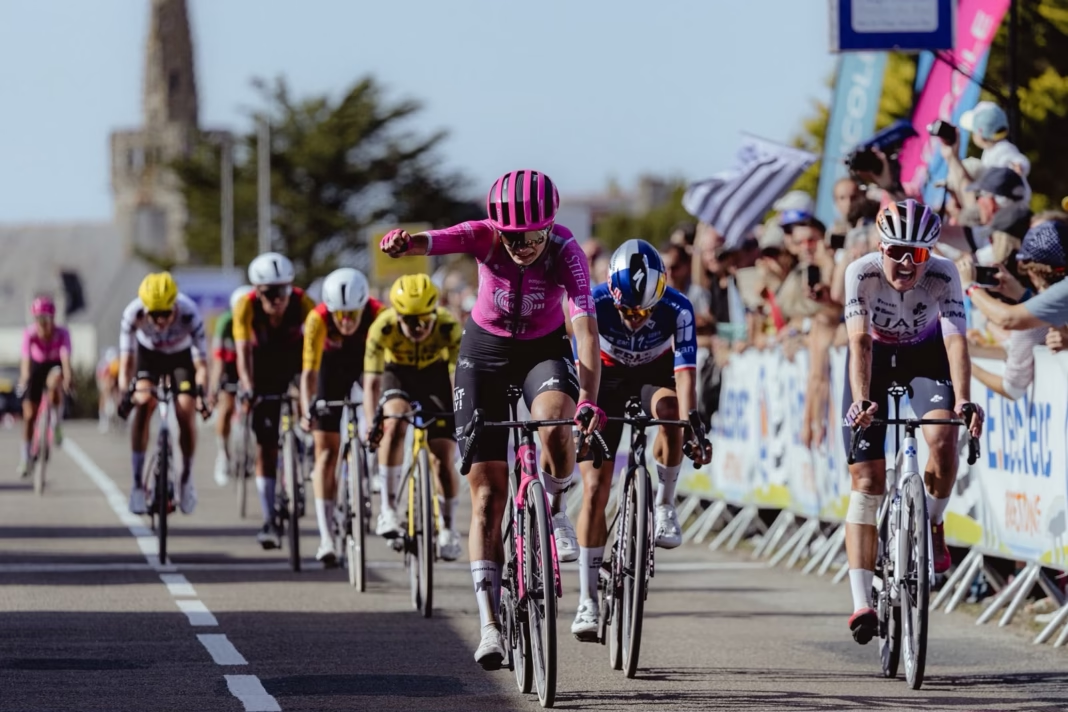
Nys was the first to commit to the sprint.
The Lidl-Trek rider opened a long acceleration and initially created enough separation to make the timing uncomfortable for Van Aert. Rather than reacting immediately, Van Aert stayed close and waited until the final metres.
He came past Nys approaching the line.
Romele also finished strongly and edged ahead of Nys for second, leaving the Lidl-Trek rider third. Debruyne finished fourth and Leknessund fifth.
For Van Aert it was a second Vuelta stage victory in three days and another example of the range he has shown during this race. His Loja victory came after surviving a large break and attacking late. Córdoba required Visma to control the early escape before Van Aert changed roles and became part of the decisive break himself.
He also strengthened a points classification he already led comfortably before the stage.
Mas carries 2:06 advantage into the rest day
There was little movement in the general classification after the major differences created on stage 14 at Sierra de La Pandera.
Red Bull-Bora-Hansgrohe applied some pressure during the descent towards Córdoba, but the effort did not develop into an attack capable of separating Mas from his main rivals. Movistar subsequently returned to the front and guided the red jersey safely towards the finish.
Mas remains first overall on 49:28:12.
Gall is second at 2:06, with Primož Roglič third at 2:10. Richard Carapaz remains fourth at 4:24, while Oscar Onley completes the top five at 5:44.
After the heat, the shortened course and a relentlessly fast 110 kilometres, the GC contenders now have Monday’s rest day before the final six stages.
Van Aert reaches it with two victories from the final three stages of week two.
Vuelta a España 2026 stage 15 result
Data powered by FirstCycling.com
Main photo credit: Getty