
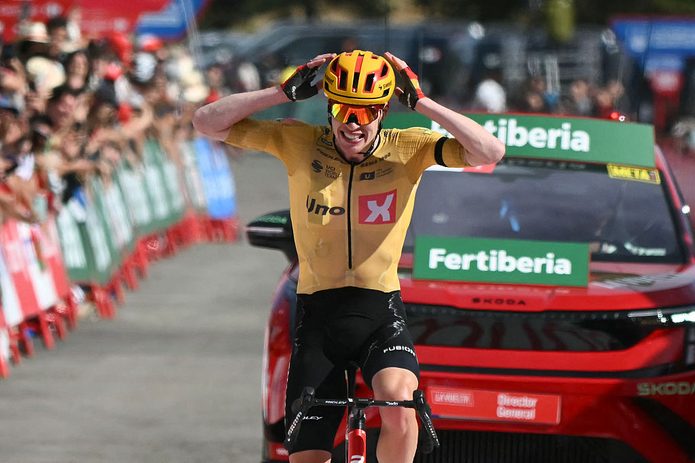
Andreas Leknessund won stage 7 of the 2026 Vuelta a España at Aramón Valdelinares, attacking from the breakaway on the final climb to take his first Grand Tour stage victory.
The Uno-X Mobility rider went clear with 7.5 kilometres remaining and held off the chase to win alone, while teammate Tobias Halland Johannessen completed a Norwegian one-two by dropping Wout van Aert in the final kilometre. Van Aert finished third after spending the entire day on the attack, having gone clear from the flag and helped shape the stage from the opening kilometres.
Behind, Tadej Pogačar extended his overall lead with another late acceleration from the GC group. The UAE Team Emirates-XRG rider finished 19th on the stage, 4:23 behind Leknessund, but gained time on every major rival. He now leads Enric Mas by 3:50, with Primož Roglič third overall at 4:50.
A mountain stage that finally went to the breakaway
Stage 7 took the race from Vall d’Alba to Aramón Valdelinares over 149.8 kilometres, giving the Vuelta another mountain finish after two hard GC days in Andorra and Castelló.
The route was shorter than stage 6 but still packed with climbing. The early Puerto El Remolcador and Alto de Zucaina helped form the race, before the Puerto de Fuente de Rubielos, Puerto de San Rafael and the final ascent to Aramón Valdelinares gave the breakaway and the GC contenders separate battles in the final 50 kilometres.
After Pogačar’s 50-kilometre solo win on stage 4 and his gravel-stage victory over Mas on stage 6, the question was whether UAE Team Emirates-XRG would again chase for another stage win. This time, they let the breakaway go far enough for the day’s honours to be decided up the road.
That changed the feel of the stage. Pogačar still found a way to gain time, but stage 7 belonged to the escape.
Van Aert attacks from the flag
The stage began with Van Aert attacking immediately after the official start.
It was an aggressive move from a rider who had spent much of the opening week working for Matthew Brennan, but who clearly saw this as a day where a strong breakaway could survive. Leknessund joined him almost immediately, with Milan Vader also initially present before being dropped as the pace lifted.
The early move did not settle the race on its own. Chasers kept coming across, the peloton remained active, and the opening climbs created a long and difficult fight for the breakaway. By the Puerto El Remolcador, Van Aert and Leknessund had been joined by Eddie Dunbar, Alexey Lutsenko and Johannessen, creating the five-rider front group that would eventually decide the stage.
It was a strong combination. Van Aert had the power and points motivation, Lutsenko had Grand Tour experience, Dunbar had proven mountain-stage pedigree, and Uno-X had two riders who could play the final climb tactically.
That last detail proved decisive.
Leknessund collects early mountain points
The first major selection came on the Puerto El Remolcador.
Leknessund led over the summit, ahead of Lutsenko and Johannessen, showing early that he had the legs for more than simply surviving in the move. Behind them, a large chase group formed with riders including Pello Bilbao, Marco Brenner, Ben Turner, Léo Bisiaux, Mads Pedersen, Valentin Paret-Peintre, Koen Bouwman, Larry Warbasse, Iván Sosa and Raúl García Pierna.
For a while, the chase group looked dangerous. It had numbers, climbing ability and enough teams represented to keep the front five under pressure. The problem was cooperation. The group repeatedly stalled, attacked itself and failed to make sustained progress.
That was exactly what the leading five needed. They did not need a huge gap immediately. They needed the chasers to waste time and energy before the stage reached the final climbs.
A special Norwegian backdrop
The stage carried added emotional weight for the Norwegian riders.
Before the start, the Norwegian contingent came to the front line as a minute’s silence was observed following the death of King Harald V. For Uno-X Mobility, a Norwegian team with two riders in the decisive move, that gave the day an obvious extra layer.
It did not win the race for them, but it framed the result. Leknessund and Johannessen were already two of the strongest riders in the breakaway. When the stage reached the final climb, they also had a team situation that gave them a tactical advantage.
Van Aert was alone. Lutsenko was isolated. Dunbar began to struggle. Uno-X had two riders, both climbing well, and one clear route to victory: attack with one, force the others to chase, then use the second as the blocker behind.
They executed it perfectly.
Van Aert takes the sprint and more mountain points
Van Aert continued to shape the middle of the stage.
He won the intermediate sprint with 26.5 kilometres remaining, taking 20 points and 6 bonus seconds, with Lutsenko second and Dunbar third. That moved him closer in the points classification and gave Team Visma | Lease a Bike another productive day after Brennan’s two stage wins earlier in the race.
Van Aert then led the front group over the Puerto de San Rafael, taking maximum mountain points ahead of Lutsenko and Leknessund. The climb did not split the five leaders immediately, but it made the final equation clearer. The stage was almost certainly going to come from the front group, with the chasers more than a minute behind and the peloton much further back.
By the time the leaders reached the final ascent, Van Aert had spent a huge amount of energy. That mattered when the pure climbing began.
Leknessund attacks on Valdelinares
The final climb to Aramón Valdelinares was 9.8 kilometres at 5.9 per cent, with ramps reaching 13 per cent.
It was not an extreme summit finish, but after a hard day in the breakaway, it was enough to separate riders who had been together for more than three hours. The five leaders began the climb with around a minute on the chasers and more than 6 minutes on the peloton.
Leknessund made his move with 7.5 kilometres remaining. It was the first real attack from the front group all day, and it immediately changed the stage. Lutsenko tried to drive the chase, Van Aert followed, and Johannessen sat on as the teammate of the leader.
That was the tactical trap. Van Aert could not wait forever, but every metre he spent chasing Leknessund made Johannessen more dangerous behind him. Lutsenko also had to work, while Dunbar was dropped from the group.
Leknessund’s advantage grew to more than 20 seconds, then towards 45 seconds. Once it reached that point, the stage began to look Norwegian.
Johannessen completes the Uno-X move
Johannessen played his role perfectly.
He followed Van Aert and Lutsenko while Leknessund extended his lead up the road. When the Belgian had to do the bulk of the chasing, Johannessen had no reason to help. His teammate was riding towards the stage win, and his own chance would come only if Van Aert began to fade.
That is exactly what happened.
Inside the final kilometre, Johannessen attacked from the chase and dropped Van Aert. He could not reach Leknessund, who was already too far ahead, but he made sure Uno-X turned a strong breakaway ride into a one-two.
Leknessund crossed the line alone in 3:49:47, finally taking the Grand Tour stage win he had repeatedly chased. Johannessen followed 34 seconds later, while Van Aert finished third at 47 seconds after an enormous day of work.
For Uno-X Mobility, it was the team’s first stage victory at the Vuelta. It could hardly have arrived in a better way.
Omrzel and Rodríguez round out the top five
Behind the leading three, Jakob Omrzel produced a strong ride to take fourth for Bahrain Victorious at 58 seconds.
Juan Felipe Rodríguez Contreras finished fifth for EF Education-EasyPost at 1:13, ahead of Iván Sosa at 1:16. Lutsenko, who had been central to the front group before fading on the final climb, finished seventh at 1:44, with Dunbar eighth at 1:51.
Bisiaux finished ninth at 1:53 after spending much of the late stage trying to animate the chase, while García Pierna completed the top 10 at 2:14 for Movistar.
The result was a proper breakaway stage list rather than a GC-controlled finish. The riders who had taken the risk early were rewarded, while the peloton arrived several minutes later after UAE allowed the escape to fight for the win.
Decathlon make the GC group hard
Even with the stage win gone, the GC race still came alive on the final climb.
Decathlon CMA CGM took control of the reduced peloton on the lower slopes, positioning Felix Gall and increasing the pace. The group began to shrink, with riders such as Mattias Skjelmose, Harold Tejada and Jarno Widar among those struggling when the tempo lifted.
By the final 3 kilometres, only a small group remained around the red jersey. Matthew Riccitello and Gregor Mühlberger were involved in the pace-making for Decathlon, with Gall, Pogačar, Mas, Roglič, Oscar Onley, Tejada, Sepp Kuss and Richard Carapaz among those still present before the decisive moves.
Gall was the first to attack, and only Pogačar and Mas could immediately follow. Roglič and Onley were a few metres behind, while Carapaz began to drift further back.
The stage win was up the road, but the podium fight was still being rewritten.
Pogačar attacks again
Pogačar then made his own move from the GC group.
It was not the same kind of long-range destruction as Andorra, and not the gravel-stage drama of Castelló, but it was still another acceleration that nobody could match. Gall had already opened the race, but Pogačar used the final climb to take more time from all of his rivals.
He finished 4:23 behind Leknessund, 6 seconds ahead of Gall, 16 seconds ahead of Mas and 29 seconds ahead of the Roglič, Kuss and Onley group. Carapaz suffered badly, finishing 1:22 behind Pogačar.
Those gaps are small compared with the time Pogačar gained on stage 4, but they matter because they came on a day where he did not need to chase the stage. He could have ridden defensively. Instead, he used the final climb to widen the race again.
Every mountain finish is now becoming another opportunity for him to add seconds.
Pogačar extends his overall lead
Pogačar now leads the Vuelta by 3:50 over Mas, with Roglič third at 4:50.
That is a major shift from the previous day, when Mas had moved up to second after matching Pogačar on Puerto El Bartolo. Mas remains the closest challenger, but he lost another handful of seconds at Valdelinares and now sits almost 4 minutes down.
Roglič remains third, but the gap to Pogačar has grown to 4:50. More importantly for the podium battle, he now has Gall only 11 seconds behind him after the Austrian’s late attack and stronger finish on the climb.
Kuss moved up to fifth overall at 6:05, with Onley sixth at 6:06. Carapaz dropped from fourth to seventh after his difficult finale, now 6:12 behind Pogačar and only 7 seconds behind Kuss.
The race for red looks increasingly settled. The race for the podium is becoming tighter and more volatile.
Carapaz pays for a difficult final climb
Carapaz was the main GC loser of the day.
The EF Education-EasyPost rider began the stage fourth overall and still looked well placed in the podium fight after Castelló. On Valdelinares, though, he could not follow the main accelerations and lost 1:22 to Pogačar.
That dropped him to seventh overall, behind Gall, Kuss and Onley. The gaps are still close, but the direction of travel was the concern. Carapaz had already looked less comfortable on the gravel stage, and another difficult mountain finish suggests he needs a response soon if he is to re-enter the podium picture.
The Vuelta is still young, and Carapaz is rarely a rider to write off after one bad day. But stage 7 was damaging because he did not simply lose time to Pogačar. He lost time to Gall, Mas, Roglič, Kuss and Onley too.
That is harder to recover.
Gall gains momentum
Gall was one of the quieter winners among the GC riders.
He did not take the stage, and he did not gain time on Pogačar, but he attacked first from the favourites’ group and finished closer to the red jersey than Mas, Roglič, Kuss, Onley or Carapaz.
That moved him to fourth overall, only 11 seconds behind Roglič. After Decathlon had helped animate the early mountain stages and then took control again at Valdelinares, Gall now looks increasingly like a genuine podium threat.
His race has been consistent rather than spectacular. He could not follow Pogačar in Andorra, he stayed close on the gravel stage, and at Valdelinares he was one of the strongest of the chasers. In a race where second to seventh are still shifting almost daily, that consistency is valuable.
Gall has not cracked the race open, but he is moving in the right direction.
Kuss and Onley recover ground in the standings
Kuss and Onley both moved up overall despite losing time to Pogačar.
That says something about how costly Carapaz’s final climb was. Kuss finished in the same group as Roglič and Onley, 29 seconds behind Pogačar, and now sits fifth overall at 6:05. Onley is just 1 second behind him in sixth.
Both had lost time on the gravel stage the previous day, so this was not a complete rebound in terms of performance. But neither suffered the kind of collapse that would have removed them from the upper GC race. The podium is still some distance away, but they remain close enough to Carapaz and not impossibly far from Gall and Roglič.
Onley, in particular, needed a steadier day after paying for trying to follow Pogačar on Puerto El Bartolo. Valdelinares was not a spectacular recovery, but it kept him in the conversation.
-
 Photo Credit: Getty
 -
 Photo Credit: Cs-wolves / Wikimedia Commons, CC BY-SA 4.0

Leknessund finally gets his Grand Tour win
The emotional centre of the day remained Leknessund.
He had been close to a Grand Tour stage win before, including repeated near misses at the Giro d’Italia. At Valdelinares, he finally converted one, and did it with a brave final-climb attack rather than a sprint or a tactical gift.
His post-stage reaction made clear how much it meant. He spoke about the emotion of finally winning after fighting for the result for so long, and credited Johannessen for letting the gap open once Leknessund attacked.
That was the essence of the win. Leknessund had the strength to make the move, but Johannessen gave Uno-X the tactical leverage behind. Once Van Aert and Lutsenko were forced to chase without help, Leknessund’s chances grew with every kilometre.
For a Norwegian team on a Norwegian day, it was an almost perfect outcome.
Uno-X turn numbers into history
Uno-X Mobility got everything right.
They placed two riders in the decisive break, survived the early climbing, reached the final ascent with both still in contention, then used their advantage exactly as they needed to. Leknessund attacked first. Johannessen sat on. Van Aert was forced into an impossible chase. Johannessen then attacked late to secure second.
It sounds simple afterwards, but it required strength, timing and trust. Johannessen could probably have chased for his own chance, especially given his climbing ability. Instead, he backed Leknessund’s move and was rewarded with second place.
The result gives Uno-X a first Vuelta stage win and a one-two on one of the race’s major summit finishes. For a team building its place at WorldTour level, that is a significant marker.
A day that gave the Vuelta two races
Stage 7 worked because it gave the Vuelta two separate contests.
At the front, the breakaway fought for the stage win, with Van Aert’s all-day aggression, Lutsenko’s experience, Dunbar’s climbing strength and Uno-X’s numbers all shaping the final climb. Behind, the GC race waited until late, then erupted just enough for Pogačar to add more time and for the podium order to change again.
That balance has not always been possible in the opening week because Pogačar has been so dominant. In Andorra and Castelló, his strength swallowed the stage story. At Valdelinares, the breakaway was allowed to live, but the red jersey still found a way to leave his mark.
Leknessund won the stage. Johannessen made it a Norwegian one-two. Van Aert turned another day of work into a podium. Pogačar extended red. Carapaz cracked. Gall gained ground.
For one stage, the Vuelta had room for all of it.
Vuelta a España 2026 stage 7 result
| Position | Rider | Team | Time/gap |
|---|---|---|---|
| 1 | Andreas Leknessund | Uno-X Mobility | 3:49:47 |
| 2 | Tobias Halland Johannessen | Uno-X Mobility | +0:34 |
| 3 | Wout van Aert | Team Visma | Lease a Bike | +0:47 |
| 4 | Jakob Omrzel | Bahrain Victorious | +0:58 |
| 5 | Juan Felipe Rodríguez | EF Education-EasyPost | +1:13 |
| 6 | Iván Sosa | Equipo Kern Pharma | +1:16 |
| 7 | Alexey Lutsenko | NSN Cycling Team | +1:44 |
| 8 | Eddie Dunbar | Pinarello-Q36.5 Pro Cycling Team | +1:51 |
| 9 | Léo Bisiaux | Decathlon CMA CGM | +1:53 |
| 10 | Raúl García Pierna | Movistar Team | +2:14 |
Main photo credit: Getty

