
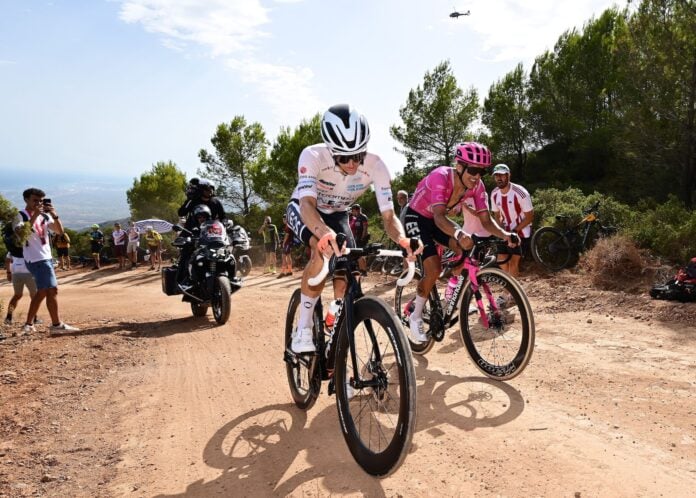
Stage 8 of the 2026 Vuelta a España gives the sprinters their clearest opportunity since Roquetes, with 171km from Puçol to Xeraco on Saturday 29 August.
After two consecutive days of climbing and GC pressure, the race finally eases. The stage is officially classified as flat, although the route is not completely featureless. The second-category Puerto de Barx, 4.7km at 5.6%, comes with 27.4km remaining and gives the stronger teams one last opportunity to complicate what otherwise looks like a conventional sprint stage.
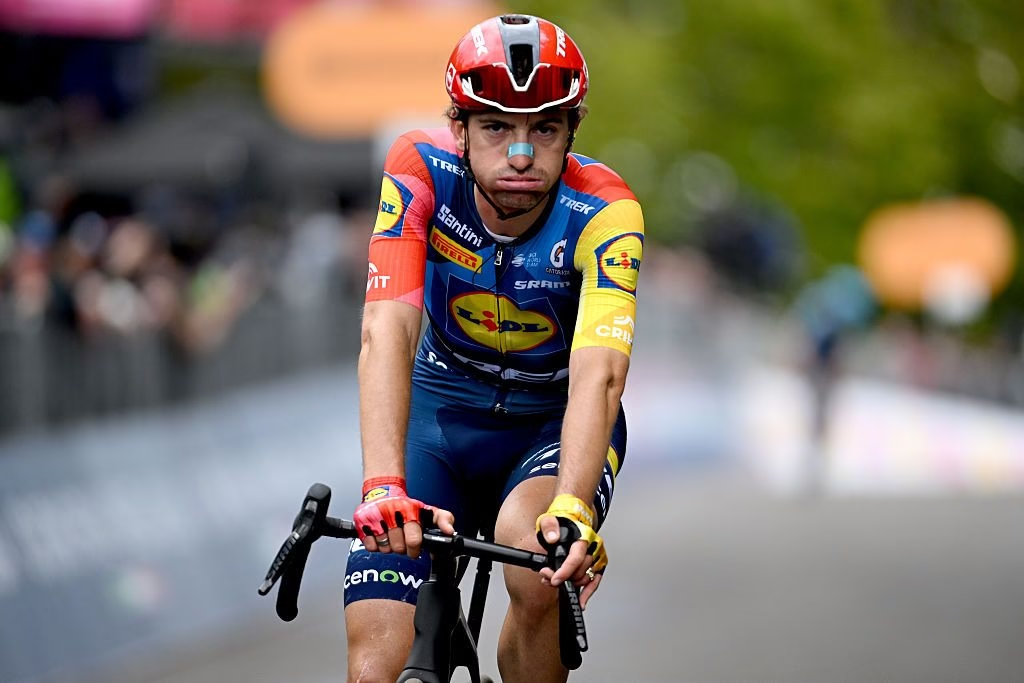
For Matthew Brennan, Jordi Meeus, Kaden Groves, Mads Pedersen and the other fast riders, this is one of the days they cannot afford to waste.
Brennan has already won twice on his Grand Tour debut. After surviving another demanding mountain stage on Friday, Xeraco gives him an immediate opportunity to make it three.
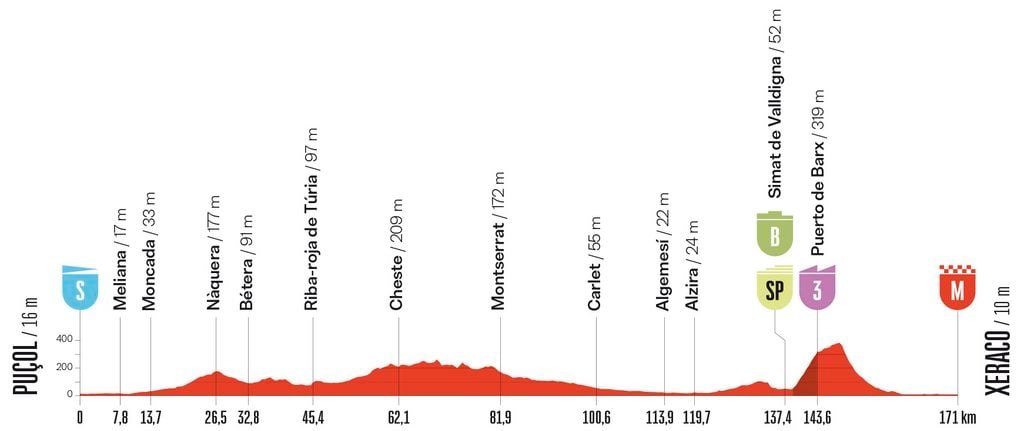
Vuelta a España Stage 8 route
Date: Saturday 29 August 2026
Start: Puçol
Finish: Xeraco
Distance: 171km
Stage type: Flat
Neutralised start: 13:42 CEST / 12:42 BST
Expected finish: Around 17:20-17:40 CEST / 16:20-16:40 BST
Main climb: Puerto de Barx
Puerto de Barx: 4.7km at 5.6%, Category 2
Summit: 27.4km from the finish
The first two-thirds of the stage take the peloton south through the Valencia region on predominantly straightforward terrain.
It is one of the relatively rare opportunities for the pure sprinters on a 2026 Vuelta route dominated by mountains, medium-mountain stages and summit finishes.
The route remains uncomplicated until the final hour, when the climb through Barx introduces the one serious question for the fast riders.
Puerto de Barx is the obstacle between the sprinters and Xeraco
Puerto de Barx starts with 32.1km remaining and measures 4.7km at an average of 5.6%, gaining 266 metres before its summit 27.4km from the finish.
Those numbers are not severe enough to make this a climbers’ stage, but they are substantial enough to expose tired sprinters after a difficult opening week.
That matters particularly after Stage 6 over Puerto El Bartolo and Friday’s summit finish at Valdelinares.
The race will not necessarily have to explode for riders to struggle. A sustained high pace on Barx could be enough to remove sprinters already carrying fatigue from the mountains.
The difficulty for teams trying to make the stage selective is what comes next.
There are more than 27km from the summit to Xeraco, initially descending before a flatter run towards the coast. Small attacking groups will therefore need a substantial advantage to stay clear of several motivated sprint teams.
Barx is more likely to decide which sprinters contest the finish than whether there is a sprint at all.
Matthew Brennan gets another major opportunity
Brennan should start among the obvious favourites.
His opening week has already produced victories in Manosque and Roquetes, giving him two wins from the stages that have most clearly suited him.
His Stage 2 victory in Manosque showed that he could handle a selective uphill finale before producing the fastest sprint.
Three days later he delivered again, with Team Visma | Lease a Bike producing a superb lead-out before Brennan won Stage 5 in Roquetes.
That second result is particularly relevant to Stage 8.
Roquetes also featured a late climb designed to make life difficult for the sprinters, but Brennan survived and still had enough speed to win convincingly.
Barx presents a similar challenge.
If Brennan reaches the summit in the main peloton or close enough to return quickly afterwards, Visma should again have one of the strongest finishing combinations in the race.
Brennan’s Vuelta has already moved beyond a breakthrough story
Two victories in the opening five stages have changed the expectations around Brennan.
Winning once on Grand Tour debut would have represented an exceptional breakthrough. Winning twice has made him one of the central figures of the first week.
ProCyclingUK looked more closely at that transformation in Matthew Brennan’s remarkable Vuelta debut is becoming much bigger than two stage wins.
Stage 8 now tests whether he can turn a brilliant opening week into something even larger.
There are relatively few conventional sprint opportunities in this Vuelta, so days such as Xeraco carry more weight than they would at a flatter Grand Tour.
Brennan cannot simply assume there will be another opportunity two days later.
When the race gives the sprinters a chance, he has to take it.
Van Aert gives Visma unusual tactical flexibility
Wout van Aert’s aggressive Stage 7 has added another dimension to Visma’s sprint strategy.
Van Aert attacked early on the road to Valdelinares and eventually finished third behind Uno-X Mobility pair Andreas Leknessund and Tobias Halland Johannessen.
The result strengthened Van Aert’s position in the green jersey competition, but on Stage 8 his most valuable role may again be helping Brennan.
Visma have already demonstrated how effective the combination of Christophe Laporte and Van Aert can be in the final kilometres.
On Stage 5, their positioning effectively placed Brennan in control of the sprint before he had even launched.
That should again be the preferred plan if Brennan survives Barx.
Visma also have a valuable Plan B.
If Brennan is dropped and cannot regain contact, Van Aert immediately becomes one of the strongest possible options from a reduced peloton.
Few teams have that sort of flexibility.
The green jersey battle gives Stage 8 extra importance
The points competition has become one of the most interesting secondary contests in the race.
Van Aert’s breakaway performance at Valdelinares moved him ahead of Pogačar, while Brennan remains close enough that the flatter stages can quickly bring him back towards the front.
The mechanics of the competition are covered in ProCyclingUK’s Vuelta a España 2026 jerseys guide.
Stage 8 matters because it is exactly the sort of day where Brennan can score heavily and Pogačar should not.
The Slovenian has accumulated points through repeated stage wins and high finishes on difficult terrain. Brennan does not have that route to points on summit finishes, meaning he must maximise the days designed for the sprinters.
That becomes even more important with Stage 9 heading immediately back into the mountains at Alto de Aitana.
Jordi Meeus is the most obvious pure sprint threat
Meeus was second to Brennan in Roquetes and looks like one of the riders most capable of reversing that result in Xeraco.
The Belgian has the outright speed required for a conventional bunch finish and should be capable of surviving Barx if Red Bull-BORA-hansgrohe manage the climb intelligently.
His biggest problem may again be positioning.
Visma’s lead-out on Stage 5 was exceptionally difficult to disrupt. Meeus never received a poor sprint opportunity, but Brennan started from the better position and simply finished the job.
If Meeus can enter the final 500 metres on Brennan’s wheel rather than several positions behind him, the contest becomes much closer.
Kaden Groves should welcome a harder Barx
Stage 8 is also well suited to Kaden Groves.
Groves is fast enough to win a conventional sprint but generally benefits when a climb removes some of the heavier specialists beforehand.
That gives his team an obvious incentive on Barx.
They do not need to attack or turn the climb into a mountain-stage effort. A sustained pace may be enough to reduce the peloton and remove several rivals.
The ideal scenario for Groves would be a group large enough to make the chase straightforward but selective enough to weaken Brennan, Meeus or other faster finishers.
A completely intact peloton probably lowers his chances.
A reduced sprint improves them considerably.

Mads Pedersen has more than one route to victory
Pedersen is another rider who should not fear Barx.
His climbing strength and durability mean he can survive a harder race than most sprinters, while his finishing speed keeps him dangerous even if the stage remains relatively controlled.
That gives Lidl-Trek options.
If Brennan looks uncomfortable, they can help increase the pace and try to make the climb decisive.
If Brennan remains comfortable, Pedersen can conserve energy and prepare for the sprint.
That versatility makes him one of the hardest riders to eliminate tactically.
He does not need the stage to follow one precise script.
Ethan Hayter could benefit from a reduced group
Ethan Hayter is another rider whose chances increase if Barx removes some of the pure sprinters.
He has already been prominent throughout the opening week, coming within fractions of beating Pogačar in the Monaco time trial and repeatedly targeting intermediate points afterwards.
Hayter may not have Brennan or Meeus’ outright top speed in a completely straightforward bunch sprint, but he has enough climbing ability to remain competitive if the final hour becomes more selective.
That makes him another rider whose team has reason to encourage a strong pace on Barx rather than simply waiting for Xeraco.
Stage 7 finally delivered Uno-X Mobility’s reward
Friday’s mountain stage belonged to Uno-X Mobility.
Andreas Leknessund attacked with 7.5km remaining on Valdelinares and rode solo to his first Grand Tour stage victory, while Tobias Halland Johannessen completed a remarkable one-two for the Norwegian team.
Van Aert finished third after spending most of the day in the breakaway.
Behind them, Pogačar again extended his advantage over the riders around him, putting another handful of seconds into Enric Mas and strengthening an already commanding red jersey position.
Stage 8 could hardly offer a greater contrast.
The Stage 7 preview centred on five categorised climbs and a summit finish at almost 2,000 metres.
Saturday is about lead-outs, positioning and whether the sprinters can survive one late climb.
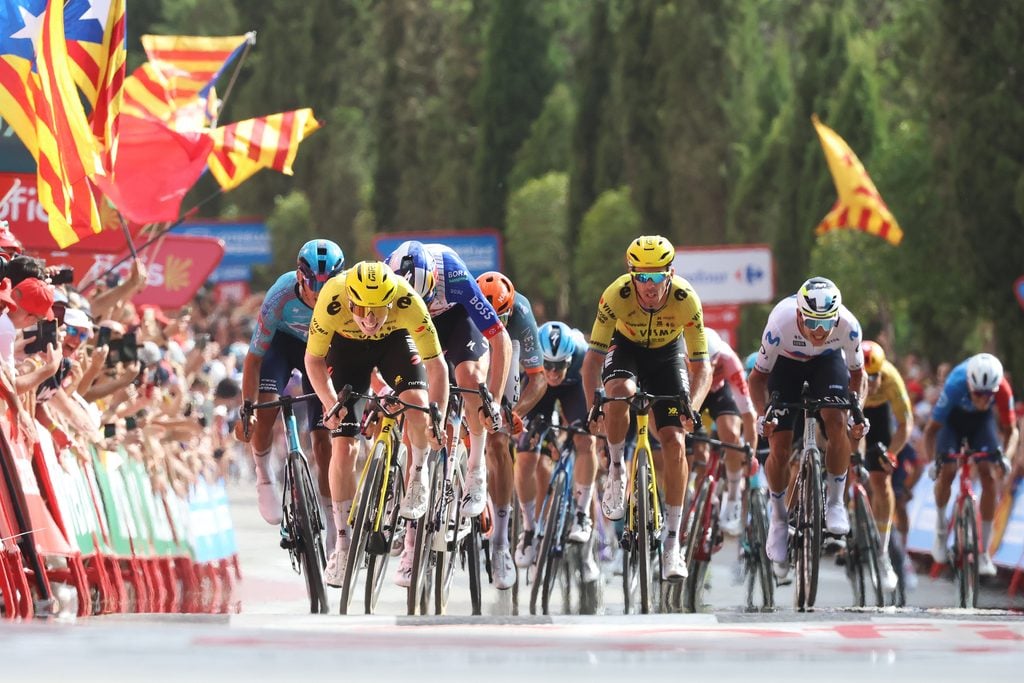 Photo Credit: Getty
The GC riders should finally get a quieter afternoon
For Pogačar, Mas, Roglič, Gall, Kuss, Onley and the rest of the general classification group, Stage 8 should primarily be about avoiding trouble.
There is little reason to spend energy attacking when Stage 9 finishes at Alto de Aitana and contains more than 5,000 metres of climbing.
UAE Team Emirates-XRG should be particularly happy to let the sprint teams assume responsibility.
Pogačar already has a substantial advantage after an opening week in which his 50km solo attack in Andorra fundamentally changed the race.
The objective on Saturday is simple: stay near the front, avoid crashes or splits and arrive in Xeraco with as little wasted energy as possible.
The only obvious wildcard is wind.
A flat Vuelta stage can quickly stop being quiet if crosswinds develop and the major teams sense an opportunity to create echelons.
Stage 9 makes energy conservation even more important
The first week ends on Sunday with one of the biggest mountain stages of the race.
Stage 9 runs 187.4km from La Vila Joiosa to Alto de Aitana, with the long summit finish coming after an exceptionally demanding day.
That makes Saturday’s flatter route particularly valuable.
The GC leaders need recovery.
The sprinters need points and a stage win.
Those competing interests should make the division of responsibility unusually clear.
Sprint teams control the race while UAE, Movistar and the other GC squads concentrate on keeping their leaders safe.
Could crosswinds disrupt the sprint?
That is the main threat to the expected scenario.
The stage takes place across the Valencia region and eventually approaches the Mediterranean coast, where exposed roads can create problems if the wind is strong enough.
Visma, Lidl-Trek, Red Bull-BORA-hansgrohe and UAE all possess enough power to exploit crosswinds if conditions become favourable.
For the GC contenders, that means Stage 8 cannot simply be treated as a recovery ride.
Positioning will remain important even if there is little climbing.
If conditions remain calm, however, the profile overwhelmingly points towards a sprint.
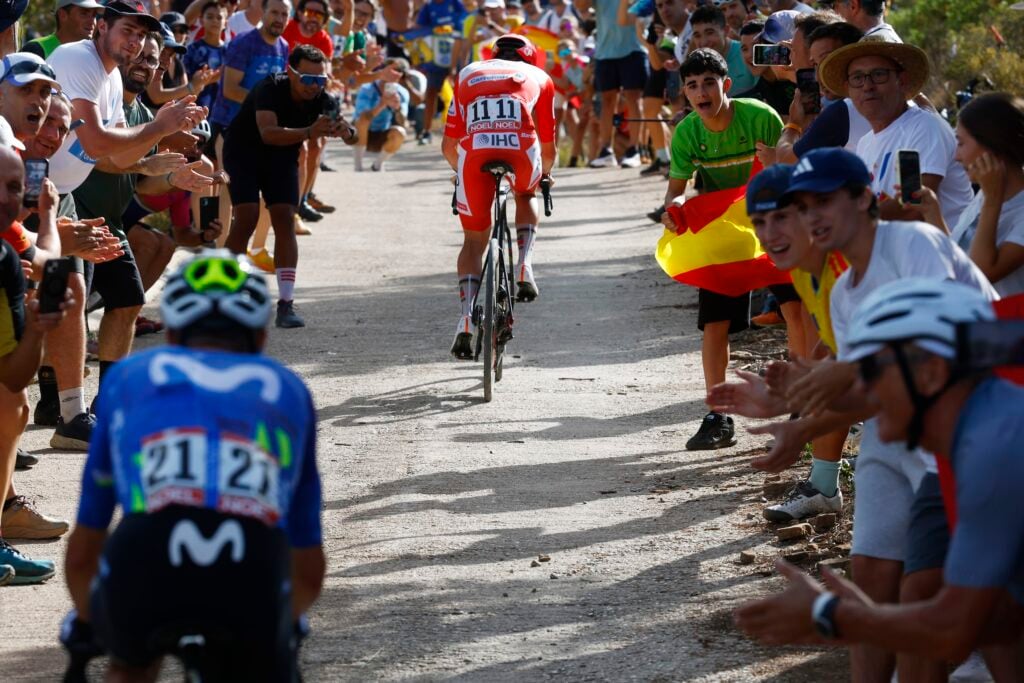 Photo Credit: Getty
The final 27km favour the peloton
Once Barx is completed, the route is difficult for attackers to defend.
The summit comes with 27.4km remaining, followed by the descent through Barx and La Drova before the race joins the N-332 for the approach to Xeraco.
By the time the peloton reaches the town itself, only 5.4km remain.
Any small group attacking around Barx therefore needs both a meaningful gap and excellent cooperation to survive.
If Brennan, Meeus, Groves and Pedersen all remain in contention, their teams should have enough collective motivation to close almost anything.
The bigger fight may be bringing riders and lead-out trains back together after the descent.
Positioning in Xeraco will matter as much as outright speed
The peloton enters Xeraco with around five kilometres remaining.
That is where the fight between the sprint trains should become serious.
The late climb could leave teams with fewer riders than normal. Some lead-out men will be dropped, while others may have spent significant energy helping a sprinter regain contact.
That creates the potential for a less structured finale than the flat profile initially suggests.
Visma have already shown that they can impose order on that chaos.
For anyone unfamiliar with how those battles develop before the sprint itself, ProCyclingUK’s guide to how a bunch sprint works explains why the final result is often decided well before the last 200 metres.
If Laporte and Van Aert again deliver Brennan into the final kilometre near the front, the rest will have a difficult job getting past him.
What time does Vuelta a España Stage 8 start?
The neutralised start in Puçol is scheduled for 13:42 CEST, or 12:42 BST.
The fastest official schedule places the finish in Xeraco at 17:20 CEST / 16:20 BST, with the slower projection extending to 17:40 CEST / 16:40 BST.
The key approximate UK timings are:
| Stage 8 point | UK time |
|---|---|
| Neutralised start | 12:42 BST |
| Algemesí | Around 15:05-15:19 BST |
| Puerto de Barx begins | Around 15:37-15:53 BST |
| Puerto de Barx summit | Around 15:47-16:04 BST |
| Xeraco, 5.4km to go | Around 16:13-16:33 BST |
| Expected finish | Around 16:20-16:40 BST |
Anyone primarily interested in the decisive part of the stage should aim to be watching by 15:30 BST.
That should capture the entire approach to Barx, any attempts to drop the sprinters and the run towards Xeraco.
-
 Photo Credit: Getty
 -
 Photo Credit: Cs-wolves / Wikimedia Commons, CC BY-SA 4.0

Stage 8 tactical outlook
The expected pattern is relatively straightforward.
A small breakaway should be allowed to establish itself before the sprint teams begin controlling the gap.
Visma have the clearest motivation because Brennan has already won twice and remains heavily involved in the points competition.
Red Bull-BORA-hansgrohe should have reason to work for Meeus, while the teams of Groves and Pedersen can contribute if their sprinters remain the chosen options.
Barx is the tactical pivot.
Teams with more durable fast riders will try to make it uncomfortable. Those built around purer sprinters will attempt to control the pace and keep the gap manageable if their leader is briefly distanced.
If Brennan crosses Barx comfortably, the incentive for prolonged attacking should fall quickly.
From there, the odds move increasingly towards another bunch finish.
Vuelta a España Stage 8 prediction
Matthew Brennan is the rider to beat.
He has already won both stages that have suited him particularly well, has one of the strongest lead-outs in the race and proved at Roquetes that a late climb does not automatically remove him from contention.
The main question is whether Barx is ridden hard enough to expose him after two difficult mountain days.
Jordi Meeus looks like the clearest pure-speed threat after finishing second to Brennan on Stage 5, while Kaden Groves and Mads Pedersen become increasingly dangerous if the climb creates a reduced peloton.
Ethan Hayter is another rider who should benefit from a more selective approach.
Van Aert remains Visma’s wildcard. If Brennan survives, his most valuable role is likely to be helping deliver him. If Brennan is dropped, Visma immediately have another rider capable of winning the stage.
After two days dominated by climbs and the general classification, Stage 8 gives the fast riders their race again.
So far, when the Vuelta has given Brennan that opportunity, he has not missed.

