Arnaud De Lie’s 2026 Tour de France is over after a brutal stage 3 struggle to Les Angles, ending a race that had already looked fragile before the Grand Départ had properly begun.
The Lotto-Intermarché sprinter abandoned on the Tour’s first mountain stage after spending much of the day chasing behind the peloton and trying to keep his race alive. It was not a formal outside-the-time-limit result. The official Tour records it as an abandon. But by the time De Lie’s race ended, the day had already become a long fight against the time cut, the mountains and an illness-hit body.
That is what made it so uncomfortable to watch.
De Lie had already started the race under caution. He missed the team presentation in Barcelona with a stomach issue, then cut short his stage 1 team time-trial reconnaissance before the race even began. Lotto-Intermarché still hoped he could recover enough to start, but the warning signs were there before the opening kilometre.
Stage 3 showed those doubts were justified.
For the background to his troubled build-up, see our earlier piece on Arnaud De Lie’s 2026 Tour de France start under caution after a stomach upset.
De Lie dropped early on the first mountain stage
Stage 3 from Granollers to Les Angles was always going to be a hard day for the sprinters.
The route covered 195.9km, with 3,850m of climbing, the category 1 Col de Toses, the Col du Calvaire and a summit finish at Les Angles. It was the first proper climbing test of the 2026 Tour de France, and it arrived after an intense opening weekend in Barcelona.
For a fully fit sprinter, this was a day to survive.
For De Lie, it quickly became something worse. He was distanced early, long before the yellow jersey fight began to take shape. Once that happened, the stage changed completely. His race was no longer about conserving energy in the gruppetto or getting through a difficult mountain day with the other fast men. It became a chase.
At one point, De Lie was already several minutes behind with more than 150km still to race. Later, the gap was close to 20 minutes. By the final part of the stage, he was more than half an hour down, with the time cut becoming the real opponent.
The main race was ahead, where Tadej Pogačar beat Jonas Vingegaard at Les Angles and took the yellow jersey. De Lie’s race was somewhere behind that, reduced to survival.
For the stage itself, see our Tour de France 2026 stage 3 report and stage 3 live viewing and start time update.
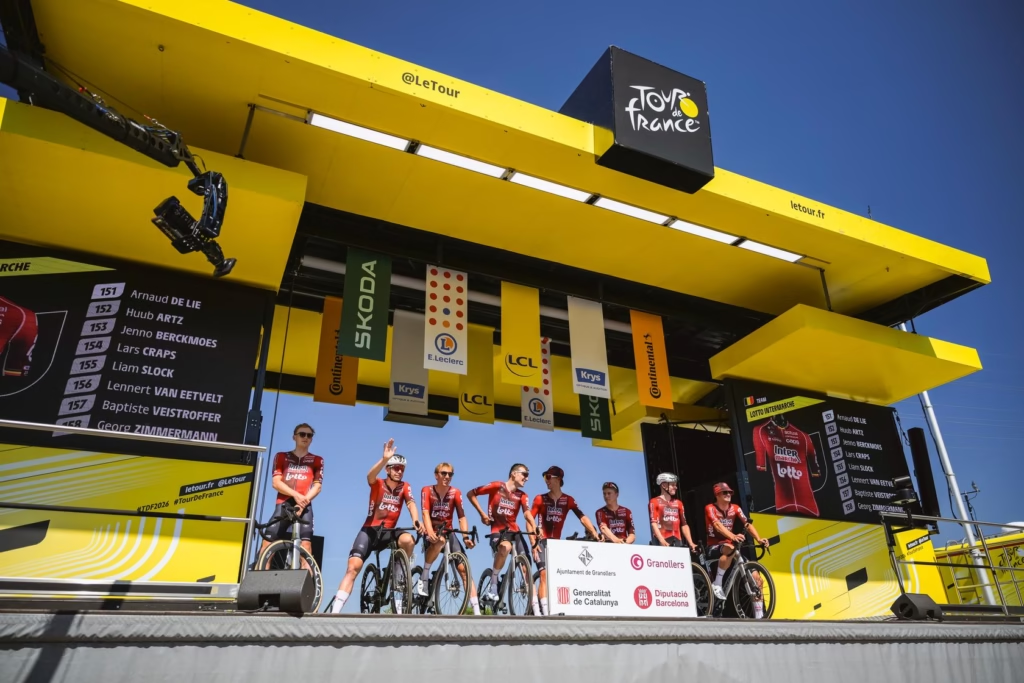 Photo Credit: A.S.O./Charly López
A Tour that never properly began
The difficult part of De Lie’s Tour is that it never really had a chance to become the race Lotto-Intermarché had planned.
He arrived as the team’s main sprint card. On paper, that made sense. De Lie is powerful, durable and usually well suited to the kind of awkward sprint stages that are not simple drag races for pure speed. The Tour de France 2026 route includes several days where a rider with his profile could have mattered.
The issue was health.
A stomach problem is not a minor detail at the Tour. Riders need to eat, drink, recover and repeat the same effort day after day. If that system is already compromised before the race starts, the Tour does not give much time to hide. A team time trial, a punchy stage in Barcelona and then a mountain day to Les Angles was a harsh opening sequence for a rider trying to recover.
De Lie’s stage 3 DNF therefore says less about his ability as a Tour sprinter than it does about the risk of starting a Grand Tour below full health.
He did not leave because he was too slow in the sprints. He left before the sprint stages had really arrived.
Why the time cut became the story
The time cut is one of the Tour de France’s quieter cruelties.
Every stage has a daily limit based on the winner’s time, the stage type and the race regulations. Riders who finish outside that limit can be eliminated, unless the commissaires apply an exception. Mountain stages are usually more generous than flat stages, but they can still become dangerous if the front of the race is fast and the back of the race is already in trouble.
That is why sprinters rely on the gruppetto. They form a group, share the pacing, manage the climbs and try to stay inside the calculation. They are not racing for the stage. They are racing to remain in the Tour.
De Lie’s problem was that he was in difficulty too early. Once a rider is dropped from the main gruppetto, or cannot sit comfortably inside it, the task becomes much harder. There are fewer wheels, less rhythm and less margin. Every climb becomes another leak in the clock.
Our explainer on how Tour de France time cuts work goes into the calculation in more detail, while what is the broom wagon at the Tour de France? explains the difference between abandoning and missing the time limit.
De Lie’s stage 3 was an abandon. But emotionally and tactically, it was still a time-cut story.
Why stage 3 was such a bad match for an ill sprinter
A summit finish makes a difficult day even harder for sprinters.
On some mountain stages, a rider can lose time on the climbs and then recover some rhythm on a flatter run-in. Stage 3 did not offer that kind of escape. The final climb to Les Angles meant the day finished uphill, at the point when a weakened rider would normally be most desperate for relief.
That is why the final part of the stage was so punishing.
The Col de Toses had already done damage. The Col du Calvaire added more. The last climb then left no easy kilometres to reduce the pressure. If De Lie was already empty, there was no obvious place to rebuild the day.
That is the basic reason sprinters suffer in the Tour de France mountains. Their strengths are explosive power, positioning and speed at the end of a stage. A long mountain day asks different questions: climbing efficiency, repeated endurance, heat management and the ability to keep fuelling when the body is under stress.
Those demands become far harsher when illness is already part of the equation.
For newer fans, our guide to what a summit finish is in the Tour de France explains why days like Les Angles can be so decisive at both ends of the race.
What Lotto-Intermarché lose
For Lotto-Intermarché, De Lie’s exit changes the shape of their Tour.
He was their clearest fast-finishing option and one of the riders who could make rolling sprint stages realistic targets. Without him, the team lose a rider who could have contested stages, chased green jersey points and forced other sprint teams to think about harder finishes.
The tactical effect is simple. Lotto-Intermarché now have to lean more heavily into breakaways, opportunistic racing and any remaining all-round options. They can still have a visible Tour, but the most obvious plan has gone after only three stages.
It also changes the wider sprint picture. De Lie was part of the pre-race conversation in our Tour de France 2026 sprinters guide and best sprinters at the Tour de France 2026 feature. His absence removes one of the stronger names from the points and stage-win equation before the race has reached several of the best sprint opportunities.
The Tour de France 2026 route: best days for sprinters now reads differently for Lotto-Intermarché. The stages are still there. Their main finisher is not.
-
 Photo Credit: Simon Wilkinson/SWpix.com
Not a failure, but a limit reached
This was not a failed sprint campaign in the usual sense.
De Lie did not come to the Tour, get beaten repeatedly and fade from the green jersey battle. He barely got the chance to enter it. His race ended before the first week had opened up the stages that might have suited him.
That distinction matters.
A Tour DNF can look blunt on paper. In this case, the story behind it is more specific. De Lie started under a health cloud, tried to race through it, was exposed by the first mountain stage and reached the point where continuing no longer made sense.
There is no shame in that. The Tour is not built to be kind to compromised riders. It is built to find them.
What comes next for De Lie?
The immediate answer should be recovery.
De Lie does not need another public survival effort. He needs to get healthy, reset properly and rebuild the second half of his season away from the pressure of a race that was moving too quickly for him.
The bigger question is how Lotto-Intermarché approach his next Grand Tour plan. De Lie is still young enough and good enough to win stages at the Tour. His profile still fits the kind of hard sprint days that can make a rider valuable in July. But this race showed again that getting to the start is not the same as being ready to race.
A fully fit De Lie remains exactly the sort of rider who can win Tour stages: powerful, robust, aggressive and fast enough to punish teams that underestimate him.
The 2026 Tour simply never saw that rider.
Main photo credit: Thomas Maheux