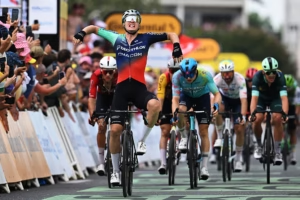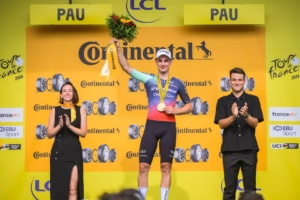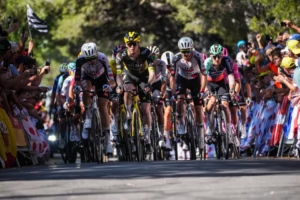
The Tour de France Femmes did not appear from nowhere in 2022. It returned through pressure, compromise, frustration and proof.
There had been women’s stage races linked to the Tour before. The female peloton joined the Tour family in 1984, with the early race creating champions such as Marianne Martin, Maria Canins and Jeannie Longo. Longo’s final wins in that era, from 1987 to 1989, still sit in the background of the modern race’s story.
But the modern Tour de France Femmes was not a simple continuation. It came after years in which women’s cycling had no stable, high-profile Tour-branded stage race. La Course by Le Tour de France, launched in 2014, became the bridge between absence and return. It was important, but it was also never enough.
That tension is what made the 2022 launch matter. The Tour de France Femmes avec Zwift was not just another new race. It was the moment the idea of a women’s Tour de France became a proper stage race again.
Our complete history of the Tour de France Femmes covers the longer story, from the earlier editions to the modern yellow jersey.
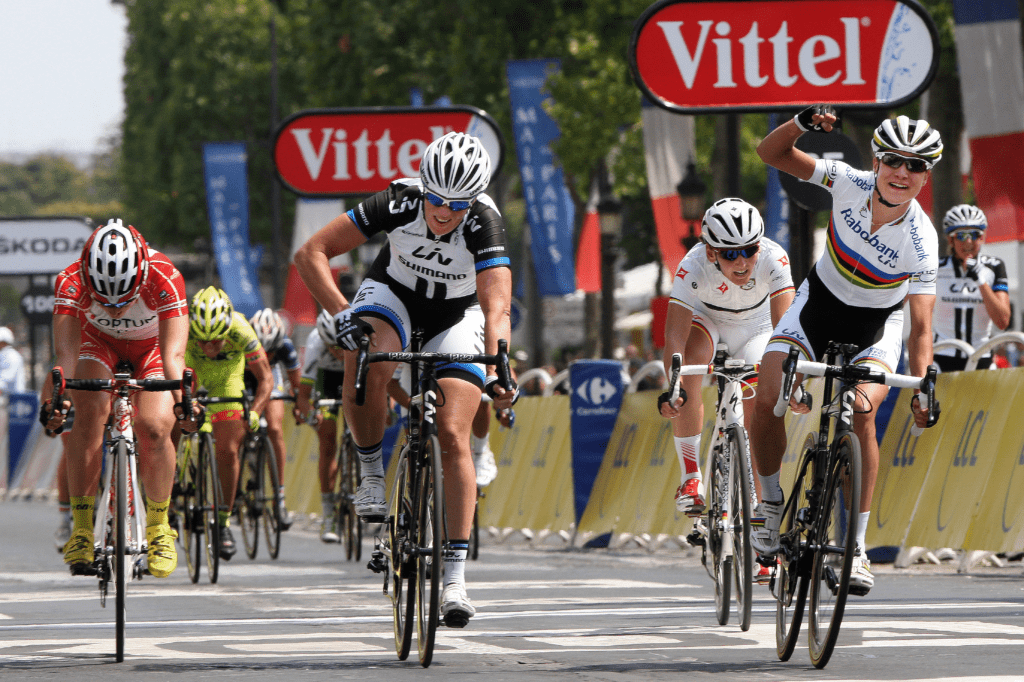
Quick answer: how did the Tour de France Femmes return?
The modern Tour de France Femmes returned after years of pressure for a women’s Tour de France, followed by the creation of La Course in 2014 and then the launch of an eight-day Tour de France Femmes in 2022. La Course gave women’s cycling visibility on the Tour platform, but it was mostly a one-day event. The Tour de France Femmes turned that visibility into a proper stage race with daily live television coverage, jerseys, general classification and a full race narrative.
| Year | Moment | Why it mattered |
|---|---|---|
| 1984 | Women’s Tour de France era begins | Women raced under the Tour umbrella |
| 1987-1989 | Jeannie Longo wins three editions | Created a French Tour icon |
| 2009 | Final Grande Boucle-style race era fades | Leaves no stable women’s Tour equivalent |
| 2013 | Le Tour Entier campaign gathers momentum | Riders and campaigners push ASO publicly |
| 2014 | La Course begins on the Champs-Élysées | Women return to the Tour platform |
| 2021 | ASO announces Tour de France Femmes | Confirms a new stage race from 2022 |
| 2022 | First modern Tour de France Femmes | Eight days, yellow jersey and live TV |
| 2025 | Pauline Ferrand-Prévot wins | First French winner of the modern race |
| 2026 | Fifth modern edition | Race continues to build its own history |
Why this was a return, not a first beginning
It is tempting to call 2022 the start of the women’s Tour de France. That is too simple.
Women had already raced versions of a Tour de France-linked stage race. The 1984 edition began a run that produced landmark winners and gave the women’s peloton a place alongside the men’s event, even if the race never received the same support, stability or cultural weight.
That distinction matters. The Tour de France Femmes is modern, professional and commercially different, but it is also part of a longer unfinished line. It did not invent the ambition. It revived it under conditions that finally made it more sustainable.
The modern race therefore carries two meanings. It is a new event in its current form, and it is a correction to a history in which women’s stage racing around the Tour had been allowed to drift, shrink and disappear.
For readers trying to place the current race within the sport, our beginner’s guide to Tour de France Femmes 2026 explains the format, jerseys and race structure.
The campaign that forced the issue
The pressure for a women’s Tour did not come from nowhere. It came from riders, campaigners and a wider shift in how women’s cycling was being discussed.
Le Tour Entier, led by figures including Kathryn Bertine, Marianne Vos, Emma Pooley and Chrissie Wellington, pushed the issue directly. Their campaign called for women to have their own Tour de France and drew major media attention.
That did not immediately create a full stage race. What it did create was visibility. It made the absence harder to ignore. It also challenged ASO to do something more tangible than talk about the difficulty of organising a women’s Tour.
La Course was the first result.
La Course: a showcase with real value
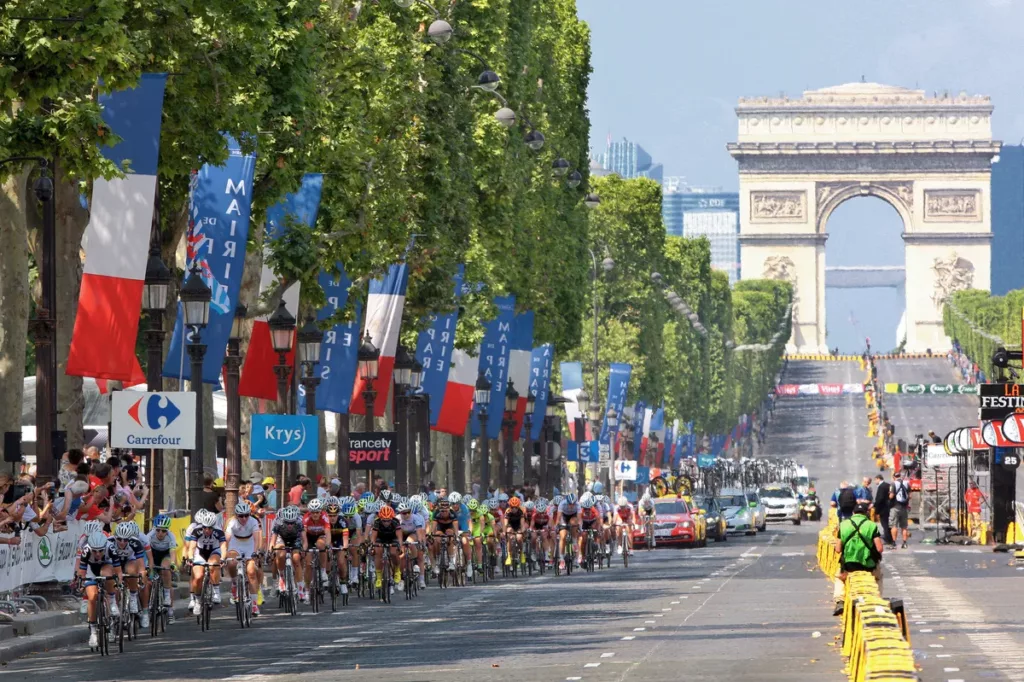
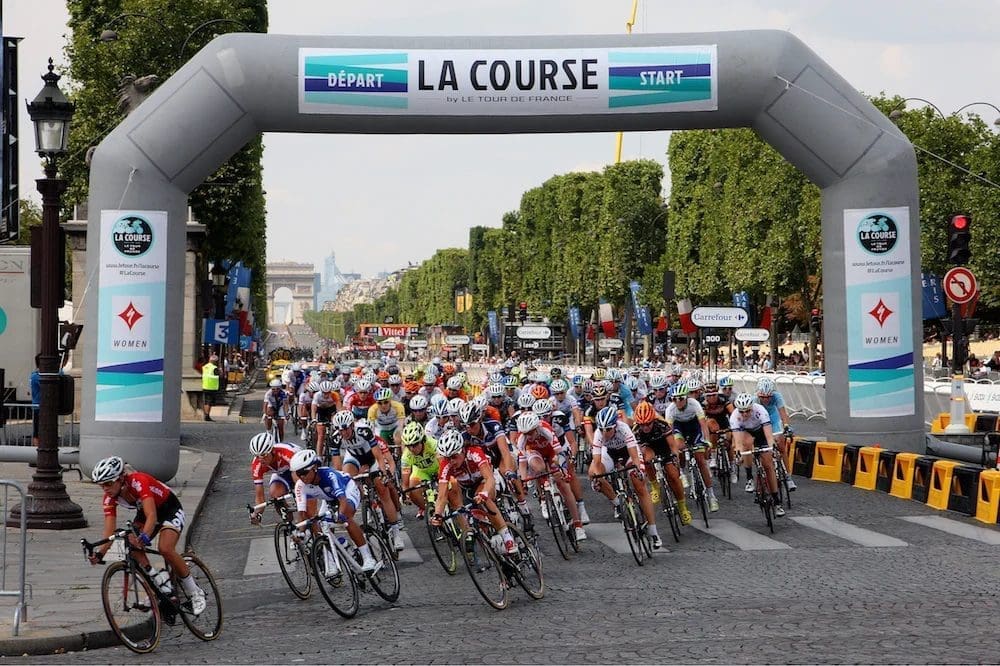
La Course began in 2014 on the Champs-Élysées, held on the final day of the men’s Tour de France. Marianne Vos won the first edition in a sprint, a fitting result given her role as one of the key voices behind the push for a women’s Tour.
It was a powerful image. The women raced on the most recognisable finishing circuit in cycling, in front of Tour crowds, with television visibility and the symbolic weight of Paris. For a sport that had often been denied space on the biggest platforms, that mattered.
La Course was not only a token. It gave sponsors, broadcasters and organisers proof that women’s racing could sit inside the Tour’s media machine and hold attention. It gave riders a race that mattered, even if it was not yet the race they wanted.
That is why La Course should not be dismissed. It was imperfect, but it was useful.
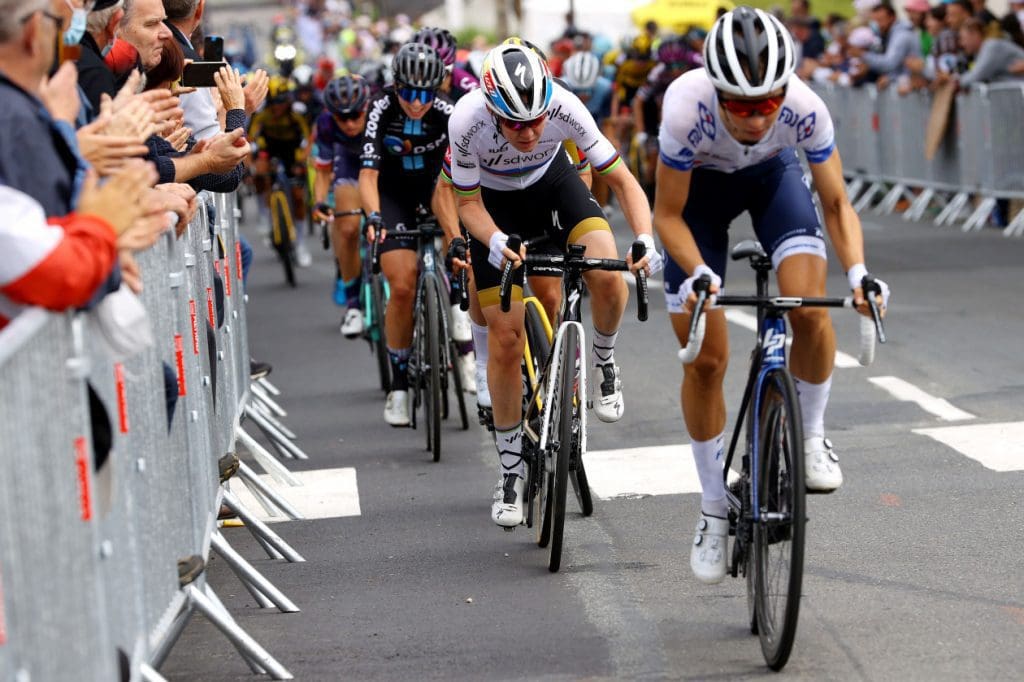 Photo Credit: Getty
Why La Course was not enough
The problem was never that La Course had no value. The problem was that it was too small for the job it was being asked to do.
For most of its life, La Course was a one-day race. It moved through different Tour-linked formats and locations, including flat circuits, punchier courses and mountain-linked editions, but it never became the multi-day race that campaigners had originally demanded.
That limited what it could mean.
A one-day race can be prestigious, but it cannot recreate the central idea of the Tour de France. It cannot build a yellow jersey story across a week. It cannot test climbing, sprinting, time gaps, recovery, crashes, team tactics and pressure over multiple days. It cannot create the same slow accumulation of meaning.
La Course gave women’s cycling a stage. It did not give it a Tour.
What changed with the Tour de France Femmes
The 2021 announcement of the Tour de France Femmes was the structural change.
ASO confirmed that the new women’s race would begin in 2022, carry the Tour de France name and run over eight days. It would have the Women’s WorldTour label, use Tour symbols and classifications, and benefit from daily live television coverage.
That last point was crucial. A stage race without visibility risks becoming another event on the calendar. A Tour-branded stage race with daily live coverage becomes a major sporting property.
The announcement also showed that the race was being built as more than a short companion event. The yellow jersey, polka-dot jersey, young rider classification, timekeeping, sponsors and broadcast plan all placed it inside the Tour de France world.
That did not make it equal to the men’s Tour. It did make it recognisably a Tour.
For a direct comparison, our guide to the Tour de France Femmes vs the Tour de France explains where the two races overlap and where they differ.
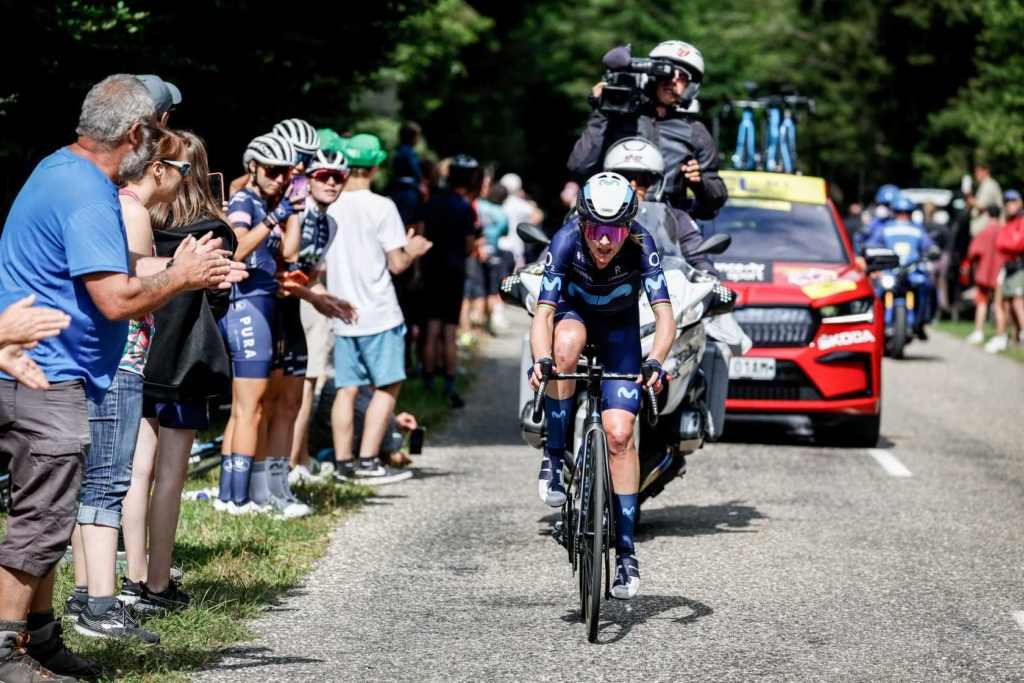 Photo Credit: A.S.O./Fabien Boukla
The 2022 race proved the concept
The first modern Tour de France Femmes had to do several things at once.
It had to prove that the race could hold public attention after the men’s Tour had finished. It had to show that an eight-day women’s stage race could create a compelling sporting arc. It had to satisfy fans who wanted a proper race rather than a ceremonial add-on. It had to show sponsors and broadcasters that the product worked.
It did that.
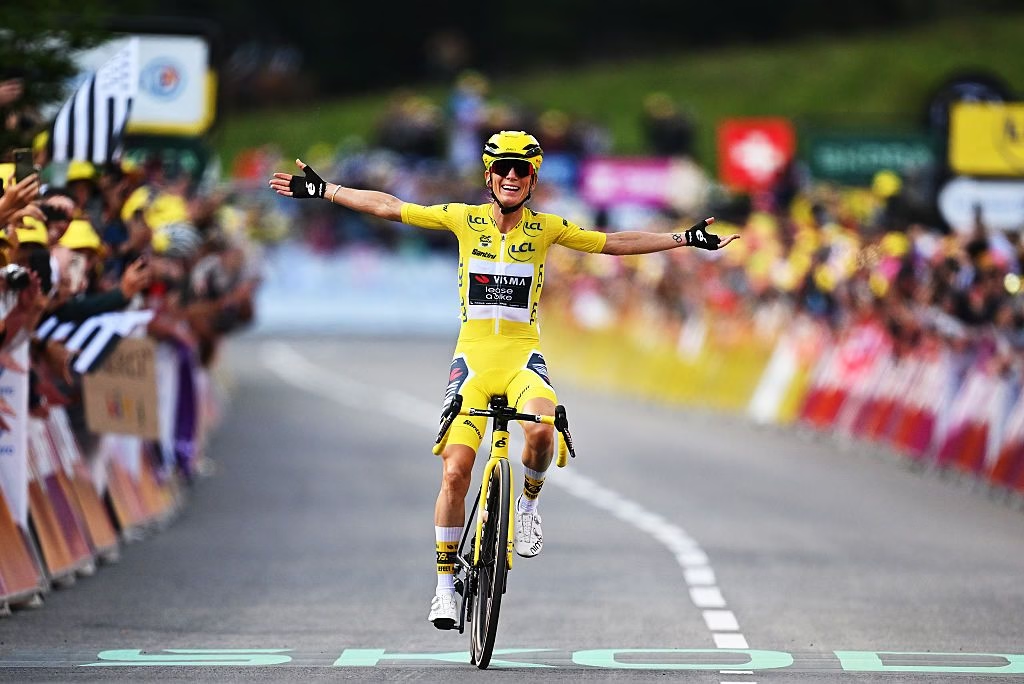
Annemiek van Vleuten won the first edition after transforming the race in the Vosges, first with a long-range move on stage 7 to Le Markstein, then by winning again on La Super Planche des Belles Filles to secure overall victory.
That was important because the race did not feel like a marketing exercise by the final weekend. It felt like a Grand Tour-style contest compressed into eight days: illness, attacks, collapses, mountain dominance, team stress and a champion forged by terrain.
The sporting credibility arrived quickly.
Why the yellow jersey mattered
The yellow jersey was central to the return.
La Course could produce great winners, but it could not build a yellow jersey identity. The Tour de France Femmes could. Once the race had daily classifications, leadership pressure and a final overall winner, it became easier for casual viewers to follow and easier for the race to build its own memory.
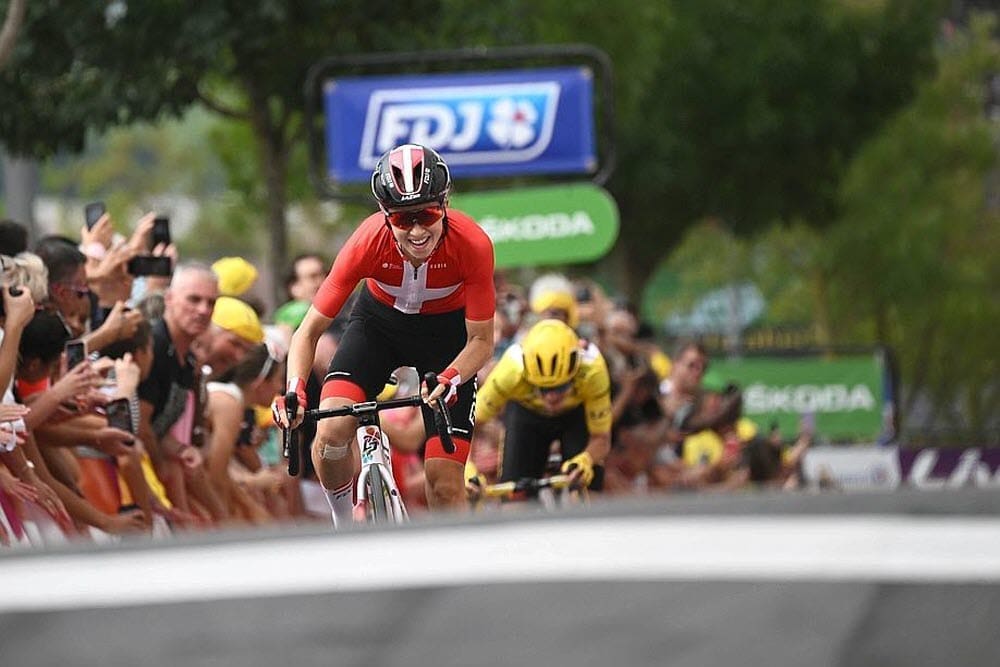
That is why the modern winners list already matters. Annemiek van Vleuten won in 2022, Demi Vollering followed in 2023, Kasia Niewiadoma-Phinney won in 2024, and Pauline Ferrand-Prévot became the first French winner of the modern race in 2025.
That sequence gives the race identity. It is no longer just “the women’s Tour is back”. It has its own champions, heartbreaks, mountains, rivalries and reference points.
Our Tour de France Femmes winners list tracks that modern roll of honour.
The race had to be different from the men’s Tour
One of the lazy arguments around the women’s Tour is that it should either match the men’s race exactly or be treated as lesser.
The better view is that the Tour de France Femmes needed to become its own race.
An eight or nine-day structure is not the same as three weeks, but it can still be hard, tactically rich and commercially readable. In some ways, the shorter format helps the modern race. There is little dead time. Every stage matters. One mistake can shape the whole event. The GC tension arrives quickly.
That does not remove the bigger questions about prize money, length, television exposure and long-term equality. It does mean the race should not be judged only by whether it copies the men’s Tour. Its job is to be the best version of a women’s stage race under the Tour banner, then keep growing from there.
Our explainer on why the Tour de France Femmes is only nine stages looks at that format question in more detail.
Why the modern race needed La Course first
La Course is easy to criticise in hindsight because the Tour de France Femmes is obviously bigger and better. But the modern race may have needed that intermediate step.
La Course showed that there was an audience. It gave ASO a women’s race under the Tour brand. It gave broadcasters a product to show. It gave riders a platform to keep making the case. It also created frustration, and that frustration mattered because it kept the demand alive.
In that sense, La Course was both a compromise and a catalyst.
It was not the destination, but it helped make the destination harder to avoid.

How the Tour de France Femmes has built its own landmarks
The strongest sign of the modern race’s growth is that it is no longer only being defined by its return.
It now has its own landmarks. Van Vleuten on La Super Planche des Belles Filles in 2022. Vollering’s 2023 victory. Niewiadoma-Phinney’s narrow 2024 success. Ferrand-Prévot’s 2025 French triumph. Alpe d’Huez, the Col de la Madeleine and Mont Ventoux have all become part of the Tour de France Femmes story.
That matters. A race becomes real in the public imagination when it has places, not just dates. The Tour de France Femmes now has those.
The 2026 edition continues that process, and our Tour de France Femmes 2026 route guide explains how the latest route fits into the race’s growing identity. The full dates and stages are also laid out in our Tour de France Femmes 2026 calendar.
What the return says about women’s cycling
The return of the Tour de France Femmes reflects a wider professionalisation of women’s cycling.
It is not only about one race. The Women’s WorldTour, stronger team structures, minimum salary progress, better broadcast expectations, deeper fields and more race days all helped create the conditions for a modern Tour-branded stage race to work.
That is why the 2022 launch succeeded in a way that might have been harder a decade earlier. The peloton was ready. The teams were stronger. The athletes were marketable. The racing product was already there. What had been missing was the platform.
The Tour de France Femmes did not create the quality of women’s cycling. It exposed it to a larger audience.
Our guide to what the Women’s WorldTour is explains the top tier that now gives the race its wider competitive setting.
What still needs to improve
The return of the Tour de France Femmes was a major step, but it was not the end of the argument.
The race is still shorter than the men’s Tour. Prize money remains a live issue. Broadcast depth can still vary by market. Team budgets are not equal. The wider women’s calendar still has gaps, pressure points and races that need more secure backing.
That does not make the Tour de France Femmes a failure. It makes it a platform with unfinished work attached.
The key difference from the La Course era is that the argument now starts from a stronger place. Women’s cycling is not asking whether it deserves to be seen on the Tour stage. It is already there. The question is how far the organisers, broadcasters, sponsors and sport’s governing bodies are prepared to take it.
La Course’s legacy
La Course’s legacy is complicated, and that is why it is interesting.
It was a compromise race that frustrated many of the people it was supposed to satisfy. It was too short, too dependent on the men’s Tour and too limited to act as a genuine women’s Tour de France. But it also gave women’s cycling a visible Tour-branded platform at a time when that mattered.
Marianne Vos winning the first edition on the Champs-Élysées remains symbolically neat. One of the riders who helped push the conversation forward also won the race that became the first official response.
In the end, La Course should be remembered neither as enough nor as nothing. It was the bridge. The Tour de France Femmes is what stood on the other side.
-
 Photo Credit: A.S.O./Charly López
Verdict: the modern race returned because pressure met proof
The Tour de France Femmes returned because pressure met proof.
Campaigners forced the question. La Course proved visibility. The Women’s WorldTour strengthened the sporting base. Sponsors and broadcasters saw enough to support a bigger product. ASO eventually moved from a showcase race to a stage race with the symbols, structure and exposure needed to matter.
The result is not perfect, but it is real.
That is the difference between La Course and the Tour de France Femmes. La Course asked the public to notice women’s cycling for a day. The Tour de France Femmes asks them to follow a race, understand its story, remember its winners and come back next year.
That is how a modern race returns. Not in one announcement, but through years of pressure, proof and persistence.
FAQs
What was La Course by Le Tour de France?
La Course was an elite women’s race organised by ASO from 2014 to 2021. It was linked to the Tour de France and began as a one-day race on the Champs-Élysées, with Marianne Vos winning the first edition.
Why was La Course important?
La Course gave women’s cycling visibility on the Tour de France platform. It showed that the women’s peloton could attract attention, sponsors and broadcast interest, but it was too short to replace a proper stage race.
Why was La Course criticised?
La Course was criticised because it was mostly a one-day event. Campaigners and riders wanted a multi-day women’s Tour de France, not only a showcase race linked to the men’s event.
When did the Tour de France Femmes start?
The modern Tour de France Femmes began in 2022. It launched as an eight-day stage race under the Tour de France banner.
Who won the first modern Tour de France Femmes?
Annemiek van Vleuten won the first modern Tour de France Femmes in 2022 after dominant mountain performances in the Vosges and on La Super Planche des Belles Filles.
Is the Tour de France Femmes the same as the old women’s Tour de France?
No. It is the modern Tour-branded women’s stage race, launched in 2022, but it follows a longer history of women’s Tour-linked races dating back to the 1980s.
Why does the Tour de France Femmes matter?
It matters because it gives women’s cycling the Tour de France platform, daily television exposure, a yellow jersey race and a major stage-race identity. It has already created its own champions, climbs and storylines.