
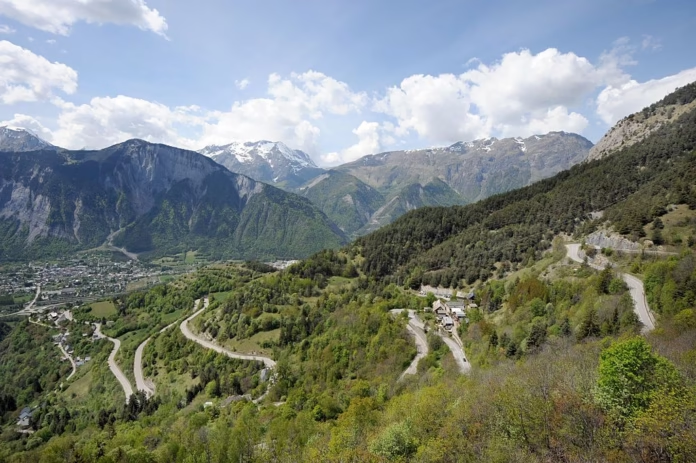
Alpe d’Huez is neither the longest nor consistently the steepest climb used by the Tour de France, but no summit finish has produced a richer collection of defining images.
Fausto Coppi established its legend at the Tour’s first summit finish in 1952. Joop Zoetemelk and Hennie Kuiper helped turn it into the Dutch mountain. Bernard Hinault and Greg LeMond crossed the line together in 1986 while fighting an increasingly bitter internal battle. Marco Pantani produced the fastest climbing performances associated with the ascent during the 1990s.
Giuseppe Guerini survived a collision with a spectator. Carlos Sastre used the climb to win the 2008 Tour. Geraint Thomas confirmed his authority in yellow in 2018, while Tom Pidcock became the most recent men’s Tour winner on Alpe d’Huez after escaping from the breakaway in 2022.
Each return adds another layer to a mountain already carrying more history than most entire races.
These are the 10 greatest Alpe d’Huez moments in Tour de France history.
Why is Alpe d’Huez so famous?
The traditional ascent from Bourg-d’Oisans measures 13.7km at 8.1% on the 2026 Tour route and contains 21 numbered hairpins. The steepest sustained section comes near the bottom, where the road rises sharply towards La Garde before settling into its famous sequence of bends.
The climb first appeared in 1952 but was not used again until 1976. It then became a regular feature of the Tour, with Dutch riders dominating so frequently that supporters began calling it the Dutch mountain.
Its importance comes from more than statistics.
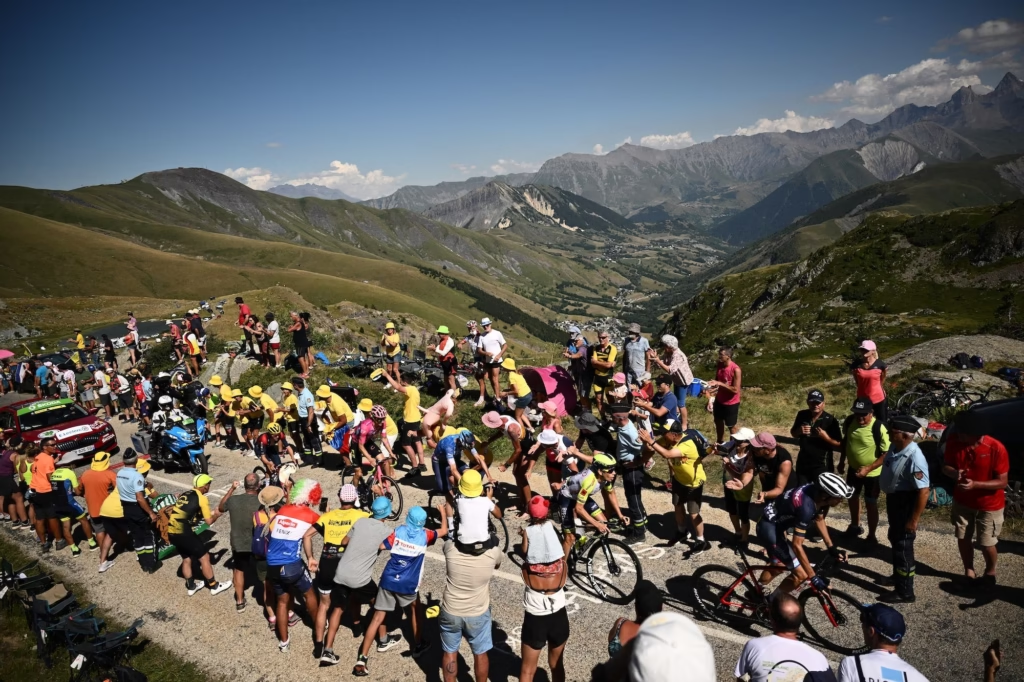
The roadside crowds create a confined wall of noise. Each bend carries the names of former winners. The changing direction allows television cameras to show riders at several different points on the mountain, while the exposed upper slopes provide some of the Tour’s most recognisable images.
The climb’s physical character and place within the race are explored in Alpe d’Huez: why the Tour still fears the 21 bends.
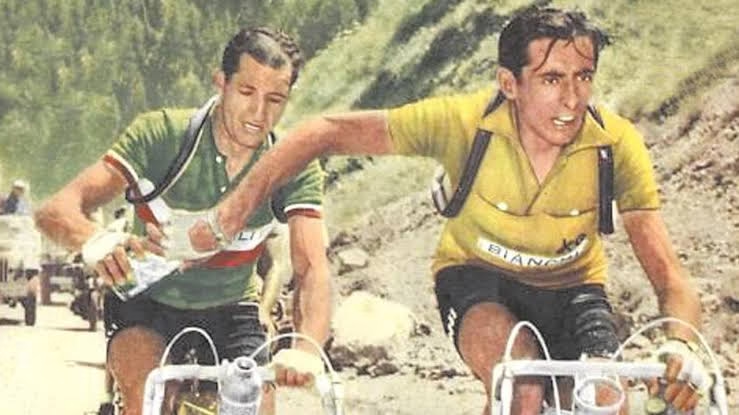
1. Fausto Coppi creates the Alpe d’Huez legend in 1952
Alpe d’Huez entered the Tour de France on 4 July 1952 at the end of a 266km stage from Lausanne.
It was the first summit finish in Tour history.
The road was still largely unpaved, the ski resort had none of its later cycling mythology and organisers could not know whether the experiment would become a permanent part of stage-race design.
Coppi supplied the answer.
The Italian attacked on the ascent, won the stage and moved into the yellow jersey. He retained the lead through to Paris, completing the Giro-Tour double for the second time.
His performance established the sporting value of finishing Tour stages at altitude. Climbs no longer needed to serve only as obstacles before a descent into a valley town. The mountain itself could become the arena.
The Tour did not return to Alpe d’Huez for another 24 years, but the template had been established. Coppi had won the first summit finish and helped create one of the most influential ideas in Tour route design.
The complete development of the climb is covered in a history of Alpe d’Huez at the Tour de France.
2. The Dutch turn Alpe d’Huez into their mountain
When the Tour returned in 1976, Joop Zoetemelk immediately began the climb’s Dutch era.
Zoetemelk won that year and again in 1979. Hennie Kuiper added victories in 1977 and 1978, while Peter Winnen succeeded in 1981 and 1983. Steven Rooks and Gert-Jan Theunisse extended the sequence in 1988 and 1989.
Eight Dutch victories transformed one part of the climb into a travelling national stadium.
Hairpin seven became known as Dutch Corner, where orange-clad supporters created one of the most intense roadside atmospheres in cycling. The Dutch success was so sustained that Alpe d’Huez acquired the nickname “the Dutch mountain”, despite sitting deep inside the French Alps.
Zoetemelk’s 1976 victory is the natural starting point.
He defeated Lucien Van Impe on the first return to the ascent, helping convince organisers that Alpe d’Huez could become a recurring part of the Tour rather than a one-off post-war experiment.
Coppi created the legend. The Dutch made it a tradition.
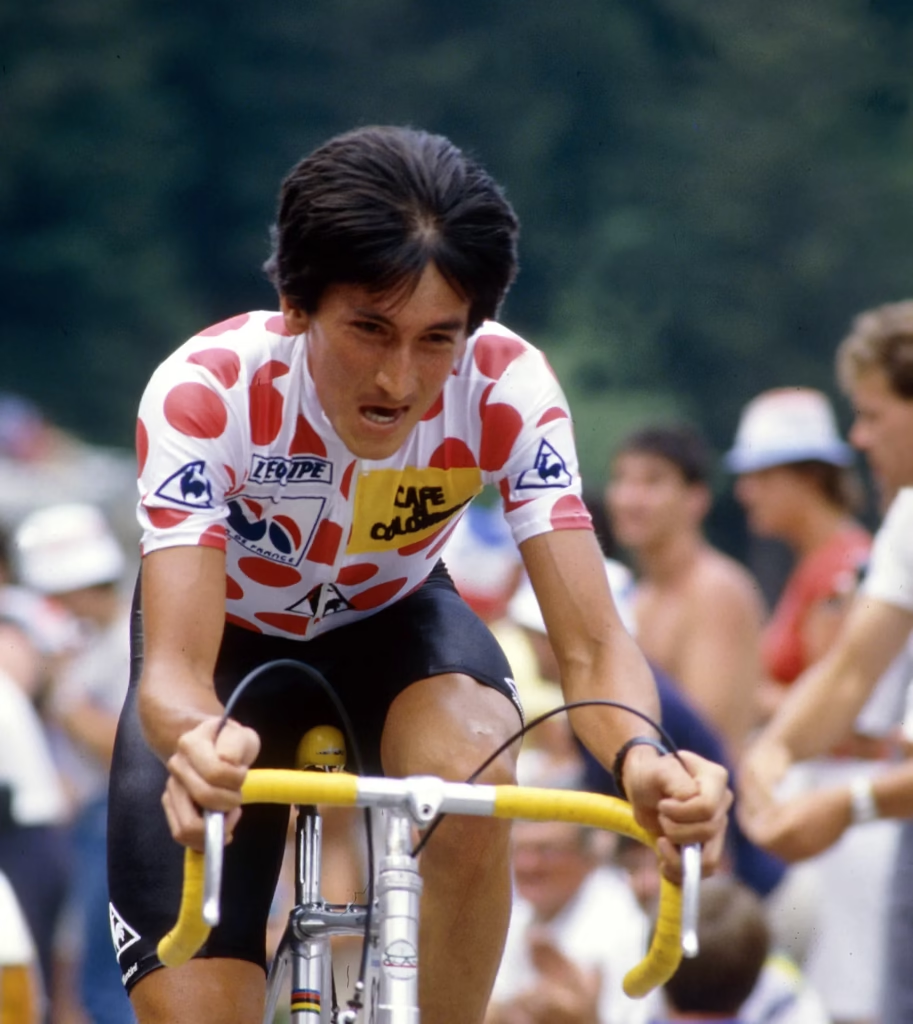
3. Luis Herrera brings Colombian climbing to Alpe d’Huez in 1984
Luis Herrera’s 1984 victory represented far more than another climber reaching the summit first.
Herrera was riding for the Colombian national amateur team at a time when the country’s riders were beginning to transform European perceptions of high-altitude racing. Their light builds, aggressive climbing and unfamiliar backgrounds made them one of the Tour’s great stories of the decade.
On Alpe d’Huez, Herrera became the first Colombian to win a Tour de France stage.
He attacked on the climb and held off established European professionals, demonstrating that the Colombian specialists were not simply colourful additions to the race. They could win on its most prestigious mountain.
Herrera’s success helped establish a lineage later continued by Fabio Parra, Santiago Botero, Nairo Quintana and subsequent generations of Colombian climbers.
Alpe d’Huez had already belonged to Coppi and the Dutch. In 1984, it became the setting for Colombian cycling’s arrival at the centre of the Tour.
4. Hinault and LeMond cross the line together in 1986
The image appears harmonious.
Bernard Hinault and Greg LeMond approach the Alpe d’Huez finish side by side, briefly joining hands before the Frenchman crosses the line first.
The reality behind it was considerably more complicated.
LeMond wore the yellow jersey and was positioned to become the first American Tour winner. Hinault had promised to support him after LeMond helped the Frenchman win his fifth Tour in 1985, but Hinault continued attacking throughout the 1986 race.
Hinault maintained that he was trying to make LeMond earn the victory. LeMond increasingly believed his teammate was attempting to take yellow for himself.
Their rivalry reached its symbolic peak on Alpe d’Huez.
The pair rode clear of the field and climbed together towards the resort. Hinault took the stage while LeMond retained yellow, but the shared finish did not resolve the tension between them.
Instead, it created one of the Tour’s most ambiguous images.
Was it reconciliation, theatre, team control or one final psychological contest?
LeMond eventually won the Tour by 3:10. Hinault never competed in the race again.
The sight of the two La Vie Claire leaders riding side by side remains perhaps the defining Alpe d’Huez image because it captures teamwork and rivalry in the same frame.
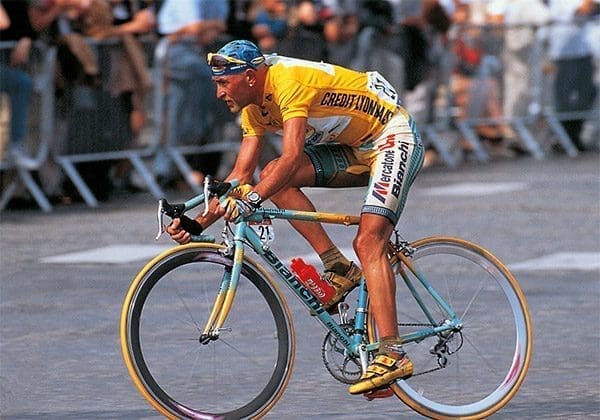
5. Marco Pantani produces the fastest Alpe d’Huez era
Marco Pantani looked built for Alpe d’Huez.
His slight frame, rapid cadence and habit of climbing out of the saddle made him visually distinctive before the stopwatch confirmed how quickly he was moving.
In 1995, Pantani attacked from the general classification group and passed riders scattered across the mountain. He climbed through the field with such intensity that he almost misjudged the final approach to the line.
His ascent is commonly cited as the fastest in the climb’s Tour history, although precise comparisons vary according to the timing points used.
What is beyond dispute is that Pantani distanced Miguel Induráin, Alex Zülle and the other leading riders while delivering one of the clearest demonstrations of pure climbing speed seen on the mountain.
He returned in 1997 and won again.
Pantani was still one year away from completing the Giro-Tour double, but the two Alpe d’Huez victories established him as the defining climber of his generation.
Few riders have appeared more naturally matched to a road than Pantani did on the upper hairpins.
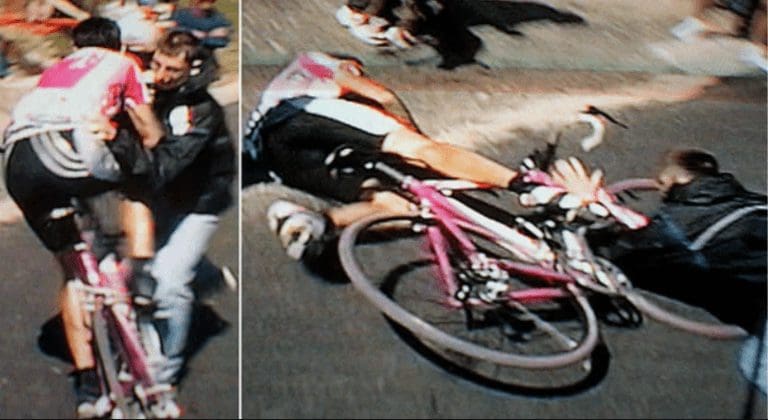
6. Giuseppe Guerini crashes into a spectator and still wins in 1999
Giuseppe Guerini had completed the difficult part. The Italian broke clear on Alpe d’Huez and entered the final kilometre ahead of Pavel Tonkov and Lance Armstrong. The stage appeared won.
Then a spectator stepped into the road to take a photograph. Guerini collided with him and fell.
The incident became an immediate demonstration of the danger created when crowds close around riders on major climbs. Guerini had no barrier separating him from spectators, little room to change direction and almost no warning before the collision.
He remounted quickly and still won by 21 seconds.
The victory is remembered because of the crash, but that should not obscure the performance required to build enough of an advantage to survive it. Guerini had attacked the strongest riders on one of cycling’s most prestigious finishes and created a gap large enough to absorb a completely avoidable accident.
The image of him sitting on the road, with the victory apparently disappearing, remains one of the mountain’s most frequently replayed moments.
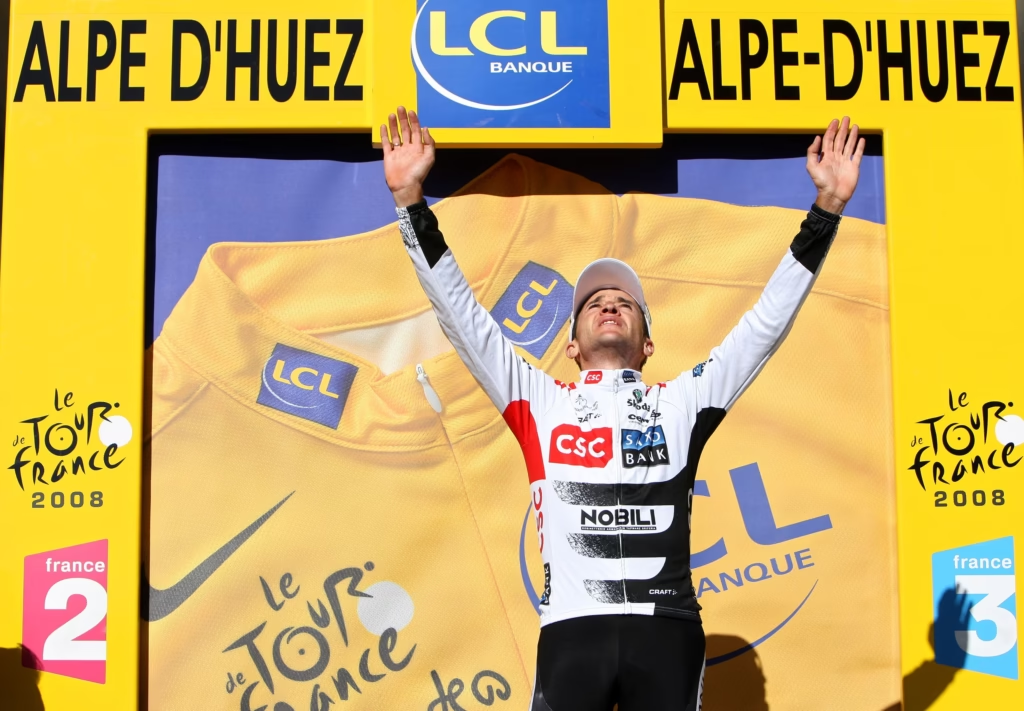
7. Carlos Sastre attacks into yellow in 2008
Carlos Sastre began the 2008 Alpe d’Huez stage in fourth overall, 49 seconds behind his CSC teammate Fränk Schleck.
Cadel Evans remained the favourite to win the Tour because of the final time trial still to come. Sastre therefore needed a meaningful advantage before Paris.
He attacked near the bottom of Alpe d’Huez.
The move looked predictable. CSC had numbers in the leading group, and Sastre was the rider most likely to test Evans on the steep lower slopes.
Knowing the attack was coming did not make it easier to follow.
Sastre opened a gap and continued extending it while the favourites watched one another behind. He won the stage by 2:03 over Samuel Sánchez and moved into yellow with 1:24 over Schleck and 1:34 over Evans.
The Spaniard later limited his losses in the time trial and won the Tour by 58 seconds.
Alpe d’Huez was not merely where Sastre gained time. It was where he transformed from an outsider within his own team into the Tour’s eventual champion.
One attack created his career-defining victory.
8. Pierre Rolland ends France’s long wait in 2011
France waited 25 years for another home winner on Alpe d’Huez after Hinault’s success in 1986.
Pierre Rolland ended that drought during one of the most chaotic finales of the modern Tour.
Thomas Voeckler began the day in yellow but finally lost contact on the Col du Galibier. Alberto Contador attacked from distance despite no longer being a realistic contender for the overall victory, forcing the leading group into an aggressive and unpredictable race.
Rolland had spent much of the Tour working for Voeckler. Once his leader’s yellow jersey challenge ended, the young Frenchman received permission to race for himself.
On Alpe d’Huez, he followed Contador and Samuel Sánchez before attacking late to win the stage.
Rolland became the first French winner on the mountain since Hinault and strengthened his hold on the white jersey, which he carried to Paris.
The victory combined several classic Tour themes: a domestique receiving his opportunity, a home rider succeeding on one of the race’s greatest mountains and the transfer of French attention from one emerging hero to another.
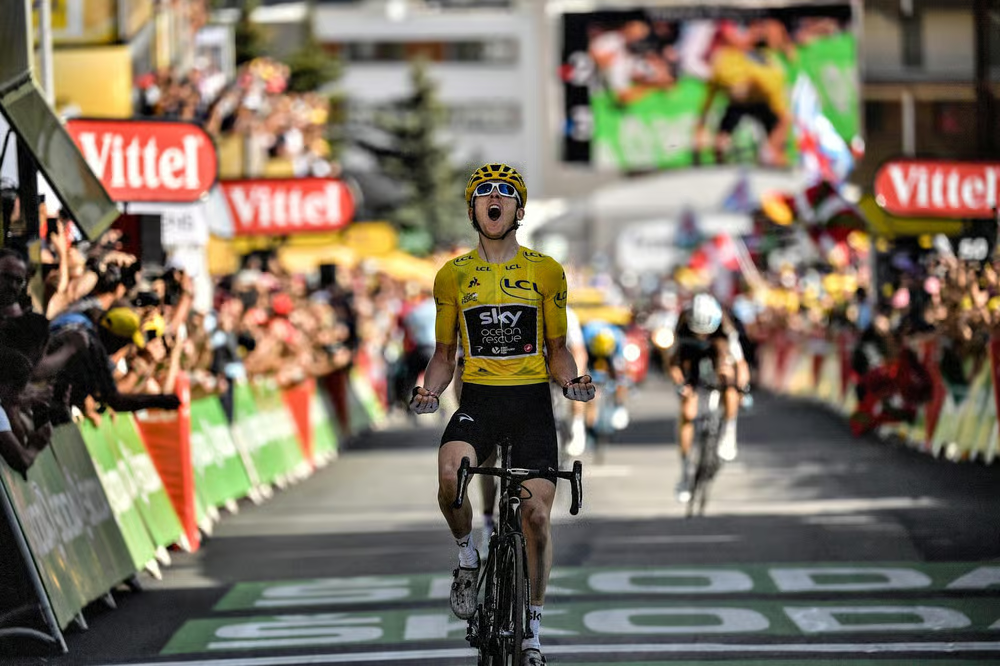
9. Geraint Thomas wins in yellow in 2018
Geraint Thomas reached Alpe d’Huez wearing yellow but still surrounded by questions about Team Sky’s leadership.
Chris Froome had won the previous four Tours he had entered and remained the team’s established Grand Tour leader. Thomas had taken yellow after winning at La Rosière one day earlier, but many expected him to lose time or eventually return to supporting Froome.
Instead, he won again.
Thomas survived attacks from Romain Bardet and Mikel Landa before reaching the final metres with Tom Dumoulin, Bardet and Froome.
He launched his sprint through the last corner and crossed the line first.
Thomas became the first British rider to win on Alpe d’Huez and the first yellow jersey to take the stage there since Sastre.
More importantly, the victory changed the internal logic of the race.
Thomas was no longer temporarily holding the jersey for Froome. He had beaten the defending champion and the other leading contenders on one of the Tour’s most prestigious finishes.
He retained yellow through to Paris.
The victory turned his 2018 campaign from an unexpected leadership opportunity into a convincing Tour-winning performance.
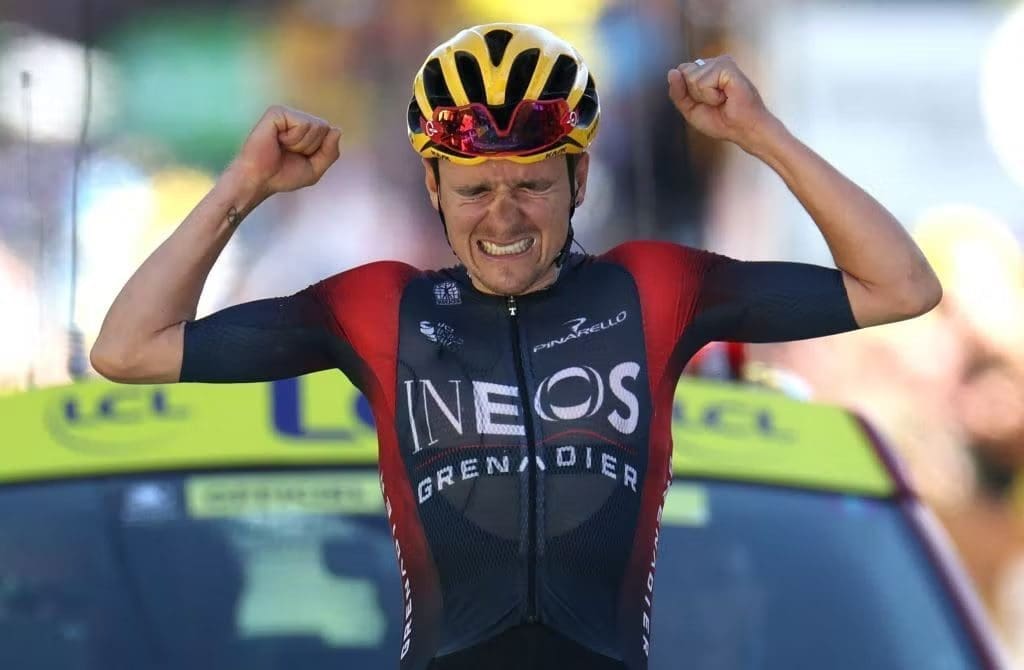 Photo Credit: A.S.O./Charly López
10. Tom Pidcock descends into the breakaway and wins in 2022
Tom Pidcock was the last rider to win a men’s Tour de France stage on Alpe d’Huez before the race returned in 2026.
His victory is remembered almost as much for the way he reached the breakaway as for the final ascent.
Pidcock attacked on the descent of the Col du Galibier, using his mountain bike and cyclocross skills to take aggressive lines while closing on riders ahead. The television motorbike struggled to follow as he leaned through corners and rapidly reduced the gap.
He joined a break containing Chris Froome, Louis Meintjes, Neilson Powless and Giulio Ciccone before the race reached the Croix de Fer.
On Alpe d’Huez, Pidcock attacked with around 10km remaining and rode alone to the finish. Meintjes took second, with Froome third in his best Tour stage result since his career-changing crash in 2019.
Pidcock was 22 years old and competing in his first Tour.
He became the youngest rider to win on Alpe d’Huez and only the second British stage winner there after Thomas.
The performance offered a new route to victory on cycling’s most famous summit. Pidcock did not simply climb faster than everyone else. He used technical descending to create the opportunity, joined the correct break and then completed the move on the mountain.
It remains the defining road victory of his career and the most recent chapter in the men’s Tour history of Alpe d’Huez.
The 10 greatest Alpe d’Huez moments ranked
| Rank | Year | Rider or moment | Why it matters |
|---|---|---|---|
| 1 | 1986 | Bernard Hinault and Greg LeMond | Teammates, rivals and a shared finish that captured their conflict |
| 2 | 1952 | Fausto Coppi | The Tour’s first summit finish and the creation of the Alpe legend |
| 3 | 1995 and 1997 | Marco Pantani | Two of the most explosive climbing performances associated with the ascent |
| 4 | 2008 | Carlos Sastre | A stage-winning attack that ultimately secured the Tour |
| 5 | 1999 | Giuseppe Guerini | Knocked down by a spectator but still able to win |
| 6 | 2022 | Tom Pidcock | A fearless descent, breakaway attack and maiden Tour stage victory |
| 7 | 2018 | Geraint Thomas | Victory in yellow that settled Team Sky’s leadership question |
| 8 | 1984 | Luis Herrera | The first Colombian Tour stage victory |
| 9 | 2011 | Pierre Rolland | The end of France’s 25-year wait for a home Alpe winner |
| 10 | 1976–1989 | The Dutch era | Eight victories that turned hairpin seven into Dutch Corner |
Other Alpe d’Huez victories that deserve remembering
A top-10 selection inevitably leaves out stages that would define almost any other climb.
Gianni Bugno won in 1990 and 1991, becoming another multiple Italian winner during the transition between the eras of Greg LeMond and Miguel Induráin.
Andy Hampsten won in 1992, taking the United States’ first official victory on the mountain.
Fränk Schleck succeeded from a breakaway in 2006, while Thibaut Pinot’s 2015 victory provided a final moment of redemption after a difficult Tour.
Each edition alters the meaning of the climb without replacing what came before.
Why Alpe d’Huez keeps producing great Tour stories
The climb is hard enough to expose weakness without being so extreme that tactics become irrelevant.
Its steep lower section encourages attacks, but the easing gradients higher up can allow riders to recover or work together. The bends repeatedly reveal gaps between groups, giving riders and team cars clear visual information about the race around them.
The crowd adds another variable.
Supporters create extraordinary theatre, but Guerini’s 1999 crash demonstrated the risks when spectators move into the road. The confined corridor of people intensifies every attack and makes even a small gap feel decisive.
Its selective use also protects its status.
Alpe d’Huez does not appear every year. Riders can complete Tour-winning careers without receiving many opportunities to win there. When the route returns, the stage carries the weight of everything that happened before.
That is why a victory there rarely feels like an ordinary mountain-stage result.
The Tour’s decision to use the resort on consecutive days in 2026 is examined in why back-to-back Alpe d’Huez finishes could define the Tour de France.
Who was the last Tour de France winner on Alpe d’Huez?
Tom Pidcock was the last rider to win a men’s Tour de France stage on Alpe d’Huez before its 2026 return.
He won stage 12 of the 2022 Tour from a breakaway, attacking alone on the final climb after joining the move through his aggressive descent of the Galibier.
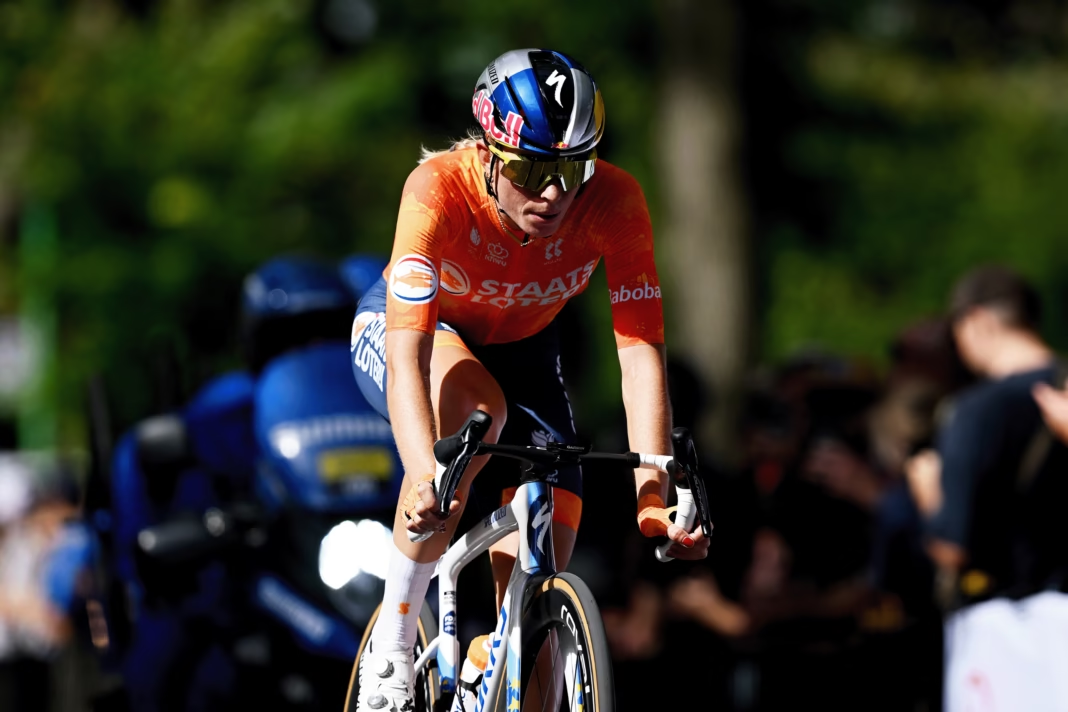
Alpe d’Huez was subsequently used as the finish of the final stage of the 2024 Tour de France Femmes. Demi Vollering won the stage, while Kasia Niewiadoma retained the yellow jersey by only four seconds in one of the closest conclusions to a major stage race.
The men’s Tour returns for consecutive finishes in 2026, giving the current generation two opportunities to add its own story.
The broader Alpine setting is covered in the Tour de France 2026 Alps guide.

Riding Alpe d’Huez beyond the Tour
Alpe d’Huez is more than a television landmark.
For recreational cyclists, it is one of the most accessible bucket-list climbs in the Alps. Bourg-d’Oisans provides a natural base, with the road rising almost immediately from the edge of town.
The numbered bends offer a clear countdown, while Dutch Corner, La Garde and the final approach into the resort provide landmarks familiar from decades of Tour footage.
The experience of riding the ascent is covered in cycling Bourg-d’Oisans and Alpe d’Huez.
Alpe d’Huez gives every generation its own image
Coppi made it the Tour’s first summit finish.
The Dutch transformed it into a travelling national stadium. Herrera introduced Colombia’s climbers to a global audience. Hinault and LeMond turned it into the setting for cycling’s most famous teammate rivalry.
Pantani made it a test of speed. Guerini made it a warning about crowds. Sastre used it to win the Tour. Rolland restored French pride, Thomas confirmed his leadership there and Pidcock showed that the route to victory could begin on the descent of another mountain.
That range explains why Alpe d’Huez remains the Tour’s most valuable historical stage.
The mountain does not produce the same race every time.
It provides the setting, gradient and crowd. The riders decide which image will be replayed for the next generation.

