
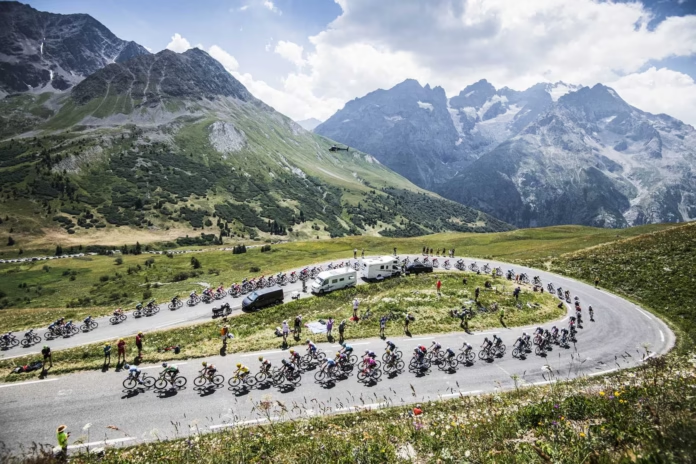
The 21 hairpins of Alpe d’Huez form the most recognisable countdown in professional cycling.
The bends begin with hairpin 21 at the bottom of the climb and descend numerically towards hairpin one near the top. Each corner carries the name of a rider who won a Tour de France stage finishing at Alpe d’Huez.
Fausto Coppi, the first winner at the summit in 1952, is honoured on bend 21. The original sequence then follows the chronology of Alpe d’Huez stage winners through to Giuseppe Guerini on bend one.
Once all 21 bends had been allocated, later winners were added to the signs from the bottom again. That is why several corners now carry two names, including Luis Herrera and Tom Pidcock on bend 12.
The signs tell the history of the Tour, but they also provide a practical countdown for anyone riding from Bourg-d’Oisans. The hardest kilometres arrive early, long before the numbers fall into single figures.
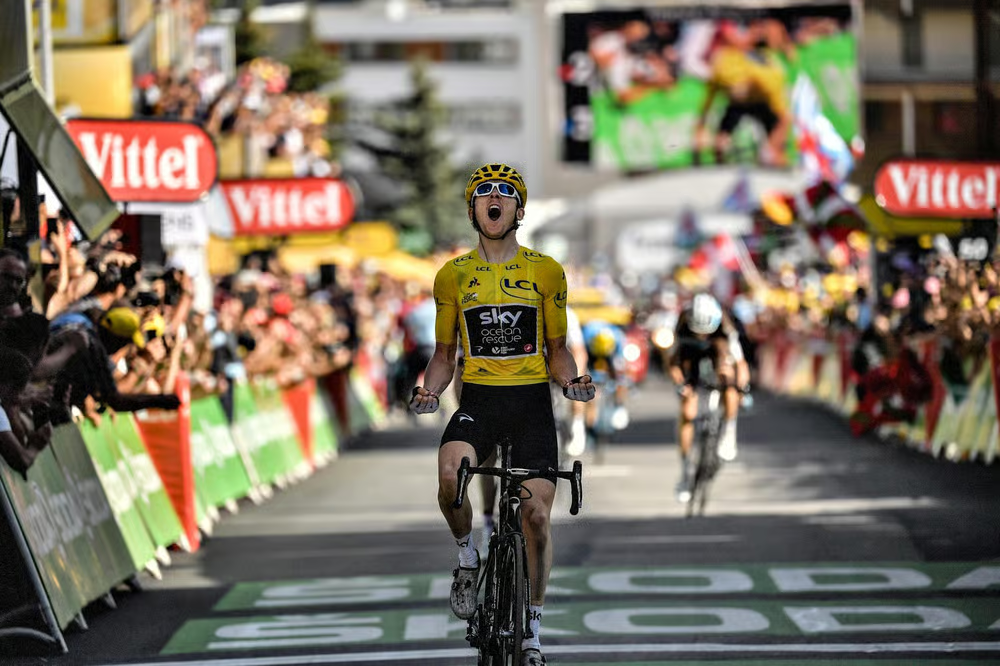
Alpe d’Huez climb at a glance
| Detail | Figure |
|---|---|
| Traditional 2026 Tour ascent | 13.7km at 8.1% |
| Number of numbered hairpins | 21 |
| Height gained | Approximately 1,100 metres |
| Starting point | Bourg-d’Oisans |
| First Tour summit finish | 1952 |
| First winner | Fausto Coppi |
| Last men’s Tour winner before 2026 | Tom Pidcock, 2022 |
| Fastest widely recognised ascent | Marco Pantani |
| Most famous spectator area | Dutch Corner, bend seven |
The exact climb statistics vary according to the start and finish points used. The official stage 19 route measures the ascent as 13.7km at 8.1%, while recreational segments beginning and ending at different points can be slightly longer.
The wider route and general classification implications are covered in the Tour de France 2026 stage 19 preview.
Why are the Alpe d’Huez hairpins numbered backwards?
The bends count down as the road climbs.
A cyclist reaches bend 21 first, then passes 20, 19 and the rest until arriving at bend one close to the resort. The system turns the ascent into a visible countdown, although reaching bend one does not mean the finish line is immediately around the corner.
The road continues through the lower part of the resort after the final numbered bend. Tour riders pass through the built-up section before completing the last approach towards the finish.
The numbering gives Alpe d’Huez an identity that other climbs struggle to reproduce. Viewers do not need a distance graphic to understand where the race is. A picture of bend seven or bend three immediately places the riders on the mountain.
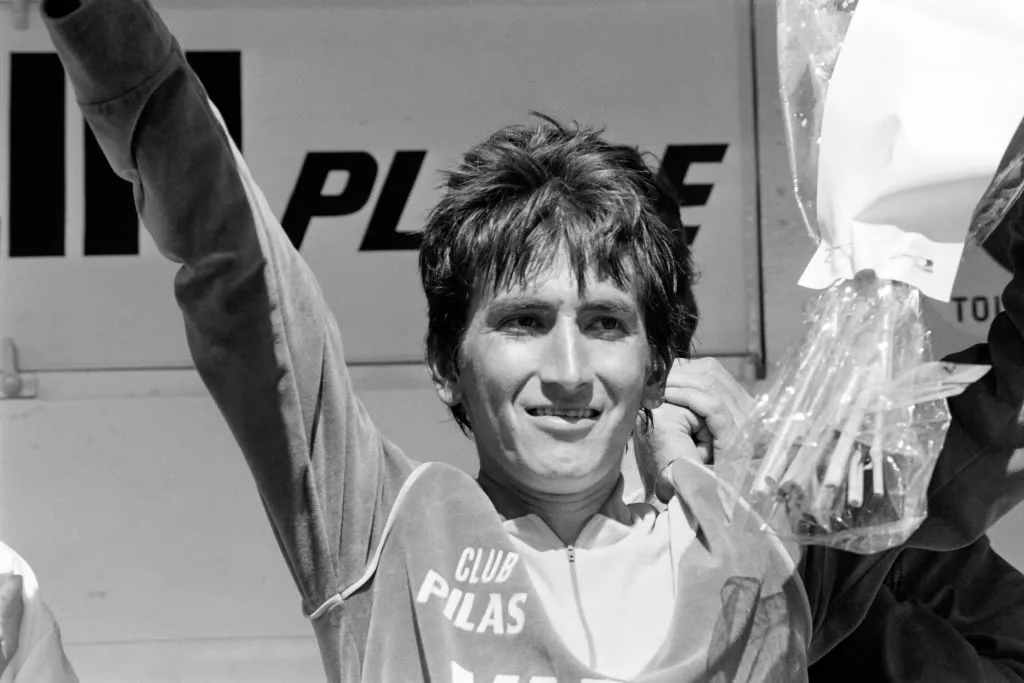
The 21 bends of Alpe d’Huez and their Tour winners
The bends below are listed in climbing order, beginning at the bottom of the mountain.
| Bend | Original stage winner | Year | Later winner sharing the bend |
|---|---|---|---|
| 21 | Fausto Coppi | 1952 | 2001 result subsequently stripped |
| 20 | Joop Zoetemelk | 1976 | Iban Mayo, 2003 |
| 19 | Hennie Kuiper | 1977 | 2004 result subsequently stripped |
| 18 | Hennie Kuiper | 1978 | Fränk Schleck, 2006 |
| 17 | Joaquim Agostinho | 1979 | Carlos Sastre, 2008 |
| 16 | Joop Zoetemelk | 1979 | Pierre Rolland, 2011 |
| 15 | Peter Winnen | 1981 | Christophe Riblon, 2013 |
| 14 | Beat Breu | 1982 | Thibaut Pinot, 2015 |
| 13 | Peter Winnen | 1983 | Geraint Thomas, 2018 |
| 12 | Luis Herrera | 1984 | Tom Pidcock, 2022 |
| 11 | Bernard Hinault | 1986 | |
| 10 | Federico Echave | 1987 | |
| 9 | Steven Rooks | 1988 | |
| 8 | Gert-Jan Theunisse | 1989 | |
| 7 | Gianni Bugno | 1990 | |
| 6 | Gianni Bugno | 1991 | |
| 5 | Andy Hampsten | 1992 | |
| 4 | Roberto Conti | 1994 | |
| 3 | Marco Pantani | 1995 | |
| 2 | Marco Pantani | 1997 | |
| 1 | Giuseppe Guerini | 1999 |
The original allocation filled the 21 available signs in chronological order. Once Guerini completed the first cycle in 1999, later winners began sharing the bends from number 21 upwards.
The full background behind those victories is explored in a history of Alpe d’Huez at the Tour de France.
Why does 1979 appear twice?
The 1979 Tour included two consecutive stages finishing at Alpe d’Huez.
Joaquim Agostinho won the first, taking bend 17 in the naming sequence. Joop Zoetemelk won the following day and is therefore named on bend 16.
It was the first time the Tour had finished at the resort on consecutive days.
The race used the mountain twice during the same stage in 2013, when the peloton climbed the traditional road, descended via the Col de Sarenne and then returned to the 21 hairpins for the summit finish.
The 2026 Tour creates another variation. Stage 19 uses the classic ascent from Bourg-d’Oisans, before the race returns to Alpe d’Huez during the much harder stage 20.
The significance of the repeated finishes is examined in why back-to-back Alpe d’Huez stages could define the Tour de France 2026.
Bend 21: Fausto Coppi and the beginning of the legend
Bend 21 comes early enough for many recreational riders to reach it before fully understanding how difficult the lower mountain will be.
The road rises sharply out of Bourg-d’Oisans before turning through the first numbered hairpin. The opening section is among the steepest parts of the ascent and provides little opportunity to establish a comfortable rhythm.
The sign honours Fausto Coppi.
Coppi won at Alpe d’Huez in 1952 during the first Tour stage designed to finish at the summit of a major climb. He attacked on the ascent, took the yellow jersey and went on to win the race.
The result did more than begin the history of Alpe d’Huez. It helped establish the summit finish as one of the defining features of modern Grand Tour route design.
The Tour did not return for another 24 years, leaving Coppi as the mountain’s only winner until Zoetemelk succeeded in 1976.

Bends 20 to 17: the climb is already at its hardest
The early numbers can be deceptive.
Cyclists may feel they have made progress after passing the first few signs, but bends 20, 19, 18 and 17 arrive during the punishing lower section towards La Garde. The gradient repeatedly reaches or approaches double figures.
This is where Tour contenders can be exposed before the most famous television images have even begun.
Bends 20 and 16 both carry the name of Zoetemelk, reflecting his victories in 1976 and 1979. Kuiper occupies bends 19 and 18 after becoming the first rider to win consecutive Alpe d’Huez stages in different editions of the Tour.
Bend 17 honours Agostinho, winner of the first of the two Alpe d’Huez finishes in 1979. Sastre was later added after his stage-winning attack in 2008 carried him into yellow and towards overall Tour victory.
The lower ramps are where a rider can lose the climb through poor pacing. Starting too hard in Bourg-d’Oisans can create a problem that does not fully appear until several bends later.
La Garde provides the first real change of rhythm
After the relentless opening ramps, the road briefly becomes less severe around the village of La Garde.
It is not flat, but the reduction in gradient feels significant after the opening section. Riders can adjust their position, take a drink and attempt to recover before the next sequence of hairpins.
For recreational cyclists, this is often the first point at which the ascent becomes psychologically manageable.
For professionals, it can become an attacking opportunity.
A rider who has survived the early pace can accelerate as the gradient changes, while rivals may hesitate after spending the opening kilometres close to their limit.
The respite does not last. The road steepens again as it continues through bends 16, 15 and 14.
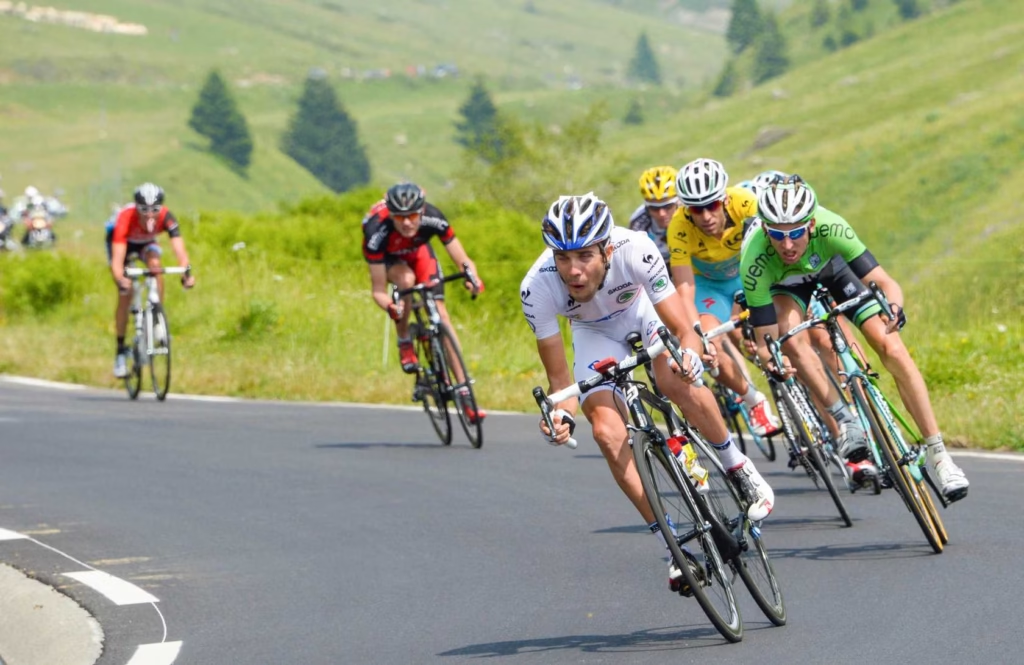 Photo Credit: A.S.O./Bruno Bade
Bend 14 and the Joaquim Agostinho memorial
Bend 14 officially carries the names of Beat Breu and Thibaut Pinot, but the area is also associated with a memorial to Joaquim Agostinho.
The Portuguese rider won on Alpe d’Huez in 1979 and remains one of his country’s greatest cyclists. He died in 1984 following a crash during the Tour of the Algarve.
His stage victory is represented on bend 17, while the memorial near bend 14 gives him another physical connection to the mountain.
The section around bend 14 comes after the brief easing through La Garde. Riders have completed much of the steep opening but still face most of the total climbing.
It is a part of the ascent where the bends become a clearer visual countdown without yet feeling close to the summit.
Bend 12: Luis Herrera and Tom Pidcock
Bend 12 connects two breakthrough victories from very different eras.
Luis Herrera won in 1984, becoming the first Colombian rider to take a Tour de France stage. His success demonstrated that the Colombian climbers arriving in European racing could compete with established professionals on the sport’s most prestigious mountains.
Tom Pidcock’s name was added following his 2022 victory.
Pidcock joined the breakaway through an aggressive descent of the Col du Galibier, then attacked his companions with around 10km of Alpe d’Huez remaining. He became the youngest rider to win on the climb and only the second British rider to succeed there after Geraint Thomas.
Pidcock was the last men’s Tour winner on Alpe d’Huez before its 2026 return.
His victory forms the final entry in our ranking of the 10 greatest Alpe d’Huez moments in Tour de France history.
Bends 11 to eight: Hinault, LeMond and the Dutch era
Bend 11 honours Bernard Hinault, the official stage winner in 1986.
Hinault and Greg LeMond reached the finish together after riding clear of the other contenders. Their apparent show of unity concealed one of the most difficult teammate relationships in Tour history.
LeMond wore yellow and believed Hinault had promised to support him. Hinault continued attacking and later argued that he was forcing the American to prove he deserved to win the race.
The pair briefly joined hands near the finish before Hinault crossed the line first.
Bends nine and eight return the story to the Dutch era. Steven Rooks won in 1988 before Gert-Jan Theunisse succeeded the following year.
Those victories brought the Netherlands’ total to eight during the period from 1976 to 1989 and strengthened the connection that eventually turned bend seven into Dutch Corner.
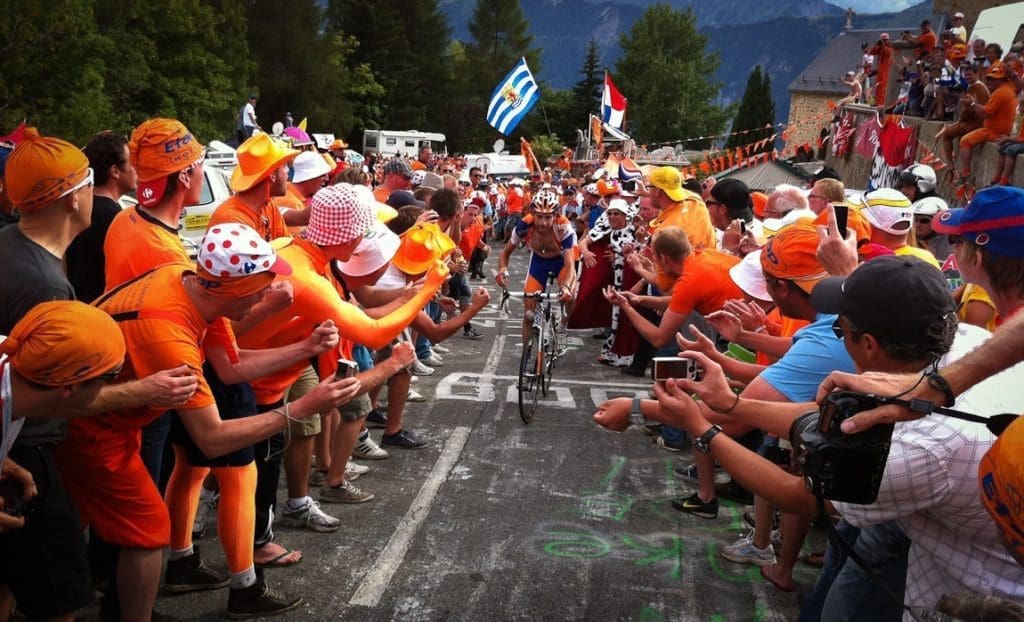
Bend seven: Dutch Corner
Bend seven is the most famous individual hairpin on Alpe d’Huez.
It is known as Dutch Corner because of the enormous gathering of Netherlands supporters who occupy the roadside when the Tour visits. Orange clothing, flags, music and smoke transform the corner into a temporary Dutch festival several days before the race arrives.
The bend itself is officially associated with Gianni Bugno, who won the Alpe d’Huez stage in 1990.
The Dutch connection comes from the wider history rather than the rider named on its sign. Zoetemelk, Kuiper, Winnen, Rooks and Theunisse combined for eight Dutch victories during the mountain’s first period as a regular Tour finish.
Bend seven became the focal point for celebrating that record.
Its atmosphere is part of the appeal and part of the challenge. Riders pass through a narrow corridor of supporters, with the noise increasing sharply as they approach the corner.
Dutch Corner is one of the most impressive sights in cycling when spectators leave enough room for the race. It also illustrates why crowd control matters on a mountain where riders can be separated from thousands of people by little more than a painted line.
Bends seven and six belong to Gianni Bugno
Bugno won consecutive Alpe d’Huez stages in 1990 and 1991.
The victories place his name on bends seven and six, immediately below the mountain’s final sequence.
Bugno’s career overlapped with the beginning of Miguel Induráin’s Tour dominance. He was one of the most complete riders of the period, capable of winning Grand Tours, world championships and major one-day races.
His Alpe d’Huez performances demonstrated the climbing ability behind that versatility.
The fact that Dutch Corner carries Bugno’s name is one of the small contradictions that make the bend system interesting. The spectator culture and the official winner attached to the sign tell two different parts of Alpe d’Huez history.
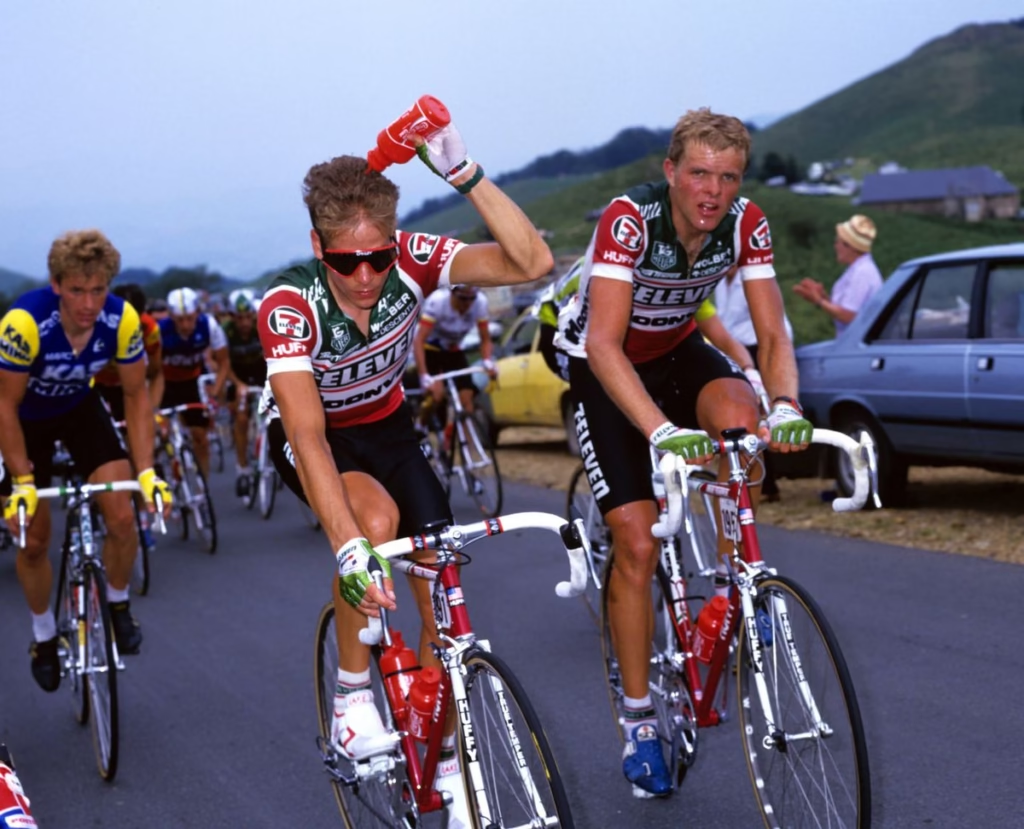 Photo Credit: BettiniPhoto
Bend five honours Andy Hampsten
Andy Hampsten won at Alpe d’Huez in 1992.
The victory made him the first official American stage winner on the climb and added another major mountain success to a career already defined by his victory at the 1988 Giro d’Italia.
Bend five sits high enough for riders to see the resort approaching, but the gradient and altitude ensure the climb remains difficult.
For recreational cyclists, the lower numbers can create false confidence. Bend five sounds close to the finish, but the remaining road still includes repeated ramps, the final numbered corners and the approach through the resort.
The countdown becomes more encouraging at this point, but it should not be mistaken for an easy final section.
Bend four: Roberto Conti’s breakaway victory
Roberto Conti won the 1994 stage from the breakaway.
His success came at the beginning of Marco Pantani’s association with Alpe d’Huez. Pantani climbed exceptionally quickly from the general classification group but could not catch his fellow Italian before the finish.
Conti’s name occupies bend four, leaving Pantani with the next two signs.
The stage underlined one of the recurring truths of Alpe d’Huez. The strongest climber on the mountain is not always the stage winner.
A breakaway beginning the ascent with enough time can survive even when the general classification riders produce an exceptional climbing performance behind.
That remains relevant whenever the Tour returns. The yellow jersey group may climb fastest without catching riders who have spent the day ahead.
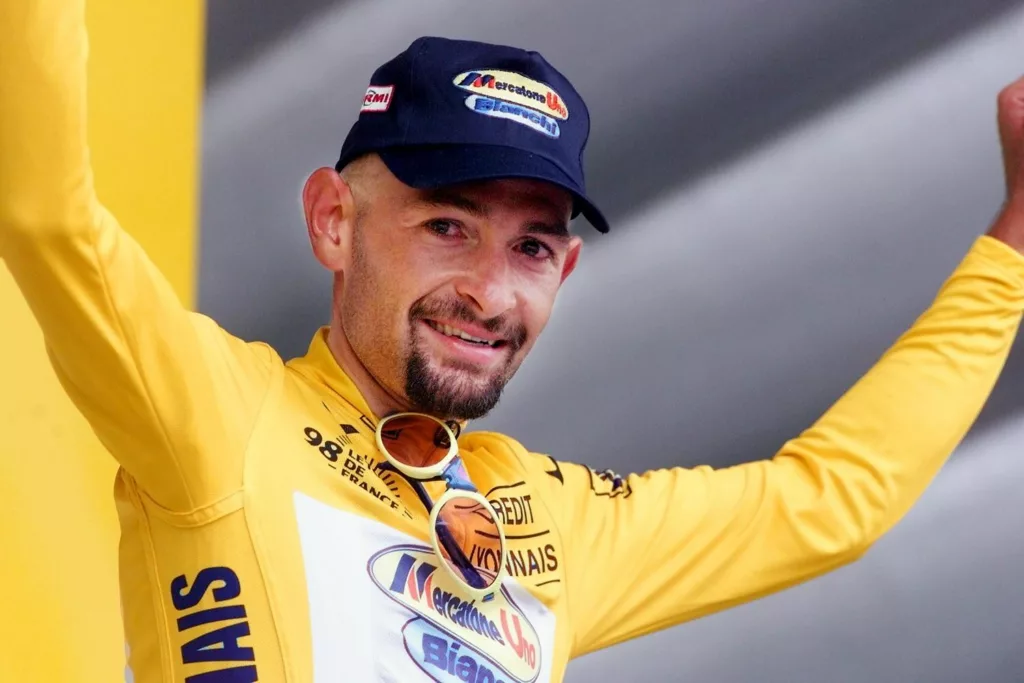
Bends three and two: Marco Pantani’s mountain
Pantani is named on consecutive bends after winning in 1995 and 1997.
Those victories established his association with Alpe d’Huez and produced the fastest ascent times widely connected with the climb.
Exact comparisons vary because different timings use different starting and finishing points. His performances are nevertheless accepted as the reference for raw climbing speed on the traditional road.
Pantani climbed with a style that made the speed appear even more dramatic. His high cadence, frequent out-of-the-saddle accelerations and ability to pass riders scattered across the mountain made the performances visually unforgettable.
Reaching bends three and two means entering the section most closely associated with the fastest climber in Alpe d’Huez history.
The numbers are nearly complete, but riders still have the final hairpin and the road through the resort ahead.
Bend one: Giuseppe Guerini
The final numbered hairpin honours Giuseppe Guerini, winner in 1999.
Guerini attacked clear of Pavel Tonkov and entered the closing section with the stage apparently secure. A spectator stepped into the road while attempting to take a photograph, collided with the Italian and knocked him from his bicycle.
Guerini remounted and still won.
His advantage had been large enough to survive an incident that should never have happened. The victory became one of the clearest warnings about spectators entering the road during mountain stages.
Bend one completes the numbered sequence, but not the climb.
The route continues through the older part of Alpe d’Huez and towards the final approach inside the resort.
First-time riders can be caught out by the distance remaining after the last sign. The countdown is complete before the physical effort is.
 Photo Credit: A.S.O./Charly López
Why do some Alpe d’Huez bends have two names?
The original system assigned one Alpe d’Huez stage winner to each bend.
Coppi took bend 21, Zoetemelk bend 20 and the sequence continued chronologically until Guerini filled bend one following his victory in 1999.
There were no unused signs when the Tour returned in 2001.
The sequence therefore restarted at the bottom. Iban Mayo joined Zoetemelk on bend 20 after winning in 2003, while later winners continued moving up the mountain.
Two results from that period were subsequently stripped and are not treated as official Tour stage victories.
The latest shared bend is number 12, where Pidcock’s name appears alongside Herrera.
A future winner on the traditional ascent would continue the second cycle towards bend 11, although the unusual design of the 2026 stages may affect how the local signs are updated.
Does Alpe d’Huez have exactly 21 hairpins?
The famous climb has 21 officially numbered bends.
The road contains other curves and changes of direction, but the countdown refers specifically to the marked hairpins between Bourg-d’Oisans and the resort.
The number is central to the identity of the ascent. Saying that a rider has reached bend seven or bend three immediately communicates how far they have progressed.
It is also why television coverage repeatedly shows the signs.
Each combines practical route information with the identity of a previous Tour winner.
The mountain becomes easier to understand because its history and geography are displayed on the same pieces of roadside furniture.
How hard is Alpe d’Huez to cycle?
Alpe d’Huez is difficult because it begins hard and rarely provides a complete recovery.
The steep lower section arrives almost immediately after leaving Bourg-d’Oisans. Riders who start too quickly can pay for that effort long before reaching Dutch Corner.
The main challenges are:
- Sustained climbing for more than an hour for many amateurs
- Approximately 1,100 metres of elevation gain
- Repeated changes of gradient
- Exposed sections with limited shade
- Summer heat rising from the road
- The temptation to ride too hard through the first bends
- A finish that continues beyond hairpin one
The hairpins themselves can offer momentary relief. The outside line is longer but generally shallower, while the inside can be significantly steeper.
Professional riders take the line dictated by position, road space and the crowd. Recreational cyclists usually benefit from using the wider outside route when traffic conditions make that safe.
The complete experience is covered in cycling Bourg-d’Oisans and Alpe d’Huez.
How long does it take to cycle Alpe d’Huez?
A sub-hour ride is a major target for strong amateur cyclists.
Times vary enormously according to fitness, weather, traffic and the exact start and finish points used.
| Climb time | Broad rider level |
|---|---|
| Under 40 minutes | Elite professional performance |
| 40–50 minutes | Exceptional amateur or professional level |
| 50–60 minutes | Very strong club rider |
| 60–75 minutes | Strong and experienced cyclist |
| 75–100 minutes | Typical fit recreational attempt |
| More than 100 minutes | A complete ascent of one of cycling’s great climbs |
Comparisons require caution because Tour timings, Strava segments and local challenge routes do not always use identical measuring points.
Completing all 21 bends matters more than whether a stopwatch shows 59 or 61 minutes.
The climb rewards controlled pacing. A rider who begins conservatively can often gain considerable time higher up compared with someone who attacks the opening ramps and fades.
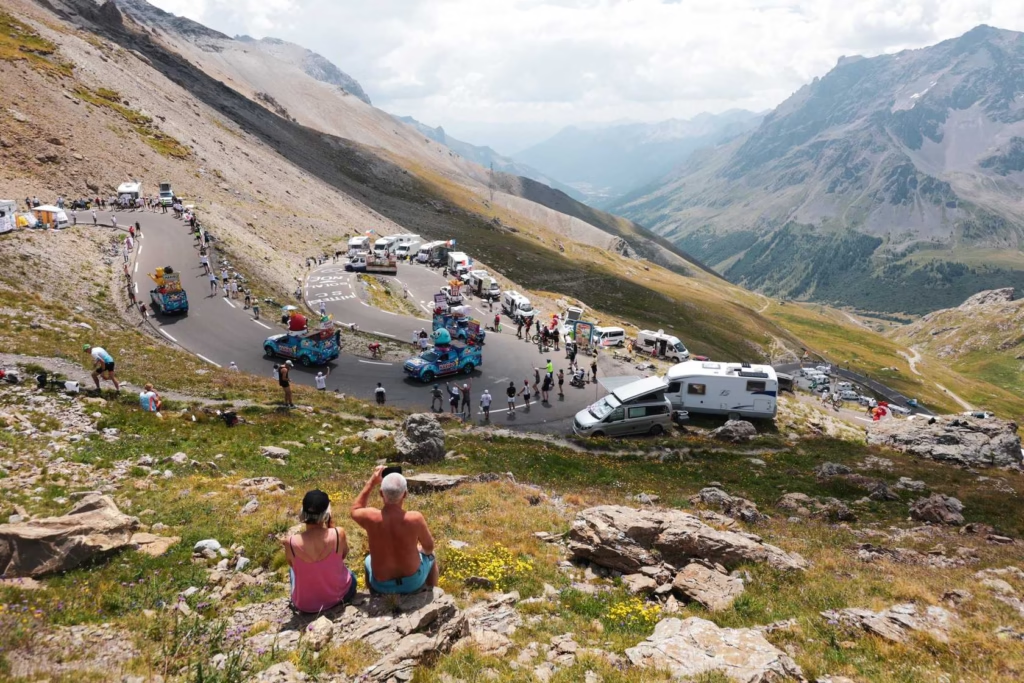
Where does the Alpe d’Huez climb start?
The traditional climb begins on the edge of Bourg-d’Oisans.
The road rises almost immediately after leaving the town on the D211, with little time to prepare before the first serious gradient.
Anyone riding from Bourg-d’Oisans should use the surrounding flat valley roads to warm up. Beginning the timed section with cold legs makes the lower ramps unnecessarily difficult.
The town is the natural base for riding Alpe d’Huez and several other major Alpine roads. It provides bike shops, accommodation, cafés and access to climbs including the Col du Glandon, Croix de Fer and Col du Lautaret.
Our cycling guide to Bourg-d’Oisans and Alpe d’Huez covers the practical side of riding the ascent.
Which Alpe d’Huez hairpin is the most famous?
Bend seven, Dutch Corner, is the best known.
Bend 21 carries the greatest historical importance because it honours Coppi and begins the countdown.
Bends three and two are associated with Pantani’s record-setting era.
Bend one honours Guerini and completes the numbered sequence.
For television viewers, Dutch Corner provides the most dramatic image. For cyclists riding the ascent, the lower bends are often remembered more vividly because of their gradient.
The most famous corner and the hardest corner are not necessarily the same.
-
 Photo Credit: Getty

What happens after bend one?
The climb is not finished.
After bend one, the road enters the resort and passes through the Vieil Alpe area. Riders continue towards the final section used for the Tour stage finish.
This catches out first-time cyclists who assume the countdown ends at the line.
The final part is generally less severe than the lower mountain, but it comes after the full climbing effort. The road can also feel less dramatic outside the Tour because the tight sequence of hairpins has ended and the route passes through the built-up resort.
On race day, barriers, crowds and the finishing straight turn that final section into part of the spectacle.
The hairpins turn one climb into 21 landmarks
The 21 bends make Alpe d’Huez easy to follow in a way few other mountains can match.
Bend 21 begins with Coppi and the creation of the Tour summit finish. The signs then move through the Dutch era, Herrera’s Colombian breakthrough, Hinault’s finish alongside LeMond, Pantani’s speed and Guerini’s extraordinary survival.
The second cycle adds Sastre, Rolland, Pinot, Thomas and Pidcock to the same physical sequence.
The numbers also give every cyclist an immediate understanding of progress. There is no need to check a computer to know that the lower slopes have passed or that Dutch Corner is approaching.
Each hairpin is part countdown, part memorial and part piece of Tour infrastructure.
That is why Alpe d’Huez is more than a 13.7km ascent.
It is 21 individual landmarks joined together by the most famous road in cycling.

