
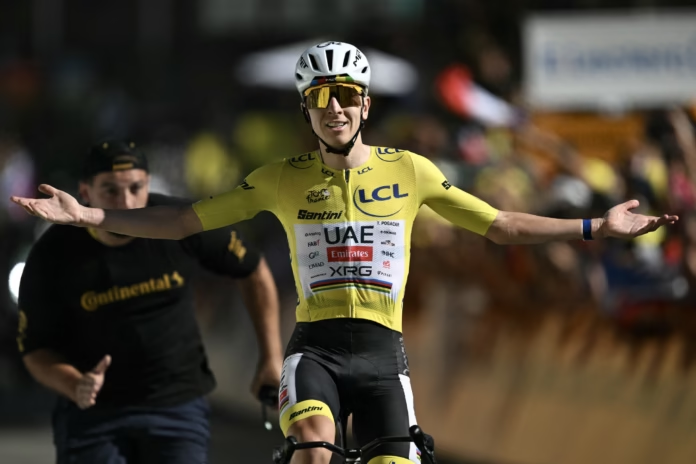
Tadej Pogačar is one mountain stage and a ride into Paris away from joining the most exclusive club in Tour de France history.
If he completes the 2026 Tour in yellow, Pogačar will become only the fifth rider to win the race five times, joining Jacques Anquetil, Eddy Merckx, Bernard Hinault and Miguel Indurain.
That alone would move the argument around his place in Tour history.
The more difficult question is whether five victories would make him the greatest Tour de France rider of all time.
Pogačar already entered the race as the defining Tour rider of his generation. What he has done over the past three weeks makes the comparison with Merckx, Hinault, Indurain and Anquetil much harder to avoid.
After winning on Alpe d’Huez and extending his lead over Remco Evenepoel to 7:11, he is now within touching distance of a fifth yellow jersey.
Statistically, he is about to equal the record.
The debate is over what those five victories mean.
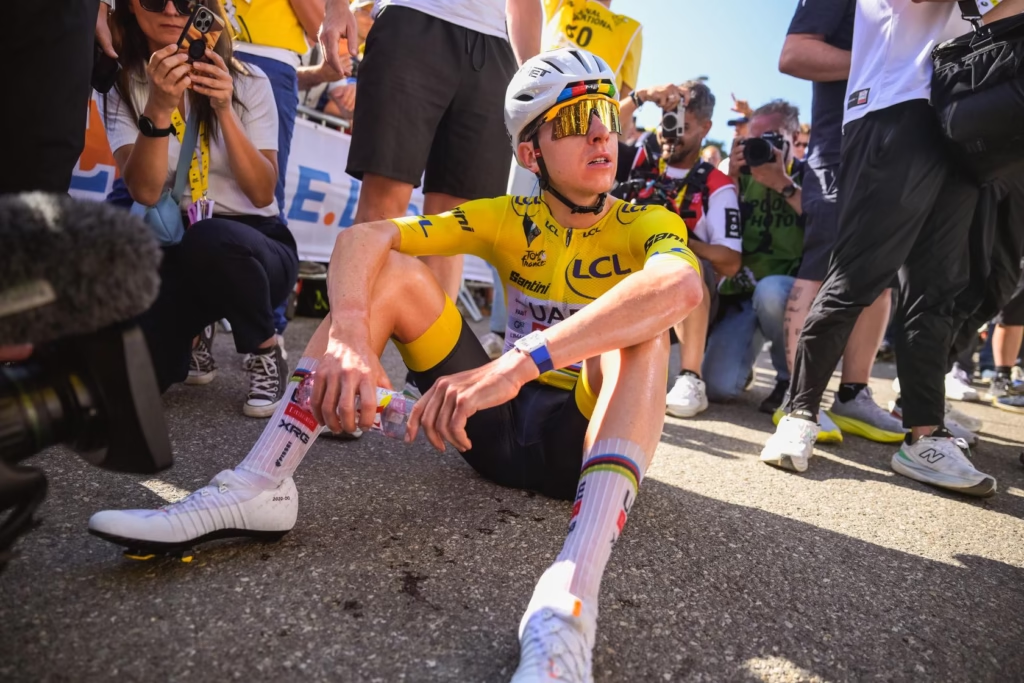
The five-time Tour de France winners
| Rider | Tour wins | Winning years |
|---|---|---|
| Jacques Anquetil | 5 | 1957, 1961, 1962, 1963, 1964 |
| Eddy Merckx | 5 | 1969, 1970, 1971, 1972, 1974 |
| Bernard Hinault | 5 | 1978, 1979, 1981, 1982, 1985 |
| Miguel Indurain | 5 | 1991, 1992, 1993, 1994, 1995 |
| Tadej Pogačar | 4, potentially 5 | 2020, 2021, 2024, 2025, potentially 2026 |
Anquetil was the first to reach five.
Merckx turned five victories into total domination of the race.
Hinault combined five wins with a confrontational style and an extraordinary range across the sport.
Indurain remains the only rider to win five Tours consecutively.
Pogačar would join them at only 27 years old.
That last point is important. A fifth victory in 2026 would not necessarily represent the end of his Tour career. It could be the point at which he moves level with the record while still having several realistic opportunities to break it.
Our pre-Tour ranking of the greatest Tour de France winners placed Pogačar fifth, behind the four five-time champions.
Winning in 2026 would make that ranking much harder to defend unchanged.
What makes Pogačar’s five different?
Pogačar’s case is not simply that he may have won the Tour five times.
It is how he has done it.
His first victory in 2020 came through one of the most dramatic reversals in Tour history, overturning Primož Roglič’s lead in the La Planche des Belles Filles time trial on the penultimate competitive day.
In 2021, he returned and dominated.
Then came the two defeats to Jonas Vingegaard in 2022 and 2023.
Those losses matter to his legacy because Pogačar did not simply accumulate victories during an uninterrupted period of superiority. He was beaten, forced to change, and then returned to win again in 2024 and 2025.
A fifth title in 2026 would complete a second sequence of three consecutive wins.
It would give him five victories across seven Tours, with his two defeats still ending in second place.
There is almost no weakness in that record.

Merckx remains the standard
Any claim that Pogačar is already the greatest Tour rider has to begin with Eddy Merckx.
Merckx won five Tours between 1969 and 1974, missing the 1973 edition rather than being beaten there.
But his Tour record was about much more than yellow jerseys.
Merckx won stages relentlessly. He won the points classification three times, the mountains classification twice and produced one of the most overwhelming performances the race has ever seen in 1969.
That first Tour victory remains almost impossible to replicate.
Merckx won the general classification, points classification, mountains classification and combativity award. He attacked when he did not need to, contested stages that other GC riders would have ignored and treated domination as an objective in itself.
That breadth is why he remains first in our ranking of the greatest Tour de France winners.
Pogačar is getting closer to that territory than any modern rider.
He attacks when yellow is already secure. He wins mountain stages, time trials and reduced sprints. He does not race the Tour as a three-week exercise in avoiding unnecessary risk.
That resemblance to Merckx is one of the strongest parts of his case.
Pogačar has something Indurain never had
Miguel Indurain achieved something Pogačar has not.
He won five Tours consecutively between 1991 and 1995.
Nobody else has done that.
Indurain’s dominance was built around extraordinary time-trialling, physical consistency and the ability to control mountain stages once he had established an advantage.
It was ruthless, but usually calculated.
Pogačar’s Tour career looks almost opposite in style.
He has lost Tours. He has attacked while already comfortably ahead. He has chased stage victories from positions where a more conservative champion would simply have followed.
That makes direct comparison difficult.
Indurain has the cleaner five-year sequence. Pogačar has the broader range of ways in which he can dominate a race.
A fifth title would probably move Pogačar above Indurain in an all-time ranking for many people, particularly when his stage victories and wider cycling career are considered.
But Indurain’s five straight wins remain a historical achievement Pogačar cannot reproduce.
Hinault’s argument is about more than five Tours
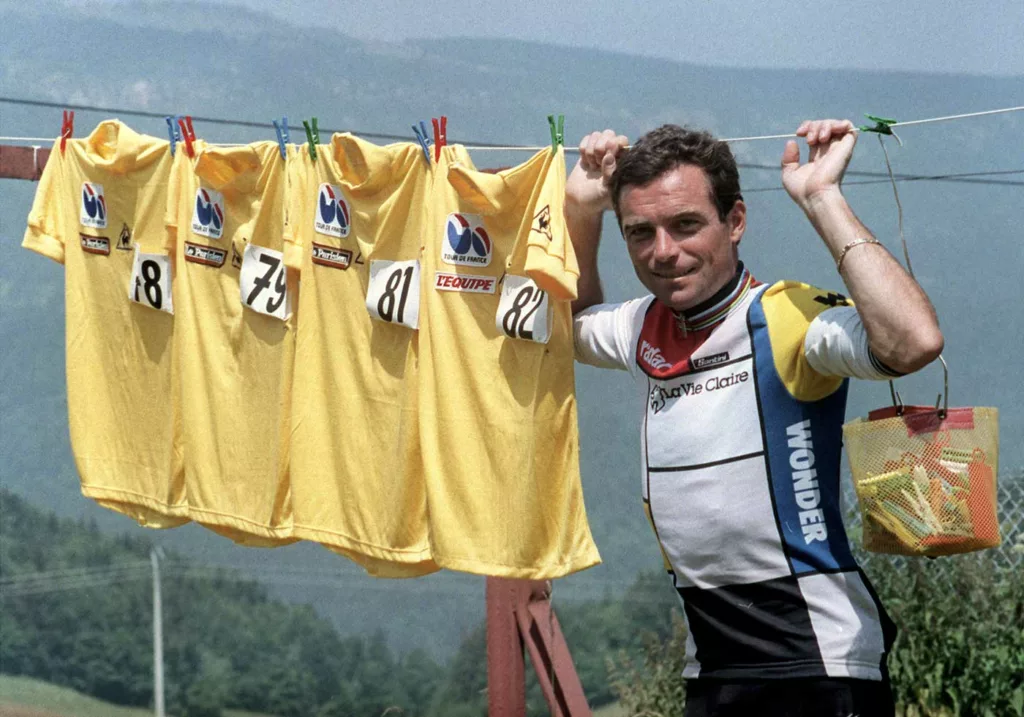
Bernard Hinault may be the most difficult comparison after Merckx.
The Frenchman won the Tour five times, finished second on his other two appearances and never started the race without finishing first or second.
That is an extraordinary record.
Hinault also raced with a style much closer to Pogačar than Indurain or Anquetil. He could attack in the mountains, win time trials, sprint from reduced groups and impose himself on races simply because he wanted to.
His 1985 victory came despite crashing and riding with a broken nose. A year later, supposedly riding in support of Greg LeMond, he attacked repeatedly and finished second.
Hinault was not simply a Tour specialist either.
That matters when comparing him with Pogačar. Both belong to the smaller category of Tour champions whose greatness cannot be separated from what they did in the rest of the sport.
A fifth Tour would probably put Pogačar level with Hinault rather than clearly ahead of him.
The difference is that Pogačar may still have years available to build the argument further.
Anquetil created the five-win ceiling
Jacques Anquetil deserves more than being treated as the first name in a statistical list.
Before him, five Tour victories did not exist as the benchmark for greatness.
Anquetil won in 1957 and then four consecutive editions from 1961 to 1964. His racing was built around precision, time-trial superiority and an exceptional understanding of where energy needed to be spent.
He rarely raced with the abandon associated with Merckx or Pogačar.
That was not a weakness. It was his method.
Anquetil understood that the objective was to win the Tour, not to win every argument inside it.
Pogačar already has a stronger claim as the more complete racing cyclist, but Anquetil’s importance to Tour history goes beyond a simple comparison of stage wins or climbing ability.
He established five victories as the record everyone else would spend the next six decades trying to equal.
Pogačar is now about to become the fourth rider since Anquetil to reach it.
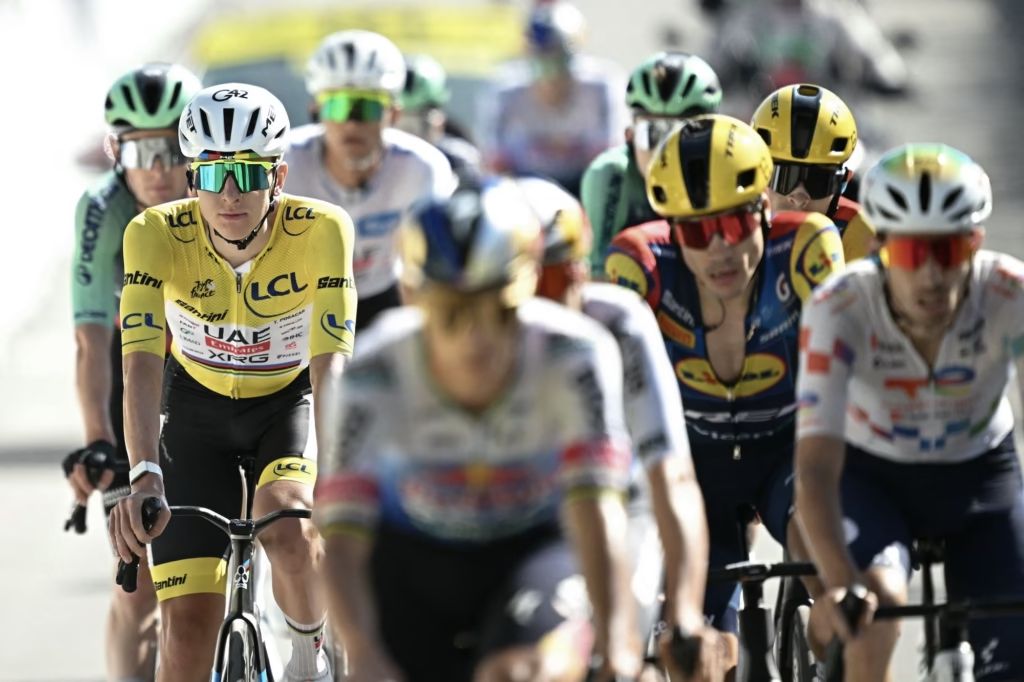
Alpe d’Huez has strengthened the argument
Stage 19 was important beyond the 10 seconds Pogačar gained for winning.
Alpe d’Huez is one of the places where Tour champions acquire images that survive longer than the classification tables.
Fausto Coppi in 1952. Bernard Hinault and Greg LeMond in 1986. Marco Pantani in the 1990s. Carlos Sastre in 2008. Geraint Thomas winning in yellow in 2018.
Pogačar now has his own Alpe d’Huez victory.
He attacked the GC group, erased the breakaway’s advantage and won while already holding a commanding yellow jersey lead.
It was unnecessary in purely defensive terms.
That is also why it matters.
The greatest Tour riders are remembered for moments when winning the race was not enough. Pogačar could have followed Evenepoel and taken another large step towards Paris. Instead, he attacked.
The climb’s wider history is covered in Alpe d’Huez: 10 greatest moments in Tour de France history.
Five titles would not automatically make Pogačar number one
Equal records do not mean identical careers.
If Pogačar reaches Paris in yellow, it would be reasonable to place him above Anquetil and Indurain in an all-time Tour ranking.
The argument with Hinault becomes much tighter.
Merckx remains harder.
The Cannibal’s combination of five overall victories, enormous stage-win totals and domination of multiple classifications gives him a Tour record that five yellow jerseys alone cannot surpass.
Pogačar needs either more Tour victories or more years of Merckx-level domination to remove the debate entirely.
That distinction is important.
There is a difference between being capable of becoming the greatest Tour rider ever and already having established that position beyond argument.
Pogačar is now firmly in the first category.
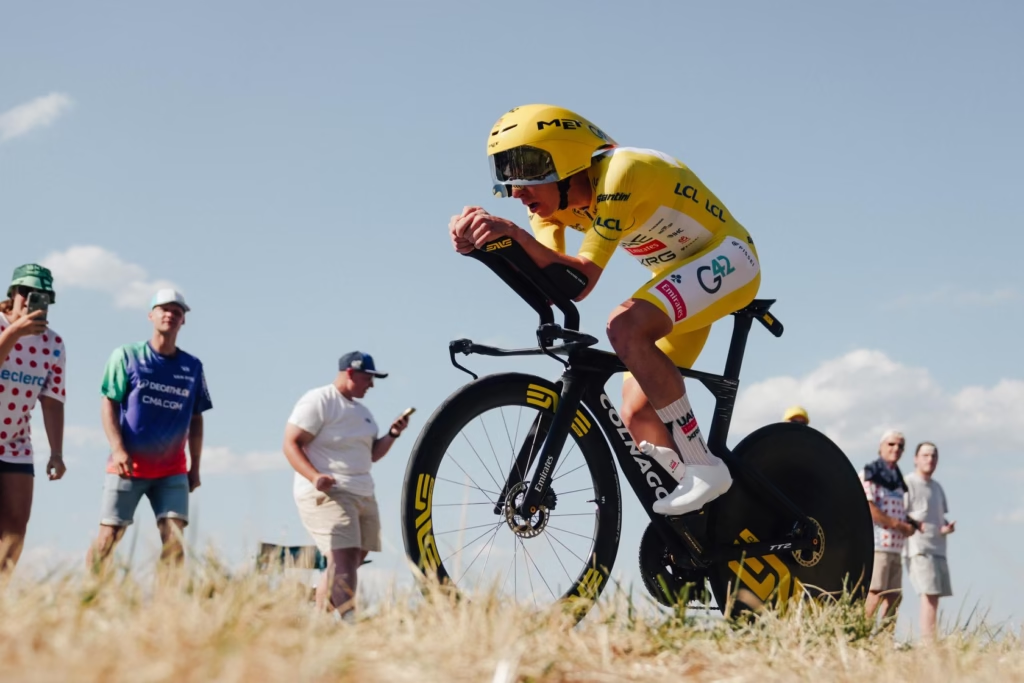 Photo Credit: A.S.O./Thomas Maheux
Could Pogačar become the first official six-time winner?
This is where the conversation becomes different from the previous five-time champions.
If Pogačar wins the 2026 Tour, he will reach five at 27.
Anquetil won his fifth at 30. Merckx was 29. Hinault was 30. Indurain was 31.
Pogačar could therefore enter the 2027 Tour with a chance to do something none of them achieved: win a sixth.
No rider has officially won the Tour de France six times.
That would end much of the statistical argument.
Merckx could still have a case based on the scale of his domination, but Pogačar would own the outright record for Tour victories.
The question would then shift from whether he belongs with the four five-time winners to whether anyone in Tour history has a stronger overall record.
His wider career strengthens the case
Even when judging Tour greatness specifically, Pogačar’s achievements outside July are difficult to ignore.
He does not structure his entire career around arriving at the Tour with the minimum possible risk.
He wins Monuments. He competes in World Championships. He attacks in stage races and one-day races. He has built a career in which the Tour is the centrepiece without being the whole picture.
That makes the Merckx and Hinault comparisons more natural.
The earlier question was whether a rider could still dominate the Tour while racing aggressively throughout the season.
Pogačar has increasingly made the answer look like yes.
Our pre-race assessment of Tadej Pogačar at the Tour de France 2026 argued that the route rewarded precisely that range. Three weeks later, he has used it to build a seven-minute lead before the final mountain stage.
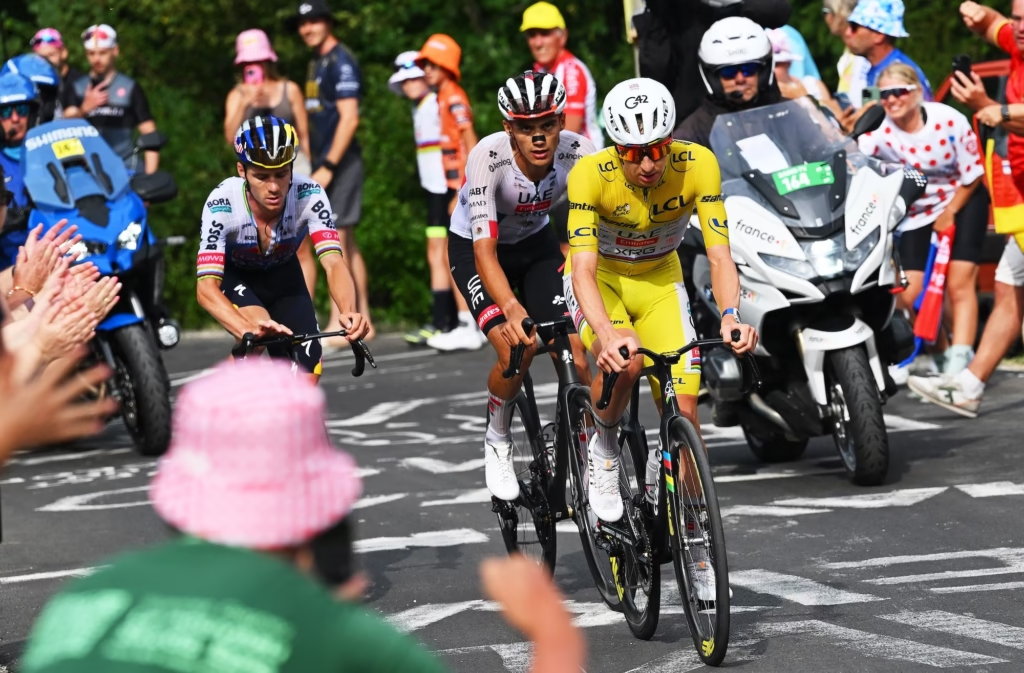 Photo Credit: Getty
The two defeats make his record stronger, not weaker
Vingegaard beating Pogačar in 2022 and 2023 is the obvious mark against an uninterrupted dominance argument.
It may ultimately strengthen the story.
Pogačar did not disappear after meeting a rival capable of beating him. He changed.
The 2024 victory was a response. The 2025 win confirmed it. A 2026 title would turn that response into another period of dominance.
That gives his Tour career several distinct phases:
- The shock breakthrough in 2020
- Domination in 2021
- Defeat to Vingegaard in 2022 and 2023
- The return to yellow in 2024
- Confirmation in 2025
- A possible fifth victory in 2026
Merckx, Hinault and Indurain all had their own different arcs, but Pogačar’s contains both dominance and recovery from defeat.
That is part of why a fifth title now feels more significant than simply adding another number.
Stage 20 is the last real obstacle
Pogačar has not won the 2026 Tour yet.
Stage 20 contains 170.9km and 5,450 metres of climbing, with the Croix de Fer, Télégraphe, Galibier and Col de Sarenne before the finish at Alpe d’Huez.
His 7:11 advantage means rivals need something extraordinary, but high mountains late in a Grand Tour leave no room for complacency.
The full challenge is broken down in our Tour de France 2026 stage 20 preview.
If he comes through that day without disaster, Paris should become a coronation.

Is Pogačar already the greatest Tour de France rider ever?
Not quite.
Merckx still has the strongest overall case.
Five Tour victories only describe part of what Merckx achieved inside the race, while Hinault also has an extraordinary claim built on five wins, two second places and the manner in which he raced.
But Pogačar is no longer chasing their historical category from below.
A fifth victory would put him inside it.
At that point, ranking Anquetil, Indurain, Hinault and Pogačar becomes a question of what kind of greatness matters most.
Anquetil created the benchmark.
Indurain achieved five consecutive victories.
Hinault combined Tour dominance with remarkable versatility and aggression.
Merckx still represents the most complete domination of the race.
Pogačar’s argument is that he increasingly combines pieces of all four.
He has the victories, the stage-winning instinct, the climbing, the time-trialling, the longevity across different versions of the Tour and the willingness to attack even when caution would be enough.
That is why the real significance of Paris may not be that Pogačar becomes another five-time Tour de France winner.
It is that, at 27, he may arrive there with five victories and still look as though the historical record is only the next target.

