
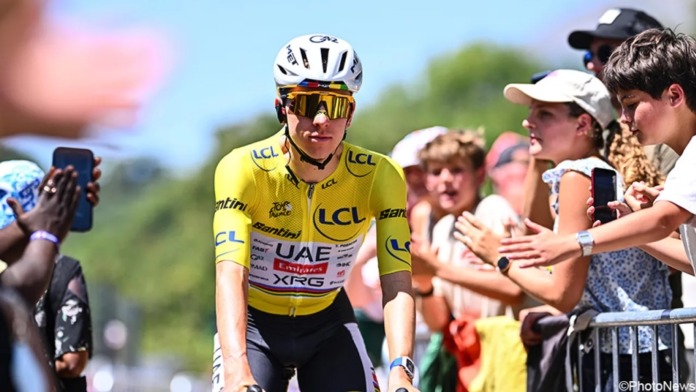
The Tour de France saves its hardest mountain stage for the penultimate day, sending the riders over 170.9km and 5,450 metres of climbing from Le Bourg-d’Oisans to Alpe d’Huez.
Stage 20 begins with the Col de la Croix de Fer, links the Col du Télégraphe directly into the Col du Galibier and then turns towards the unfamiliar ascent of the Col de Sarenne. The riders cross Sarenne with only 14.4km remaining before descending towards the finish at Alpe d’Huez.
This is not a second full ascent of the traditional 21 hairpins.
Stage 19 used the classic road from Bourg-d’Oisans, where Tadej Pogačar caught the breakaway and won six seconds ahead of Lenny Martinez. Stage 20 approaches the resort from the opposite side after climbing Sarenne.
Pogačar begins the day with a 7:11 advantage over Remco Evenepoel after taking 2:39 from the Belgian through road time and finish bonuses on stage 19. Isaac del Toro remains third, but Paul Seixas is only 24 seconds behind in the fight for the podium and white jersey.
Yellow appears secure unless Pogačar crashes or suffers a complete collapse. The battles behind him remain considerably more open.
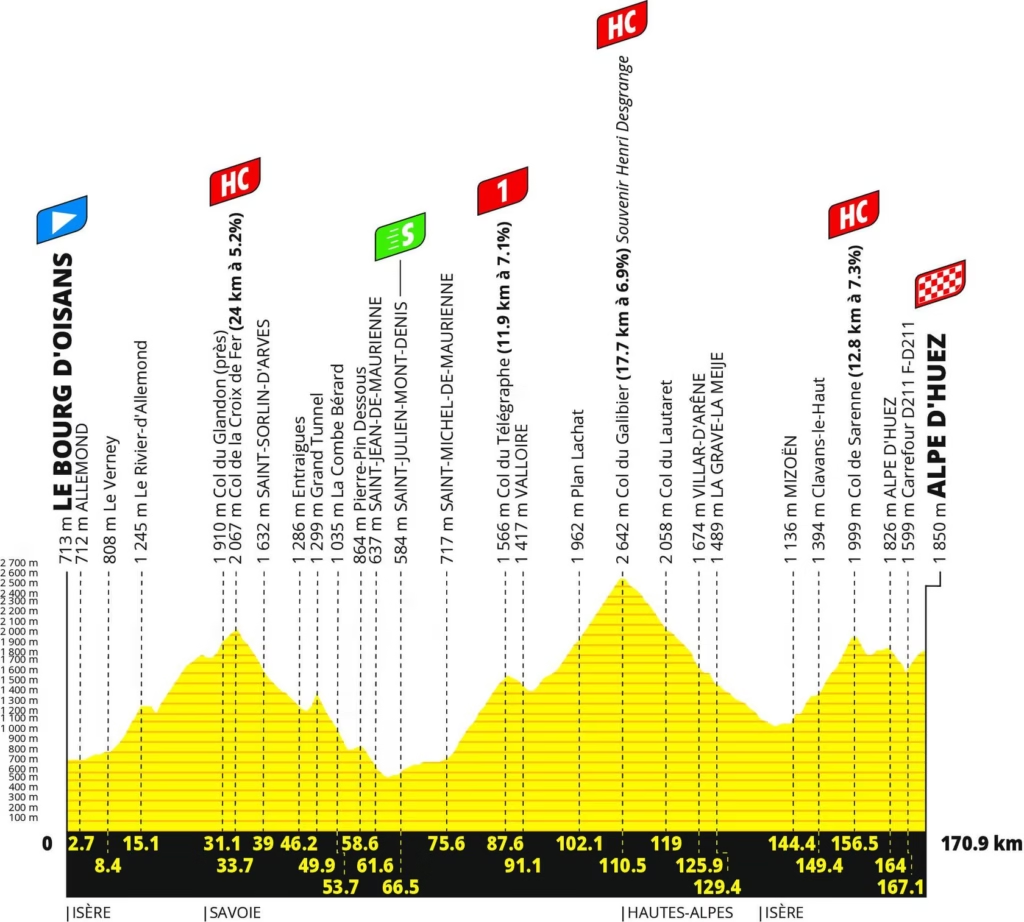
Tour de France stage 20 route at a glance
| Detail | Stage 20 information |
|---|---|
| Date | Saturday 25 July 2026 |
| Start | Le Bourg-d’Oisans |
| Finish | Alpe d’Huez |
| Distance | 170.9km |
| Elevation gain | 5,450 metres |
| Stage type | Mountain |
| Neutralised start | 11:20 CEST / 10:20 BST |
| Expected finish | 16:11–16:50 CEST / 15:11–15:50 BST |
| Highest point | Col du Galibier, 2,642 metres |
| Final categorised climb | Col de Sarenne |
| Finish bonuses | 10, six and four seconds |
The route forms the hardest climbing day of the Tour and gives riders very little opportunity to recover between its major ascents.
The wider significance of the stage is covered in the Tour de France 2026 queen stage guide.
Tour de France stage 20 climbs
| Climb | Summit point | Length | Average gradient | Category |
|---|---|---|---|---|
| Col de la Croix de Fer | 33.7km | 24km | 5.2% | Hors catégorie |
| Col du Télégraphe | 87.6km | 11.9km | 7.1% | Category one |
| Col du Galibier | 110.5km | 17.7km | 6.9% | Hors catégorie |
| Col de Sarenne | 156.5km | 12.8km | 7.3% | Hors catégorie |
The stage contains 70 mountains classification points.
Twenty are available on the Croix de Fer, 10 on the Télégraphe and another 20 on both the Galibier and Sarenne. There are no additional mountains points at the finish.
That makes stage 20 decisive for Richard Carapaz, Pogačar and Valentin Paret-Peintre in the polka-dot jersey competition.
The scale of the climbing also places stage 20 at the top of our ranking of the Tour de France 2026 mountain stages by difficulty.
General classification before stage 20
| Position | Rider | Team | Gap |
|---|---|---|---|
| 1 | Tadej Pogačar | UAE Team Emirates-XRG | Leader |
| 2 | Remco Evenepoel | Red Bull-Bora-Hansgrohe | +7:11 |
| 3 | Isaac del Toro | UAE Team Emirates-XRG | +9:42 |
| 4 | Paul Seixas | Decathlon CMA CGM | +10:06 |
| 5 | Lenny Martinez | Bahrain Victorious | +13:00 |
| 6 | Mattias Skjelmose | Lidl-Trek | +13:09 |
| 7 | Juan Ayuso | Lidl-Trek | +15:58 |
Pogačar’s victory on the traditional Alpe d’Huez ascent changed the emphasis of the final mountain day.
Evenepoel lost 2:29 on the road and another 10 seconds through the difference in finish bonuses. The Belgian now holds a 2:31 advantage over Del Toro, giving him a useful buffer in the fight for second.
The closest battle remains immediately behind him.
Del Toro finished four seconds ahead of Seixas on stage 19, extending his advantage from 20 to 24 seconds. That remains small enough to disappear through one attack, a poor descent or the finish bonuses at Alpe d’Huez.
The pair’s earlier position was analysed in the Tour de France 2026 white jersey battle between Del Toro and Seixas. Stage 20 now gives Seixas one final opportunity to reverse it.
The Croix de Fer begins the damage immediately
Stage 20 offers very little time for the peloton to settle.
The riders leave Bourg-d’Oisans and begin moving towards the Croix de Fer almost immediately. The climb reaches its summit after 33.7km and measures 24km at 5.2%.
That average understates its difficulty.
The ascent is long and irregular, with changes of gradient that repeatedly interrupt a rider’s rhythm. Its position at the start of a 5,450-metre climbing day makes it more dangerous than the headline figures suggest.
The first battle will be for the breakaway.
Carapaz and Paret-Peintre need mountains points, while teams still without a stage victory have one final realistic opportunity before Paris. Strong climbers will attempt to place themselves ahead, but the presence of 20 points at the summit means the move could take a long time to settle.
The Croix de Fer is unlikely to decide the general classification directly.
It can decide which leaders still have teammates when the race reaches the Galibier.
The Télégraphe and Galibier form one enormous climbing block
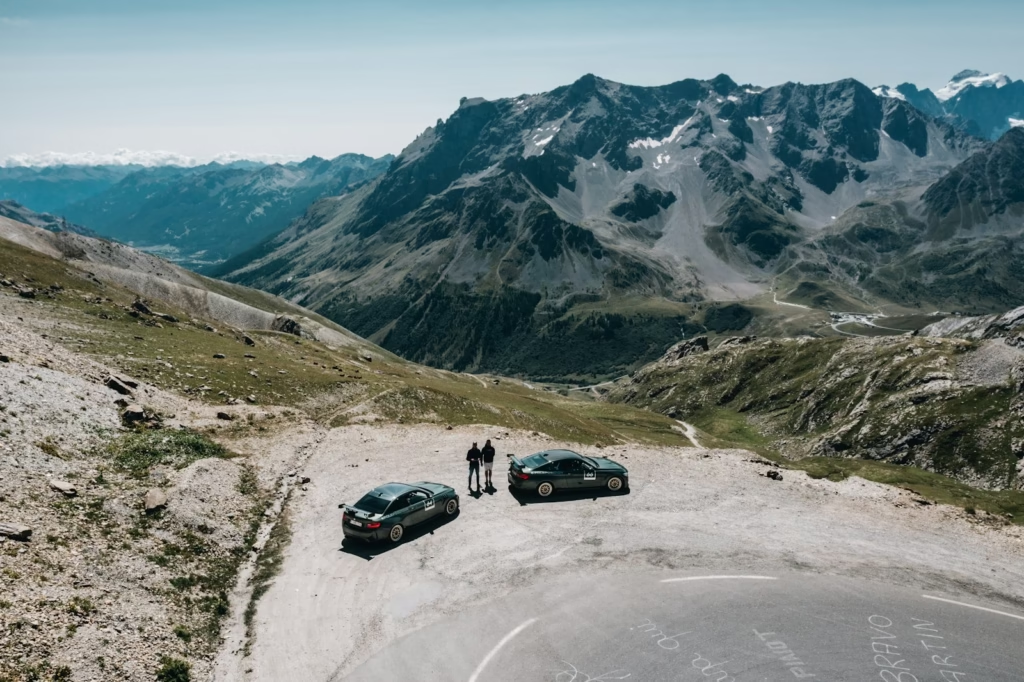
The Col du Télégraphe begins after the intermediate sprint at Saint-Julien-Mont-Denis.
It measures 11.9km at 7.1% and reaches its summit after 87.6km. The riders then descend briefly into Valloire before beginning the 17.7km climb of the Galibier.
That short interruption does not provide a complete recovery.
From the lower slopes of the Télégraphe to the summit of the Galibier, the riders face close to 30km of sustained climbing. The Galibier reaches 2,642 metres, making it the highest point of the 2026 Tour.
This is the obvious place for a long-range general classification move.
Seixas, Skjelmose or Ayuso could attack on the upper Galibier and use a teammate from the breakaway during the descent. Evenepoel could also attempt something ambitious, although overturning 7:11 requires more than simply distancing Pogačar near the summit.
The altitude increases the uncertainty.
Riders who appeared secure on stage 19 may react very differently above 2,000 metres after three weeks of racing.
The major climbs of the route are covered more widely in our Tour de France 2026 climbs guide.
Could Evenepoel attack Pogačar on the Galibier?
He can attack, but winning the Tour now requires an extraordinary failure from Pogačar.
Evenepoel begins stage 20 at 7:11. He would need to distance the yellow jersey on the Galibier, maintain the advantage through the long descent and then survive Sarenne without Pogačar returning.
Red Bull-Bora-Hansgrohe could place Jai Hindley, Maxim Van Gils or another teammate into the breakaway. An Evenepoel move near the top of the Galibier would then give him assistance on the road towards Mizoën.
The problem is that Pogačar showed no weakness on stage 19.
He attacked on Alpe d’Huez, erased the breakaway’s advantage and won the stage. Evenepoel finished 2:29 behind on the road, while Del Toro and Seixas arrived shortly afterwards.
Evenepoel’s more realistic priority is defending second.
A failed long-range attack could cost enough energy to bring Del Toro or Seixas into the fight for the runner-up position. He therefore needs strong evidence that Pogačar is vulnerable before committing everything on the Galibier.
The scale of the challenge is clear from our earlier analysis of whether Remco Evenepoel could still win the Tour de France 2026.
The Col de Sarenne is the real final climb
The Col de Sarenne may decide more than the famous Galibier.
The ascent begins from Mizoën late in the stage and measures 12.8km at 7.3%. It reaches 1,999 metres with only 14.4km remaining.
The gradient becomes particularly difficult near the top, after the riders have already climbed the Croix de Fer, Télégraphe and Galibier. Sections reach double figures, while the exposed upper road offers little shelter if the weather changes.
The Tour previously used Sarenne as a descent during the 2013 stage that climbed Alpe d’Huez twice. In 2026, it is raced uphill for the first time.
That unfamiliarity matters.
Teams know every kilometre of the traditional Alpe d’Huez ascent. Sarenne offers fewer established reference points, a more isolated road and less opportunity to judge effort through familiar landmarks.
An attack four or five kilometres below the summit could decide the stage, podium and white jersey.
What happens after the Col de Sarenne?
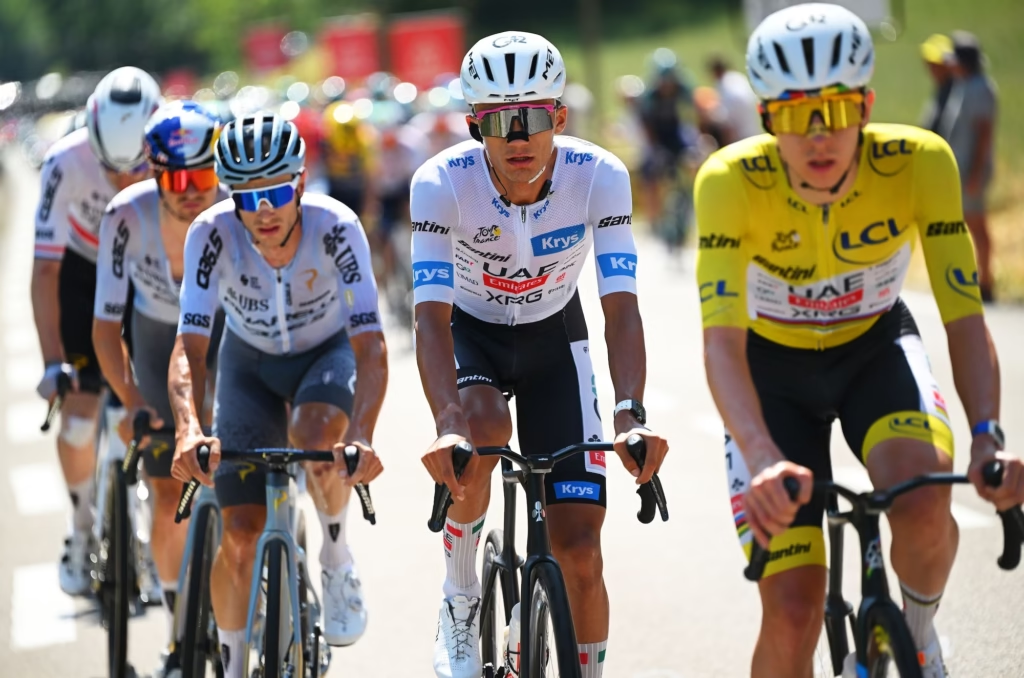
The summit comes at kilometre 156.5, leaving 14.4km to the finish.
The riders then descend towards Alpe d’Huez before joining the roads through the resort for the final approach.
This is not the traditional descent from a major mountain followed by another full summit climb.
Sarenne effectively forms the final decisive ascent. The remaining kilometres combine a technical descent and an uneven approach towards the finish.
That creates an unusual tactical finale.
A rider reaching the Sarenne summit alone must descend accurately before completing the final uphill sections. A small group could work together after the summit, but hesitation may allow chasers to return.
The race may be won by the strongest climber, the best descender or the rider most willing to commit before the final summit.
The difference between the two Alpe d’Huez finishes is central to why the back-to-back stages could define the Tour de France 2026.
The Del Toro-Seixas duel has one final mountain stage
Del Toro begins stage 20 with 24 seconds over Seixas.
Stage 19 suggested there is very little between them. Del Toro finished four seconds ahead after Pogačar’s attack, while Seixas crossed the line alongside Skjelmose.
Stage 20 provides more opportunities to create a meaningful gap.
Seixas can attack on the Galibier, use Nicolas Prodhomme or another Decathlon rider as a satellite teammate and force Del Toro to chase before Sarenne. Decathlon CMA CGM do not need to wait until the final climb.
Del Toro has a more complicated role.
He is defending third and white, but he also remains Pogačar’s most important surviving mountain teammate. Brandon McNulty has abandoned, while illness has weakened UAE’s support during the final week.
UAE should allow Del Toro to protect his own classification unless Pogačar faces a genuine crisis. The yellow jersey has enough time to manage much of the race himself.
The calculation for Seixas is clear: 25 seconds gives him the podium and white jersey outright. A smaller road gap could still be enough if he earns a better finish bonus.
Lenny Martinez is suddenly part of the podium picture
Martinez transformed his position by finishing second on stage 19.
The Bahrain Victorious climber crossed the line only six seconds behind Pogačar after spending much of the stage in the breakaway. That moved him to fifth overall at 13:00, 3:18 behind Del Toro.
That remains a substantial gap, but stage 20 is capable of producing losses measured in minutes.
Martinez also has another possible route into the race through the early breakaway.
If he enters the move and reaches the Croix de Fer with a meaningful advantage, UAE, Decathlon and Lidl-Trek will need to monitor the gap. Unlike before stage 19, he is now close enough on general classification to affect several teams’ objectives.
Bahrain Victorious must decide whether to protect fifth or gamble on a move capable of reaching the podium.
Skjelmose is only nine seconds behind Martinez
Mattias Skjelmose begins stage 20 only nine seconds behind Martinez.
That creates another direct classification battle beneath the podium fight.
Lidl-Trek have two possible cards through Skjelmose and Ayuso, although Ayuso’s time loss on stage 19 moved him further from the positions he had been targeting.
Skjelmose can race more conservatively for fifth, but Lidl-Trek should aim higher.
The team could send Ayuso into the breakaway and allow Skjelmose to wait with the GC group. If Decathlon or UAE are forced to chase Ayuso, Skjelmose benefits without spending his own energy.
Alternatively, Skjelmose can attack on the Galibier while Ayuso remains behind as a second option.
Finishing fifth is valuable. Stage 20 offers enough terrain to attempt something more ambitious.
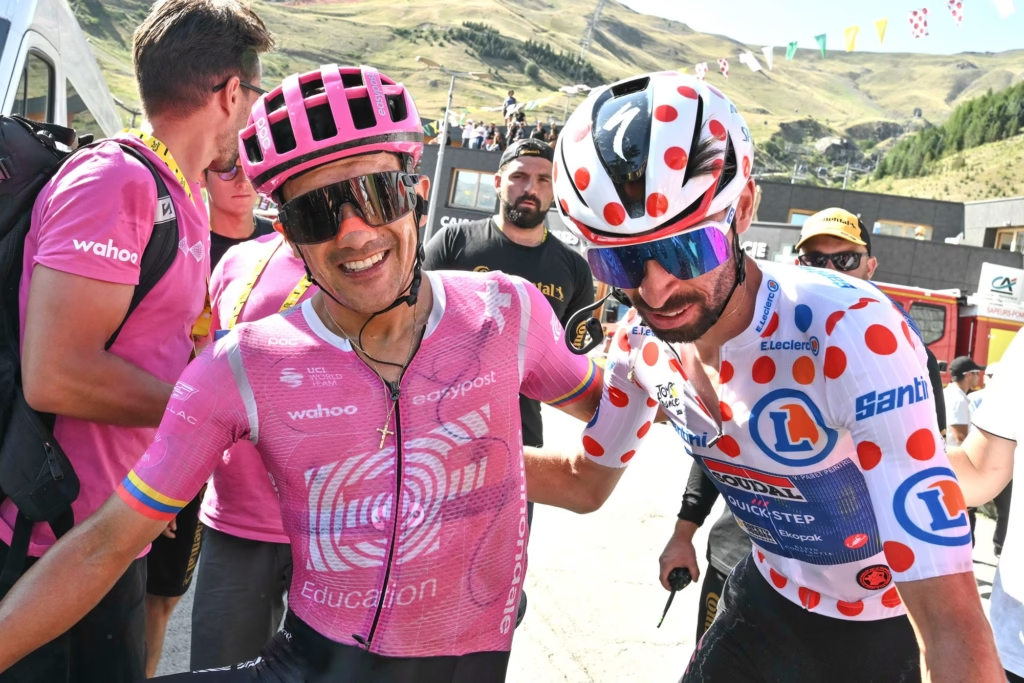
Carapaz takes a one-point polka-dot lead into stage 20
Richard Carapaz begins the queen stage with 91 mountains points.
Pogačar has 90 and Paret-Peintre 84.
| Position | Rider | Mountains points |
|---|---|---|
| 1 | Richard Carapaz | 91 |
| 2 | Tadej Pogačar | 90 |
| 3 | Valentin Paret-Peintre | 84 |
| 4 | Remco Evenepoel | 42 |
| 5 | Lenny Martinez | 37 |
The distribution of points makes the strategy difficult.
Carapaz and Paret-Peintre need to enter the breakaway because Pogačar is unlikely to contest the Croix de Fer from the peloton. If either specialist scores heavily on the opening climbs, the yellow jersey may not be able to recover the deficit on Sarenne.
There are no mountains points at the finish itself.
The final 20 points are awarded at the Col de Sarenne summit. The polka-dot jersey could therefore be settled before the stage winner reaches Alpe d’Huez.
Carapaz has the narrow advantage, but he has also spent two consecutive days racing aggressively. Paret-Peintre may have more reason to gamble everything on the opening move.
Pogačar remains dangerous because he can collect 20 points simply by being the strongest general classification rider on Sarenne.
The contest developed from the scenario outlined in our earlier Tour de France 2026 polka-dot jersey analysis.
Will the breakaway win stage 20?
The breakaway has a strong chance, but its composition will determine how much freedom it receives.
UAE have no need to chase. Pogačar leads by more than seven minutes and has already won on the traditional Alpe d’Huez ascent. Their priority should be surviving the stage with yellow rather than pursuing another victory.
Red Bull-Bora-Hansgrohe may also avoid controlling if Evenepoel chooses to defend second.
That leaves several teams with reasons to attack:
- Team Visma | Lease a Bike with Sepp Kuss
- EF Education-EasyPost with Carapaz
- Bahrain Victorious with Martinez
- Soudal Quick-Step with Paret-Peintre
- Netcompany INEOS Cycling Team with Thymen Arensman
- Uno-X Mobility with Tobias Halland Johannessen
- Lidl-Trek with riders supporting a Skjelmose or Ayuso move
The danger for the breakaway is that the podium battle may create a high pace from the Galibier onwards.
A rider could begin Sarenne with several minutes and still be caught if Seixas, Del Toro or Evenepoel attacks behind.
The route is naturally suited to the kind of aggressive racing examined in our Tour de France 2026 breakaway stages guide.
 Photo Credit: Getty
Tour de France stage 20 contenders
Tadej Pogačar
Pogačar is the strongest rider in the race and therefore the most obvious favourite.
Stage 19 demonstrated that he can close a large breakaway advantage on a single climb. Stage 20 should suit him even more because altitude, fatigue and repeated climbing increase the difference between the strongest rider and everyone else.
The question is motivation.
He already has yellow effectively secured, won the traditional Alpe d’Huez stage and may prefer to follow rather than chase another escape. His team is depleted, making a controlled race less attractive.
Pogačar can still win without UAE working. If attacks for the podium bring the breakaway back, he will be difficult to beat on Sarenne.
Richard Carapaz
Carapaz has combined aggressive racing with excellent form throughout the final week.
He won stage 18, finished third on stage 19 and now leads the mountains classification. Stage 20 gives him a clear reason to join the breakaway from the Croix de Fer.
His challenge will be recovery.
Carapaz has spent two consecutive days racing for stage victories while several rivals conserved more energy. He may also need to choose between collecting every available point and pacing himself for Sarenne.
Lenny Martinez
Martinez came within six seconds of winning on Alpe d’Huez.
His stage 19 performance showed that he can survive a hard breakaway and still climb close to Pogačar’s level at the end. The queen stage offers another route through the escape, but his improved general classification position may make the peloton less willing to let him go.
Martinez is now close enough to fifth overall that Decathlon, Lidl-Trek and UAE must monitor him.
Sepp Kuss
Kuss finished fourth on stage 19 after attacking from the breakaway.
Team Visma | Lease a Bike no longer have a general classification leader to protect, giving the American freedom to target the final mountain stage. The repeated high climbs and long endurance test suit him.
He does not need to contest every mountains point and can save his effort for the Galibier and Sarenne.
Paul Seixas
Seixas is the most likely general classification rider to attack.
He needs only 25 seconds to take the podium and white jersey. Decathlon can send teammates ahead and use the Galibier to begin the move before Del Toro expects it.
His attempt to gain time may bring him into stage-winning contention even if the stage victory is not the original objective.
Isaac del Toro
Del Toro can win if defence turns into attack.
He looked strong enough to finish ahead of Seixas on stage 19 and may prefer to increase his advantage rather than spend the entire day reacting. Pogačar’s secure yellow jersey gives UAE more freedom to protect its second rider.
Del Toro’s faster finish would also make him dangerous if a small group reaches the final approach together.
Mattias Skjelmose
Skjelmose has reasons to race aggressively and conservatively at the same time.
He is only nine seconds from fifth, but needs nearly three minutes to reach Del Toro. Following Martinez may improve one position, while attacking on the Galibier creates a route towards something larger.
Lidl-Trek’s remaining strength should allow Skjelmose to delay his main move until the race has already been reduced.
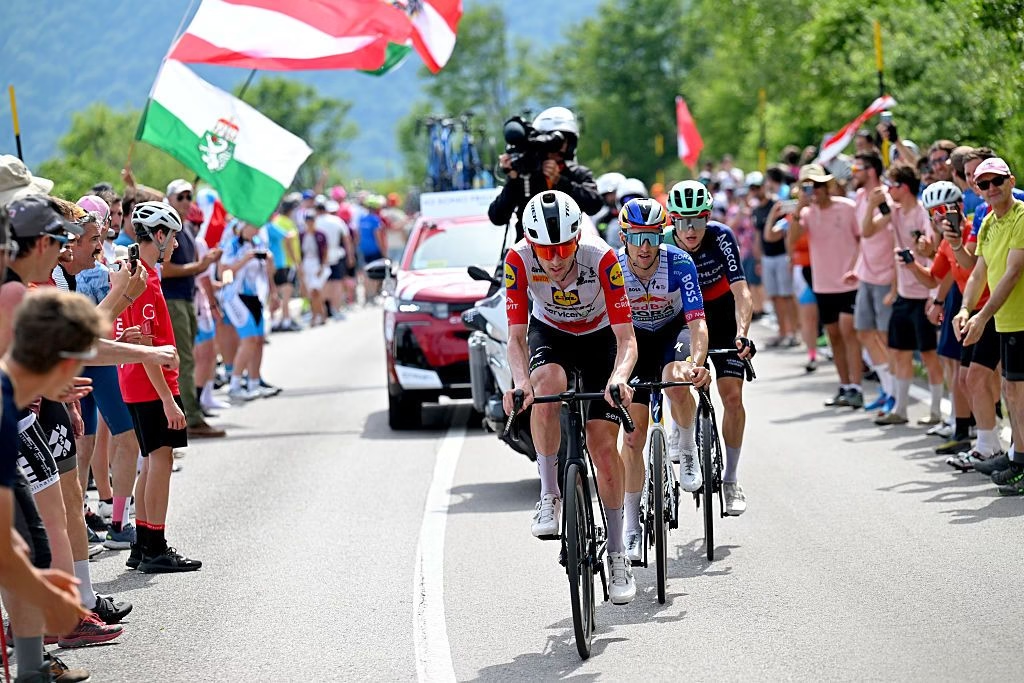
Riders to watch from the breakaway
Several other riders fit the demands of the route:
- Thymen Arensman has the climbing endurance for a stage containing more than 5,000 metres of ascent.
- Tobias Halland Johannessen finished fifth on stage 19 and remains one of the strongest climbers outside the leading GC group.
- Michael Storer can target the breakaway if Tudor Pro Cycling Team give him complete freedom.
- Felix Gall is naturally suited to the Alpine terrain if his recovery is strong enough.
- Harold Tejada showed useful form on stage 19 and could benefit from a less controlled race.
- Valentin Paret-Peintre must attack for mountains points and could remain in contention if he manages the opening climbs intelligently.
- Juan Ayuso may now be more useful as Lidl-Trek’s attacking card than as a rider protecting seventh overall.
Where stage 20 will be decided
The stage has three likely decision points.
The Croix de Fer
The opening climb decides the composition of the breakaway and whether Carapaz or Paret-Peintre gains an early advantage in the mountains competition.
A large group containing Martinez, Ayuso or another high-placed rider could force UAE, Decathlon or Lidl-Trek to chase earlier than planned.
The upper Galibier
This is where the first serious general classification attack can happen.
Seixas has a reason to move, Lidl-Trek need to create chaos and Evenepoel must decide whether he is defending second or attempting one final attack on yellow.
A split near the summit could expand dramatically during the long descent.
The final kilometres of Sarenne
The upper section of Sarenne is steep, exposed and late enough that tactical calculations become secondary.
Anyone who still has the legs can attack. The descent and remaining approach are short enough for a committed rider to stay away.
-
 Photo Credit: A.S.O./Gaëtan Flamme

Tour de France stage 20 prediction
Pogačar is capable of winning again, but UAE have no reason to control 170.9km with a weakened team.
The most likely scenario is a large and powerful breakaway forming on the Croix de Fer. Carapaz and Paret-Peintre contest the mountains points, while Kuss, Martinez and Arensman attempt to preserve enough energy for the final two climbs.
Behind them, Seixas attacks Del Toro on the Galibier or Sarenne. That increases the pace of the favourites but may begin too late to catch the strongest survivor from the breakaway.
Stage winner prediction: Sepp Kuss
Kuss showed his form by finishing fourth on stage 19 and should receive complete freedom from Team Visma | Lease a Bike. He does not need to spend energy contesting every mountains summit and can focus on reaching Sarenne with enough left for one decisive effort.
Tour de France stage 20 favourites
- Sepp Kuss
- Tadej Pogačar
- Lenny Martinez
- Richard Carapaz
- Thymen Arensman
The yellow jersey may already be effectively settled.
The stage victory, polka-dot jersey, white jersey and final Tour podium are not.

