
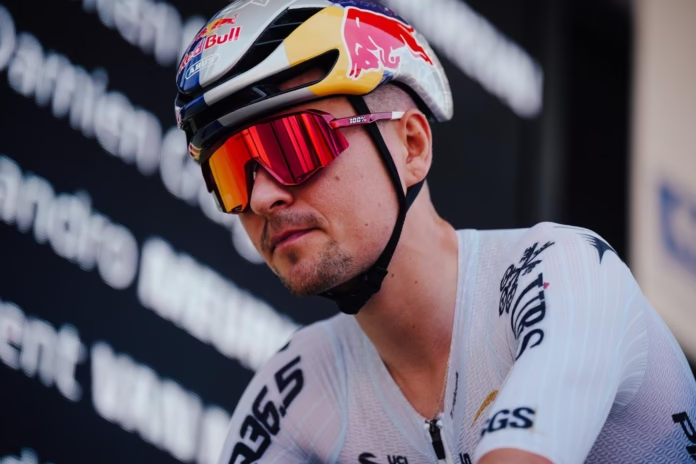
Tom Pidcock’s return to Alpe d’Huez could hardly have been more different from the afternoon that helped establish him as one of Britain’s most exciting riders four years ago.
In 2022, Pidcock attacked the Tour de France from the breakaway, descended the Galibier with astonishing confidence and then rode away from his companions on Alpe d’Huez to claim his first Tour stage victory. His win remains one of the defining road performances of his career.
On Friday, the same mountain became a survival exercise.
Pidcock finished Stage 19 in 20th place and slipped from eighth to ninth overall. The explanation afterwards was brutally simple.
“That second last climb, I went so deep, I think I paid for that on the last climb; I was dead there,” Pidcock said. “Of course I had hoped for more, but there was nothing more I had in my legs there, so it is what it is.”
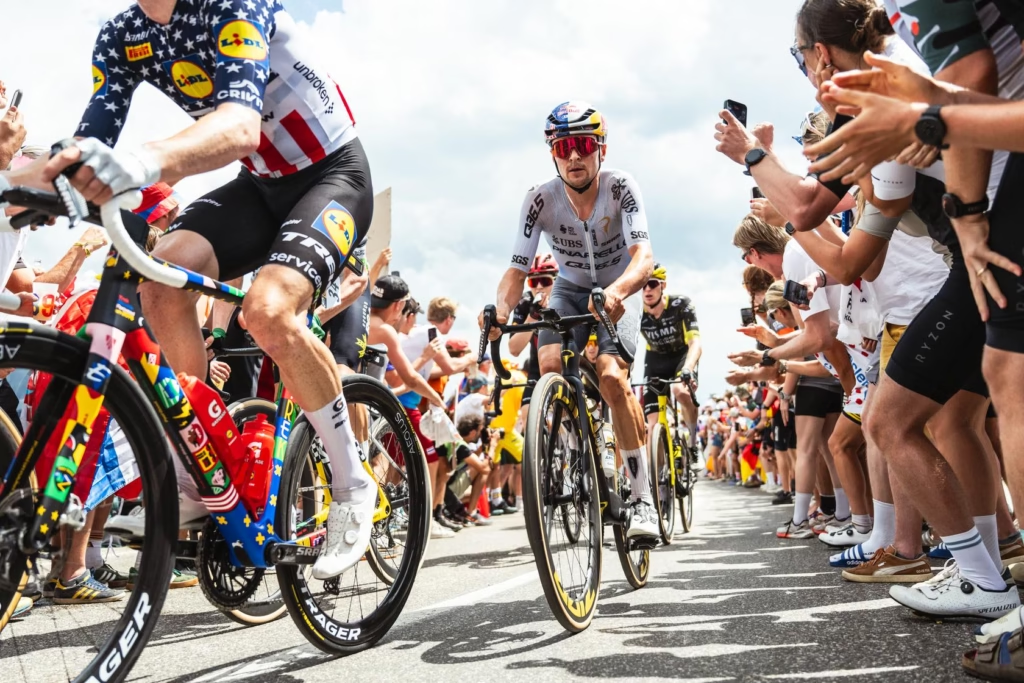 Photo Credit: A.S.O./Charly López
Pidcock’s problems started before Alpe d’Huez
The decisive damage was arguably done on the Col d’Ornon rather than the famous 21 hairpins themselves.
As expected from the Stage 19 route to Alpe d’Huez, the relatively short 127.9km stage encouraged aggressive racing. The Col d’Ornon then provided the final opportunity to soften the GC group before the road descended towards Bourg d’Oisans.
Pidcock managed to stay in contact through that pressure, but doing so required an effort that left him with very little for the finale.
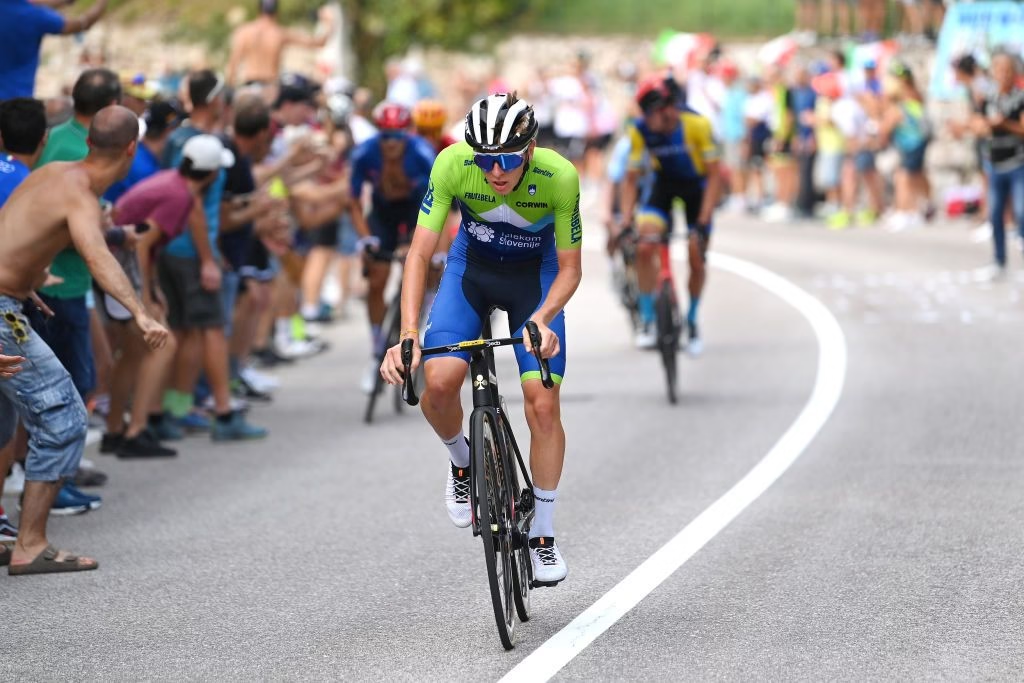
Once the race reached Alpe d’Huez, the pace increased again and Pidcock was among the GC riders unable to remain with the strongest group.
There was no obvious mechanical problem and no suggestion that Pidcock deliberately eased off to save himself for Saturday. He had simply spent too much energy maintaining his position earlier in the stage.
By the time the favourites began racing properly on Alpe d’Huez, Pidcock was already empty.
The final kilometres therefore became about limiting losses rather than challenging the riders around him on GC.
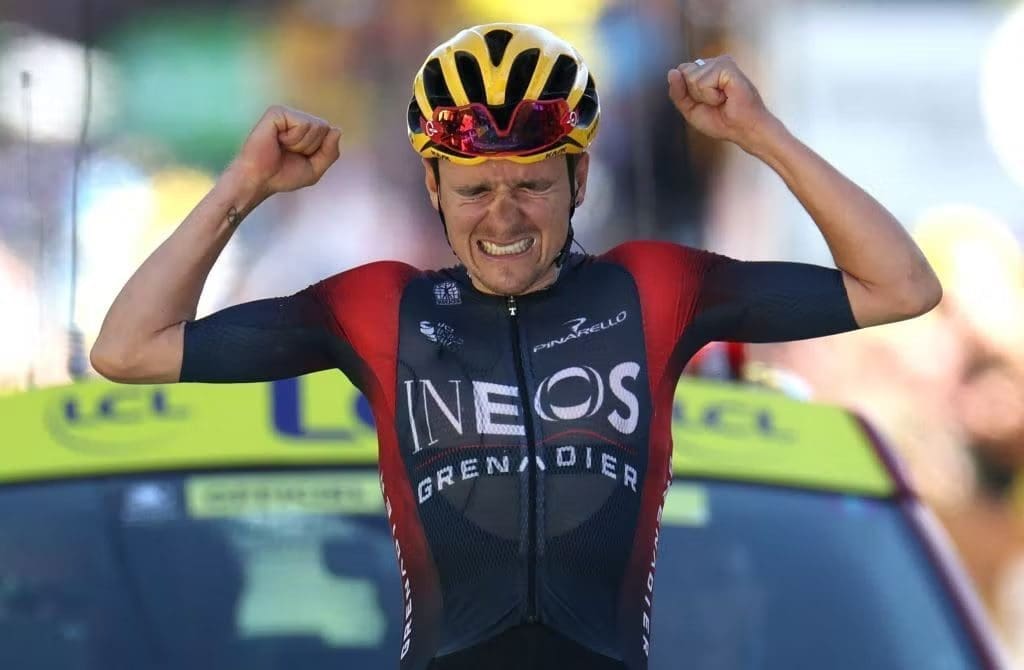 Photo Credit: A.S.O./Charly López
Why this was nothing like Pidcock’s 2022 victory
The contrast with 2022 is striking, but the circumstances were completely different.
Four years ago, Pidcock had already lost enough time overall to receive freedom in a breakaway. He used the descent of the Galibier to bridge across to the move, joined riders including Chris Froome and Louis Meintjes, then proved the strongest on Alpe d’Huez.
It was a victory built from the full range of Pidcock’s abilities. His descending created the opportunity and his climbing finished it.
That performance now sits among the greatest moments in Alpe d’Huez history, and Pidcock remains the most recent men’s Tour stage winner on the climb before its return in 2026.
This time, though, he arrived at Alpe d’Huez after almost three weeks of racing as a genuine top-10 GC rider.
That changes everything.
Instead of choosing when to spend energy, Pidcock has repeatedly had to follow the pace of riders fighting for the Tour podium. Every difficult mountain stage becomes an exercise in defending position rather than simply targeting one decisive moment.
His podium challenge had become realistic earlier in the race after he gained more than seven minutes from the breakaway on Stage 13 and moved up to fourth overall.
The final week has provided the other side of that equation.
Pidcock has already shown during this Tour that he can climb with some of the best stage racers in the world, but Friday demonstrated the cost of trying to do it day after day.
Alpe d’Huez did not suddenly expose a lack of climbing ability. It exposed accumulated fatigue.
Pidcock still has a Tour top 10 to protect
Despite losing substantial time, Pidcock remains ninth overall.
That is important context. His Tour has not collapsed.
A top-10 finish would still represent a significant result, particularly given how his role has evolved since the start of the race. Before Barcelona, the question was whether Pidcock would operate as a stage hunter or test himself as a GC rider. His race has ultimately answered that.
He has been able to do both.
The pre-Tour assessment of Pidcock as a GC outsider now looks conservative. He has spent much of the race far higher than that and put himself into the podium conversation before the hardest mountain stages finally began to separate the strongest pure stage racers.
The immediate priority is now making sure one bad day does not become two.
Stage 20 could be even worse for tired legs
Pidcock has almost no opportunity to recover.
Stage 20 is the queen stage of the 2026 Tour de France, taking the riders from Le Bourg-d’Oisans back to Alpe d’Huez over an extraordinary sequence of Alpine climbs.
The Col de la Croix de Fer arrives early, followed by the Col du Télégraphe and Col du Galibier. The riders then face the Col de Sarenne before eventually returning to Alpe d’Huez.
It is not simply another summit finish.
ProCyclingUK ranked Stage 20 as the hardest mountain stage of the 2026 Tour because of the combination of distance, altitude, climbing volume and its position on the penultimate day.
For a rider who finished Friday admitting he had nothing left, that matters.
The nature of the stage could cut both ways.
A longer endurance effort may suit Pidcock better if the race settles into a more predictable rhythm, allowing him to climb at his own pace rather than repeatedly responding to explosive accelerations.
But Stage 20 also offers almost nowhere to hide. If Friday was evidence that three weeks of racing have finally caught up with him, Croix de Fer, Télégraphe, Galibier and Sarenne could expose that much earlier than the final climb.
Pidcock does not need to follow Tadej Pogačar or the riders still fighting over the podium.
His race is now about recognising when the pace is unsustainable, managing the effort and protecting ninth overall.
Four years after Alpe d’Huez provided one of the defining victories of Pidcock’s career, the mountain has offered him a very different test.
In 2022, he conquered it.
In 2026, simply surviving two consecutive days on Alpe d’Huez while preserving a Tour de France top 10 may prove almost as revealing.

