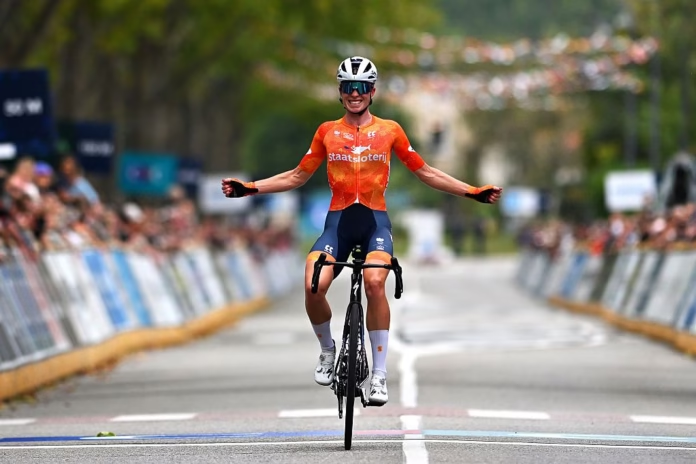
Demi Vollering starts Saturday’s elite women’s European Championships road race with the strongest form line in the field. Six days after winning the world title in Montréal, the defending European champion arrives in Slovenia with the rainbow jersey, the Giro d’Italia Women and the Tour de France Femmes already on her 2026 palmarès.
The challenge is that this is not simply a repeat of Montréal. The 130km race from Ljubljana to Šenčur is built around two ascents of Možjanca, 2.1km at 10.2% with ramps to 15.8%, followed by rolling roads and a fast run back towards the finish. It is steep enough for the climbers to make a difference, but there is enough road afterwards for a tactical race to develop.
Kasia Niewiadoma-Phinney, Elisa Longo Borghini and Marlen Reusser finished second, third and fourth behind Vollering at the World Championships and all return immediately for another championship race. Puck Pieterse gives the Netherlands a second aggressive option, while Lorena Wiebes changes the race entirely if the final selection is larger than the pure climbers want.
The final start list is now confirmed, removing several names that appeared on the earlier UEC entry list. Great Britain are absent from the elite women’s road race, while France have Juliette Berthet, Maeva Squiban, Cédrine Kerbaol and Evita Muzic but not Célia Gery or Pauline Ferrand-Prévot. The full 2026 European Championships women’s road race start list contains 88 riders from 26 nations.
Previous winners
2025 – Demi Vollering
2024 – Lorena Wiebes
2023 – Mischa Bredewold
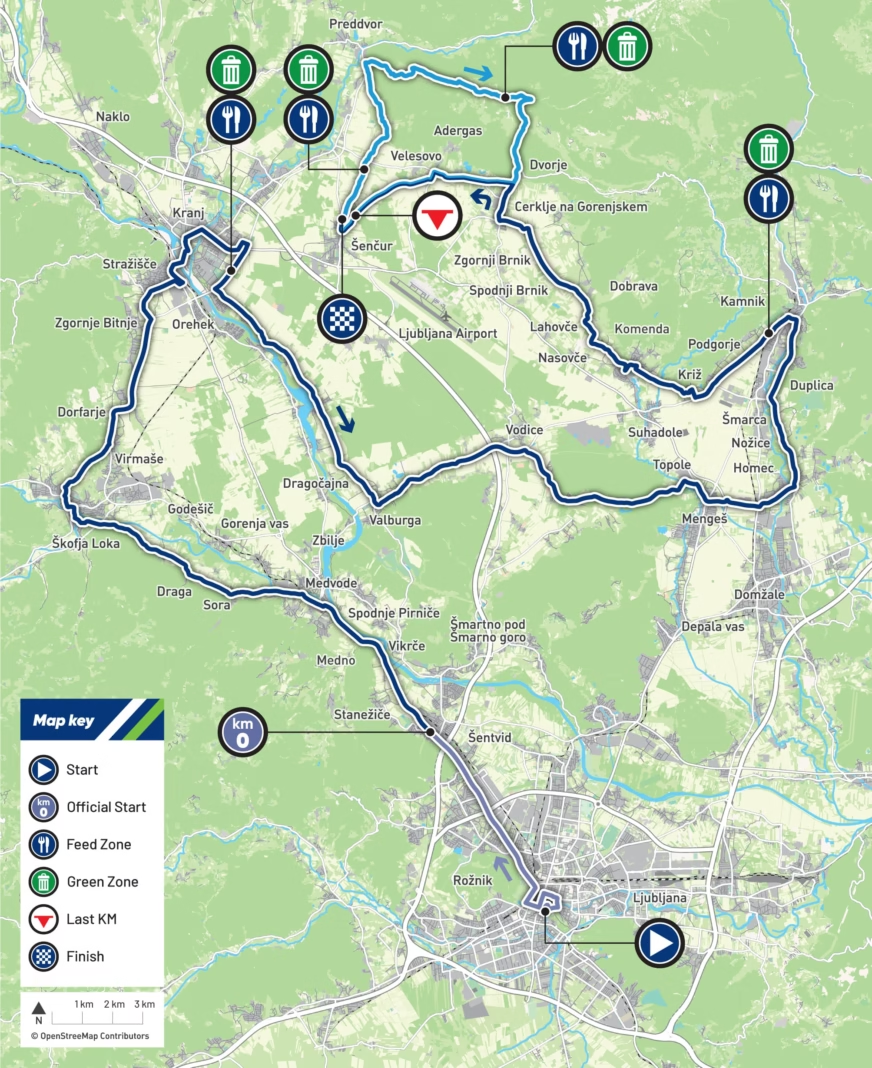
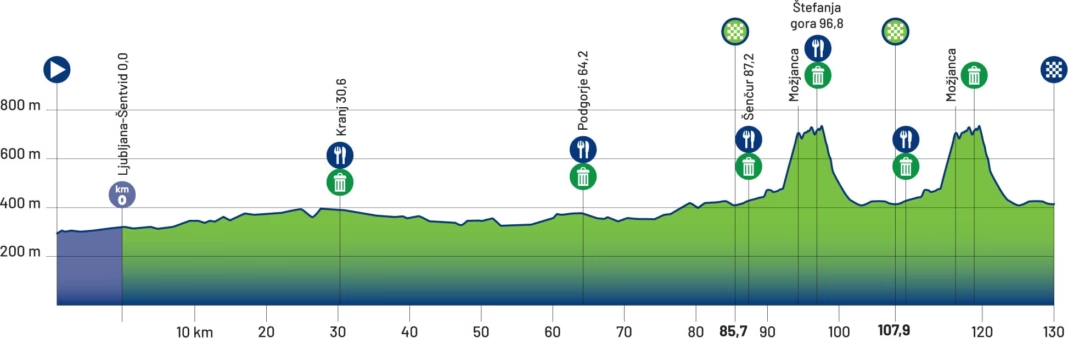
2026 European Championships women’s road race route
The race begins at Kongresni trg in central Ljubljana before the neutralised section takes the peloton towards kilometre zero in Šentvid. The opening portion of the race is mostly flat or rolling, running through Škofja Loka, Kranj, Volčji Potok, Kamnik, Komenda and Cerklje na Gorenjskem before the first arrival in the Šenčur area.
The race changes once the peloton reaches the 22.1km finishing circuit. Each lap contains 367 metres of climbing and is centred on Možjanca. The climb is only 2.1km long, but an average of 10.2% and a maximum of 15.8% make it hard enough to split a group very quickly if one of the stronger teams commits.
The important detail comes after the steepest section. Riders do not immediately descend back to the finish. The road continues over rolling and narrow terrain before the technical descent towards the lower station of the Krvavec cable car, meaning a rider who opens a small gap over Možjanca still has work to do before the faster roads towards Šenčur.
That makes the first ascent more important than it might appear. With only two laps there is little room to wait for the final climb and assume the race will sort itself out. Italy, France, Poland and Spain all have reasons to make the first passage hard enough to reduce the Dutch numbers, because allowing Vollering, Pieterse and Wiebes to reach the final lap together gives the Netherlands almost every tactical option.
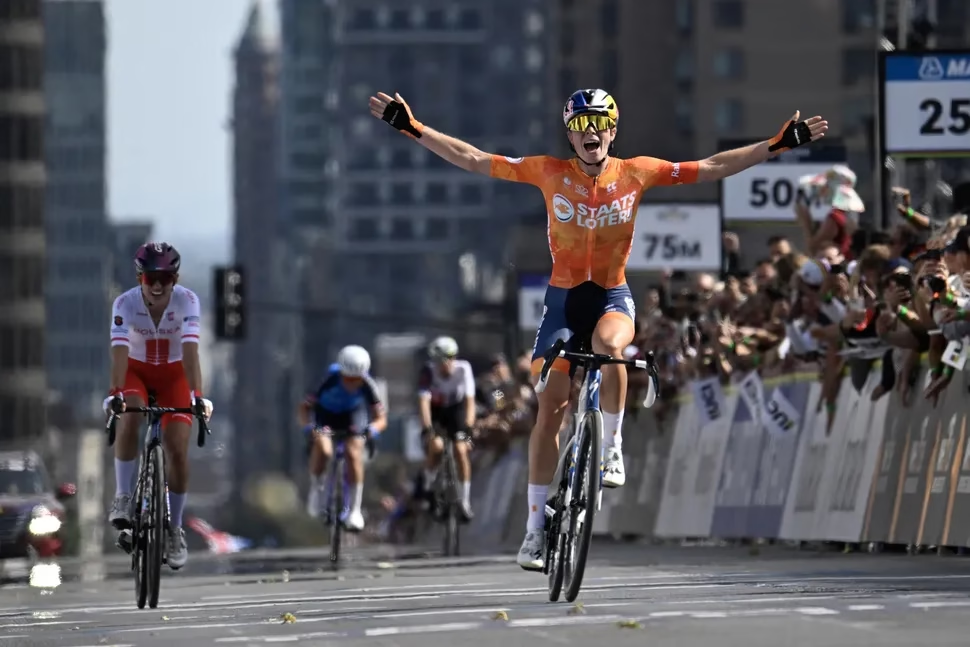 Photo Credit: Getty
Demi Vollering starts with the strongest case
Vollering won the European title in France last year with a 37km solo attack and returns wearing a different set of championship bands after winning the elite women’s world title in Montréal. Her first long attack there was eventually caught, but she still had enough left to beat Niewiadoma-Phinney in the final sprint after a difficult final lap.
Možjanca suits her even better on paper. It is long enough for climbing strength to count and steep enough to prevent a large group simply sitting in the wheels. Vollering can attack on the gradient, keep the pressure on over the rolling section afterwards and still sprint if a very small group reaches Šenčur.
The Netherlands also proved in Montréal that they do not need one fixed plan. Their World Championships tactics worked even after Vollering’s first move was brought back, and the European team is arguably even better suited to controlling different race scenarios because Pieterse and Wiebes offer such different ways to win.
Kasia Niewiadoma-Phinney needs to make Vollering race on her terms
Niewiadoma-Phinney came closer than anyone to taking the rainbow jersey from Vollering. She helped close the Dutchwoman’s long move in Montréal, stayed with the final selection and reached the finishing straight on the same time before being beaten in the sprint.
The Slovenian route again gives her the terrain to stay with Vollering, but simply following may not be enough. Poland have a stronger team than their five-rider Worlds line-up, with Dominika Wlodarczyk, Marta Lach and Agnieszka Skalniak-Sójka among the support, yet they still do not have the same depth of winning options as the Netherlands.
That creates a familiar problem. If Niewiadoma-Phinney waits until Vollering attacks on the final ascent, she may again find herself reacting to the rider with the strongest current form. Poland’s better race may be one where Wlodarczyk or Lach forces the Netherlands to work on the first circuit, leaving Niewiadoma-Phinney free to attack before the steepest part of the final Možjanca climb.
Elisa Longo Borghini has the team to attack early
Longo Borghini took bronze in Montréal and spent much of the final phase trying to create separation rather than accept a sprint against Vollering and Niewiadoma-Phinney. That instinct should matter again because Italy have enough depth to make the European race difficult well before the final ascent.
The final Italian eight are Francesca Barale, Letizia Borghesi, Eleonora Gasparrini, Longo Borghini, Gaia Masetti, Soraya Paladin, Silvia Persico and Debora Silvestri. Persico can survive a hard race and still finish quickly, while Gasparrini gives Italy another rider who becomes more dangerous if a larger group survives than the main climbers expect.
For Longo Borghini, the key may be to refuse the obvious script. Waiting until Vollering chooses the moment on Možjanca risks turning the race into a direct climbing contest. An attack on the approach, over the first ascent or in the rolling kilometres after it could force the Dutch team to spend riders before the final lap.
 Photo Credit: Getty
Marlen Reusser’s best terrain comes after the climb
Reusser arrives as the elite women’s time trial world champion and fourth-place finisher in the Montréal road race. She was only eight seconds behind Vollering there, which is important evidence that she can stay involved when a championship race becomes selective rather than simply relying on long power efforts.
The 15.8% ramps on Možjanca are less comfortable for her than the roads after the summit. Reusser’s task is therefore to limit any gap on the climb and reach the rolling section close enough to use her power. A five or ten-second deficit is very different from a clean separation when there are still fast kilometres before the finish.
Switzerland also have Noemi Rüegg, Steffi Häberlin and Petra Stiasny among a seven-rider selection. Rüegg is particularly useful if the race produces a larger front group, allowing Switzerland to avoid treating every move as though Reusser must personally close it.
Puck Pieterse and Lorena Wiebes give the Netherlands two more ways to win
Pieterse finished sixth in Montréal after playing an important role in the Dutch pressure that preceded Vollering’s first attack. On this course she can be more than a helper. The combination of a short steep climb, technical roads and a possible reduced sprint fits her well, particularly if she attacks on the first lap while the other nations are still trying to save riders for Vollering.
Wiebes presents the opposite problem. She won the European title in 2024 and remains the fastest finisher in the field, but two passages of Možjanca should be too much if the strongest climbing nations race aggressively. The danger for everyone else is allowing the pace to stall once the climb is over.
If 15 or 20 riders regroup on the run to Šenčur, Wiebes immediately becomes relevant again. That possibility changes how rival nations have to race. They cannot merely survive the climb and look at Vollering afterwards, because every second of hesitation creates the possibility of the Dutch sprint option returning.
 Photo Credit: Getty
France have the depth to make the first lap count
France were one of the strongest collective teams at the World Championships, with Juliette Berthet fifth and Maeva Squiban ninth. Célia Gery, seventh in Montréal, is not part of the final European Championships line-up, but Berthet and Squiban are joined by Cédrine Kerbaol, Evita Muzic, Léa Curinier, Célia Le Mouël, Marie Le Net and Émilie Morier.
Berthet has the clearest recent form after staying close to the leading group throughout the decisive phase in Montréal. Squiban is more likely to benefit from a race that starts moving earlier, while Kerbaol and Muzic both give France the climbing strength to put pressure on the Netherlands before the final ascent.
That depth is most valuable if France use it. A passive race leaves Berthet trying to match Vollering and Niewiadoma-Phinney on the steepest part of Možjanca. An active first lap can make the Dutch team decide which attacks matter and potentially remove Wiebes from the equation before the final circuit.
Liane Lippert and Paula Blasi lead the next line of contenders
Liane Lippert has the acceleration for a climb like Možjanca and Germany also have Antonia Niedermaier, Franziska Koch, Ricarda Bauernfeind and Linda Riedmann. Koch was tenth at the World Championships, while Niedermaier gives the team a rider more comfortable if the race turns into a sustained climbing test.
Spain’s most interesting card is Paula Blasi, whose 2026 stage-racing results have shown that she can handle steep late climbs without needing a summit finish. Mavi García, Usoa Ostolaza, Sara Martín and Alicia González give Spain enough experience to attack rather than wait for the strongest Dutch and Italian riders.
Blanka Vas also deserves attention on a course that mixes steep gradients with technical roads, while Cecilie Uttrup Ludwig remains dangerous in a hard one-day race. Silvia Persico, Marta Lach, Dominika Wlodarczyk, Noemi Rüegg, Riejanne Markus and Karlijn Swinkels all become more important if the leading favourites neutralise one another and the front of the race remains larger than expected.
How the women’s European Championships could be won
The opening 85km should be about keeping numbers intact and avoiding unnecessary work. The first passage over Možjanca is where the race is likely to become tactical. The Netherlands can afford to wait longer than anyone else because almost every outcome suits one of their leaders.
Italy, France, Poland and Spain have the opposite incentive. They need to make the Dutch team answer moves before Vollering reaches the final climb with Pieterse and several helpers still around her. Longo Borghini and Squiban are obvious riders to anticipate, while Poland can use Wlodarczyk or Lach to create a race Niewiadoma-Phinney does not have to control herself.
If Vollering reaches the foot of Možjanca on the final lap with the race together, the course is close to ideal for her. Niewiadoma-Phinney may need to attack before the steepest ramps, Reusser needs to remain close enough over the top to use the faster roads, and everyone else must avoid the worst possible outcome of marking one another until Pieterse attacks or Wiebes returns.
The finish is therefore less straightforward than the profile suggests. Ten seconds over the top can be enough if teammates behind disrupt the chase, but a small front group that stops working can lose that advantage quickly. The winner is likely to need both the legs for Možjanca and the tactical discipline to keep racing once the climb is finished.
How to watch the 2026 women’s European Championships road race
The elite women’s road race starts in Ljubljana at 13:30 CEST on Saturday 3 October, which is 12:30 BST in the UK. The international broadcast window begins at 13:20 CEST, or 12:20 BST, with the finish expected at around 17:40 CEST, 16:40 BST.
UK coverage is scheduled on TNT Sports and HBO Max. Our European Championships TV guide has the full viewing schedule and international options.
Top 3 prediction
1. Demi Vollering
2. Kasia Niewiadoma-Phinney
3. Elisa Longo Borghini
-
 Photo Credit: Gaetan Flamme