

The Vuelta a España is the youngest of cycling’s three men’s Grand Tours, but nearly a century after its creation it has developed an identity every bit as recognisable as the Tour de France or Giro d’Italia.
First held in 1935, the Spanish Grand Tour has survived civil war, the Second World War, organisational problems, repeated interruptions and a complete change in its position within the cycling season. The modern Vuelta is very different from the race won by Gustaaf Deloor before the Spanish Civil War, yet many of the qualities now associated with it have developed naturally from that uneven history.
Today the Vuelta is the final men’s Grand Tour of the season, known for steep summit finishes, intense heat, aggressive racing and riders arriving with wildly different objectives after the Giro and Tour. The red leader’s jersey, mountains such as the Angliru and Lagos de Covadonga, and an increasing willingness to start outside Spain have given the race a distinctive modern identity.
Getting there took decades.
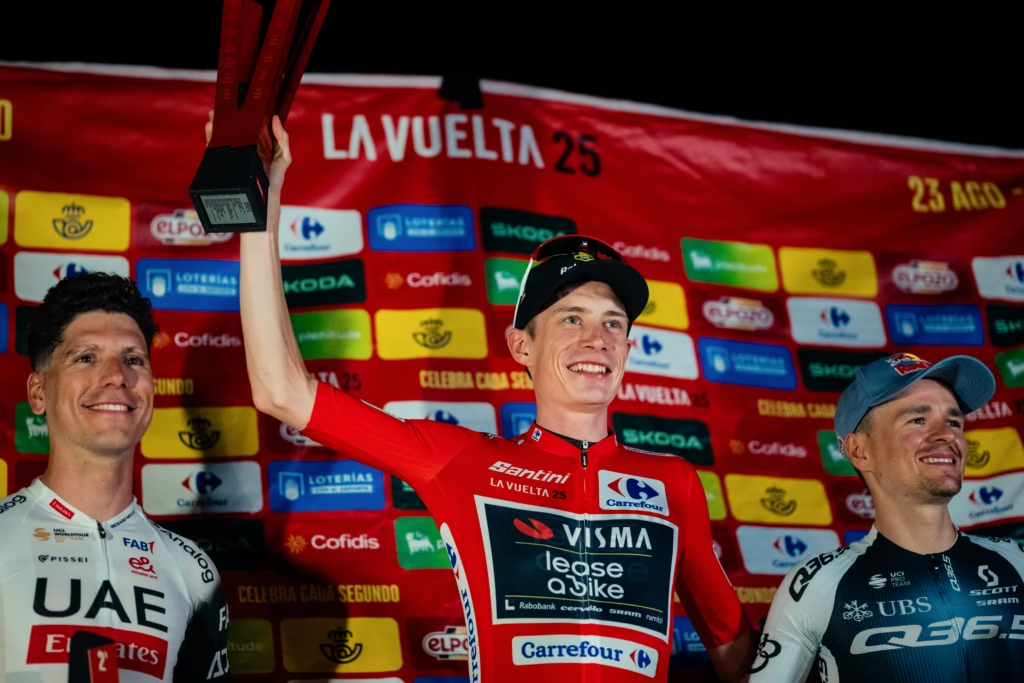
The Vuelta began in 1935
The first Vuelta a España started in Madrid on 29 April 1935, created with the backing of the newspaper Informaciones in an era when newspapers were central to the development of major cycling races.
The model was already established elsewhere. L’Auto had helped build the Tour de France, while La Gazzetta dello Sport had created the Giro d’Italia. Spain now had a national tour of its own.
The inaugural Vuelta contained 14 stages and covered more than 3,400km, a substantial undertaking given the roads, bicycles and support available during the 1930s.
Belgian Gustaaf Deloor became the first champion, ahead of Spanish favourite Mariano Cañardo. Deloor returned in 1936 and won again, this time with his brother Alfons finishing second.
The Vuelta had produced its first dynasty after only two editions.
Then the race disappeared.
The Spanish Civil War nearly ended the race before it had started
The Spanish Civil War began only weeks after the second Vuelta finished in 1936.
There was no race in 1937, 1938 or 1939, and the disruption continued after the conflict ended as Europe moved into the Second World War.
The Vuelta finally returned in 1941. Julián Berrendero became the first Spanish winner and defended his title the following year, but the race disappeared again in 1943 and 1944.
It returned in 1945, with Delio Rodríguez taking overall victory, yet stability remained elusive. Editions were held through 1948 before another cancellation in 1949. Emilio Rodríguez won when the race came back in 1950, only for the Vuelta to disappear completely from 1951 through 1954.
For the first two decades of its existence, there was no guarantee that Spain’s national tour would survive.
That separates its early history sharply from the modern assumption that the Tour, Giro and Vuelta are permanent annual fixtures.
The 1955 revival finally gave the Vuelta continuity
The decisive revival came in 1955, when the race returned under organisation associated with the Basque newspaper El Correo Español-El Pueblo Vasco.
Frenchman Jean Dotto won that edition.
More importantly, the Vuelta did not disappear again.
From 1955 onwards, it became an annual fixture and finally began accumulating the continuity required to build a genuine Grand Tour tradition.
That same edition was also significant from a British perspective. Britain’s first riders entered the Vuelta in 1955, beginning a history explored in our feature on every British rider in the Vuelta a España.
By the end of the decade, the race had become more international. Jesús Loroño won in 1957, Jean Stablinski in 1958 and riders from across western Europe increasingly treated the Vuelta as a major stage-racing objective rather than a predominantly Spanish event.
Jacques Anquetil gave the Vuelta another level of legitimacy
The 1963 Vuelta produced one of the major milestones in Grand Tour history.
Jacques Anquetil won the race and became the first rider to complete the career set of Tour de France, Giro d’Italia and Vuelta a España victories.
Anquetil had already established himself as one of the dominant stage racers of his generation. Adding Spain to his palmarès demonstrated that the Vuelta had become a race important enough for cycling’s greatest riders to target directly.
Others would later join him in winning all three Grand Tours, including Felice Gimondi, Eddy Merckx, Bernard Hinault, Alberto Contador, Vincenzo Nibali, Chris Froome and Primož Roglič.
The achievement also reinforced the Vuelta’s position as the third part of cycling’s Grand Tour structure, even if its place in the calendar remained very different from today.
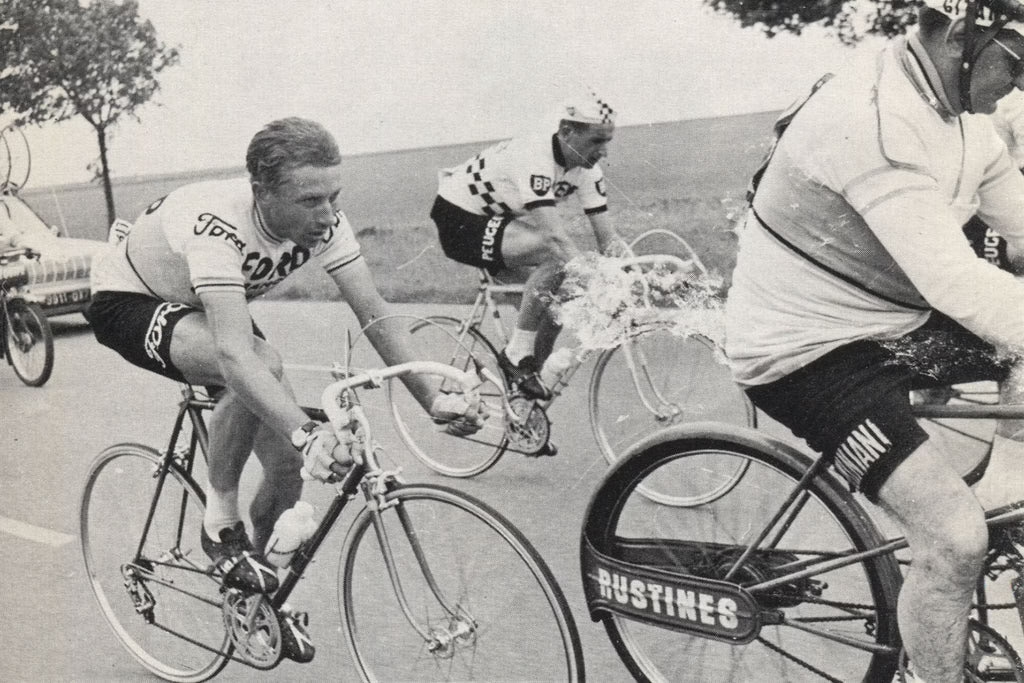
For decades, the Vuelta was a spring race
The historical Vuelta was not the late-August race modern fans know.
For much of its existence it was held in April and May, placing it before the Tour de France and sometimes very close to, or overlapping with, the Giro d’Italia.
That fundamentally changed how riders approached it.
The Vuelta could serve as an early-season Grand Tour target for Spanish riders, preparation for the Tour or an alternative for riders not planning to compete in Italy.
It also made attracting the strongest possible international field more difficult. The Tour remained the central target for most elite stage racers, while the Giro occupied its own prestigious spring position.
The modern role of the Vuelta as a second chance after the Tour simply did not exist.
That would change dramatically in 1995.
Spain developed its own generation of Vuelta champions
The 1960s and 1970s helped deepen the race’s domestic importance.
Angelino Soler won in 1961 at only 21 years old, becoming the youngest overall winner in Vuelta history. José Manuel Fuente later won two editions, in 1972 and 1974, with Eddy Merckx taking the race between them in 1973.
Merckx’s appearance mattered for the same reason Anquetil’s had a decade earlier. The dominant rider of his era had travelled to Spain and won.
The Vuelta was becoming part of the palmarès expected of complete Grand Tour champions.
Spanish winners including Agustín Tamames in 1975 and José Pesarrodona in 1976 maintained the race’s strong home identity, before Freddy Maertens produced something completely different in 1977.
Freddy Maertens dominated the 1977 Vuelta
Maertens won the 1977 Vuelta overall while taking an astonishing 13 stages.
That remains one of the most remarkable individual performances in Grand Tour history.
Maertens was primarily known for sprinting and one-day racing rather than as the archetypal mountain GC rider, which makes the result particularly revealing about the Vuelta of that period.
Earlier editions did not always revolve around the extreme summit finishes that define the modern race. Consistency, time trialling, stage bonuses and the ability to repeatedly win could produce a very different type of overall champion.
Maertens exploited that environment better than anyone.
No rider needs 13 stage wins to win the modern Vuelta.
It remains difficult to imagine anyone doing it again.
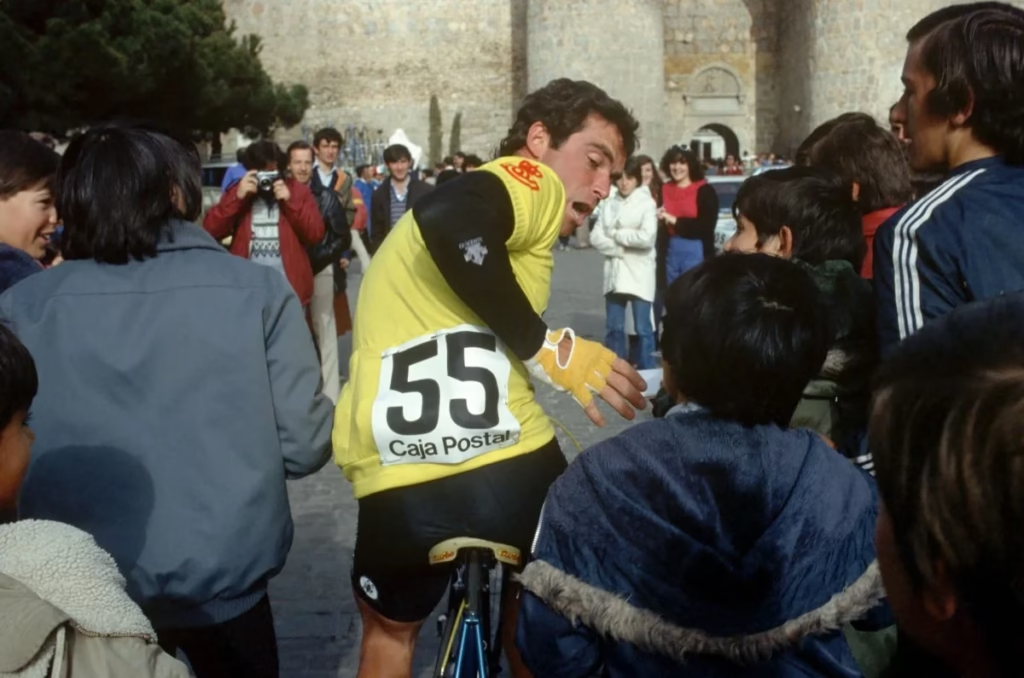
Bernard Hinault won the Vuelta twice
Bernard Hinault took his first Vuelta victory in 1978 before returning to win again in 1983.
The second victory came during one of the more combative Grand Tour campaigns of his career, as the Frenchman fought through a difficult final week against Spanish opposition before taking overall victory ahead of Marino Lejarreta.
Like Anquetil and Merckx before him, Hinault’s presence strengthened the race’s international status.
By the 1980s, the Vuelta had achieved the continuity it had lacked during its first 20 years. It had Spanish champions, international stars and several decades of history.
What it still lacked was the calendar position that would eventually transform how the race fitted into the season.
Lagos de Covadonga became one of the race’s great mountains
The 1983 Vuelta also introduced a climb that would become one of the defining landmarks of the race.
Lagos de Covadonga first appeared as a summit finish that year and quickly became one of the great Vuelta ascents.
The Asturian climb does not rely on the extreme ramps later associated with the Angliru. Its difficulty comes through sustained climbing, irregular gradients and a setting that makes it one of the most visually recognisable roads in Spanish cycling.
The Vuelta has repeatedly returned since.
Covadonga became proof that the race could build its own mountain mythology rather than simply trying to imitate the famous Alpine and Pyrenean passes of the Tour.
The Angliru would take that philosophy much further.
Sean Kelly won the race in 1988
Sean Kelly’s Vuelta victory in 1988 remains one of the most important Grand Tour wins by a rider better known for Classics success.
Kelly had already won Milan-San Remo, Paris-Roubaix, Liège-Bastogne-Liège and numerous stage races before finally adding a Grand Tour.
His victory ahead of Reimund Dietzen gave Ireland its first Vuelta winner and added another unusual rider profile to the race’s history.
Kelly’s success followed the pattern established by Maertens. The Vuelta could reward riders who would never fit neatly into the image of a traditional Tour de France mountain specialist.
That ability to produce different types of winners has remained part of its appeal.
Pedro Delgado became Spain’s defining Vuelta rider of the 1980s
Pedro Delgado won the Vuelta in 1985, three years before his Tour de France victory, then returned to win his home Grand Tour again in 1989.
By then, Delgado had become one of the biggest figures in Spanish cycling.
His two Vuelta victories helped bridge the race from the Hinault era towards a 1990s period when Spanish teams and riders would play an increasingly important role in shaping modern stage racing.
One of those teams was ONCE, whose history became closely tied to the Vuelta through riders such as Melcior Mauri, Laurent Jalabert and Alex Zülle.
Our history of the ONCE team covers how its success in Spain helped turn the Vuelta into one of the defining races of the team’s existence.
Tony Rominger became the first three-time champion
Tony Rominger dominated the early 1990s.
The Swiss rider won in 1992, 1993 and 1994, becoming the first rider to win the Vuelta three times and the first to take three consecutive editions.
Rominger combined elite time trialling with strong climbing, a particularly effective formula in an era before the race became so heavily associated with repeated extreme summit finishes.
His third victory closed a major chapter in Vuelta history.
The next edition moved to late summer.
The timing could not have been more significant.
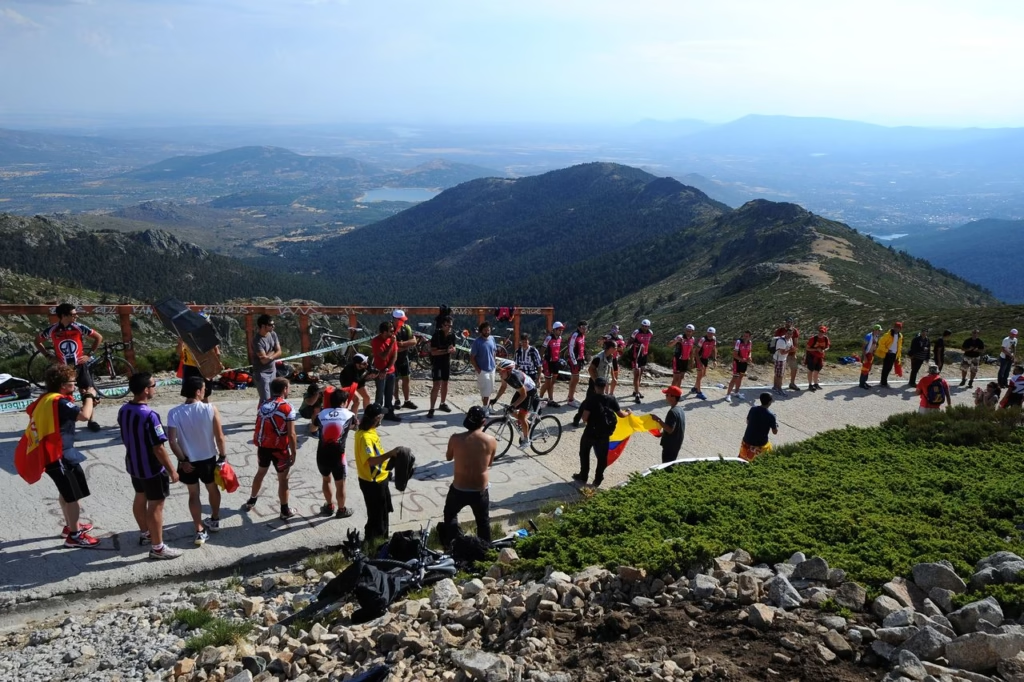
Moving to September in 1995 created the modern Vuelta
The 1995 Vuelta was held in September rather than its traditional spring slot.
It was one of the most important decisions in the history of the race.
The move separated the Vuelta from the Giro and placed it after the Tour de France. That created a completely new function within the season.
A rider whose Tour had gone badly could rebuild for Spain.
Someone who had completed the Tour successfully could attempt another Grand Tour.
A young rider could receive leadership after teammates had spent the summer working towards France.
A rider targeting the World Championships could use three weeks of hard racing as part of their preparation.
The first winner of this new late-season Vuelta was Laurent Jalabert, who produced a dominant 1995 campaign and won the general classification, points competition and mountains classification.
The race had found the calendar position that still defines it today.
The beginner’s guide to the Vuelta a España 2026 shows how completely that identity has become established. The modern Vuelta is now cycling’s final Grand Tour and often the most unpredictable of the three.
The late-season Vuelta became the race of second chances
Moving the race after the Tour changed more than its start date.
It changed who arrived and why they were there.
At the Tour de France, teams often spend months preparing around carefully defined hierarchies. Riders reach July knowing exactly who leads and what the season has been built around.
The Vuelta field can be much less orderly.
A GC leader may be there because they crashed out of the Tour.
Another rider may receive leadership because their season has developed better than expected.
Some have trained specifically for Spain.
Others arrive trying to salvage a year that has gone badly.
This mixture creates a race where motivations, form and team hierarchies vary enormously.
The 2026 edition again fits that pattern. As our beginner’s guide explains, the race runs from 22 August to 13 September and combines two individual time trials with six officially classified mountain stages and more than 58,000 metres of climbing.
It remains a Grand Tour built to punish anyone hoping for an easy final act to the season.
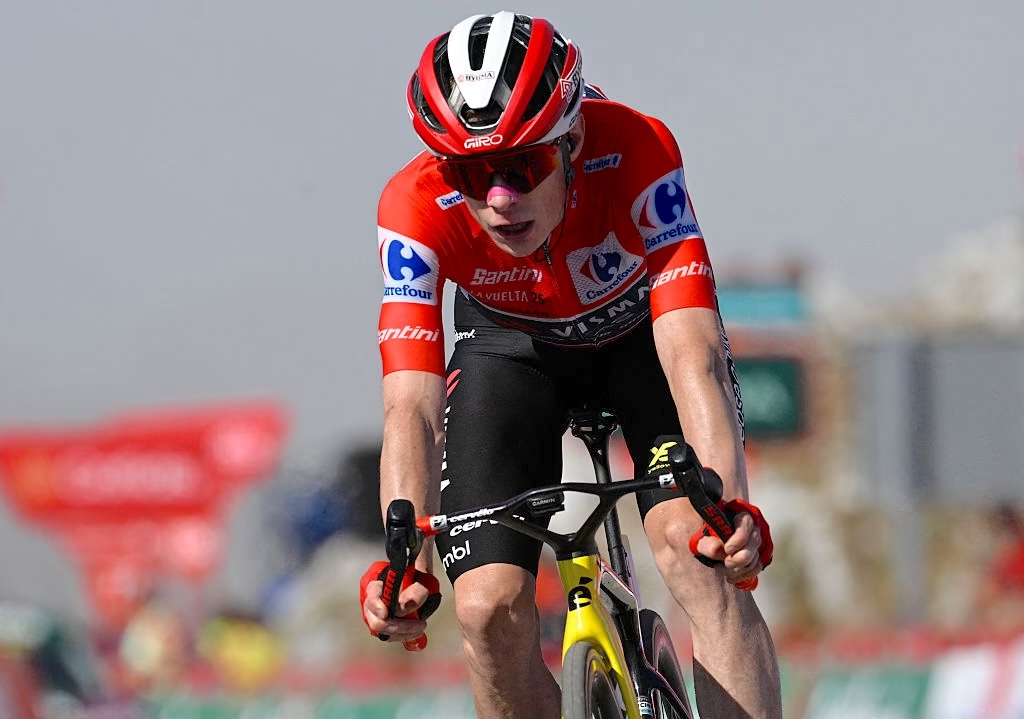 Photo Credit: Getty
The Angliru gave the Vuelta its ultimate modern symbol
If the calendar change created the modern Vuelta structurally, the Alto de l’Angliru helped define it competitively.
The Asturian climb made its Vuelta debut in 1999, when José María Jiménez won the inaugural summit finish.
The Angliru is not especially long compared with many famous Alpine passes. Its reputation comes from its gradient.
Sections exceed 20%, with the Cueña les Cabres ramp reaching around 23%.
The climb quickly became synonymous with the race.
The Tour has Alpe d’Huez.
The Giro has mountains such as the Stelvio and Mortirolo.
The Vuelta has the Angliru.
Our full feature on the history of the Angliru covers how the road developed into one of the most feared climbs in professional cycling.
Its influence goes beyond the stages actually finishing there.
The success of the Angliru helped encourage the Vuelta to search for increasingly severe mountain roads elsewhere.
The Vuelta became the Grand Tour of the steep finish
Lagos de Covadonga had already given the Vuelta a great mountain before the Angliru appeared, but the modern race increasingly embraced climbs with unusually severe gradients.
La Camperona.
Los Machucos.
Mirador de Ézaro.
Cuitu Negru.
Bola del Mundo.
The list grew.
Some are short compared with traditional Alpine passes. Others are irregular rather than sustained. What many have in common is the presence of gradients capable of creating enormous differences in only a few kilometres.
That gives the Vuelta a different feel from the Tour.
The French race often builds its mountain identity around long famous passes and accumulated climbing.
The Vuelta is more willing to finish on a road where the final kilometre itself feels almost unreasonable.
That unpredictability has become one of the defining features of the race.
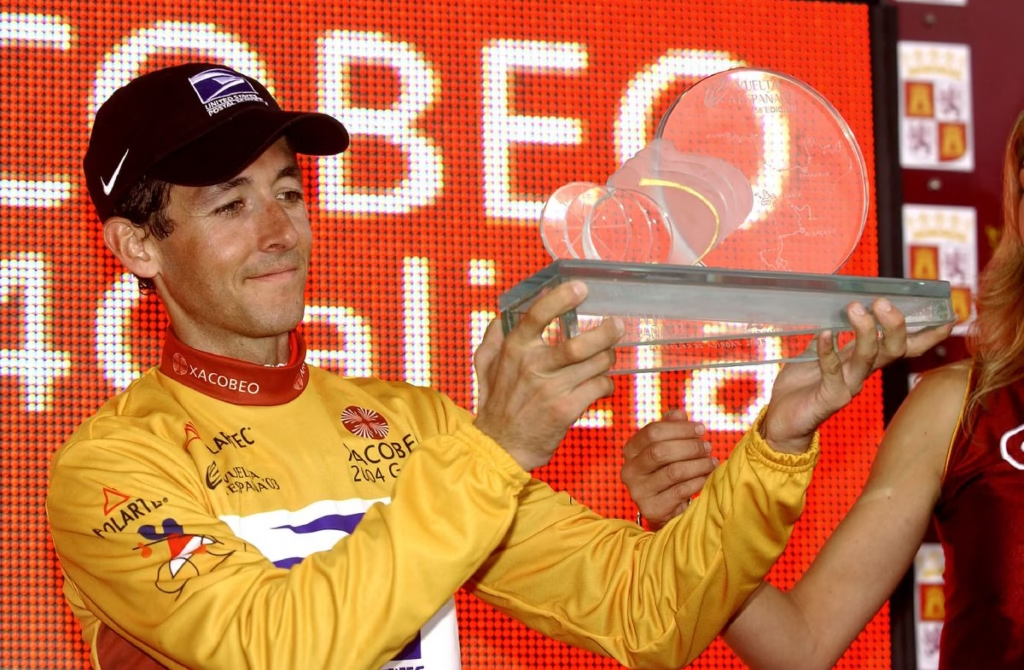
Roberto Heras established the four-win benchmark
Roberto Heras won the Vuelta in 2000, 2003, 2004 and 2005.
That made him the first four-time champion.
His final victory became controversial when he initially tested positive for EPO after the 2005 race and was disqualified, promoting Denis Menchov to first place.
The sanction was later overturned through the Spanish courts because of procedural problems surrounding the handling and testing of the sample.
Heras was restored as the official winner.
His four victories stood as the outright Vuelta record for almost two decades before Primož Roglič eventually matched it.
That rivalry across eras now defines the top of the all-time winners list.
The leader’s jersey was not always red
The red leader’s jersey feels inseparable from the Vuelta today.
It is actually a relatively recent tradition.
Over the race’s history, the GC leader has worn several different colours, including orange, white, yellow and gold. For much of the period before 2010, the leader wore the maillot oro, or gold jersey.
The switch to red came in 2010.
Vincenzo Nibali won that year’s race and became the first final champion of the modern maillot rojo era.
The change gave the Vuelta a cleaner identity alongside the other Grand Tours.
Yellow belongs to the Tour.
Pink belongs to the Giro.
Red belongs to the Vuelta.
Alberto Contador made the Vuelta central to his career
Alberto Contador won the Vuelta three times, in 2008, 2012 and 2014.
The first completed his own career set of all three Grand Tours.
The second became one of the defining editions of the modern race.
Joaquim Rodríguez appeared to have the 2012 Vuelta under control before Contador attacked from long range on Stage 17 towards Fuente Dé. Rodríguez’s team struggled to regain control and the race changed completely.
Contador took the red jersey and kept it.
The attack is remembered because it represented exactly the type of racing the Vuelta’s modern structure encourages. Rather than waiting for the final summit finish, Contador used terrain, tactical isolation and urgency to create a GC reversal from much farther out.
Spain’s biggest stage racer of his generation treated the Vuelta as a race worth attacking to win, not merely the Grand Tour left over after July.
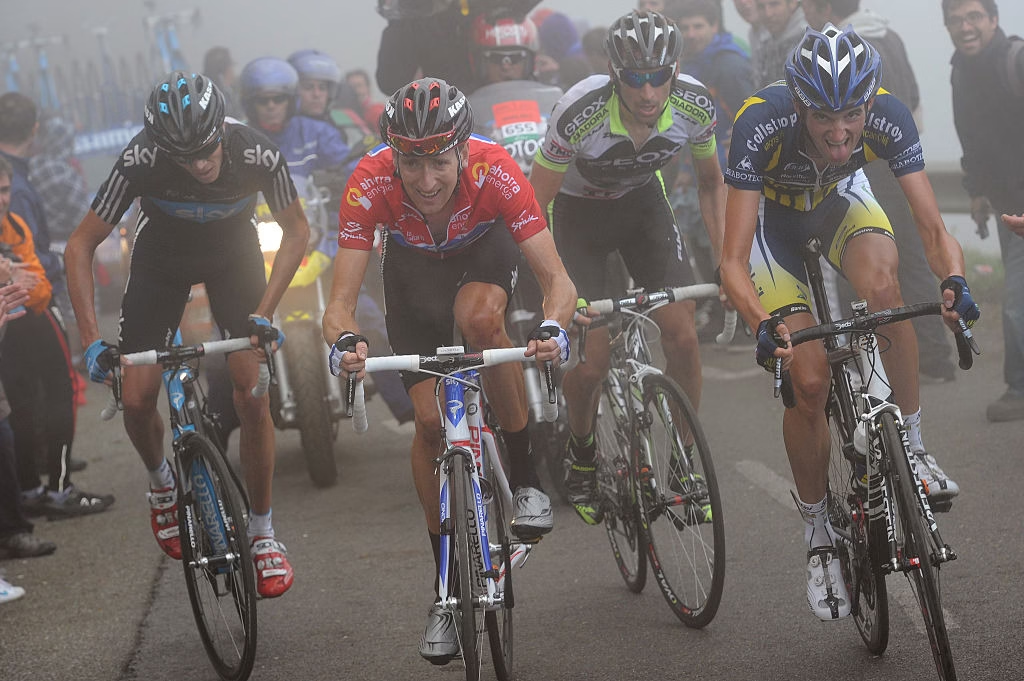
Chris Froome spent years trying to win the Vuelta
Chris Froome’s relationship with the Vuelta began before he became a multiple Tour champion.
He originally finished second in 2011 behind Juan José Cobo. Years later, Cobo was stripped of the title following abnormalities in his biological passport data, making Froome the retrospective winner of the race.
Froome returned repeatedly, finishing second again in 2014 and 2016 before winning the race on the road in 2017.
That victory came weeks after he had won his fourth Tour de France.
Froome therefore became the first rider to complete the Tour-Vuelta double since Spain’s Grand Tour moved to its late-summer slot.
For British cycling, his success sits within a much longer history stretching back to the first British Vuelta participants in 1955. That lineage is covered in every British rider in the Vuelta a España.
Foreign Grand Départs became part of the modern Vuelta
The race remains unmistakably Spanish, but its opening stages have become increasingly international.
Lisbon hosted the start in 1997, making Portugal the first foreign country to stage a Vuelta Grand Départ.
Assen in the Netherlands followed in 2009.
Nîmes hosted the opening in France in 2017, Utrecht took the race back to the Netherlands in 2022 and Lisbon returned in 2024.
The 2025 Vuelta began in Italy, while the 2026 Vuelta starts in Monaco with a short individual time trial before moving through France and Andorra towards Spain.
The trend reflects the wider internationalisation of Grand Tour starts.
The Tour, Giro and Vuelta remain national races at their core, but the Grand Départ has become a way of bringing each event to new cities and audiences before the main route reaches home territory.
The 2010s produced an unusually varied list of champions
The decade beginning with Nibali’s 2010 victory demonstrated just how open the Vuelta could be.
Froome holds the revised 2011 title.
Contador won in 2012.
Chris Horner became the oldest Grand Tour winner in history when he took the 2013 race at the age of 41.
Contador returned in 2014, Fabio Aru won in 2015 and Nairo Quintana followed in 2016.
Froome won again in 2017 before Simon Yates took his first Grand Tour victory in 2018.
Different rider types, teams and nationalities repeatedly reached Madrid in red.
Then Primož Roglič changed the pattern.
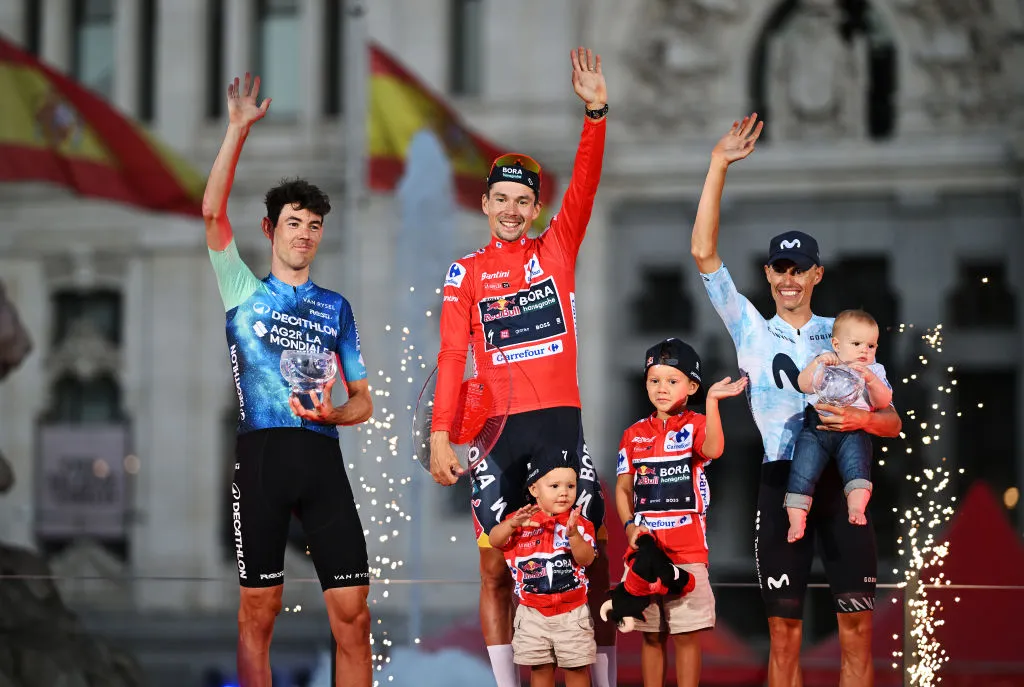
Roglič became the defining Vuelta rider of the modern era
Primož Roglič won his first Vuelta in 2019, then defended the title in 2020 and 2021.
That made him only the second rider after Rominger to win three successive editions.
His attempt at four in a row ended in 2022 after a crash forced him to withdraw while fighting Remco Evenepoel for the overall victory. Evenepoel went on to win his first Grand Tour.
Roglič returned in 2023 as part of a Jumbo-Visma squad containing Jonas Vingegaard and Sepp Kuss. Instead of winning himself, he finished third as his team swept the podium.
The fourth title finally arrived in 2024.
Roglič took control late in the race, moving into red after his Stage 19 victory on Alto de Moncalvillo and then sealing his fourth Vuelta victory in Madrid.
That put him level with Heras at the top of the all-time standings.
The 2023 Jumbo-Visma podium sweep was unlike anything before it
The 2023 Vuelta produced one of the strangest internal team battles in Grand Tour history.
Sepp Kuss entered the race primarily as a domestique after helping Jumbo-Visma win both the Giro and Tour earlier that season. A successful breakaway moved him into the GC picture, and he eventually took the red jersey.
The problem was that his strongest rivals were his own teammates.
Vingegaard had won the Tour.
Roglič had won the Giro.
Both remained capable of winning the Vuelta.
The tactical situation became increasingly uncomfortable as Vingegaard and Roglič attacked on stages where Kuss was under pressure, before the team ultimately committed to preserving the American’s lead.
Kuss won ahead of Vingegaard and Roglič, completing an unprecedented team podium sweep.
Our look at Visma-Lease a Bike’s subsequent Vuelta ambitions revisited the unusual dynamics of that 2023 race and Kuss’ transition from elite domestique to Grand Tour winner.
The team also completed a clean sweep of all three 2023 men’s Grand Tours with three different riders.
It was an achievement unlikely to be repeated quickly.
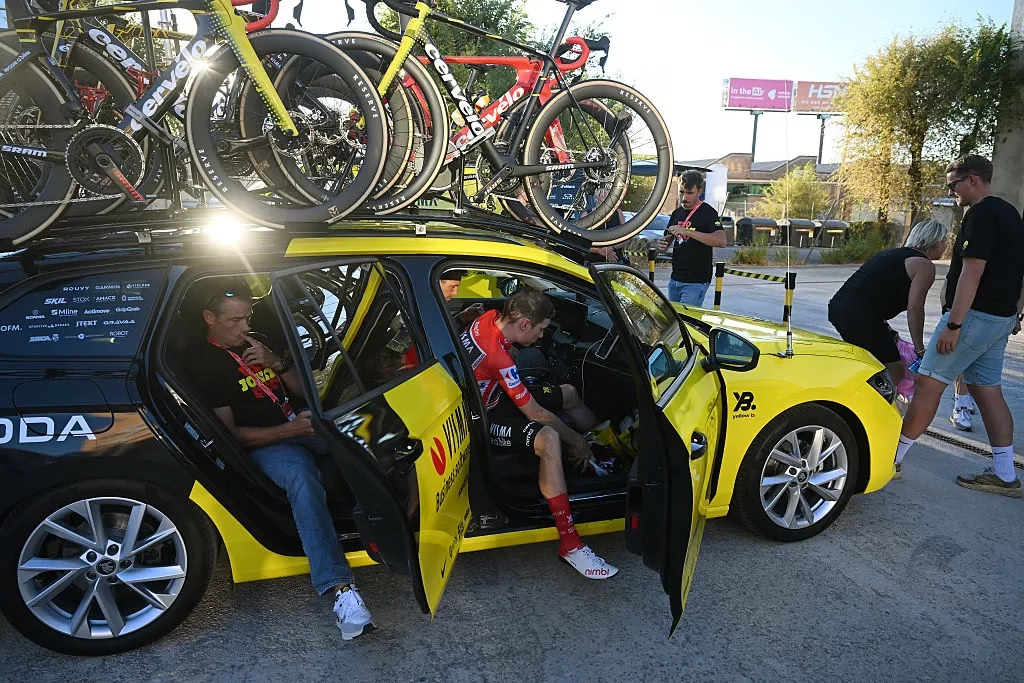
Vingegaard finally added the Vuelta in 2025
Jonas Vingegaard returned to Spain in 2025 and won the race overall, adding the Vuelta to his two Tour de France victories.
The manner of the ending was highly unusual.
The final stage in Madrid was cancelled after protests overwhelmed the finishing circuit, meaning Vingegaard’s victory was confirmed without the traditional final podium on the planned race course.
Our report on Jonas Vingegaard’s 2025 Vuelta victory covers a finale remembered as much for what happened away from the racing as for the GC result itself.
Vingegaard enters the historical list as another Tour champion who eventually added Spain to his Grand Tour record.
He is also the defending champion heading into 2026.
Why the Vuelta often feels less controlled than the Tour
The modern Vuelta has developed a reputation for aggressive and unpredictable racing.
The route contributes heavily.
Repeated summit finishes, short steep climbs and difficult medium-mountain stages create more opportunities for attacks than a race built around only two or three major mountain blocks.
The calendar plays an equally important role.
By late August, every rider arrives with a different season behind them. Some are peaking specifically for Spain. Others have already completed one or two Grand Tours. Some are coming back from injury, while others are desperately looking for a major result before the year ends.
The beginner’s guide to the 2026 Vuelta describes it as usually the least predictable of the three men’s Grand Tours for exactly this reason.
The strongest team can still control the Vuelta.
The race simply contains more reasons for that control to break down.
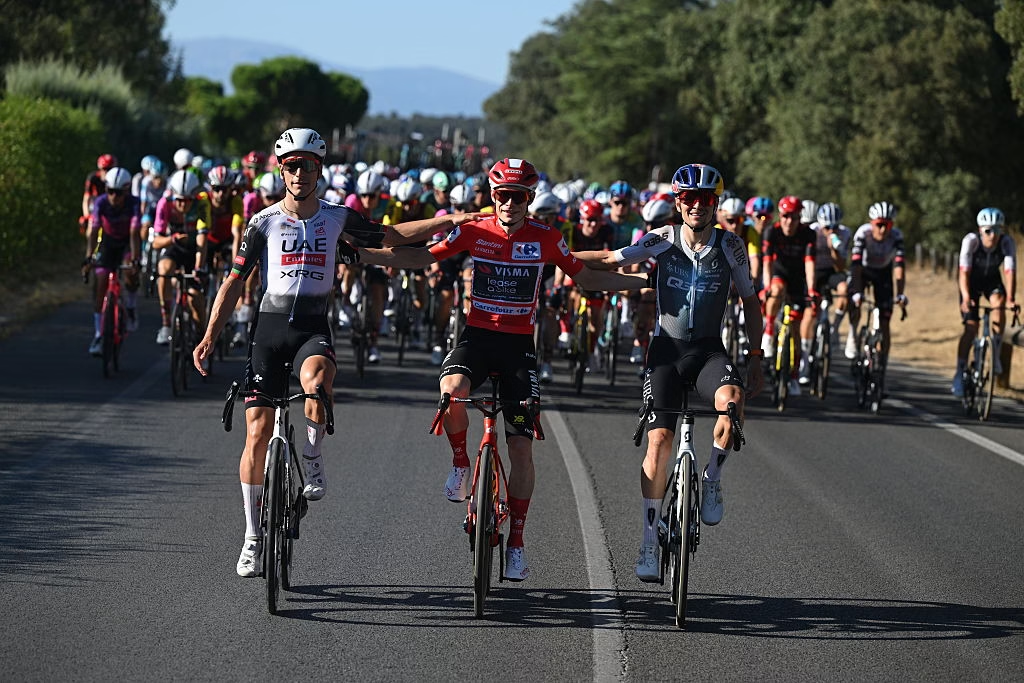 Photo Credit: Getty
Heat became part of the late-season Vuelta identity
Moving the race to August and September brought another defining characteristic.
Heat.
Spanish summer conditions can be severe, particularly when the route moves through southern or central regions.
Riders can spend hours on exposed roads in temperatures above 30°C before tackling a summit finish, placing additional pressure on hydration and recovery as well as physical performance.
The 2026 route takes that challenge particularly seriously with a final block based in Andalusia, where the race visits Calar Alto, La Pandera, Peñas Blancas and Collado del Alguacil.
The modern Vuelta is therefore not simply another mountain Grand Tour.
Heat, steep roads and the accumulated fatigue of an already long season combine to create its character.
The Vuelta likes discovering mountains
The Tour repeatedly returns to climbs that already carry decades of mythology.
The Vuelta often creates mythology by finding somewhere new.
Lagos de Covadonga and the Angliru remain established landmarks, but organisers have repeatedly searched for unfamiliar summit roads capable of becoming decisive.
Some become permanent parts of the race.
Others disappear after one memorable appearance.
That willingness to experiment means a Vuelta route announcement can include a climb that even committed cycling fans have never heard of.
A few months later, everyone knows the gradient.
It is one of the reasons the race continues to feel less predictable than its age suggests.
Madrid became the traditional final destination
Madrid has traditionally served as the finishing city of the Vuelta, giving the race a recognisable conclusion in the same way Paris does for the Tour.
The final stage has often been built around a circuit and sprint in the Spanish capital, allowing the race leader to reach Madrid with the GC effectively secured.
There have been important exceptions.
The 2024 race ended with an individual time trial through Madrid, where Stefan Küng won the stage and Roglič sealed his fourth overall title.
The 2025 finale never reached its planned conclusion after protests forced the abandonment of the final stage.
And in 2026, the Vuelta breaks with the tradition altogether by finishing in Granada, not Madrid.
The history of the Vuelta is full of traditions.
It has never been particularly frightened of changing them.
The race has built its own jersey identity
The red jersey is the most important symbol, but the modern Vuelta also contains points, mountains, young rider and team classifications.
Green identifies the points leader, while the mountains classification uses a distinctive blue polka-dot design.
These secondary competitions create races within the race, particularly because the Vuelta’s route gives breakaway riders so many opportunities to accumulate mountain points.
A rider may spend three weeks with no realistic chance of winning the GC while still building an entire campaign around one of the other jerseys.
That structure will be familiar to anyone who already follows the Tour or Giro.
The Vuelta’s route simply gives those competitions its own particular character.

The record holders sit at four wins
Roberto Heras and Primož Roglič share the all-time record with four Vuelta victories each.
| Rider | Vuelta wins | Winning years |
|---|---|---|
| Roberto Heras | 4 | 2000, 2003, 2004, 2005 |
| Primož Roglič | 4 | 2019, 2020, 2021, 2024 |
| Tony Rominger | 3 | 1992, 1993, 1994 |
| Alberto Contador | 3 | 2008, 2012, 2014 |
A wider group has won twice, including Gustaaf Deloor, Julián Berrendero, José Manuel Fuente, Bernard Hinault, Pedro Delgado, Alex Zülle and Chris Froome.
Roglič’s fourth victory in 2024 brought a modern rider level with a record that had stood since Heras’ final triumph in 2005.
Whether anyone reaches five remains one of the obvious historical questions hanging over future editions.
The Vuelta grew from the least secure Grand Tour into the season’s great final chance
The first Vuelta lasted only two editions before civil war stopped it.
The race returned, disappeared, returned again and then vanished for four years in the early 1950s. For much of its early history, permanence was not guaranteed.
From 1955, the story changed.
The Vuelta established continuity, attracted Tour and Giro champions and gradually created its own identity. Moving to late summer in 1995 transformed its international position. The Angliru gave it a mountain that looked unmistakably Spanish. The red jersey created a strong visual symbol, while foreign Grand Départs and increasingly adventurous routes expanded its reach.
The modern race can still be unpredictable enough to produce something like the 2023 Kuss-Vingegaard-Roglič internal battle, followed only two years later by Vingegaard winning the 2025 edition after the Madrid finale was cancelled.
That unpredictability is not an accidental part of the Vuelta.
It is the product of where the race sits and how its history developed.
The Tour de France is usually the central plan of a season.
The Vuelta often begins after those plans have already changed.
For three weeks at the end of summer, Spain offers one last opportunity to rewrite the year.

