
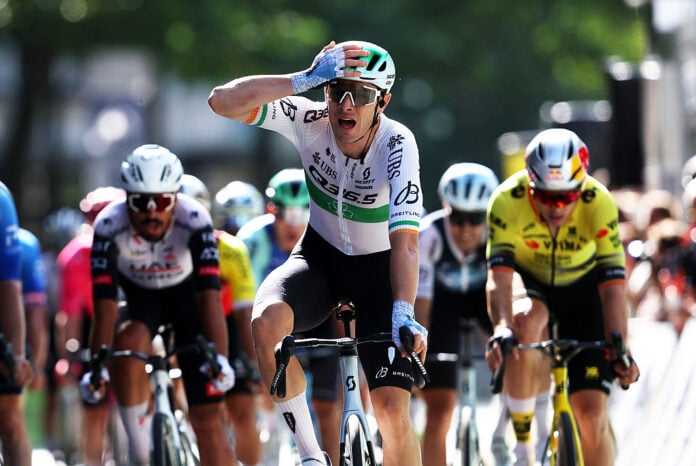
The ADAC Cyclassics returns on Sunday 16 August 2026 with a 206-kilometre route from Buxtehude to Hamburg, once again combining the broad, fast roads of northern Germany with five late ascents of the Waseberg before the finish on Mönckebergstraße.
It is a route that looks flat on paper and often produces a fast race, but the final 100 kilometres are far more selective than that description suggests.
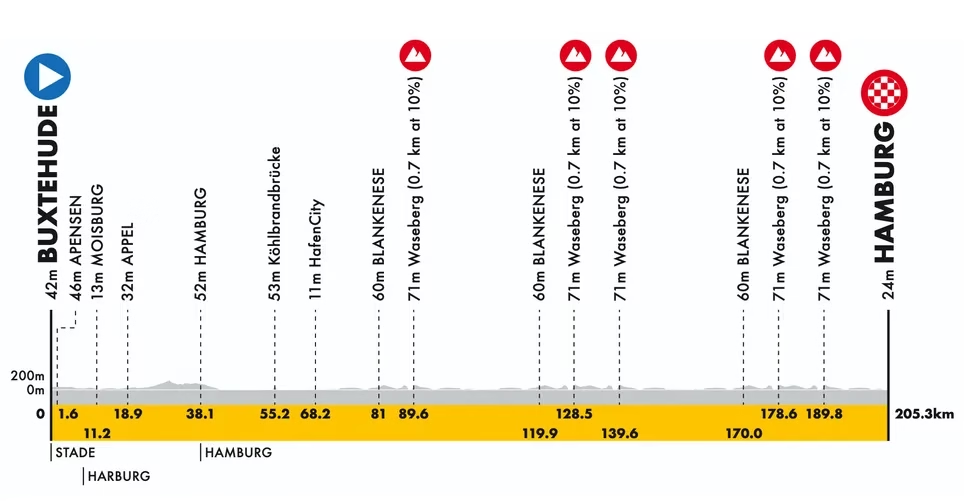
The Waseberg is only 700 metres long, yet reaches 16% and comes five times during the second half of the race. Those repeated efforts give the strongest Classics riders opportunities to remove pure sprinters before the long run back into central Hamburg.
The race starts outside Hamburg in Buxtehude for the second consecutive year, follows a fast opening section through Lower Saxony and the Hamburg metropolitan region, crosses the Köhlbrand Bridge and then settles into the familiar pattern between the city centre and Blankenese.
The result is a race that gives sprinters a genuine chance, but only if they can survive one of the most awkward finishing circuits on the WorldTour.
For the wider race history, previous winners and what makes Hamburg unusual, see our beginner’s guide to the ADAC Cyclassics 2026.
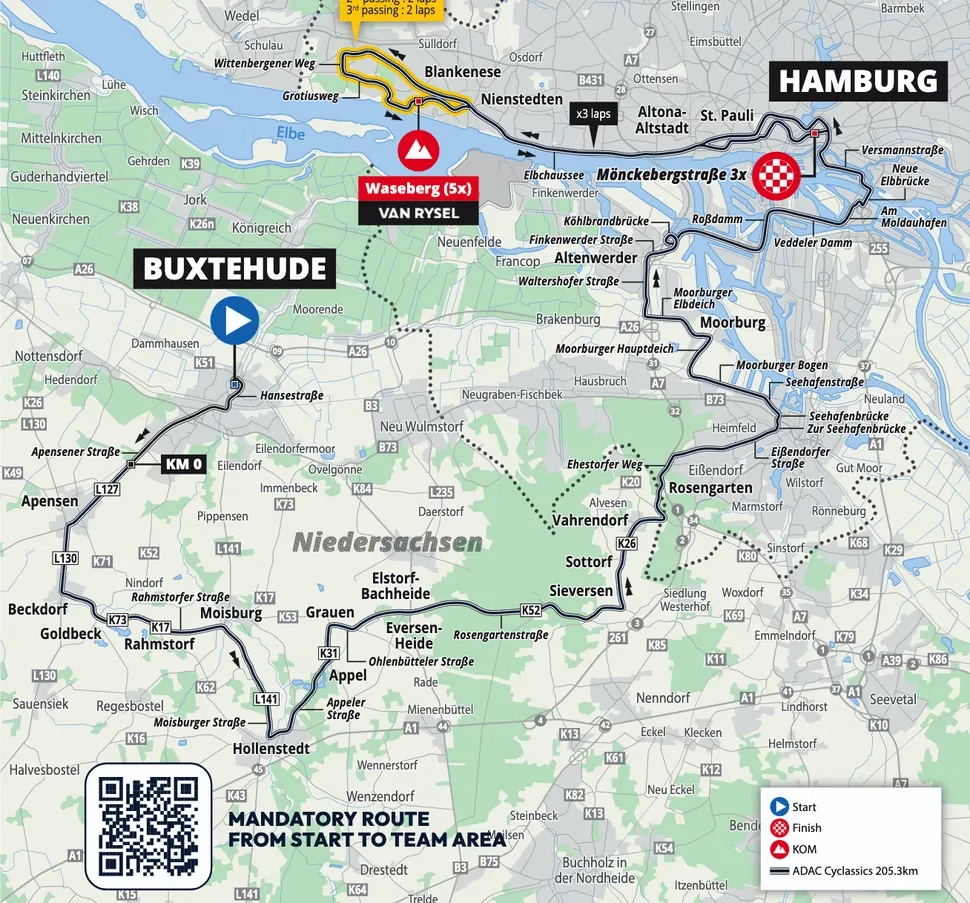
ADAC Cyclassics 2026 route at a glance
| Route detail | Information |
|---|---|
| Date | Sunday 16 August 2026 |
| Start | Buxtehude |
| Finish | Hamburg, Mönckebergstraße |
| Distance | 206km |
| Race classification | UCI WorldTour |
| Waseberg passages | Five |
| Waseberg length | 700m |
| Maximum gradient | 16% |
| Expected winner type | Powerful sprinter, puncheur or Classics specialist |
The organiser categorises the route as flat, which is broadly accurate in terms of total climbing. The profile does not contain anything remotely comparable to the climbs of Liège-Bastogne-Liège or the major Ardennes races.
That does not make it straightforward.
The repeated Waseberg efforts, city-centre accelerations and 206-kilometre distance mean the final hour becomes a succession of short, high-intensity efforts rather than a conventional flat run towards a bunch sprint.
Buxtehude hosts the start again
For much of its history, the Cyclassics was almost entirely identified with Hamburg.
That changed in 2025 when Buxtehude, south-west of the city in Lower Saxony, hosted the elite start for the first time.
The arrangement remains for 2026.
The peloton rolls through Buxtehude before the racing begins on the road towards Hamburg, following part of the same route later used by the 110km amateur Challenge event.
The first section offers little in the way of serious climbing, making this the obvious part of the day for the early breakaway to establish itself.
It should also be extremely fast.
Teams with no realistic sprint option will want riders ahead, while the major WorldTour squads have little reason to commit to an immediate chase with most of the race still to come.
That opening dynamic is particularly relevant after what happened in 2025, when Rory Townsend survived from the day’s early breakaway and held off the peloton by the smallest of margins.
The Köhlbrand Bridge provides the first major landmark
After approaching Hamburg, the riders head towards the harbour and the Köhlbrand Bridge.
The bridge is one of the visual highlights of the race.
It is not a serious climb in the same sense as the Waseberg, but the extended rise over the Elbe can still create pressure when combined with wind.
That matters because the Cyclassics is frequently exposed to conditions coming through the port and along the river.
A strong crosswind can make the opening half of the race considerably more selective than the profile suggests.
The bridge also marks the transition from the more open approach roads towards the urban and increasingly tactical part of the race.
From there, the peloton moves deeper into Hamburg before eventually beginning the repeated journeys west towards Blankenese.
The race turns west towards Blankenese
Once the riders are established in Hamburg, the route begins moving towards its defining section.
The peloton heads west along the Elbe and towards Blankenese, where the Waseberg waits.
This is the key transition in the race.
The opening part is primarily about establishing the breakaway, managing the gap and keeping leaders safe. Once the Waseberg enters the picture, the composition of the peloton starts changing.
The climb itself measures approximately 700 metres and reaches gradients of up to 16%.
Those numbers explain why it matters despite its size.
The Waseberg is short enough that riders can attack it almost entirely above threshold, but steep enough that anyone badly positioned can lose contact almost immediately.
Doing that once is manageable.

Doing it five times towards the end of a 206km WorldTour race is different.
The characteristics of riders best suited to that sort of climb are covered in our guide to what a puncheur is in cycling.
The first Waseberg begins the attrition
The opening passage is unlikely to eliminate the genuine favourites.
Its main purpose is attrition.
Teams increase the pace before Blankenese, forcing sprinters to spend energy maintaining position before producing another hard effort on the climb itself.
Anyone briefly dropped this early may still have enough road to return.
The more important consequence is cumulative fatigue.
A sprinter who has to chase after the first ascent is already using energy that a stronger Classics rider can preserve for later.
The route then returns towards central Hamburg before eventually heading back west again.
That repeated movement between the city centre and Blankenese gives the Cyclassics a very different rhythm from a conventional finishing circuit.
The middle Waseberg passages start exposing weaknesses
The second and third ascents are where weaker riders can begin showing signs of difficulty.
By this point, the early break should be under greater pressure and the sprint teams need to decide how much energy they are willing to spend controlling the race.
The important distinction is between being dropped and merely surviving.
A sprinter does not need to lose contact with the peloton to be damaged by the Waseberg.
Repeatedly sprinting into position, producing a hard effort over the steepest section and then accelerating again after the summit all consume energy.
A rider can still be sitting in the main group while progressively losing the finishing speed that made them a favourite at the start.
That is why the Waseberg often has a greater influence on the result than the final group size suggests.
Repeated returns to Mönckebergstraße shape the finale
Between the Waseberg passages, the race repeatedly returns towards central Hamburg and the eventual finish on Mönckebergstraße.
That is tactically useful.
The riders see the finishing area before the race is actually decided, allowing teams to assess the road width, approach and likely sprint positioning.
More importantly, each journey through Hamburg marks another reduction in the remaining opportunities to remove the sprinters.
Once the race heads west for the final time, the tactical choices become much clearer.
There are only a couple of serious Waseberg efforts left.
Attackers know they need to exploit them.
Sprint teams know that simply surviving the climb may not be enough if they lose all the teammates required for the chase afterwards.
The penultimate Waseberg can create the winning selection
The penultimate passage is where the race should become genuinely explosive.
By then, the riders have almost 200 kilometres in their legs and the climb is close enough to Hamburg for an attack to matter.
A strong Classics rider gaining even ten seconds can force the entire race to change.
The sprint teams then have to decide whether to chase immediately, wait for another team or trust that the group will naturally come back together.
Those decisions are made while many domestiques are already at their limit.
A sprinter may survive the Waseberg but lose the riders needed to control what happens afterwards.
That is often the real significance of the climb.
It does not always remove the favourite.
It removes their team.
The final Waseberg is the key point on the route
The fifth and final ascent provides the last major opportunity to stop a sprint.
The summit is close enough to Hamburg that any attack becomes serious immediately.
That creates the central tactical question of the ADAC Cyclassics.
Can the strongest attackers gain enough over a 700-metre climb to survive the fast run back into the city?
Usually, the answer depends less on the size of the initial gap than on what happens behind.
A rider does not necessarily need 30 seconds over the summit.
Five or ten seconds can be enough if the remaining sprint teams look at one another rather than commit immediately.
If three teams organise a chase, the attacker is likely to be caught.
If everyone expects somebody else to work, a tiny advantage can grow.
The mechanics of that chase and the way lead-out teams switch from bringing back attackers to preparing the sprint are explained in our guide to how a bunch sprint works in cycling.
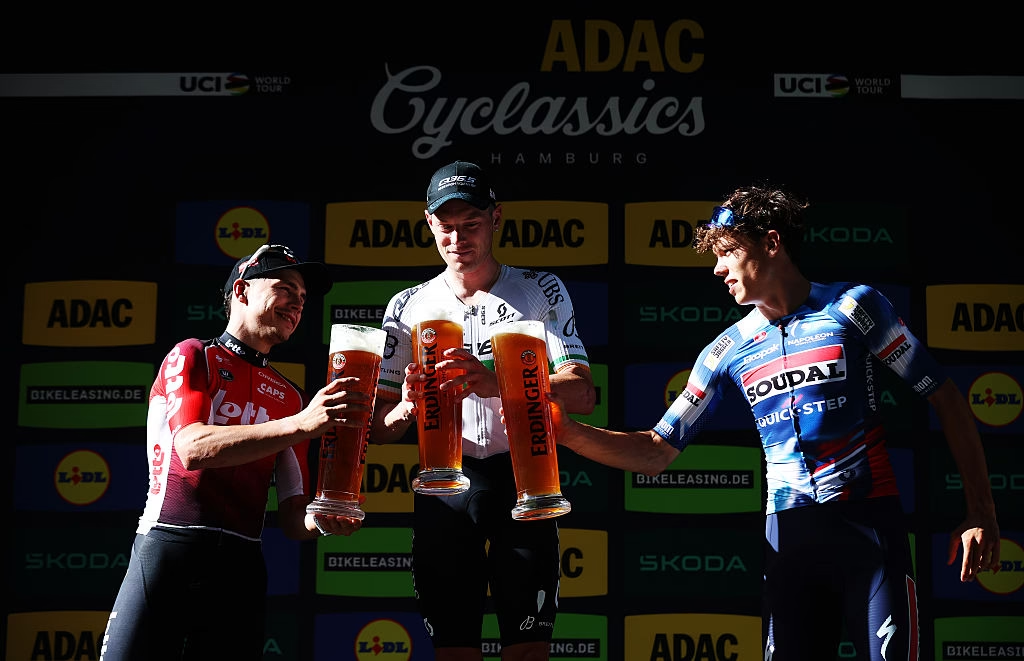 Photo Credit: Getty
The run back to Hamburg favours the chase
Once the final Waseberg is behind them, there are no further serious climbs.
That is why the race continues to provide opportunities for sprinters despite all of the preceding climbing.
The roads back towards central Hamburg generally favour an organised group.
The problem is that organisation may no longer exist.
After 200 kilometres and five Waseberg passages, some teams will have only one or two riders remaining around their protected sprinter.
A reduced peloton can contain several quick riders but nobody willing to sacrifice themselves to close the final gap.
That creates the classic late-race stalemate.
Each team knows a chase benefits its rivals.
Every second spent waiting increases the attacker’s chance of surviving.
The 2025 race demonstrated the danger perfectly. Townsend had spent almost the entire day in the breakaway but still reached the finish just ahead of a charging peloton.
The result is covered in more detail in our beginner’s guide to the 2026 ADAC Cyclassics.
Mönckebergstraße remains the finish
The race finishes once again on Mönckebergstraße in central Hamburg.
The broad city-centre road provides a very different environment from the narrow Waseberg and the roads through Blankenese.
If the race comes back together, the final kilometres should favour organised sprint teams.
Positioning remains essential.
After more than 200 kilometres and five hard climbs, most teams will have only a limited number of riders available. A sprinter who loses position entering the final kilometre may not have enough support left to recover.
That means the winner does not necessarily have to possess the highest top speed.
They need to survive the Waseberg, retain enough energy to sprint and arrive on Mönckebergstraße in the right position.


Five Wasebergs change the race more than the profile suggests
The most important feature of the 2026 route is not that the Waseberg is especially long.
It is the repetition.
Five passages create a completely different race from one containing a single steep climb.
The first weakens riders.
The middle passages expose which sprinters are spending too much energy.
The penultimate ascent begins the serious selection.
The final one decides whether that selection turns into an attack or another sprint.
This is why simply looking at the total elevation gain undersells Hamburg.
There are no mountains, but the race repeatedly asks riders for explosive efforts after several hours at WorldTour speed.
What sort of rider does the 2026 route favour?
The obvious answer is a sprinter who can climb.
A pure sprinter may be the fastest rider on Mönckebergstraße but never reach it with the front group.
A pure climber can attack on the Waseberg but may struggle to create enough separation on such a short ascent.
The ideal profile sits between those extremes.
Powerful Classics riders with strong sprints are particularly dangerous because they can survive the climbs without needing the race to break apart completely.
Recent winners illustrate that range.
Mads Pedersen won in 2023 as a powerful Classics sprinter. Olav Kooij took the 2024 edition with outright sprint speed. Townsend then won from the early breakaway in 2025.
That variety is one reason the ADAC Cyclassics remains much harder to predict than its flat profile suggests.
Where will the 2026 ADAC Cyclassics be decided?
The decisive phase begins before the final two Waseberg passages.
Before then, attacks can matter, but the major teams still have enough distance and resources to reorganise.
Once those last climbs arrive, every move becomes dangerous.
The penultimate Waseberg can reduce the peloton and strip away domestiques.
The final passage provides the last clear opportunity for the strongest riders to escape.
If nobody creates a sustainable gap there, the balance swings decisively towards a reduced bunch sprint on Mönckebergstraße.
That gives the 2026 route a simple underlying structure despite all the movement through Hamburg.
The first 180 kilometres determine who still has the legs.
The final section decides whether the winner uses them to attack or sprint.

