

Pauline Ferrand-Prévot’s Tour de France Femmes title defence had already slipped away before Mont Ventoux. Stage 7 made the scale of the decline impossible to ignore.
The defending champion finished 18th on the stage, 10:44 behind Kasia Niewiadoma-Phinney, on the mountain where many had expected her to rediscover the climbing level that carried her to the 2025 Tour title.
Instead, Ferrand-Prévot was dropped early on the final climb, before the decisive fight between Niewiadoma-Phinney, Demi Vollering and Marlen Reusser had properly developed.
The result did not come completely out of nowhere. She had already lost heavily in the Dijon time trial, was dropped again on Stage 5 and started Ventoux five minutes from yellow.
What made Stage 7 more striking was that Ferrand-Prévot had continued to insist her underlying level remained strong. Ventoux was supposed to provide the opportunity to show that the problems earlier in the week were not representative of her climbing form.
Instead, the defending champion lost another ten minutes.
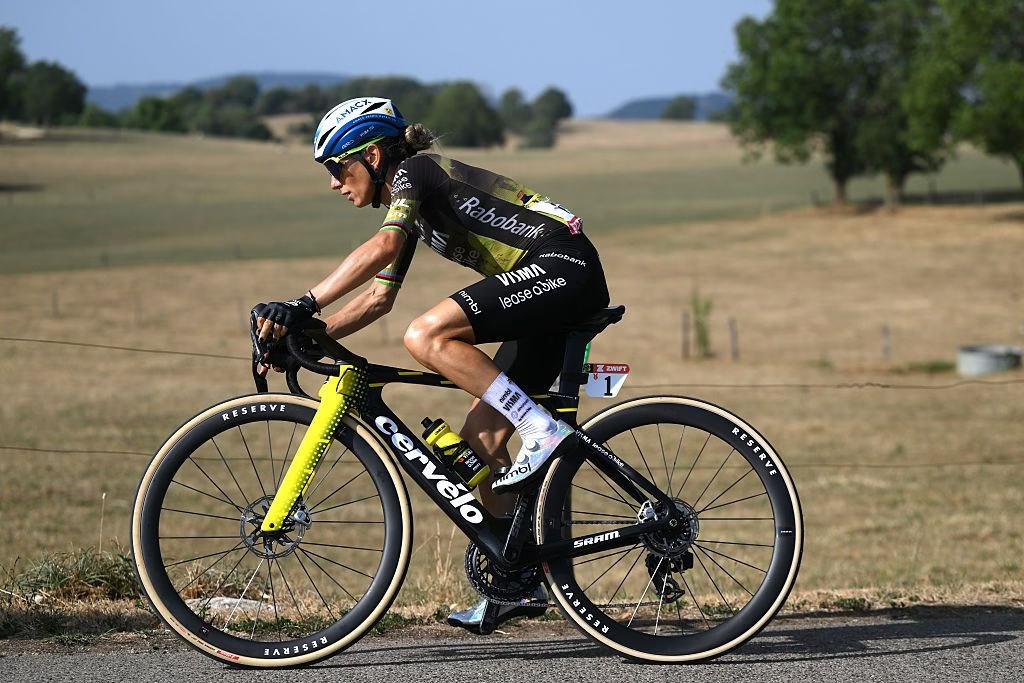
Ferrand-Prévot was already out of the yellow jersey battle
The first thing to separate is what happened on Ventoux from what had already happened before it.
Ferrand-Prévot did not begin Stage 7 as a realistic general classification contender.
Her Tour had started to unravel in the Stage 4 time trial to Dijon, where she finished 34th and lost 2:13 to Reusser and 1:55 to Vollering.
That result was a major surprise because the defending champion had arrived with the mountain stages expected to compensate for whatever she conceded against the clock.
The scale of that first setback and what it meant for the rest of the race was covered in is Pauline Ferrand-Prévot’s Tour de France Femmes title defence over?.
Stage 5 then removed most of the remaining optimism.
Ferrand-Prévot was unable to follow when Vollering, Reusser and Niewiadoma-Phinney emerged as the strongest riders on the Beaujolais climbs. She lost another 2:35 to the leading GC group and ended the day five minutes behind yellow.
Afterwards, Ferrand-Prévot effectively conceded that the title defence was gone.
That difficult afternoon is covered in our analysis of what happened to Ferrand-Prévot on Tour de France Femmes Stage 5.
By the start of Stage 7, the target had changed.
Ventoux was no longer about defending yellow.
It was about proving that the climbing form that delivered the 2025 Tour was still there.
Ferrand-Prévot was dropped early on Mont Ventoux
There was no prolonged tactical battle involving Ferrand-Prévot on the final climb.
She was dropped early.
As FDJ United-Suez began increasing the pace after Saint-Estève, Ferrand-Prévot and Nienke Vinke were among the first notable riders to lose contact with the main GC group.
That happened well before Niewiadoma-Phinney made the attack that eventually won the stage and yellow jersey.
By then, the defending champion was already riding a completely different race.
The complete sequence of the final climb is covered in our Tour de France Femmes 2026 Stage 7 race report.
This matters because Ferrand-Prévot’s 10:44 deficit cannot be explained by the tactical stalemate between Vollering and Reusser.
She was no longer there when that began deciding the race.
 Photo Credit: A.S.O./Aurélien Vialatte
This was not a tactical defeat
There was plenty of tactical complexity at the front.
Niewiadoma-Phinney attacked while Vollering and Reusser marked one another. Vollering waited until the final kilometre to make the acceleration that finally dropped Reusser. The two had spent much of the climb trying to force the other to work.
None of that explains Ferrand-Prévot’s result.
Her deficit was physical.
She simply could not climb Mont Ventoux at anything close to the speed of the riders fighting for yellow.
That makes her defeat very different from Vollering’s.
Vollering can look back at Stage 7 and question whether a different tactical decision might have put her into yellow.
Ferrand-Prévot has to look at why she was already several minutes behind before that tactical race had properly begun.
The warning signs had been visible all week
In isolation, one bad mountain day can happen.
Placed alongside the previous stages, Ventoux looks much more like the culmination of a pattern.
Dijon produced the first major warning.
Ferrand-Prévot’s time trial left her substantially further behind Reusser and Vollering than expected and transformed what had been a manageable pre-race question into a serious GC problem.
Stage 5 was more revealing because it removed the possibility that the problem was simply specific to the time trial.
When the strongest GC riders accelerated uphill, Ferrand-Prévot could not follow.
Stage 6 looked slightly more stable. She finished with the main GC group and reached Ventoux without losing additional time.
Then Stage 7 produced the biggest deficit of all.
Across three very different tests, the same pattern kept appearing: the riders expected to fight Ferrand-Prévot for the Tour were operating at a level she could not currently match.

Why is 2026 so different from Ferrand-Prévot’s 2025 Tour?
That is the bigger question.
Twelve months ago, Ferrand-Prévot was the rider creating huge mountain gaps.
On Stage 8 of the 2025 Tour, she attacked on the Col de la Madeleine, won alone and took yellow with one day remaining. That ride was the decisive performance of her race and is revisited in our report on Ferrand-Prévot conquering the Madeleine in 2025.
She then backed it up by winning the final stage in Châtel and sealing the overall title.
The 2026 race has produced almost the inverse.
Instead of the favourites waiting for Ferrand-Prévot to attack, they have repeatedly ridden away from her.
Part of the explanation may simply be that the opposition has improved.
Reusser has climbed at a much higher level than many expected. Niewiadoma-Phinney produced the ride of the Tour on Ventoux. Vollering remains one of the strongest climbers in the peloton, while Longo Borghini, Niedermaier and several younger riders have also raised the level around the top 10.
Ferrand-Prévot herself had suggested before the race that defending the title would require a different performance from 2025, something explored in our Pauline Ferrand-Prévot Tour de France Femmes 2026 profile.
But a gap of 10:44 on Ventoux is too large to explain purely through rivals becoming slightly stronger.
Stage 7 showed that Ferrand-Prévot is not currently producing the same type of sustained climbing performance that defined her victory a year ago.
Was Pauline Ferrand-Prévot ill?
There is currently no confirmed illness explaining the result.
That distinction is important.
Ferrand-Prévot has not publicly identified a virus, injury or other specific medical issue as the cause of her Tour struggles.
Without confirmation from Ferrand-Prévot or Team Visma | Lease a Bike, it would therefore be wrong to attribute the collapse to illness.
The clearest evidence available is what has happened on the road.
She lost substantial time in the time trial.
She could not follow the leading GC riders on Stage 5.
And she was dropped early on Mont Ventoux before eventually finishing more than ten minutes behind Niewiadoma-Phinney.
There can be many reasons why a rider who appears strong in training or through shorter efforts cannot reproduce that level across a Grand Tour mountain stage: fatigue, heat, accumulated racing stress, recovery and the particular demands of a long sustained climb.
What cannot currently be said is that a confirmed medical problem caused the result.
 Photo Credit: A.S.O./Gaëtan Flamme
Ventoux was supposed to suit her
That is why the result carries more weight than her earlier setbacks.
The Tour de France Femmes 2026 Mont Ventoux guide highlighted Ferrand-Prévot as one of the riders with an obvious reason to welcome a long, sustained mountain finish.
The climb offered something very different from the shorter, repeated efforts of Stage 5.
There was one extended ascent.
A largely consistent gradient.
Plenty of opportunity to settle into a rhythm.
And a finish where pure climbing ability mattered more than positioning or sprinting.
Those characteristics appeared much closer to the terrain on which Ferrand-Prévot dominated in 2025.
Instead, Ventoux exposed the gap even more clearly.
-
 Photo Credit: Getty



Her Tour is now about something completely different
Before Stage 7, there was still an argument for Ferrand-Prévot using her GC deficit to chase the Ventoux stage.
That possibility has gone.
Losing 10:44 means the final weekend is no longer about salvaging the general classification.
Her freedom will now be almost complete.
Nobody fighting for yellow needs to treat Ferrand-Prévot as a significant GC threat if she attacks from distance.
That could make her useful in a breakaway or an aggressive long-range move on the final stage around Nice.
The complete final-day terrain, including the repeated Col d’Èze ascents, is covered in our Tour de France Femmes 2026 Nice finish guide.
The issue is no longer whether Ferrand-Prévot will receive tactical freedom.
It is whether she has the legs to use it.
The title defence did not unravel on Ventoux alone
Mont Ventoux will probably become the defining image of Ferrand-Prévot’s 2026 Tour because the final deficit was so large.
It was not where the title defence was lost.
Dijon created the first major hole.
Stage 5 showed she could not recover that time in the hills.
Ventoux confirmed that even the terrain most associated with her 2025 dominance could not reverse the trend.
That is what makes the result more significant than an 18th place on one stage.
Ferrand-Prévot began 2026 as the defending Tour champion and one of the reference points of the women’s peloton, a position set out in our Pauline Ferrand-Prévot 2026 season guide.
She arrived on Mont Ventoux looking for evidence that the climbing level behind that title was still available.
Instead, she finished 10:44 behind the stage winner.
Whatever happens over the final weekend, the 2026 Tour has produced a very different Pauline Ferrand-Prévot from the rider who dominated the Alps a year ago.

