
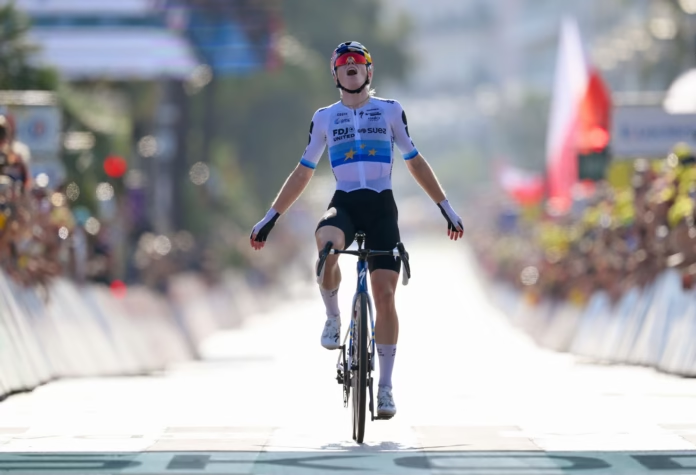
Demi Vollering won stage 8 of the 2026 Tour de France Femmes in Nice, attacking over the Côte de la Ginestière and descending clear to take both the stage victory and the yellow jersey with one day remaining.
The FDJ United-Suez rider split the GC group inside the final 6 kilometres, opened enough of a gap on the descent towards the Promenade des Anglais, and held off the chase led by Elisa Longo Borghini and Kasia Niewiadoma-Phinney. Longo Borghini finished second at 17 seconds, with Niewiadoma-Phinney third on the same time after losing yellow by just 8 seconds overall.
Kim Le Court-Pienaar won the chase sprint for fourth at 38 seconds, ahead of Lotte Kopecky, Dominika Włodarczyk, Sarah van Dam, Noemi Rüegg, Paula Blasi and Cédrine Kerbaol. Vollering now leads the Tour by 8 seconds from Niewiadoma-Phinney, with Marlen Reusser third at 1:12.
A stage that looked calm until it was not
Stage 8 was the longest day of the race, taking the riders 171.9 kilometres from Sisteron to Nice in blazing sunshine. After the summit finish on Mont Ventoux and before the final stage around the Col d’Èze, it looked at first like a day that might give the peloton a chance to reset.
That was misleading. The route was not mountainous in the same way as Ventoux, but it still carried enough climbing and late difficulty to make it dangerous. The final section included the Côte de Colomars and Côte de la Ginestière before the fast descent and run-in to the Promenade des Anglais.
Niewiadoma-Phinney started the day in yellow after her brilliant Mont Ventoux victory. Vollering was close enough to attack, Reusser was still within reach, and Longo Borghini had reason to keep pushing after losing ground in the earlier mountain stages.
It was a stage that could have ended in a sprint. Instead, it became another GC ambush.
Early skirmishes before the real break
The opening kilometres were lively, with several riders trying to go clear before the first proper move formed. Ma Petite Entreprise launched the first attack, then Daniek Hengeveld of Team Visma | Lease a Bike briefly went away before being brought back.
Lieke Nooijen also tried to attack for Team Visma | Lease a Bike, while Marianne Vos later attempted to bridge solo once a move had formed. None of those early efforts stuck, but they showed how many teams were still searching for opportunities after a hard week.
The break that finally mattered came when Maëva Squiban of UAE Team L’IMAD and Loes Adegeest of Lidl-Trek attacked with around 140 kilometres remaining. They quickly opened a useful gap, with Morgane Coston later trying to bridge across for Ma Petite Entreprise.
Squiban began the day 24:48 down on Niewiadoma-Phinney, while Adegeest was more than an hour behind. Neither was a GC threat, which made the move easier for the peloton to allow.
Squiban and Adegeest build a strong lead
The front pair worked well together and gradually stretched their advantage. They had over 2 minutes by 130 kilometres to go, more than 3 minutes by 120 kilometres to go, and eventually more than 6 minutes as the race passed through the middle of the stage.
Adegeest took maximum points at the Col des Robines, ahead of Squiban, while Squiban returned the favour at the Col de Toutes Aures, taking the QOM points there ahead of Adegeest.
The peloton allowed the gap to grow, with SD Worx-Protime initially trying to bring some order to the bunch for Lorena Wiebes, while AG Insurance-Soudal, Liv AlUla Jayco and FDJ United-Suez also began to place riders near the front later in the stage.
For a time, the break looked genuinely dangerous. With 80 kilometres remaining, Squiban and Adegeest still had just over 6 minutes. On a long day after Ventoux, that was more than enough to give the peloton something to think about.
Wiebes collects more green points
The intermediate sprint came in Puget-Théniers, where Adegeest crossed first ahead of Squiban. Wiebes led the peloton across for third on the road and 17 points, keeping her green jersey campaign firmly under control.
Wiebes’ points total moved to 164, with Kopecky second on 98 and Le Court-Pienaar third on 89. Even on a stage too hard and too long to guarantee a sprint, Wiebes still found a way to strengthen her grip on the points classification.
The sprint also showed that SD Worx-Protime were still interested in the day, even if the final climbs looked likely to complicate the run-in. Kopecky would later remain in the front selection once Wiebes was finally dropped.
The stage still had a long way to run, but the classification picture was already being reinforced: Wiebes in green, Puck Pieterse safe in polka dots, and Canyon SRAM still trying to protect yellow and white.
Pieterse’s polka-dot jersey is effectively secure
Pieterse began the stage with a commanding lead in the mountains classification, and the numbers were already heavily in her favour. Before the decisive late racing began, her advantage was large enough that she had effectively won the polka-dot jersey, provided she finished the race inside the time limit across the final two days.
That freed her up in a different way. Pieterse no longer had to chase every point with the same urgency, and could instead think about stage opportunities or protecting her wider race.
It is a significant achievement. She had passed the 50-point mark earlier in the race, set new Tour de France Femmes mountains-classification records and turned the jersey into one of the clearest campaigns of the week.
Stage 8 did not need to be another big QOM day for Pieterse. The job had already been done.
The chase begins to bite
The long descent and valley roads after the middle climbs gave the peloton time to organise. The gap began to fall steadily, dropping below 5 minutes with 50 kilometres remaining and then to 4:33 with 40 kilometres still to race.
The calculation became tight. Squiban and Adegeest were still riding strongly, but the peloton was taking back time in chunks. With 30 kilometres remaining, the gap was down to 3:35, and multiple teams were now working hard on the front.
There were also crashes in the peloton. Nikola Nosková, Nadia Gontova, Alice Coutinho and Marine Allione were involved in one crash with around 30 kilometres remaining, with Coutinho going down for the second time on the day.
The stage was becoming nervous. The road was narrowing, the climbs were approaching and the break’s advantage was disappearing.
Squiban crashes on the descent
The race turned sharply on the Côte de Colomars. Squiban and Adegeest still led into the climb, with Squiban taking the QOM points ahead of Adegeest, but the descent immediately afterwards brought disaster for the UAE Team L’IMAD rider.
Squiban slid out after taking risks on the downhill, leaving Adegeest alone at the front. Squiban initially got back up quickly, but she was visibly in pain, unable to hold the handlebars properly and later receiving treatment from the medical bike.
Moments later, Usoa Ostolaza crashed in the peloton a couple of corners after the place where Squiban had gone down.
It was a brutal end to Squiban’s stage after spending so much of the day in the break. She had been giving UAE a strong attacking presence up the road, but the descent into the final 15 kilometres took her out of contention.
Adegeest continued alone, now trying to hold off a rapidly closing GC-led peloton.
FDJ set up the final climb
The Côte de la Ginestière was the final categorised climb of the day, 2.5 kilometres at 4.4 per cent, but the official average understated the difficulty of the finale. After the climb came a gradual descent, then a savage late kicker of around 700 metres at 17 per cent before the drop into Nice.
FDJ United-Suez moved into position at exactly the right moment. Franziska Koch led onto the climb, with Juliette Berthet behind and Vollering placed perfectly. The pace quickly lifted, and the reduced bunch began to thin.
Adegeest was caught with around 9 kilometres remaining after a superb day in the breakaway. She would later receive the combativity award, a deserved recognition for a ride that shaped most of the stage.
Célia Gery then took over for FDJ as the group crested the Côte de la Ginestière. She led across the top ahead of Vollering, with Niewiadoma-Phinney, Longo Borghini, Le Court-Pienaar, Blasi, Kerbaol, Reusser, De Vries, Niedermaier, Włodarczyk and others still present.
The key move came almost immediately afterwards.
Vollering attacks twice
Vollering attacked on the descent and transition after the climb. Longo Borghini and Niewiadoma-Phinney initially bridged, but the yellow jersey was already under pressure.
Vollering went again. This time she created separation. Longo Borghini chased, Niewiadoma-Phinney fought to follow, but Vollering had the gap.
The situation became instantly clear. Vollering needed only 16 seconds to take yellow from Niewiadoma-Phinney. With 5 kilometres remaining, she had already taken 22 seconds on the road and was the virtual race leader.
The road into Nice suited a rider able to commit fully. Vollering descended fast, held speed on the rolling roads and made the most of every hesitation behind. Longo Borghini was producing huge power in the chase, but she was also racing for her own time and podium position.
Niewiadoma-Phinney could see the yellow jersey disappearing up the road.
 Photo Credit: Getty
Longo Borghini almost saves yellow for Niewiadoma-Phinney
The chase behind Vollering was led largely by Longo Borghini. The Italian champion had a major incentive to ride: she was trying to take time on Reusser and move closer to the podium.
That effort nearly kept Niewiadoma-Phinney in yellow. With 4 kilometres remaining, the gap was down to 9 seconds. When Vollering turned left onto the Promenade des Anglais, the gap was only 7 seconds. For a moment, it looked as if the chase might bring the race back together or at least limit the damage enough for Niewiadoma-Phinney to keep yellow.
But Vollering had committed fully, and the gap opened again in the final kilometres. Under the flamme rouge, it was 17 seconds. With 500 metres to go, yellow was changing hands.
Longo Borghini’s chase was one of the strongest rides of the finale, but it was not quite enough to close the door.
Vollering wins in Nice
Vollering crossed the line first on the Promenade des Anglais, winning stage 8 and moving into the yellow jersey with one day remaining.
It was a huge reversal after Ventoux. There, Vollering had hesitated when Niewiadoma-Phinney attacked and had to watch the Polish rider ride into yellow. In Nice, she corrected that mistake by racing on instinct, attacking late and refusing to wait for the final stage.
After the finish, Vollering summed up the emotional swing of stage racing.
“In a stage race, you live day by day. So you can be disappointed tonight, but then the next morning you need to put on a new mask and you go again. You try again, you make a plan with the team.
“I think this is proof that if you really believe in something, if you really dream big about something, then it doesn’t matter what it needs to take, how much pain it will cost you.”
This was the answer to the disappointment of Mont Ventoux. Vollering did not wait for the Col d’Èze stage. She took the race back in Nice.
Niewiadoma-Phinney loses yellow by eight seconds
Niewiadoma-Phinney finished third on the stage, 17 seconds behind Vollering, with Longo Borghini second in the same time. The margin was small, but the consequence was huge.
Vollering now leads the general classification by 8 seconds over Niewiadoma-Phinney. Reusser is third at 1:12, with Longo Borghini fourth at 3:05. Niedermaier sits fifth at 3:54, Kerbaol sixth at 4:34 and Blasi seventh at 5:05.
It was a painful day for Niewiadoma-Phinney because the race had almost been saved. Longo Borghini’s chase brought the gap down to a point where yellow looked secure again, but Vollering’s final drive restored the advantage.
The final stage now becomes a direct duel. Niewiadoma-Phinney is still close enough to win the Tour, but she is no longer defending. She has to attack.
Tension after the finish
The drama did not end at the line. After the stage, Niewiadoma-Phinney called out FDJ United-Suez’s tactics, particularly Gery’s positioning at the beginning of the final climb.
“I was annoyed at the beginning of the climb because Gery, on purpose, just blocked me to the barriers where I had to stop pedalling,” Niewiadoma-Phinney said. “I feel like, if they want to compete they should compete fair play and not look to block me on the barriers because I feel it is so childish. Honestly, I lost all the respect for them for that.”
Niewiadoma-Phinney later confronted Gery while the French champion was being interviewed by international media. It underlined how high the stakes have become after eight days of racing, and how narrow the margins now are.
FDJ had executed the stage-winning plan. Canyon SRAM felt that the final climb had been shaped by more than just legs. With only one stage left, that tension will carry into the final day.
Reusser slips further from the race lead
Reusser finished in the chase group at 38 seconds, a result that pushed her to 1:12 overall. After taking yellow in Dijon and defending well through the first hilly stages, the Movistar rider is now further away from the top two.
Her Tour is not over, but her route to victory is much harder. She no longer needs to mark one rider. She needs to recover time on both Vollering and Niewiadoma-Phinney, and the final stage around Nice and the Col d’Èze will not allow any passive approach.
Reusser has been one of the defining riders of this Tour, but stages 7 and 8 have shifted the momentum away from her. The time trial put her in control. Ventoux cracked that control. Nice pushed her into the role of outside challenger.
She will need to attack on the final day if she is to win the race.
Longo Borghini strengthens fourth
Longo Borghini’s second place on the stage was an important result for UAE Team L’IMAD. She did not win, and she could not close Vollering, but she rode herself further clear in fourth overall and took time on Reusser in the podium fight.
Her chase also showed her condition. After a difficult stage 5 and an aggressive stage 6, she was again one of the strongest riders in a technical, high-pressure finale.
UAE Team L’IMAD also kept Włodarczyk and Blasi inside the top 10, with Blasi now seventh overall and Włodarczyk eighth. The team’s multi-leader approach has been tested throughout the race, but the results still show depth.
The final stage may require a clearer hierarchy, though. Longo Borghini is now the obvious rider to support if UAE want to reach the podium.
Niedermaier holds white
Canyon SRAM lost yellow but kept the white jersey through Niedermaier. She remains fifth overall and holds a 1:11 lead over Blasi in the young rider classification.
That matters for the final day. Canyon SRAM now have two priorities: helping Niewiadoma-Phinney regain yellow and protecting Niedermaier’s white jersey. Those objectives can align if the team races aggressively, but the final stage could also become messy if attacks start early.
Niedermaier’s own stage was not as explosive as Ventoux, but she stayed in the main GC group and limited the damage. Given the depth of the final week, that was enough to keep her firmly in control of the youth classification.
The white jersey is now hers to lose, but the bigger team mission will be yellow.
-
 Photo Credit: Getty

Wiebes and Pieterse keep their jerseys
Wiebes extended her points-classification lead by taking 17 points at the intermediate sprint. Even though she was dropped before the final GC battle, the green jersey remains firmly under her control.
Pieterse continues in the polka-dot jersey and had already mathematically secured enough of an advantage before the stage began, provided she finishes the race. After a week of relentless points collecting, she can now think about getting through the final stage or perhaps chasing one more stage result.
Those two classifications feel more stable than the yellow jersey. Wiebes has built her lead through stage wins and intermediate sprints, while Pieterse has dominated the mountains competition climb by climb.
The yellow jersey, by contrast, has changed hands again.
The Tour flips again before the final day
Stage 8 was supposed to be the recovery day between Ventoux and the final Nice stage. Instead, it became another turning point in the general classification.
Vollering attacked late, won the stage and took yellow. Niewiadoma-Phinney lost the lead by 8 seconds. Reusser slipped further back. Longo Borghini strengthened her podium challenge. Niedermaier kept white. The final stage now has a race still completely alive.
The Tour de France Femmes has changed direction repeatedly across the week: Wiebes in yellow, Haugset after the long solo to Poligny, Reusser after Dijon, Niewiadoma-Phinney after Ventoux, and now Vollering after Nice.
That volatility is the story of this edition. No jersey has felt completely safe, no day has been neutral, and no favourite has been able to control the race for long.
With one stage remaining, Vollering has the smallest of leads and the biggest of targets. Niewiadoma-Phinney now has to chase. The final day around Nice will decide whether this was the winning move of the Tour or just the latest twist.
Tour de France Femmes 2026 stage 8 result
[results]
Main photo credit: Getty

