
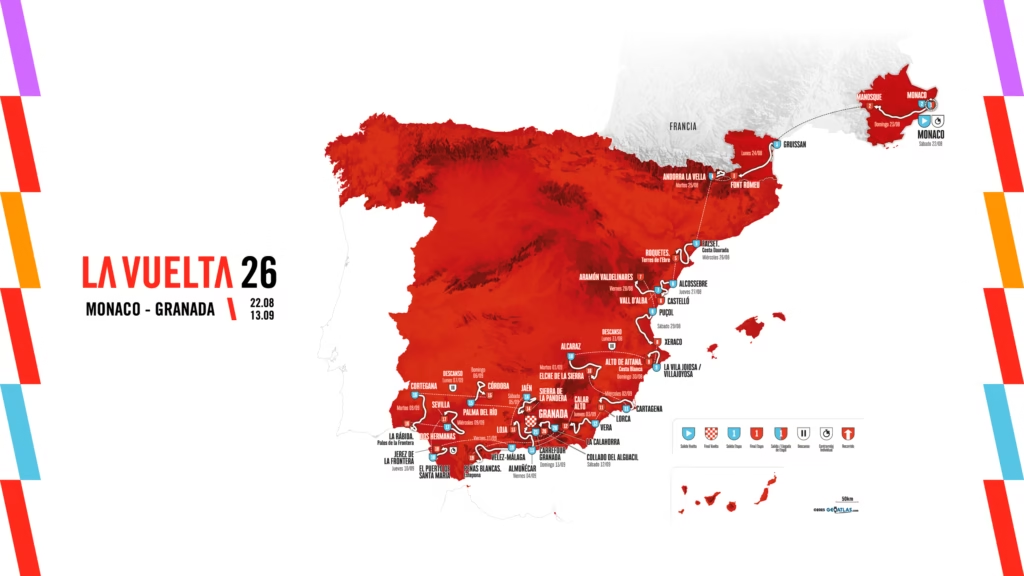
The 2026 Vuelta a España runs from Saturday 22 August to Sunday 13 September, beginning with a 9.4km individual time trial through Monaco and finishing three weeks later in Granada. Across 21 stages and roughly 3,275km, the route contains two individual time trials, six officially classified mountain stages, four medium-mountain stages and more than 58,000 metres of climbing.
It is an unusually demanding route from the outset. Font-Romeu arrives on Stage 3, the peloton is in Andorra a day later and the opening week still has Valdelinares and the enormous Alto de Aitana stage to come. The second week brings Calar Alto and Sierra de la Pandera, while the decisive final sequence combines a 32km individual time trial with consecutive uphill finishes at Peñas Blancas and the new Collado del Alguacil.
There is also a major geographical change at the finish. Madrid is absent, with the Vuelta instead ending in Granada and using the Alhambra as the focal point of its final stage. For a wider introduction to the race, its classifications and how the Spanish Grand Tour tends to differ from the Tour de France and Giro d’Italia, see our beginner’s guide to the Vuelta a España 2026.
Vuelta a España 2026 route at a glance
| Stage | Date | Route | Distance | Type |
|---|---|---|---|---|
| 1 | 22 August | Monaco to Monaco | 9.4km | Individual time trial |
| 2 | 23 August | Monaco to Manosque | 214.3km | Hilly |
| 3 | 24 August | Gruissan-Aude to Font-Romeu | 174km | Medium mountain |
| 4 | 25 August | Andorra la Vella to Andorra la Vella | 104.8km | Mountain |
| 5 | 26 August | Falset-Costa Daurada to Roquetes-Terres de l’Ebre | 173.4km | Hilly |
| 6 | 27 August | Alcossebre to Castelló | 177.4km | Medium mountain |
| 7 | 28 August | Vall d’Alba to Aramón Valdelinares | 149.8km | Mountain |
| 8 | 29 August | Puçol to Xeraco | 171km | Flat |
| 9 | 30 August | La Vila Joiosa to Alto de Aitana | 187.4km | Mountain |
| Rest | 31 August | Rest day | ||
| 10 | 1 September | Alcaraz to Elche de la Sierra | 184.7km | Hilly |
| 11 | 2 September | Cartagena to Lorca | 151.3km | Flat |
| 12 | 3 September | Vera to Calar Alto | 166.6km | Mountain |
| 13 | 4 September | Almuñécar to Loja | 192.8km | Medium mountain |
| 14 | 5 September | Jaén to Sierra de la Pandera | 154.5km | Mountain |
| 15 | 6 September | Palma del Río to Córdoba | 189.7km | Medium mountain |
| Rest | 7 September | Rest day | ||
| 16 | 8 September | Cortegana to La Rábida, Palos de la Frontera | 181.1km | Hilly |
| 17 | 9 September | Dos Hermanas to Sevilla | 185km | Flat |
| 18 | 10 September | El Puerto de Santa María to Jerez de la Frontera | 32km | Individual time trial |
| 19 | 11 September | Vélez-Málaga to Peñas Blancas | 210km | Hilly, uphill finish |
| 20 | 12 September | La Calahorra to Collado del Alguacil | 187km | Mountain |
| 21 | 13 September | Carrefour Granada to Granada | 99.4km | Flat |
The race starts with one of its longest days immediately after the Monaco time trial, then moves rapidly into the Pyrenees. That sequencing is important because there is almost no period in which the main favourites can simply ride themselves into form.

Stage 1: Monaco to Monaco individual time trial
Saturday 22 August, 9.4km
The Vuelta begins against the clock, but the opening test is short enough to establish an early hierarchy without defining the race.
At 9.4km, the gaps between the main GC contenders should be measured in seconds rather than minutes. Those seconds still matter because there is almost no gentle introductory phase before the climbing begins. Anyone conceding 20 or 30 seconds in Monaco will already be chasing before Font-Romeu and Andorra.
The course should reward riders who combine outright power with technical precision, while also creating the possibility of an early red jersey for a specialist who may have little chance of defending it once the race reaches the mountains.
Stage type: Individual time trial
GC importance: Medium
Best suited to: Time triallists and explosive GC riders

Stage 2: Monaco to Manosque
Sunday 23 August, 214.3km
The first road stage is also one of the longest of the race, taking the peloton from Monaco into southern France towards Manosque.
Two third-category climbs interrupt the route, but neither should be difficult enough to force the main GC riders into action. The greater challenge comes from more than 200km of rolling terrain immediately after the opening time trial.
The likeliest outcome is a contest between durable sprinters and fast puncheurs, with the overall contenders concentrating on positioning, avoiding crashes and making sure an apparently harmless day does not create an early split.
Stage type: Hilly
GC importance: Low
Best suited to: Durable sprinters and puncheurs

Stage 3: Gruissan-Aude to Font-Romeu
Monday 24 August, 174km
The GC riders receive their first sustained climbing test on only the third day.
Stage 3 spends much of its opening half across comparatively benign terrain before beginning a long rise into the Pyrenees. The Col de Mont-Louis leads almost directly into the climb towards Font-Romeu, creating a prolonged period where the road rarely stops rising.
The gradients are not severe enough to guarantee major differences between evenly matched favourites, but that can make the stage more revealing rather than less. Sustained moderate climbing at altitude is difficult to bluff through if a rider has arrived below their expected level.
Font-Romeu is unlikely to decide the Vuelta, but it should offer the first reliable indication of who is genuinely ready to contend for it.
Stage type: Medium mountain
GC importance: High
Best suited to: Climbing all-rounders and GC riders
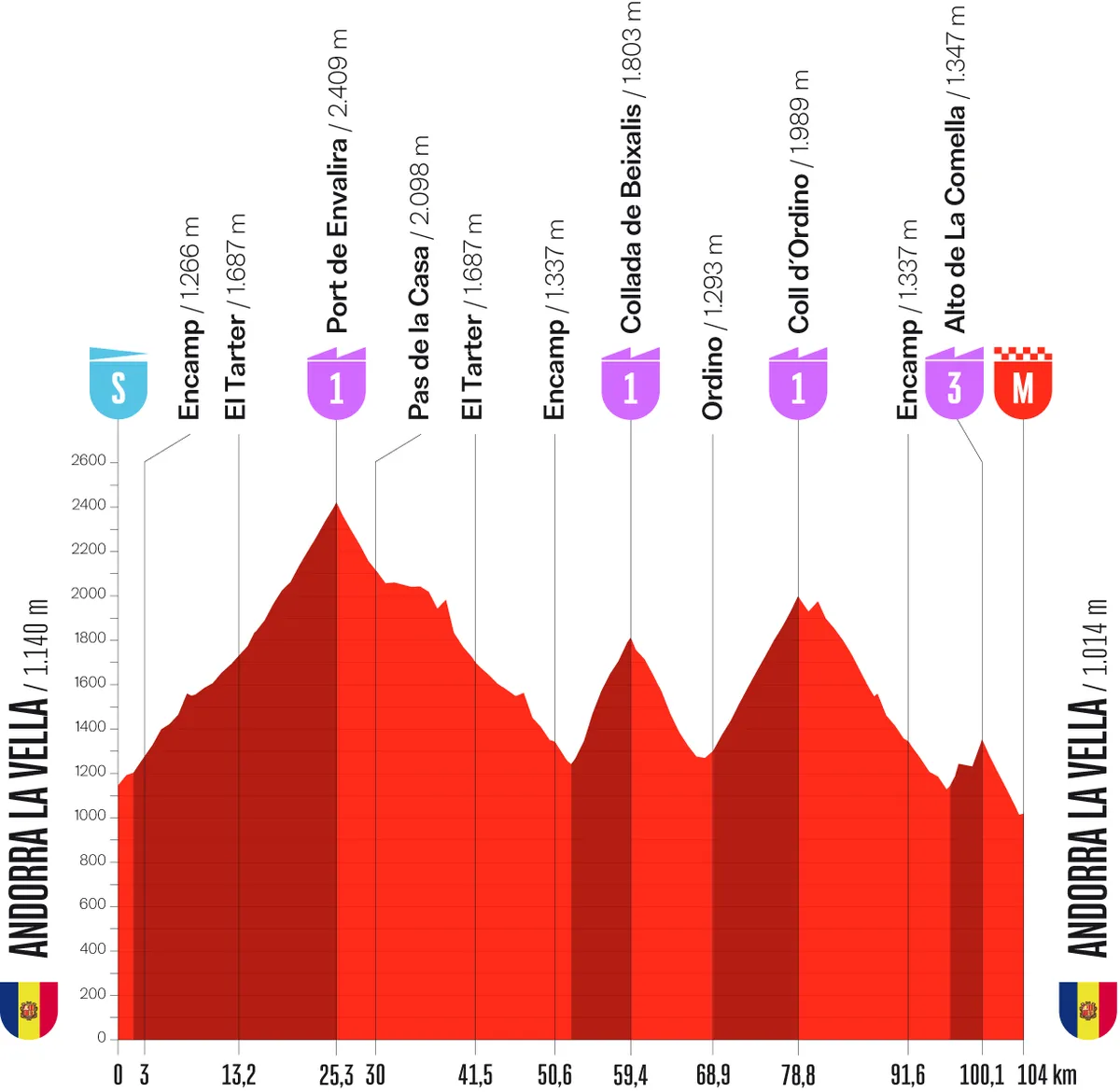
Stage 4: Andorra la Vella to Andorra la Vella
Tuesday 25 August, 104.8km
This is where the route becomes unmistakably Vuelta-like.
The stage is only 104.8km long but packs a succession of major climbs into a course with very little easy terrain. Port d’Envalira brings altitude early, while Collada de Beixalis and Col d’Ordino introduce much steeper climbing before La Comella provides the final ascent ahead of the descent into Andorra la Vella.
The short distance matters almost as much as the climbs themselves. Teams can race aggressively from the start without having to budget their effort across 200km, and a contender isolated early could face pressure on several successive climbs.
Nobody needs to win the Vuelta here, but a rider who has arrived underprepared could lose it.
Stage type: Mountain
GC importance: Very high
Stage 5: Falset-Costa Daurada to Roquetes-Terres de l’Ebre
Wednesday 26 August, 173.4km
After Andorra, Stage 5 provides something closer to a transition day, although its hilly classification makes a conventional sprint far from certain.
The terrain through southern Catalonia should appeal strongly to breakaway riders, particularly those already far enough down the GC to receive freedom. The overall teams will be more interested in recovering from Andorra and preparing for another difficult sequence later in the week.
It is the sort of stage where a break containing strong one-day riders could build enough of an advantage that the peloton has little reason to bring it back.
Stage type: Hilly
GC importance: Low to medium
Best suited to: Breakaway riders
Stage 6: Alcossebre to Castelló
Thursday 27 August, 177.4km
Stage 6 introduces one of the more unusual features of the route.
Several climbs precede El Bartolo, the major late ascent, while a gravel sector adds another positioning battle before the race reaches Castelló. It is exactly the kind of Vuelta stage which looks secondary beside the summit finishes but can become dangerous if one team decides to make the race difficult.
The main late climb is close enough to the finish for attacks to remain viable, making this a good stage for breakaway specialists and powerful all-rounders. GC teams will mainly want to avoid punctures, splits and an unexpectedly aggressive finale.
Stage type: Medium mountain
GC importance: Medium
Stage 7: Vall d’Alba to Aramón Valdelinares
Friday 28 August, 149.8km
Valdelinares provides another proper climbing finish before the first week is even complete.
The final climb is not among the steepest on the route, but it comes after repeated climbing and gives the favourites a clearer opportunity to test one another than Font-Romeu. Its steadier gradients should reward sustained climbing strength, while accumulated fatigue from the previous ascents may make the final kilometres more selective than the headline average suggests.
Coming only three days after Andorra, Stage 7 also starts testing recovery rather than just climbing ability. Grand Tours are rarely won by producing one great mountain performance. They are won by being able to repeat it.
Stage type: Mountain
GC importance: High
Stage 8: Puçol to Xeraco
Saturday 29 August, 171km
The sprinters finally receive one of their clearest opportunities.
Stage 8 runs south through the Valencia region and is officially classified as flat. After the mountain-heavy opening days, most GC teams will be perfectly happy to let the sprint squads assume responsibility.
Wind near the Mediterranean remains a possible complication, but in normal circumstances this should be one of the most straightforward bunch-finish opportunities of the entire race.
Stage type: Flat
GC importance: Low
Best suited to: Pure sprinters
Stage 9: La Vila Joiosa to Alto de Aitana
Sunday 30 August, 187.4km
The first week ends with one of the most important stages of the entire Vuelta.
The route contains more than 5,000 metres of climbing, with the exceptionally steep Miserat appearing before the long final ascent towards Alto de Aitana. The last climb stretches for more than 20km, turning the conclusion into an endurance test after an already exhausting day.
Aitana is not brutally steep throughout, but the total workload should make conservative racing increasingly difficult. Anyone who has managed to conceal poor form through Font-Romeu, Andorra and Valdelinares is unlikely to manage it here.
By the first rest day, the Vuelta should have a genuine hierarchy rather than merely a provisional GC.
Stage type: Mountain
GC importance: Very high
First rest day: Monday 31 August
The first rest day arrives after a block which has already included Monaco, Font-Romeu, Andorra, Valdelinares and Alto de Aitana.
That is a substantial amount of decisive racing before September has even started. Riders already one or two minutes down cannot assume the race will patiently wait for the final week before giving them another opportunity.
Stage 10: Alcaraz to Elche de la Sierra
Tuesday 1 September, 184.7km
The second week begins with hilly terrain rather than another immediate summit finish.
This should be one of the better breakaway opportunities of the Vuelta, particularly after the rest day gives stage hunters the chance to reset. The route is difficult enough to remove many pure sprinters without being obviously selective enough for the leading GC teams to commit significant resources.
The traditional danger is the first day after a rest. A favourite who has restarted poorly can lose time on terrain which looked harmless when the route was announced.
Stage type: Hilly
GC importance: Low to medium
Stage 11: Cartagena to Lorca
Wednesday 2 September, 151.3km
A relatively short flat stage gives the sprinters another opportunity before the mountains return.
For the GC teams, this should be one of the few genuine conservation days of the race, although positioning through the finale remains important. For the sprinters, the limited number of straightforward opportunities means Lorca cannot be wasted.
Stage type: Flat
GC importance: Low
Stage 12: Vera to Calar Alto
Thursday 3 September, 166.6km
The second major mountain block begins with one of the most recognisable combinations on the 2026 route.
Alto de Velefique provides the first major test before the road descends and begins climbing again towards the Calar Alto observatory. The significance lies in using the two climbs together. If the race remains controlled over Velefique, the favourites can wait for Calar Alto. If a team uses the first climb aggressively, the final ascent becomes much harder to manage.
This is a stage where squad strength can be as important as the final individual climbing performance.
Stage type: Mountain
GC importance: Very high
Stage 13: Almuñécar to Loja
Friday 4 September, 192.8km
There is no completely easy recovery stage after Calar Alto.
Stage 13 is officially medium mountain and crosses Andalucía over almost 193km, making it ideal territory for a substantial breakaway. The leading teams should prefer not to contest the stage, but its length and constant terrain still require energy.
Managing that effort becomes especially important because Sierra de la Pandera arrives the following afternoon.
Stage type: Medium mountain
GC importance: Medium
Stage 14: Jaén to Sierra de la Pandera
Saturday 5 September, 154.5km
Sierra de la Pandera is one of the clearest GC stages of the second week.
The final ascent is long and steep enough to expose meaningful differences without requiring elaborate tactics. By this stage of the race, accumulated fatigue should also make it harder for weaker riders simply to follow wheels and minimise losses.
The approach through Jaén provides further climbing before the final ascent, meaning the GC group should already be reduced by the time the decisive gradients begin.
Stage type: Mountain
GC importance: Very high
Stage 15: Palma del Río to Córdoba
Sunday 6 September, 189.7km
The second week finishes with another medium-mountain stage rather than allowing the GC contenders to begin their rest day early.
Córdoba regularly lends itself to interesting racing because the surrounding climbs are difficult enough to remove pure sprinters without automatically producing a showdown between the leading GC riders.
After Calar Alto and La Pandera, the overall teams may have little appetite for chasing a strong breakaway, creating another important opportunity for stage hunters.
Stage type: Medium mountain
GC importance: Medium
Second rest day: Monday 7 September
By the second rest day, most of the established mountain names on the route will already have been used.
The final week changes the problem. Two stages provide some relative breathing room before a long individual time trial creates a new GC hierarchy, followed immediately by two uphill finishes capable of overturning it again.
Stage 16: Cortegana to La Rábida, Palos de la Frontera
Tuesday 8 September, 181.1km
The final week begins with a hilly route through Huelva towards La Rábida.
This should favour the breakaway, especially because the leading GC teams have every reason to conserve energy before Jerez and the final mountain weekend.
The overall contenders will still need to remain attentive, but this is unlikely to be a day they deliberately make harder than necessary.
Stage type: Hilly
GC importance: Low to medium
Stage 17: Dos Hermanas to Sevilla
Wednesday 9 September, 185km
Sevilla offers the sprinters their final obvious conventional opportunity.
With the individual time trial following immediately, the GC teams will want the day to be as uneventful as possible. The sprint squads should therefore find plenty of cooperation when it comes to controlling the breakaway.
Stage type: Flat
GC importance: Low
Stage 18: El Puerto de Santa María to Jerez de la Frontera individual time trial
Thursday 10 September, 32km
The second time trial could completely reshape the race with only three stages remaining.
At 32km, the course is long enough for the strongest riders against the clock to take substantial time from more specialised climbers. Its placement on Stage 18 makes the normal hierarchy less predictable because almost three weeks of accumulated fatigue can change how riders perform.
A strong time triallist could potentially gain a minute or more on a direct rival. The beauty of the route is that doing so does not settle the Vuelta, because the next two stages give the climbers immediate opportunities to retaliate.
This may be the stage which determines how the entire final mountain weekend is raced.
Stage type: Individual time trial
GC importance: Very high
Stage 19: Vélez-Málaga to Peñas Blancas
Friday 11 September, 210km
There is no recovery period after Jerez.
Stage 19 covers 210km before finishing at Peñas Blancas, making it an endurance test even before the final climb is considered. The decisive ascent lasts almost 19km and is steady enough for teams to apply sustained pressure rather than relying on one explosive move.
Its position immediately after the time trial is particularly effective. Any climber who lost substantial time in Jerez knows exactly what needs to be recovered, while a race leader who gained there now faces almost 20km of climbing with nowhere to hide.
Stage type: Hilly with uphill finish
GC importance: Very high
Stage 20: La Calahorra to Collado del Alguacil
Saturday 12 September, 187km
The penultimate stage is the obvious final opportunity to win the 2026 Vuelta.
The race moves into the Sierra Nevada, tackles Alto de Hazallanas twice and then finishes on the previously unused Collado del Alguacil. The final climb includes gradients reaching around 20 per cent, but its real difficulty comes from everything accumulated before it.
By the time the favourites reach the last ascent they will have raced for almost three weeks, completed a 32km time trial two days earlier and climbed Peñas Blancas the previous afternoon. Team strength should be heavily depleted and riders who have looked secure throughout the race may suddenly find the accumulation too much.
If the red jersey is still separated by seconds rather than minutes, there is nowhere left to wait.
Stage type: Mountain
GC importance: Maximum
Stage 21: Carrefour Granada to Granada
Sunday 13 September, 99.4km
The Vuelta breaks with its familiar Madrid finish in 2026 and instead ends in Granada.
The final stage is only 99.4km and officially classified as flat, but the route around Granada and the Alhambra gives it a very different identity from the usual capital-city procession.
Unless Stage 20 leaves the GC extraordinarily close, the red jersey should already be secure. The remaining sporting battle will be for the final stage victory and the chance to finish beside one of Spain’s most recognisable landmarks.
For UK viewers following the entire race, our guide to how to watch the Vuelta a España 2026 in the UK covers TNT Sports, HBO Max and the full three-week viewing schedule.
Stage type: Flat
GC importance: Very low
Where will the 2026 Vuelta be won?
There are too many difficult stages to identify one single climb where the Vuelta will inevitably be decided.
The opening week should establish the hierarchy extremely quickly. Font-Romeu provides the first sustained climbing test, Andorra creates genuine danger on Stage 4 and Aitana finishes the opening block with more than 5,000 metres of climbing.
The second week centres on Calar Alto and Sierra de la Pandera. By the second rest day, anyone still hoping to win should already have demonstrated the ability to survive repeated mountain stages rather than relying on one particularly favourable afternoon.
The final week provides the most interesting tactical balance. The 32km Jerez time trial gives stronger riders against the clock the chance to change the classification significantly, but they must immediately defend those gains on Peñas Blancas and Collado del Alguacil.
That sequencing prevents the race becoming a pure climbing contest or a pure time-trial contest.
The eventual champion needs both.

The five most important GC stages
Stage 20: Collado del Alguacil
The final mountain stage, a new summit finish and gradients reaching 20 per cent make this the last and potentially biggest opportunity to overturn the race.
Stage 9: Alto de Aitana
More than 5,000 metres of climbing before a long summit finish should establish the first genuine order among the favourites.
Stage 18: Jerez individual time trial
Thirty-two kilometres against the clock is enough to turn a small GC disadvantage into a serious problem.
Stage 4: Andorra
A 104.8km mountain stage on only the fourth day can expose a favourite who has arrived even slightly below the required level.
Stage 12: Calar Alto
Velefique followed by Calar Alto provides the classic multi-climb Vuelta structure where teams can begin making the race before the final ascent.
Which is the hardest stage of the 2026 Vuelta?
In terms of pure accumulated climbing, Stage 9 to Alto de Aitana has the strongest claim.
More than 5,000 metres of ascent comes before a long summit finish, and the stage arrives at the end of an opening week which has already taken the peloton through Font-Romeu, Andorra and Valdelinares.
Stage 20 may prove harder in practice because of its position. A climb tackled on the penultimate day after almost three weeks of racing bears little resemblance to the same gradients ridden fresh.
That distinction is typical of the Vuelta. The hardest-looking stage on paper is not always the one that creates the largest gaps.
 Photo Credit: Getty
How many major uphill finishes are there?
The main climbing finishes are spread through all three weeks:
- Stage 3: Font-Romeu
- Stage 7: Aramón Valdelinares
- Stage 9: Alto de Aitana
- Stage 12: Calar Alto
- Stage 14: Sierra de la Pandera
- Stage 19: Peñas Blancas
- Stage 20: Collado del Alguacil
Stage 4 in Andorra does not finish on the hardest climb of the day, but the sequence of Envalira, Beixalis, Ordino and La Comella means it belongs firmly among the race’s major GC stages.
The frequency is more important than the raw number. There is a substantial climbing test in every week and almost no prolonged phase where the favourites can simply wait for a later mountain block.
Two time trials give the route balance
Despite the enormous climbing total, the 2026 Vuelta is not designed purely for mountain specialists.
There are 41.4km of individual time trialling, split between 9.4km in Monaco and 32km from El Puerto de Santa María to Jerez.
The opening test establishes an immediate order, while the second can create much larger differences. Its position on Stage 18 is particularly important because neither type of rider gets the final word.
A climber who loses heavily in Jerez gets Peñas Blancas and Collado del Alguacil immediately afterwards. A time triallist who takes red in Jerez has to defend it through consecutive uphill finishes.
That makes the final three GC stages part of one connected tactical sequence rather than separate challenges.
-
 Photo Credit: Cor Vos
 -
 Photo Credit: Zac Williams/AusCycling


Sprinters have limited opportunities
This is not a particularly generous Vuelta for pure sprinters.
Only a handful of stages offer an obvious conventional bunch finish. Xeraco on Stage 8, Lorca on Stage 11 and Sevilla on Stage 17 are the clearest opportunities, while Manosque could suit a more durable fast rider.
Granada potentially offers one last chance, although the nature of the final circuit means riders with greater climbing strength may again have an advantage.
The larger problem is surviving everything in between. Any sprinter hoping to reach Granada must first get through Andorra, Aitana, Calar Alto, La Pandera, Peñas Blancas and Collado del Alguacil.
Why the 2026 route looks so characteristically Vuelta
The modern identity of the Vuelta is increasingly built around the frequency of difficult stages rather than finding one enormous climb and allowing everything to wait for it.
The 2026 route follows that philosophy closely.
The mountains arrive early. Medium-mountain stages occupy the spaces between the summit finishes. Gravel appears before Castelló. Altitude matters in Andorra and the Sierra Nevada. A long time trial is deliberately positioned immediately before two decisive mountain stages, and the penultimate day introduces a completely new summit rather than simply returning to one of the race’s established climbs.
For the deeper story of how the Spanish Grand Tour developed that identity, our brief history of the men’s Vuelta a España traces the race from its first edition in 1935 through to the modern era.
The route can also be found alongside ProCyclingUK’s other major stage-race coverage in the men’s cycling route guide hub.
The 2026 Vuelta does not look designed to allow anybody to control it comfortably for three weeks. There are too many opportunities to lose time, too few stretches where the GC riders can switch off and enough variation between time trialling, altitude and repeated mountain stages to expose different weaknesses.
Monaco provides the first seconds.
Aitana should reveal the serious contenders.
Jerez can overturn the hierarchy.
Peñas Blancas and Collado del Alguacil then decide whether anyone can hold onto it before the Vuelta finally reaches Granada.

