
The Grand Prix Cycliste de Montréal 2026 takes place on Sunday 13 September, bringing the men’s WorldTour back to one of the hardest one-day races in North America.
Held on the roads around Mount Royal, Montréal is the tougher of Canada’s two September WorldTour races and usually produces a much more selective race than the Grand Prix Cycliste de Québec two days earlier. The repeated climbing gradually strips riders from the peloton until only the strongest puncheurs, climbers and Classics specialists remain.
The 2026 edition carries even greater significance because the UCI Road World Championships will be held in Montréal just one week later, from 20 to 27 September. The Worlds road races use many of the same Mount Royal roads, meaning GP Montréal becomes an unusually important dress rehearsal for anyone targeting the rainbow jersey.
It is also the second half of the Canadian WorldTour double-header, following the Grand Prix Cycliste de Québec on Friday 11 September. Together, Québec and Montréal form two of the most distinctive late-season races on the calendar.

Grand Prix Cycliste de Montréal 2026 at a glance
Date: Sunday 13 September 2026
Country: Canada
City: Montréal, Québec
Race type: Men’s one-day road race
UCI classification: 1.UWT
Series: UCI WorldTour
First edition: 2010
2025 winner: Brandon McNulty
2024 winner: Tadej Pogačar
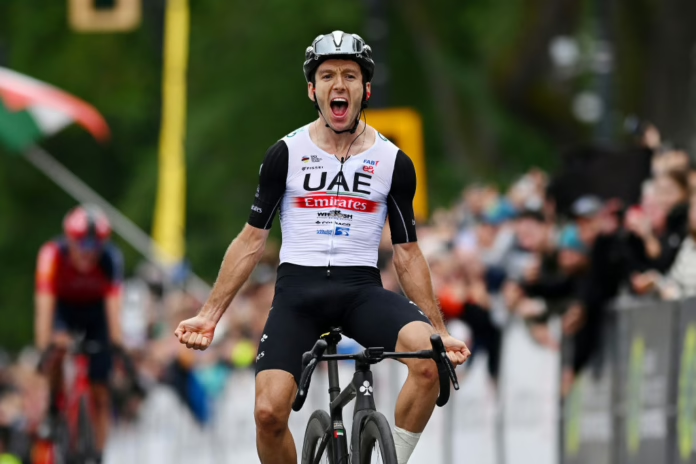
2023 winner: Adam Yates
Terrain: Hilly circuit race around Mount Royal
World Championships connection: Uses many of the same roads as the 2026 Worlds
Montréal is one of only two Canadian events on the men’s WorldTour calendar, alongside Québec. ProCyclingUK’s men’s cycling race hub places both races within the wider 2026 WorldTour calendar.
What is the Grand Prix Cycliste de Montréal?
The Grand Prix Cycliste de Montréal is a men’s WorldTour one-day race held entirely within Montréal.
It was created in 2010 alongside the Grand Prix Cycliste de Québec as part of an attempt to establish a permanent top-level North American presence on the international road calendar. Both races succeeded in becoming established WorldTour fixtures, but they have developed noticeably different identities.
Québec generally gives faster puncheurs and Classics riders a better chance. Montréal is much more attritional. Repeated laps around Mount Royal produce thousands of metres of climbing without ever requiring one major mountain, creating a race particularly suited to riders who combine climbing ability with the explosiveness needed for one-day racing.
The importance of the Canadian pair was already clear when Tadej Pogačar, Tom Pidcock and Biniam Girmay headed to Québec and Montréal in 2024. In 2026, their position immediately before the Montréal World Championships gives them even greater significance.
Where does GP Montréal take place?
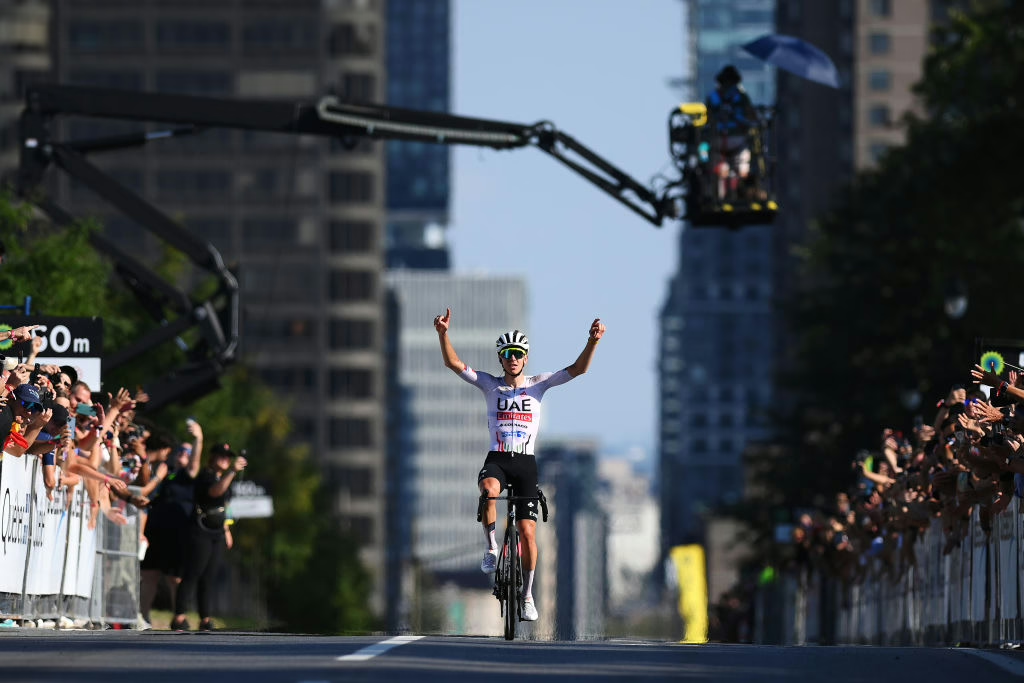
The race is centred on Mount Royal, the hill dominating central Montréal and the feature that gives the race its unmistakable identity.
Rather than travelling far into the surrounding countryside, riders complete repeated circuits through the city. That gives spectators multiple opportunities to see the peloton and makes the race relatively easy to understand visually. The same climbs, descents and corners appear again and again, but each passage becomes harder as fatigue accumulates.
The key roads traditionally include the Côte Camillien-Houde, the technical roads around the Université de Montréal and the uphill approach towards the finish on Avenue du Parc.
That circuit format creates an unusual rhythm. Riders know exactly what is coming because they have already ridden the same roads several times, but knowledge does not make the final laps any easier. A climb that feels manageable during the opening hour can become decisive after more than 200 kilometres.
Why is GP Montréal so hard?
The difficulty comes from accumulation rather than one spectacular ascent.
There is no climb long enough to make Montréal look like a mountain Classic when viewed in isolation. Instead, the riders repeatedly tackle short and medium-length ascents until the total amount of climbing becomes substantial.
That makes fatigue and positioning just as important as outright climbing ability. A rider who repeatedly loses ten positions before an ascent and then has to close gaps afterwards can waste enormous amounts of energy before the decisive part of the race even begins.
It also makes Montréal difficult for conventional sprinters. Even riders who are normally strong enough to survive rolling Classics can find that the repeated climbing gradually removes their finishing speed.
The selection therefore tends to happen in stages. The peloton becomes smaller lap after lap until the final circuits are fought out by a much more exclusive group.
 Photo Credit: Getty
What are the key climbs?
The most recognisable ascent is Côte Camillien-Houde, the road climbing Mount Royal.
It is long enough for teams to apply sustained pressure but still short enough for the strongest riders to attack explosively. The other important feature is the steep climbing around the Polytechnique, where sharper gradients can quickly expose anyone already riding at their limit.
Neither climb is extraordinary on its own. What matters is how many times the race returns to them.
By the final hour, repeated efforts begin to compound. Riders who comfortably followed the first passages can suddenly find themselves unable to respond when the favourites accelerate.
The uphill drag towards the finish also means surviving the climbs is not enough. Anyone hoping to win from a small group still needs enough power left for one final acceleration.
Why is the 2026 edition different?
Normally, GP Montréal is an important late-season WorldTour race in its own right.
In 2026, it is also effectively a competitive test of the roads that will decide the World Championships a week later.
The UCI Road World Championships take place in Montréal from 20 to 27 September, bringing the rainbow jersey races back to Canada. The elite road races use the Mount Royal area that GP Montréal riders already know extremely well.
That makes the Grand Prix unusually valuable.
A training reconnaissance can show riders the corners, gradients and road surfaces. A WorldTour race shows them what those roads feel like after hours of racing while the strongest riders in the world are attacking.
The link between Montréal and the Worlds is not new. ProCyclingUK was already discussing the city’s future World Championship course when Pogačar returned to racing in Canada ahead of the 2024 Worlds.
In 2026, however, the connection is immediate.

What is the connection with the 2026 World Championships?
The World Championship road races and GP Montréal are not identical courses, but there is substantial overlap in the decisive Mount Royal terrain.
That makes previous experience here unusually valuable. Riders already know where positioning becomes difficult, where the pace tends to rise and which sections become far more painful after repeated laps.
National teams will therefore be watching GP Montréal particularly closely.
A rider who looks exceptionally strong on Camillien-Houde may move up a country’s leadership hierarchy. Someone struggling repeatedly on the same roads may raise doubts only seven days before the biggest one-day race of the season.
That makes GP Montréal one of the rare WorldTour races where the tactical information produced could matter almost immediately in another major event.
How does GP Montréal differ from GP Québec?
The two Canadian WorldTour races are often grouped together, but the racing is noticeably different.
The Grand Prix Cycliste de Québec is still demanding, but its shorter climbs and punchier finish keep a wider range of riders involved. Fast Classics specialists have a realistic chance of surviving and winning there.
Montréal asks for considerably more climbing.
The Mount Royal circuits gradually turn the race into something closer to an Ardennes Classic, particularly once teams begin increasing the pace late in the day.
That makes winning both races difficult. A rider needs enough speed for Québec but also enough climbing endurance to survive Montréal.
The distinction is one of the main reasons the Canadian double-header works so well. Two races held only two days apart can still produce very different tactical contests.
Previous winners
2025 – Brandon McNulty
2024 – Tadej Pogačar
2023 – Adam Yates
The recent winners tell their own story.
This is not a race being dominated by conventional sprinters. McNulty, Pogačar and Yates are all riders with serious climbing ability, and recent editions have increasingly rewarded stage-race specialists capable of transferring that power into aggressive one-day racing.
2025: Brandon McNulty leads a UAE one-two
The 2025 edition produced a remarkable UAE Team Emirates-XRG one-two, with Brandon McNulty taking victory ahead of teammate Tadej Pogačar.
It was an emphatic demonstration of the team’s strength on a course that rewards both climbing depth and tactical flexibility.
McNulty’s victory also showed why having multiple leaders can be particularly useful in Montréal. If rivals spend too much time concentrating on one superstar, another elite climber can gain enough freedom to turn a tactical opportunity into the winning move.
That principle should be especially relevant in 2026, when several teams may arrive with more than one rider simultaneously preparing for the World Championships.
2024: Tadej Pogačar dominates Montréal
Tadej Pogačar won the 2024 edition with a long solo attack, accelerating around 23 kilometres from the finish and riding away from the strongest remaining riders.
The performance reinforced Montréal’s reputation as one of the WorldTour one-day races best suited to Grand Tour-level climbers.
It also became part of Pogačar’s successful World Championship preparation. His Canadian victory came shortly before he travelled to Zürich and won the rainbow jersey with another enormous long-range attack.
ProCyclingUK’s preview of Pogačar’s 2024 World Championship challenge came after that commanding Montréal performance and showed how strongly his Canadian form shaped expectations for the Worlds.
That sequence becomes particularly relevant again in 2026. This time, the World Championships are not merely another hilly race later in September. They are taking place on many of the same Montréal roads.
2023: Adam Yates wins on Mount Royal
Adam Yates won the 2023 edition, another result illustrating how strongly the race can favour elite climbers.
Yates is not a conventional Classics specialist. His strengths are sustained climbing, repeated hard efforts and maintaining a high level deep into difficult races.
Montréal allows that type of rider to succeed because the cumulative climbing gradually removes riders with more outright sprint speed but less ability to repeat uphill efforts.
By the last few laps, what began as an urban WorldTour Classic can effectively become a climbing contest conducted on short city ascents.
What type of rider wins GP Montréal?
The simplest description is a climber with a one-day racing engine.
Pure climbers can succeed, but they need to deal with repeated accelerations and aggressive positioning rather than settling into one long mountain rhythm. Classics specialists can win, but they require considerably more climbing ability than they usually need in Québec.
Puncheurs naturally suit the short climbs, although even some of them eventually struggle with the sheer amount of accumulated elevation.
The very best Grand Tour riders therefore have an obvious advantage. They can repeatedly produce high climbing power without losing as much after four or five hours of racing.
That helps explain why Pogačar, Yates and McNulty have taken the three most recent editions.
Does GP Montréal suit Tadej Pogačar?
Very much so.
There are few one-day races outside the Ardennes that fit Pogačar’s characteristics quite as naturally.
The climbs are hard enough for him to create separation but short enough to attack explosively. The accumulation of elevation rewards his endurance, while the uphill finish also gives him options if a small group remains together.
His 2024 victory confirmed how well he fits the course, and his second place behind McNulty in 2025 continued an exceptional record in Montréal.
The 2026 context makes him even more interesting. The race takes place just one week before the Montréal World Championships, so if Pogačar starts, every move will inevitably be analysed for what it might mean seven days later.
That interest is increased further by his 2026 season. Pogačar has already won a fifth Tour de France, with ProCyclingUK looking at his place among the sport’s greatest riders after his latest yellow jersey. Montréal offers a very different challenge, but one exceptionally well matched to the qualities that make him so difficult to beat.
Is GP Montréal a good race for World Championship preparation?
In 2026, almost certainly.
Normally, riders have to balance the benefit of racing with the danger of arriving at the World Championships fatigued. Montréal changes that calculation because the race itself provides competitive experience on the roads that will matter a week later.
Training can tell a rider where a climb starts.
Racing tells them how difficult that climb becomes after hours at WorldTour pace, where the peloton stretches, how difficult it is to move up and which sections provide enough separation for an attack.
That information is far more valuable.
It means national teams should be watching closely even though riders are competing in trade-team colours. Performances here could influence leadership hierarchies and tactical plans almost immediately.
The wider significance of Montréal within the international calendar is also reflected in ProCyclingUK’s coverage of the 2026 men’s racing calendar, with the Canadian races forming a key part of the final major block of the season.
Are there any Canadian riders to watch?
The race always gives Canadian riders an unusual opportunity to compete in a home WorldTour event.
That matters because Canada has relatively few opportunities to host men’s racing at this level. Québec and Montréal therefore carry more significance for domestic riders than a normal WorldTour stop elsewhere on the calendar.
Canadian riders may not always enter as outright favourites, but home knowledge, motivation and crowd support make them worth following.
The races have also traditionally created opportunities for Canadian riders outside the largest WorldTour squads to compete against the strongest peloton in professional cycling.
In 2026, that home interest should be amplified further by the World Championships arriving in Montréal immediately afterwards.
Why September matters
Montréal’s September position gives it a distinctive role in the season.
The Tour de France has long finished, the Vuelta a España reaches its conclusion on the same day and the spring Classics are months in the past. Riders therefore arrive in Canada with very different objectives.
Some are targeting one of their final major victories of the season. Others are building specifically towards the World Championships or Il Lombardia. Some arrive searching for a result after a difficult summer.
That mixture often encourages aggressive racing because fewer teams have the same objective.
In 2026, the Worlds should make that dynamic even stronger. Riders targeting the rainbow jersey need to be approaching their best immediately rather than slowly building towards an event several weeks away.
When is GP Montréal 2026?
The Grand Prix Cycliste de Montréal takes place on:
Sunday 13 September 2026
The Grand Prix Cycliste de Québec is held two days earlier on Friday 11 September, creating the traditional Canadian WorldTour double-header.
Montréal also falls on the final day of the Vuelta a España, making 13 September an unusually busy day on the men’s calendar before attention shifts rapidly towards the World Championships.
-
 Photo Credit: Getty
 -
 Photo Credit: Olly Hassell/SWPix.com
How to watch GP Montréal 2026
The full UK broadcast arrangements should be confirmed closer to September.
As a WorldTour race, GP Montréal normally receives extensive international coverage, and the importance of the 2026 edition should ensure the decisive part of the race is widely available.
Broadcast times are especially worth checking because of the time difference between the UK and Québec. The race takes place during the Canadian afternoon, which means the decisive final laps fall during the evening for British viewers.
ProCyclingUK’s men’s cycling TV guide hub brings together the latest UK viewing information across the WorldTour calendar and will provide the relevant Montréal guide once the 2026 schedule is confirmed.
The most important part to watch is normally the final 40 to 50 kilometres, when repeated Mount Royal climbing begins reducing the race rapidly and the principal favourites start using teammates to set up attacks.
Why should you watch GP Montréal 2026?
Even in an ordinary year, GP Montréal is one of the most distinctive races on the WorldTour calendar. The circuit is easy to understand, the repeated climbs almost guarantee attrition and the strongest riders generally have to race aggressively rather than waiting for a straightforward sprint.
The 2026 edition adds another dimension entirely. Seven days later, many of the same riders will return to the same Mount Royal roads trying to become world champion.
Every attack on Camillien-Houde becomes a clue. Riders who look comfortable under repeated pressure will immediately move into the Worlds conversation, while anyone struggling will have very little time to change the picture.
GP Montréal is therefore more than the second of Canada’s two WorldTour races in 2026. It is effectively the final full-speed rehearsal for the men’s World Championship road race.
Unlike a normal reconnaissance ride, however, there is still a major WorldTour Classic to win at the end of it.

