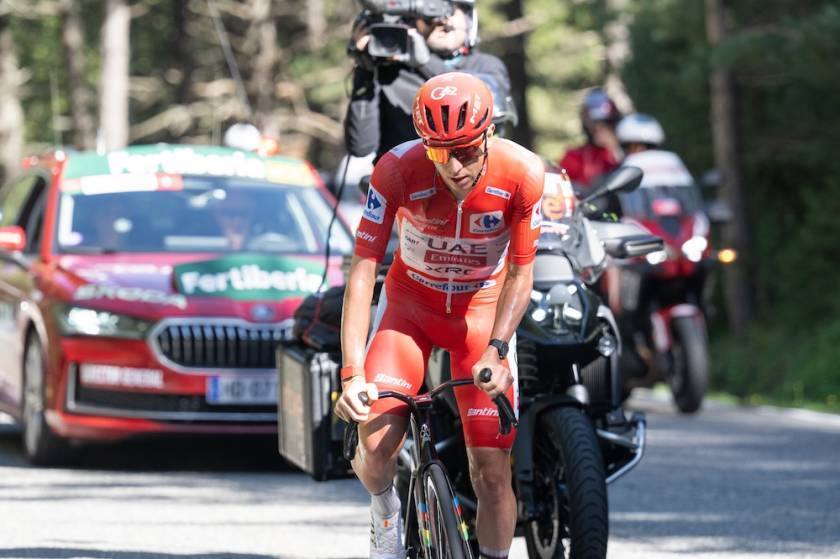
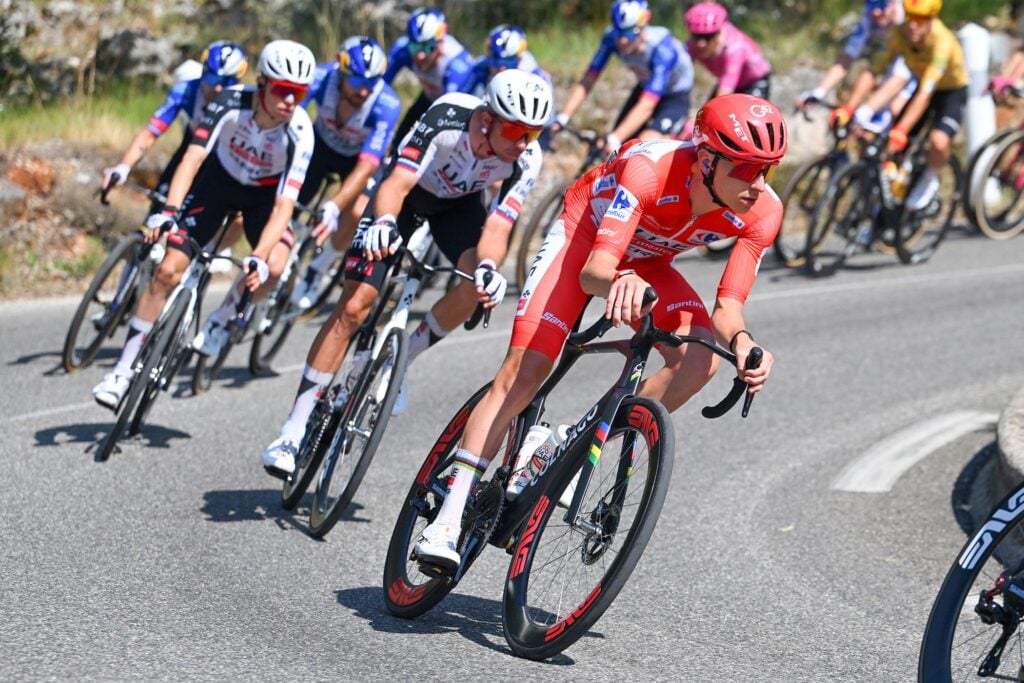
Tadej Pogačar delivered the first major GC blow of the 2026 Vuelta a España, winning stage 4 in Andorra after a 50-kilometre solo attack from the Collada de Beixalis.
The UAE Team Emirates-XRG rider attacked on the steepest climb of the day, quickly dropped Felix Gall and then never looked back. He crossed the line alone in Andorra la Vella, taking the stage win, extending his overall lead, moving into the mountains jersey and turning the first full mountain test of the race into a one-man exhibition.
Jarno Widar finished second at 2:39, ahead of Gall, Oscar Onley, Sepp Kuss, Enric Mas and Primož Roglič in the same time. Richard Carapaz was eighth at 2:57 after being distanced on the final climb. Pogačar now leads the general classification by 3:21 over Roglič, with Mas third at 3:32.
A short Andorran stage with no hiding place
Stage 4 was the first proper mountain verdict of the Vuelta after the weather-hit cancellation of stage 3.
The route was short, sharp and brutal. The riders faced three first-category climbs and more than 2,800 metres of elevation, beginning almost immediately with the Port d’Envalira, then continuing with the Collada de Beixalis, the Coll d’Ordino and the final third-category climb of La Comella before the finish in Andorra la Vella.
On paper, the distance was modest. In practice, the stage was designed to hurt from the start. Port d’Envalira climbed for 23.3 kilometres at 5.1 per cent, taking the race to the highest point of the 2026 Vuelta. The Collada de Beixalis then provided the key launchpad, with 6.5 kilometres at 8.5 per cent, before the Coll d’Ordino and La Comella ensured there would be no easy road to the finish.
After stage 3 had been cancelled before the planned Font-Romeu summit finish, this was the first chance for the GC riders to test one another properly. Pogačar did not wait for the final climb to do it.
Early attacks from the start
The stage opened aggressively, with Diego Uriarte the first rider to attack shortly after the flag dropped.
That move was quickly brought back, but the attacks continued on the opening slopes of the Port d’Envalira. A large group formed with riders including Wout van Aert, Matthew Brennan, Ben Tulett, Bruno Armirail, Finn Fisher-Black, Pablo Castrillo, Paul Double, Eddie Dunbar, Georg Steinhauser, Lorenzo Fortunato, Jan Hirt, Simon Dalby, Raúl García Pierna and Ivan Sosa.
Team Visma | Lease a Bike had numbers in the move, including Van Aert, Brennan, Tulett and Armirail, which briefly gave the stage a very different complexion. Van Aert was still close enough overall to become a virtual threat, while Brennan began the day in the young rider’s jersey after his stage 2 victory in Manosque.
UAE Team Emirates-XRG were not prepared to give the group too much room. Pogačar’s team held the break close, with the gap moving around 1 minute before Decathlon CMA CGM took a much more aggressive role in the chase.
Fortunato takes the first mountain points
The breakaway began to thin as the race climbed towards the summit of Port d’Envalira.
Brennan did a strong turn at the front before being distanced near the top, while other early attackers also fell away under the pace. The strongest climbers remained, including Fortunato, Double, Sosa, Castrillo, Dunbar and Hirt.
Fortunato beat Double in a two-man sprint over the summit to take maximum points and briefly move into the virtual lead of the mountains classification. Behind, the peloton had already been reduced sharply. Santiago Buitrago was among those dropped, while João Almeida also lost contact early after mechanical trouble and the pressure of the climb.
That was an important warning for UAE Team Emirates-XRG. Pogačar still had Jay Vine close, but the support around him was already thinner than usual. The stage was short enough that team control could disappear quickly, and Decathlon CMA CGM clearly sensed an opportunity.
Decathlon CMA CGM make the race hard
Decathlon CMA CGM were the team that lit the fuse before Pogačar detonated the race.
They drove the peloton on the first climb, continued setting a strong pace on the descent, and then led onto the Collada de Beixalis. Gall had made it clear before the stage that he wanted a hard race, and his team delivered exactly that.
By the foot of Beixalis, the breakaway had been caught and the peloton was already heavily reduced. Pogačar had only a small UAE presence around him, with Vine setting the pace before the Slovenian moved into second wheel.
It was the kind of situation that can tempt a rival team to believe the leader is isolated. Instead, it gave Pogačar the opening he wanted.
As soon as the road rose on Beixalis, he attacked.
Pogačar goes from 50 kilometres out
Pogačar attacked with exactly 50 kilometres remaining.
Gall was the only rider able to respond immediately, but even that lasted only briefly. The Austrian tried to follow, then faded as Pogačar continued to accelerate away on the steep slopes of the Collada de Beixalis.
The gap grew with frightening speed. Pogačar had 15 seconds almost instantly, then a minute after just a few kilometres. The chase group behind was still full of major GC names, but it was already clear that they were racing for second unless cooperation improved quickly.
It did not. The group behind contained riders with different priorities and different levels of strength. Roglič, Mas, Kuss, Onley, Carapaz, Widar, Skjelmose, Gall and others were all still in the race, but none could match Pogačar’s move directly.
The attack was decisive not because nobody recognised the danger, but because everyone recognised it and still could not stop it.
Beixalis blows the race apart
Pogačar crested the Collada de Beixalis alone, taking the maximum mountain points and already building a race-changing advantage.
Behind him, the chase group kept shifting. Gall was caught by a group containing Roglič, Torres, Vine, Mas, Kuss, Mühlberger, Onley, Svestad-Bårdseng, Skjelmose, Tobias Halland Johannessen, Carapaz, Brenner, Tejada and Widar. Carapaz later jumped clear to take second place over the summit behind Pogačar, but the important story was the gap.
By the time Pogačar was over the climb and into the descent, the stage had transformed. The breakaway was gone, the peloton was gone, and the GC field had been split into small groups trying to organise a pursuit.
Decathlon CMA CGM had helped create the perfect conditions for an attack. Pogačar was simply the rider strong enough to turn that setup into a solo raid.
Gall, Onley and Roglič try to organise the chase
The Coll d’Ordino became the next phase of the chase.
Gall attacked again, with Onley able to follow. Roglič then counter-attacked from the group behind and quickly bridged across, while Mas and Kuss later joined to form a more dangerous chasing unit.
For a while, that looked like the most credible response. Gall had teammates involved earlier, Onley was clearly climbing well, Roglič had the acceleration to bridge gaps, and Mas and Kuss both knew the roads and the stakes.
But they were already fighting for a reduced prize. Pogačar’s lead moved beyond 2 minutes, then towards 3 minutes. Attacks behind him changed the podium battle, but they did not change the stage win.
Mas tried to lift the pace near the top of the Coll d’Ordino, with Onley reacting quickest and Kuss and Roglič able to hold on. Gall had to fight to stay with them, while Carapaz, Widar, Skjelmose and Mühlberger were distanced behind.
At the summit, Pogačar took another 10 mountain points. The mountains jersey was now his as well.
Carapaz and Skjelmose lose ground
The second half of the stage also created clear losers among the GC contenders.
Carapaz had been active earlier and took mountain points on Beixalis, but he eventually lost contact with the main chase group and then cracked again on the final climb. He finished eighth on the stage at 2:57, losing 18 seconds to the Roglič, Mas, Kuss, Onley, Widar and Gall group.
Skjelmose suffered more. He was the first rider dropped from the enlarged chase group on the final climb and faded further behind before the finish. After starting the race among the possible podium contenders, this was an early setback on terrain that should have suited him more than some of the heavier riders.
Almeida had already been distanced earlier in the stage after mechanical trouble and never became part of the decisive chase. For UAE Team Emirates-XRG, that mattered less because Pogačar was up the road alone, but it still underlined how quickly the race had become chaotic.
The Andorran stage did not just give Pogačar time. It began to sort the chasing hierarchy behind him.
La Comella confirms the damage
The final climb of La Comella was short compared with the earlier ascents, but it still mattered.
Pogačar started the climb with more than 3 minutes in hand. The 3.9 kilometres at 5.9 per cent were not going to stop him by then, and he had enough time to briefly acknowledge Adam Yates at the roadside as he rode towards the finish.
Behind, the fight for second place sharpened again. Gall attacked, Onley pushed on, Carapaz was dropped, and the group kept fragmenting before partially regrouping near the top.
Pogačar took the final mountain points and bonus seconds over La Comella, then descended into Andorra la Vella with the stage already won. The race behind still mattered for podium positions, but the central story had long been settled.
This was Pogačar racing on a different timetable from everyone else.
Pogačar completes his longest Grand Tour solo
Pogačar crossed the line in 2:40:35, completing the longest solo victory of his Grand Tour career.
The distance of the attack mattered. This was not a final-kilometre acceleration, not a summit sprint and not a late move once the stage had already been softened by others. He went with 50 kilometres remaining, on the second major climb of the day, then carried the move over Beixalis, Ordino, La Comella and the descents between them.
It was his 37th Grand Tour stage win and his fifth stage win at the Vuelta. It was also his first Vuelta stage victory while wearing the red jersey.
The immediate numbers were brutal. He won the stage by 2:39, took 16 seconds in bonuses, added mountain points across the day and stretched his general classification lead to more than 3 minutes.
After only four stages, the Vuelta already looks like a race being shaped almost entirely on Pogačar’s terms.
Widar takes second from the chase
Widar finished second on the stage, leading home the chasing group at 2:39.
It was a striking result from the young Lotto-Intermarché rider, who came through the final climb and sprinted ahead of Gall, Onley, Kuss, Mas and Roglič. On a day dominated by Pogačar, Widar’s ride still stood out. He survived the decisive selection, stayed with the strongest chasers and had enough left to win the sprint for second.
Gall took third after Decathlon CMA CGM had helped ignite the day. His team made the race hard and he was the first to try to follow Pogačar, but the Slovenian’s acceleration proved too much. Onley was fourth after another composed ride, taking bonus seconds and moving further into the early GC picture.
Kuss, Mas and Roglič all finished in the same time. None could match Pogačar, but all remained in the front chase and avoided the further losses suffered by Carapaz and Skjelmose.
Roglič moves to second overall
Roglič did not take time from Pogačar, but he did move into second overall.
After losing 22 seconds in the opening Monaco time-trial, the Red Bull-Bora-Hansgrohe rider needed a cleaner mountain day. He could not follow Pogačar’s attack, but he responded well behind, bridging across to Gall and Onley on the Coll d’Ordino and finishing with the strongest chase group.
He now sits second overall at 3:21. That is already a large gap, but the position still matters. Roglič has put himself ahead of the rest of the chasing pack, and the Vuelta is long enough that the podium fight remains a separate race even if Pogačar already looks out of reach.
Mas is third at 3:32 after finishing in the same group, with Kuss fourth at 3:44 and Onley fifth at 3:45. Carapaz is sixth at 3:50 after losing contact late.
The GC is no longer compressed. Pogačar has opened a gap, and the rest are already fighting for position behind him.
Onley and Kuss strengthen podium cases
Onley and Kuss both came out of stage 4 with stronger podium arguments.
Onley was one of the most active riders in the chase, following Gall’s move, pushing on late and taking bonus seconds near the finish. He finished fourth on the stage and moved to fifth overall, only 1 second behind Kuss and 13 seconds behind Mas.
Kuss also rode well on familiar Andorran roads. He had been among the early attackers before the race settled, then stayed with the key GC group when the decisive chase formed. He did not have the explosive response to Pogačar, but he did enough to move into fourth overall.
Both riders benefited from the fact that the chase behind Pogačar eventually became selective. They did not close the gap to the leader, but they gained clarity in the podium race. At this early point, that still matters.
A stage that changes the race
Stage 4 did what stage 3 had been expected to do before the hailstorm intervened.
It gave the race its first full mountain selection, and the answer was emphatic. Pogačar was not just strongest, he was strong enough to attack from 50 kilometres out and still increase his lead across the final climbs. The others could only organise their own race behind.
The result leaves the Vuelta in a difficult place for everyone else. Pogačar now has time, confidence, the red jersey, the mountains jersey and a team that has already shown it can control when needed. Even when UAE Team Emirates-XRG were reduced, it did not matter because the leader could simply go alone.
For Roglič, Mas, Kuss, Onley, Carapaz and the rest, the tactical challenge has changed. They are no longer testing whether Pogačar can be put under pressure. They are already trying to find a way back from a deficit of minutes.
The race is not over. But after Andorra, it has a very clear leader.
Vuelta a España 2026 stage 4 result
Data powered by FirstCycling.com
Main photo credit: ASO