
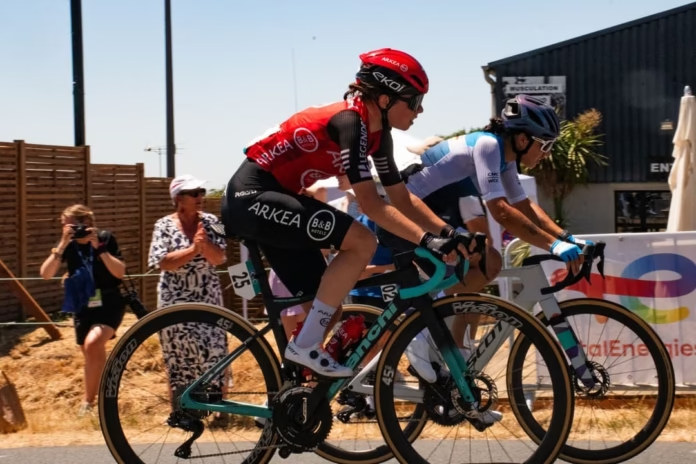
The first line-up for Decathlon CMA CGM’s new women’s team has emerged ahead of the French organisation’s entry into professional women’s cycling in 2027, with 11 riders reportedly signed for its inaugural season.
The roster combines established professional road riders with some of the most promising juniors in Europe and two notable recruits from Decathlon’s mountain bike programme. Samara Maxwell, Océane Mahé, Laura Molenaar and Greta Seiwald provide the most recognisable names, while more than half of the group are aged 19 or younger.
According to a report from Daniel Benson, the first 11 riders are Justine Baud, Laura Molenaar, Anna Dubier, Zoe Roche, Greta Seiwald, Samara Maxwell, Laly Pichon, Océane Mahé, Laura Lizette Sander, Lidia Castro de la Serna and Lien Schampaert.
One place therefore appears to remain open. When Decathlon announced the creation of its women’s ProTeam in July, the organisation said its first roster would contain 12 riders and emphasised development rather than immediately attempting to assemble a team of established Women’s WorldTour stars.
The first names suggest Decathlon have followed that plan closely.
Decathlon CMA CGM women’s reported 2027 roster
| Rider | Age | Nationality | 2026 team / background |
|---|---|---|---|
| Justine Baud | 17 | France | Junior |
| Laura Molenaar | 24 | Netherlands | VolkerWessels Cycling Team |
| Anna Dubier | 18 | Australia | Keukens Redant Cycling Team |
| Zoe Roche | 18 | Great Britain | Junior |
| Greta Seiwald | 29 | Italy | Decathlon Ford Racing Team |
| Samara Maxwell | 24 | New Zealand | Decathlon Ford Racing Team |
| Laly Pichon | 18 | France | Junior |
| Océane Mahé | 24 | France | Ma Petite Entreprise |
| Laura Lizette Sander | 22 | Estonia | Hitec Products-Fluid Control |
| Lidia Castro de la Serna | 18 | Spain | Junior |
| Lien Schampaert | 19 | Belgium | Keukens Redant Cycling Team |
The group is strikingly young. Baud is still only 17, four more riders are 18 and Schampaert is 19, meaning Decathlon’s first season should be viewed as the start of a development cycle rather than a demand for immediate Women’s WorldTour-level results.
The team’s 2027 moves will also form part of ProCyclingUK’s Women’s Cycling Transfers Hub, which is tracking confirmed signings, contract extensions, departures and retirements across the professional peloton.
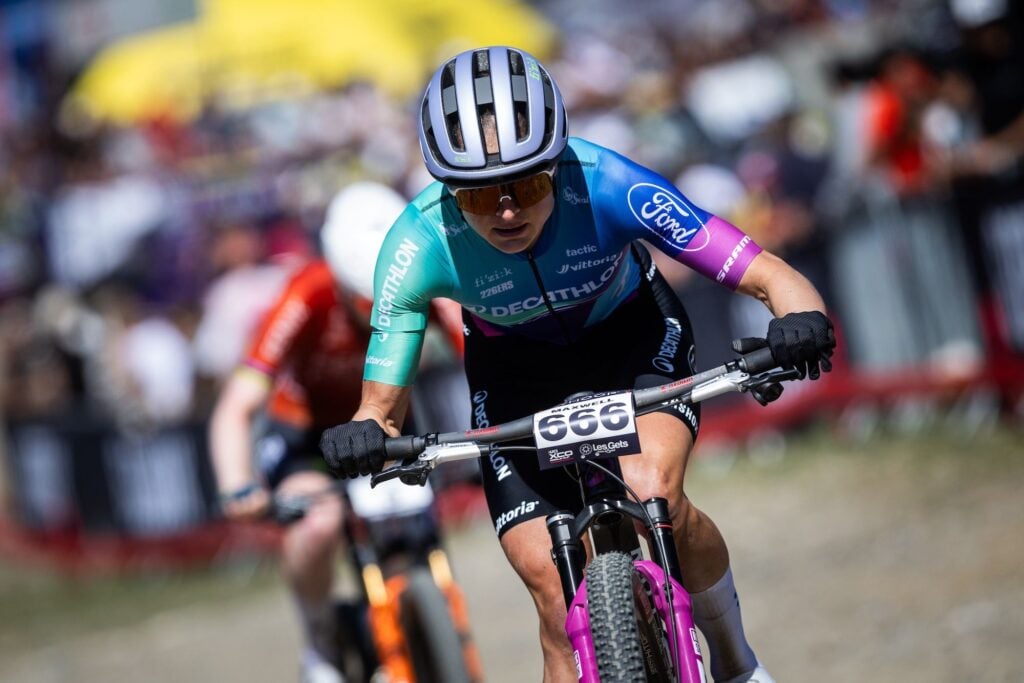 Photo Credit: Getty
Samara Maxwell gives the new team an elite athlete immediately
In terms of achievement at the highest level of any cycling discipline, Samara Maxwell stands out.
The New Zealander won the overall elite XCO World Cup in 2025 after a breakthrough season that included World Cup victories in Brazil and Andorra. She also finished second at the elite cross-country World Championships, establishing herself among the strongest mountain bike racers in the world.
Her move into the road structure is particularly interesting because it does not appear to represent a straightforward departure from mountain biking. Maxwell is already tied into Decathlon’s off-road programme through the Los Angeles 2028 Olympic cycle, making a dual programme the more likely direction.
That gives Decathlon an intriguing development project. The physical characteristics required for elite cross-country racing should transfer naturally towards climbing and hard one-day races, but the tactical demands of road cycling are very different. Positioning inside a large peloton, conserving energy, following team plans and handling longer races will all require adaptation.
Maxwell does not need to become a conventional full-time road racer for the experiment to work. A carefully selected road calendar could strengthen her racing programme while also giving Decathlon a rider capable of producing results on selective terrain much earlier than most riders making their first serious move into the discipline.
Greta Seiwald provides experience from the same mountain bike structure
Greta Seiwald is the second significant crossover from Decathlon Ford Racing.
The Italian has raced internationally in cross-country mountain biking for years and, at 29, will be the oldest rider among the first 11 names. That makes her experience valuable in a squad containing so many teenagers even if she also has to adjust to the routines of a professional road programme.
Her presence reinforces the multi-discipline philosophy Decathlon outlined when it first announced the team. Guillaume Bonnafond, who will oversee the NewGen structure, specifically identified road racing, cyclocross and mountain biking as different pools from which the organisation intended to recruit.
Maxwell and Seiwald show that was more than a general statement about talent identification. Decathlon are actively using their existing mountain bike operation as part of the pathway into the women’s road team.
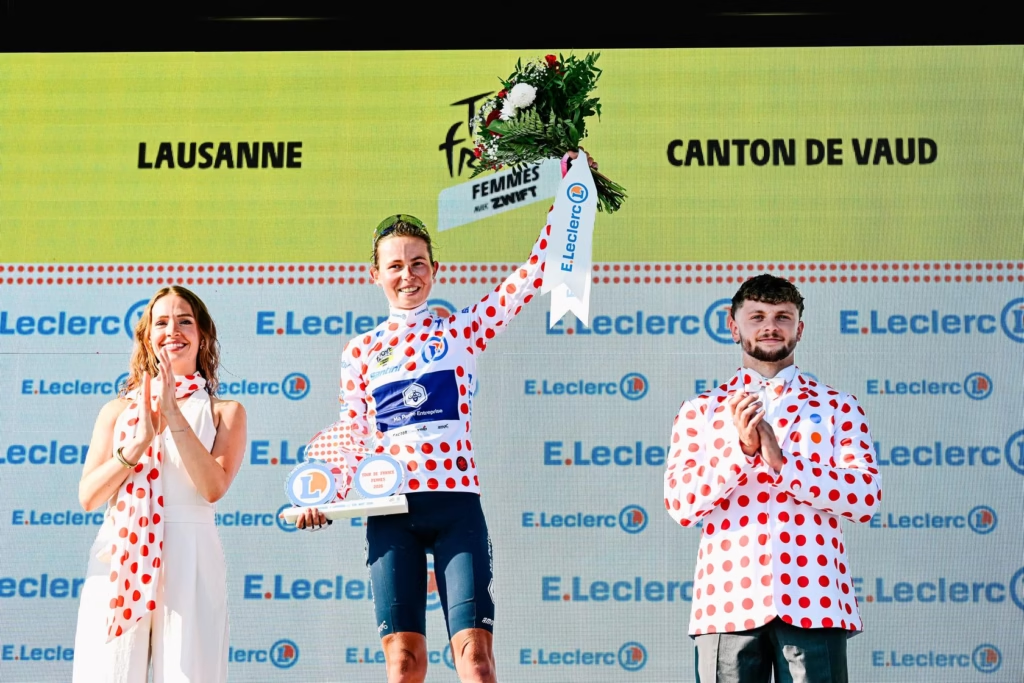 Photo Credit: A.S.O./Billy Ceusters
Océane Mahé arrives with Tour de France Femmes experience
Océane Mahé should provide one of the strongest immediate links with top-level professional road racing.
Mahé was the first rider signed by Ma Petite Entreprise when that French project was being assembled for 2026, and her first season there quickly moved her profile forward.
She won the Tour du Haut Limousin Féminin before making her Tour de France Femmes debut in August. Mahé then became one of the visible figures of the opening weekend in Lausanne by attacking and collecting enough mountains points to take the first polka-dot jersey of the race.
Her success gave Ma Petite Entreprise immediate exposure at its first Tour and left Mahé leading the mountains classification after Stage 1. She retained the jersey through Stage 2 before Puck Pieterse moved ahead once the race reached the Col de la Faucille.
That experience matters for Decathlon. Mahé will still only be 24 when the new team begins racing, but she has already experienced the demands and positioning of the Tour de France Femmes and should be capable of taking responsibility in races where many of her younger teammates are still learning.
Justine Baud underlines the French development focus
The recruitment of Justine Baud fits almost perfectly with the philosophy outlined at the team’s launch.
Baud is only 17 and is the reigning French junior road champion. Her 2026 campaign has also included strong performances in international junior races, providing Decathlon with one of France’s more interesting young prospects at precisely the point where she is preparing to move towards senior competition.
There is no need to rush that transition.
One of the major advantages of beginning at ProTeam rather than Women’s WorldTour level is the ability to construct a calendar around development. Baud can race smaller events, build experience in senior pelotons and gradually take on more demanding races rather than immediately being asked to survive the biggest Classics.
That route from French junior racing into an increasingly well-funded professional structure is exactly what Decathlon said it wanted to create when the project was unveiled.
Laura Molenaar adds proven stage-race ability
Laura Molenaar is another rider capable of providing results rather than simply development potential.
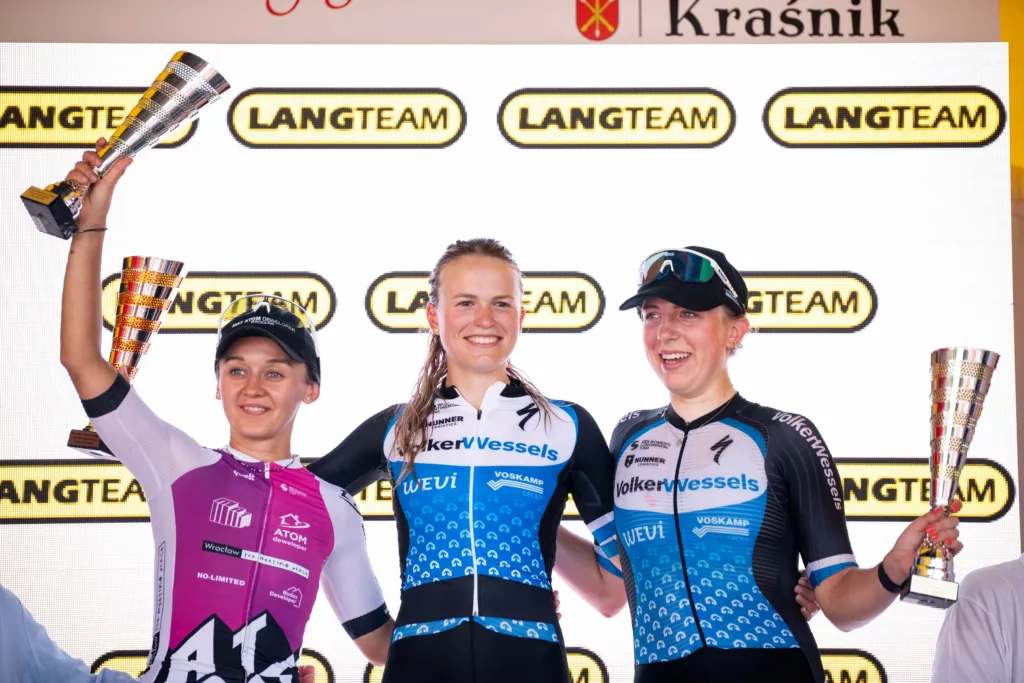
The Dutch rider won the revived Tour de Pologne Women in 2024 after taking her first professional victory with a solo attack on Stage 2, then successfully defended the yellow jersey on the final day.
That remains the biggest result of her career and demonstrates why she could be useful within the Decathlon project. Molenaar is not a pure sprinter or specialist climber, but she can perform on rolling terrain, race aggressively and handle short stage races where consistency matters.
Her 2026 Tour de France Femmes ended much earlier than she wanted. Molenaar was forced to abandon during Stage 2 after being unable to keep food down because of gastrointestinal problems, later explaining the circumstances behind her early Tour de France Femmes exit.
That should not obscure the amount of professional experience she brings. In a team containing riders moving directly from the junior ranks, Molenaar is one of those Decathlon can expect to handle a substantial calendar from the beginning.
Laly Pichon adds another French junior with international results
Laly Pichon provides another example.
The 18-year-old has produced a strong 2026 junior season, including victory at In Flanders Fields in Ypres after a race containing the Kemmelberg. She has combined road racing with cyclocross, making her another rider whose development has not followed a single-discipline pathway.
Pichon and Baud give the first Decathlon roster a particularly clear French core without making the team exclusively French.
That distinction is important. The organisation is working closely with the French Cycling Federation and naturally wants to improve the pathway available to domestic riders, but the first roster also reaches into Britain, Australia, Belgium, Spain, Estonia, the Netherlands, Italy and New Zealand.
The result looks less like a national development team and more like an international ProTeam with a particularly strong French talent pathway.
Zoe Roche becomes the British prospect in the project
Britain’s Zoe Roche is another rider arriving directly from the junior ranks.
Roche has combined road racing with cyclocross and mountain biking, fitting the multi-discipline profile Decathlon appear particularly interested in. Her road results have included fourth at the junior Piccolo Trofeo Alfredo Binda and a strong run of stage-race performances in Spain.
She won the opening stage of the Emakume Gazteen Itzulia and finished second overall, while also taking the points classification. That followed third overall at the Vuelta Cantabria Femenina, where she collected both the points and mountains competitions.
Roche also finished eighth at the junior cyclocross World Championships earlier in 2026.
At 18, none of those results should create expectations of immediately transferring into professional victories. They do, however, show the breadth Decathlon are recruiting for. Roche can climb, handle difficult one-day racing and already has substantial experience moving between disciplines.
Lidia Castro gives Decathlon a young climbing option
Lidia Castro de la Serna adds a different type of junior prospect.
The Spanish rider has been particularly effective on harder terrain, including victory on the Grand Colombier stage of the Valromey Tour Féminin. She also finished sixth overall at the Tour du Gévaudan Occitanie Femmes and won its mountains classification.
Castro followed that with third overall at the Emakume Gazteen Itzulia, finishing third on both road stages.
Those results make her one of the more obvious longer-term climbing projects within the group. There is a large difference between performing strongly on junior climbs and becoming competitive against elite professionals, but Decathlon do not need that transition to happen within one season.
If the team genuinely treats 2027 as year one of a longer WorldTour project, Castro is exactly the sort of rider who can be given several seasons to develop.

Laura Lizette Sander brings time-trial strength
Laura Lizette Sander provides another rider with considerably more senior experience than her age might suggest.
The 22-year-old Estonian has already raced across several professional and development structures and has repeatedly dominated her national championships. She is a multiple Estonian time trial champion and has also won the national road race title.
That makes her one of the most obvious riders in the initial group for races where Decathlon require reliability rather than long-term potential alone.
Sander has experience across Belgian one-day racing and international stage races, while her repeated time-trial success gives the roster another specialist strength that is not especially common among the younger recruits.
Lien Schampaert has already shown she can win senior races
Lien Schampaert sits somewhere between the junior prospects and more established professionals.
The Belgian is only 19 but has already spent 2026 competing regularly in senior racing with Keukens Redant Cycling Team. Her season included victory at GP Schellebelle, where she proved quickest from a reduced group after an attritional race over Belgian roads.
That combination of durability and finishing speed should make her particularly interesting for Decathlon’s Classics programme.
Schampaert is joined from Keukens Redant by Anna Dubier, giving the new team two riders already accustomed to racing together.
Anna Dubier continues her European development
Australian Anna Dubier is another 18-year-old making the transition into the new structure.
Dubier moved into the Belgian calendar with Keukens Redant for 2026 after previously racing with ARA | Skip Capital. Her results included eighth at GP Schellebelle alongside Schampaert and a solid series of finishes in Belgian one-day racing.
Those results are less immediately spectacular than some of the junior victories elsewhere on the roster, but the racing experience could prove just as valuable.
Learning to survive positioning battles, narrow roads and repeated accelerations in Belgium is useful preparation for a rider moving towards a professional Classics calendar. Decathlon can now add the performance support and coaching resources of its wider structure without Dubier having to learn European racing from scratch.
-
 Photo Credit: quentinphotographiebe
 -
 Photo Credit: Getty
Decathlon have resisted the temptation to buy an instant WorldTour team
The most revealing feature of these 11 names may be who is not there.
With the resources of Decathlon and CMA CGM behind the project, it would have been relatively straightforward to enter the transfer market for several established Women’s WorldTour leaders and attempt to create an immediately competitive team through spending power.
Instead, Decathlon have largely done what they said they would do when the women’s ProTeam project was announced.
Mahé and Molenaar provide useful professional road experience. Maxwell arrives with genuine elite credentials from mountain biking. Seiwald gives the group another senior international rider. Around them sits a large group of prospects who could look substantially different after two or three years inside a high-performance programme.
That creates risk because development is rarely linear, particularly when riders move from junior competition into the professional peloton. Some of these signings will progress more quickly than others.
It also gives Decathlon far greater upside than assembling a roster exclusively from established riders already close to their career ceilings.
The road towards the Women’s WorldTour begins in 2027
Decathlon CMA CGM will start at Women’s ProTeam level, placing the new squad directly below the Women’s WorldTour.
That means it will not automatically receive a place in every top-level race. Invitations, sporting results and the developing UCI qualification system will determine how much Women’s WorldTour racing the team can access during its first season.
The infrastructure behind it should nevertheless look considerably more like a WorldTour organisation than a conventional new second-tier team.
The women’s squad will operate within Decathlon’s NewGen structure at the Performance Centre in La Motte-Servolex, sharing expertise in coaching, nutrition, physical preparation, medical support and equipment development with the wider organisation. Van Rysel will supply the team’s bikes, while CMA CGM remains part of the title partnership.
The long-term objective is to reach the Women’s WorldTour rather than remain permanently at ProTeam level.
The first 11 riders reveal how Decathlon intend to get there. Rather than buying an established top-tier team, they are attempting to build one.
Maxwell gives the project immediate intrigue, Mahé and Molenaar provide road experience, and riders such as Baud, Roche, Pichon, Castro, Dubier and Schampaert give Decathlon a group whose best seasons may still be several years away.
One place remains if the original 12-rider plan is unchanged. The identity of that final signing could alter the balance slightly, particularly if Decathlon choose a more experienced road captain.
The overall direction is already unmistakable. Decathlon CMA CGM’s first women’s roster has been constructed around development, multi-discipline talent and what these riders could become by the time the team is ready to challenge for a place in the Women’s WorldTour.

