
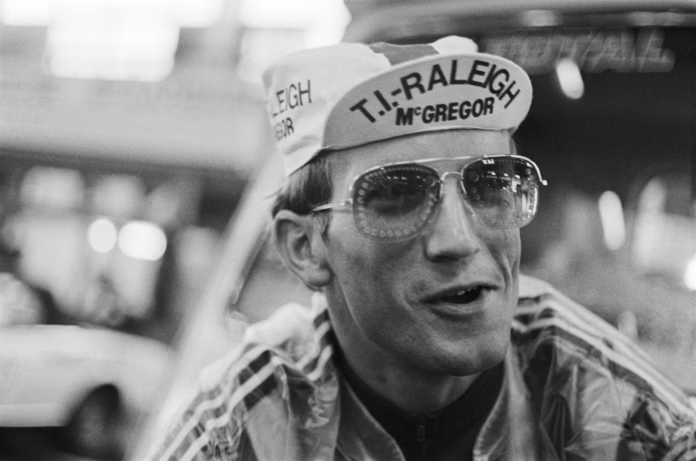
Jan Raas was never the rider who needed the road to become impossibly hard before he could take control of a race. His best territory was more subtle than that. Short climbs, exposed roads, a reduced group and a finish where positioning mattered as much as raw strength were enough for the Dutchman to turn a race in his favour.
That made Raas one of the defining one-day racers of the late 1970s and early 1980s. He won the 1979 world road race title, two editions of the Tour of Flanders, Paris-Roubaix, Milan-San Remo and a record five Amstel Gold Races. He also collected ten Tour de France stage wins and three Dutch road titles, a reminder that his range stretched well beyond a spring Classics campaign.
Yet his career is best understood through the way he raced. Raas was quick enough to win sprints, strong enough to survive difficult Classics and tactically sharp enough to make rivals race on his terms. In the strongest years of TI-Raleigh, he became one of the team’s central figures and one of the most feared riders in northern Europe.

From Zeeland to the professional peloton
Raas was born on 8 November 1952 in Heinkenszand, in the Dutch province of Zeeland. He did not come from one of cycling’s traditional mountain regions and his eventual strengths reflected the landscape and racing culture around him. He developed as a rider for fast, selective races rather than the long Alpine climbs that shaped Grand Tour contenders.
He turned professional with TI-Raleigh in 1975 under Peter Post. The early results were promising rather than spectacular, but by 1976 Raas had become Dutch road champion. He already had the finishing speed and racing intelligence that would define his career, although his relationship with Post was not always straightforward.
Raas left for Frisol in 1977, a move that immediately changed his standing in the sport. That spring he won Milan-San Remo and then Amstel Gold Race. The victories proved he was not simply a fast domestic rider waiting for opportunities. He could win the biggest one-day races in the calendar.
The race that became Amstel Gold Raas
No race is more closely associated with Raas than Amstel Gold Race. He won it in 1977, 1978, 1979, 1980 and 1982, a run so dominant that the race acquired the nickname “Amstel Gold Raas”.
The course suited him almost perfectly. Raas was not a pure climber, but repeated short climbs were different. He could absorb the accelerations, stay close to the front and still have the speed to finish the job. Just as importantly, he understood how to manage a race in which there were dozens of moments when positioning and judgement could matter.
His first win came in 1977, the same year as Milan-San Remo. In 1978 he went clear to beat Francesco Moser by more than a minute. A year later he won solo again during the season that would make him world champion. He then won in the rainbow jersey in 1980 before completing the record with a fifth victory in 1982.
That five-win record still defines his place in the history of the men’s Amstel Gold Race. It was not simply a case of one rider being stronger than everyone else for a few seasons. Raas understood the event so completely that rivals often had to shape their tactics around him.

Returning to TI-Raleigh and becoming the man to beat
Raas returned to TI-Raleigh for 1978 and became one of the most important riders in a team that specialised in imposing control on races. Post’s squad had the strength to dictate the peloton, but Raas gave that strength a ruthless finishing point.
The 1978 season included another Amstel Gold Race victory, Paris-Brussels, Paris-Tours and three stages of the Tour de France. It was a pattern that became familiar. Raas could spend the spring winning major Classics and then arrive at the Tour capable of winning flat or rolling stages against the fastest riders in the race.
He was not built to contest the Tour de France overall. Long mountain passes exposed the limits of a rider whose strengths were speed, power and short climbs. That did not reduce his impact on the race. Across his career he won ten Tour stages, with victories coming in 1977, 1978, 1979, 1980, 1982 and 1984.
1979: Flanders, the rainbow jersey and a career-defining season
The 1979 season was the clearest expression of what Raas could do at his peak. He won the Tour of Flanders, E3, Amstel Gold Race, a Tour de France stage and the overall classification of the Tour of the Netherlands. Then, in August, he won the world road race championship at Valkenburg.
A home World Championships suited Raas in more ways than one. The Limburg circuit demanded repeated changes of pace rather than sustained high-mountain climbing, and the finish gave him the chance to use his sprint after a hard race. The final was controversial, but the result stood: Raas beat Dietrich Thurau and became the successor to fellow Dutchman Gerrie Knetemann as world champion.
For a rider whose identity was so closely tied to Dutch cycling, winning the rainbow jersey in the Netherlands carried particular weight. Raas joined the list of champions in an era when the men’s road race was routinely won by riders who were already stars of the Classics. His name remains part of ProCyclingUK’s cycling world champions list.
A Classics palmares built across different kinds of races
Raas was often described as a Classics specialist, but even that label can hide how varied his major wins were. Milan-San Remo in 1977 demanded patience over nearly 300 kilometres. The Tour of Flanders required power on cobbled climbs. Paris-Roubaix demanded positioning, resilience and the ability to keep functioning deep into a brutal race.
His first Tour of Flanders victory came in 1979, and he won the race again in 1983. In between came victories in Gent-Wevelgem, Omloop Het Volk, E3 and Paris-Tours. Raas repeatedly found ways to win races that looked similar on a calendar but demanded different decisions on the road.
Paris-Roubaix was the major cobbled prize that took longer to arrive. Raas finally won it in 1982 after years of trying, using the strength of TI-Raleigh and his own finishing ability to add the race to an already exceptional palmares. His place in the history of men’s Paris-Roubaix is another reason his career cannot be reduced to Amstel Gold Race alone.

Why Raas was so difficult to race against
Raas did not need to attack from an impossible distance to dominate a race. His advantage was often that he could wait. If a rival attacked too early, TI-Raleigh could chase. If nobody attacked, Raas reached the final with one of the best sprints among the remaining riders. If the race split on a short climb, he was strong enough to be in the decisive group.
That created a tactical problem. Rivals knew they should not take him to the finish, but removing him before the finish was difficult. Raas could read hesitation quickly and had the authority within his teams to make the race bend around his own chances.
It also helps explain why he was so effective in an era when radio communication did not dictate every move. Raas was capable of making decisions for himself and understood the balance between conserving energy and taking control. His racing was rarely random, even when the final kilometres became chaotic.
The tension with Peter Post
The partnership between Raas and Peter Post helped create some of TI-Raleigh’s biggest victories, but it was never a simple one. Both were strong personalities and both expected to control the team around them.
By 1983 that tension had become increasingly visible. Raas was no longer simply a rider carrying out a team plan. He had become a leader with enough status to influence how teammates raced. The split eventually helped push him away from TI-Raleigh and towards the Kwantum project for 1984.
It is tempting to frame that as the decline of his career, but 1983 itself produced another major result. Raas won the Tour of Flanders for a second time and took another Dutch national title. He was still one of the most dangerous one-day racers in the peloton.

The crash that changed the final part of his career
Raas suffered a serious crash at Milan-San Remo in 1984. He returned to racing and still managed to win the Dutch road championship and a Tour de France stage later that year, but the accident marked a clear break in his career.
The ability to recover between races and absorb the training load became harder. For a rider whose success depended on arriving at one-day races with speed and sharpness, that mattered enormously. Raas retired midway through the 1985 season, still only 32.
Jan Raas career highlights
- World road race champion: 1979
- Tour of Flanders winner: 1979, 1983
- Paris-Roubaix winner: 1982
- Milan-San Remo winner: 1977
- Amstel Gold Race winner: 1977, 1978, 1979, 1980, 1982
- Gent-Wevelgem winner: 1981
- Paris-Tours winner: 1978, 1981
- E3 winner: 1979, 1980, 1981
- Dutch road champion: 1976, 1983, 1984
- Tour de France stage wins: 10
-
 Photo Credit: Canyon SRAM (supplied media release)
 -
 Photo Credit: Park Tool


From rider to one of Dutch cycling’s most influential managers
Retirement did not remove Raas from professional cycling. He moved almost immediately into team management with the squad that had begun as Kwantum, using many of the same qualities that had made him effective on the road: authority, tactical judgement and a clear idea of how a team should race.
The project changed sponsors repeatedly through Superconfex, Buckler, WordPerfect and Novell before becoming Rabobank in the mid-1990s. Raas moved into a managerial role and became one of the central figures in the Dutch team’s development.
That second career gives Raas an unusual place in Dutch cycling history. He did not simply win for one of the strongest teams of his generation. He later helped shape another organisation that became central to Dutch professional cycling, a story explored further in ProCyclingUK’s Rabobank men’s team history.
Why Jan Raas still stands out
Raas’s results alone put him among the great Classics riders. Four Monument victories, a world title, five Amstel Gold Races and ten Tour de France stages would be enough to make almost any career historically significant.
What separates him is the method behind those wins. Raas was a rider who understood when a race needed to be controlled, when it needed to be opened and when doing nothing was the most aggressive choice available. He did not rely on one spectacular physical quality. He combined enough speed, enough strength and a much deeper understanding of race situations than most of the riders around him.
That is why the five Amstel victories remain such a fitting symbol of his career. Raas found a race that rewarded judgement as much as power, learned every way it could be won, and then spent years making everyone else race it on his terms.

