Primož Roglič finally reached the stage he had been waiting for in Jerez, but Enric Mas did not give him the result he needed. The Vuelta a España leader produced one of the strongest time trials of his career on Stage 18, limiting his losses sufficiently to retain a substantial advantage as the race heads straight back into the mountains.
Roglič did enough to move ahead of Felix Gall, but the more important contest with Mas barely shifted compared with what Red Bull-Bora-hansgrohe required. The Slovenian was taking useful time through the first two intermediate checks, only for Mas to finish particularly strongly over the final 10 kilometres. The scenario discussed before the time trial, where Roglič might recover around 90 seconds and turn the final mountain weekend into a near-reset, never materialised.
That makes Friday’s 210.8km stage from Vélez-Málaga to Peñas Blancas much more demanding tactically for Roglič. He no longer has another time trial waiting further down the road. There are two mountain stages left before Sunday’s largely ceremonial finish in Granada, and Mas has already been the stronger climber on Alto de Aitana, Calar Alto and Sierra de La Pandera.
Stage 19 does not contain the brutal gradients awaiting the riders on Saturday, but its combination of distance, more than four hours of attritional terrain and a final 18.7km climb at 6.5% provides more than enough road for another serious GC test.
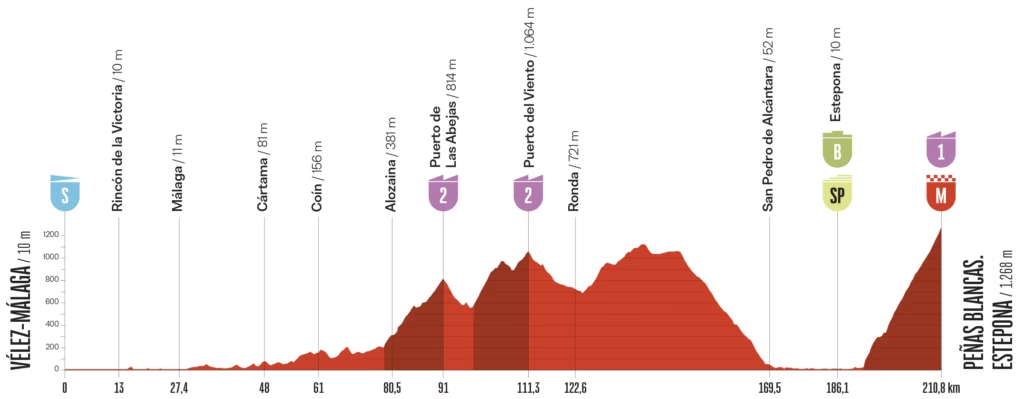
Vuelta a España Stage 19 at a glance
- Date: Friday 11 September 2026
- Start: Vélez-Málaga
- Finish: Peñas Blancas, Estepona
- Distance: 210.8km
- Stage type: Hilly with summit finish
- Neutralised start: 11:50 CEST / 10:50 BST
- Racing start: Around 12:06 CEST / 11:06 BST
- Expected finish: 17:14-17:47 CEST / 16:14-16:47 BST
- Puerto de las Abejas: 14.5km at 4.3%
- Puerto del Viento: 13.1km at 3.7%
- Peñas Blancas: 18.7km at 6.5%, category one
The wider Vuelta a España 2026 route has always made this sequence important. The long Jerez time trial is followed immediately by Peñas Blancas before Saturday’s much steeper finish at Collado del Alguacil. There is no easy stage separating the three major GC tests.
 Photo Credit: Getty
Stage 18 changed the order more than it changed the race
Roglič entered Thursday knowing simply gaining time on Mas was not enough. Our pre-stage analysis of how much time Roglič needed in Jerez identified something around 90 seconds as the result that would genuinely alter the final weekend. That would have put Mas close enough for one successful mountain attack to change the jersey.
Instead, Mas produced the sort of time trial Movistar had hoped would be sufficient rather than merely survivable. Roglič was quicker and moved ahead of Gall, but Mas remains firmly in command of the overall race heading towards terrain where he has repeatedly looked stronger.
That changes the burden on Roglič. Before Jerez, he could reasonably view the time trial as the place where his advantage over Mas would compensate for what had happened in the mountains. From Friday onwards, he has to create the difference in those mountains himself.
There is still enough terrain available to do it. Peñas Blancas is followed by a far harder Stage 20 containing two passages of El Purche, Puerto de El Duque and the final 8.3km at 9.8% to Collado del Alguacil. The issue is no longer opportunity. It is evidence. Nothing since Mas inherited red has suggested Roglič can simply ride away from him on a sustained climb.
Peñas Blancas is the first chance to change that.
The longest stage of the Vuelta is not simply a final-climb race
The 210.8km distance is important. Stage 19 is the longest day of the 2026 Vuelta and comes less than 24 hours after every GC rider completed a maximum individual effort against the clock.
The opening 70km largely follow easier roads west from Vélez-Málaga, initially tracing the Mediterranean coast through Rincón de la Victoria and Málaga before turning inland. That should produce a prolonged fight for the breakaway, particularly because almost every climber outside the general classification can see the obvious opportunity ahead.
The character changes markedly once the race approaches the Serranía de Ronda. Puerto de las Abejas begins after 76.4km and climbs for 14.5km at 4.3%, reaching its summit at kilometre 91. There is little respite afterwards before Puerto del Viento starts at 98.2km, adding another 13.1km at 3.7%.
Neither is difficult enough to trouble Mas, Roglič or Gall directly unless something unusual happens. Together they make the middle of the stage expensive. The bunch will spend a substantial period climbing before continuing through Ronda and over the uncategorised Puerto del Madroño, which takes the race above 1,000 metres again despite offering no mountains points.
Only after the long descent towards San Pedro de Alcántara does the race return to the coast. From there, approximately 40km remain, including the run through Estepona and the full ascent of Peñas Blancas.
A rider reaching the final climb after an easy day is one thing. Reaching it after 190km and several thousand metres of accumulated climbing, one day after a 32.1km time trial, is another.
Peñas Blancas is long enough to expose a bad day
The final climb rises for 18.7km at 6.5%, gaining 1,216 metres between Estepona and the finish at 1,268 metres.
Those numbers describe a sustained mountain climb rather than an exceptionally steep one. The road contains harder ramps, particularly lower down, but much of the ascent settles into gradients where the strongest GC riders can find a rhythm and where sitting on a wheel still offers some benefit.
That is important when considering how Roglič can attack Mas.
This is not the obvious place for one violent acceleration to create a minute. If Roglič wants to take significant time, Red Bull may need to increase the pressure much earlier and turn the climb into a sustained threshold contest. The alternative is to attack repeatedly on the steeper early sections and hope Mas finally shows a weakness that has been absent through most of this Vuelta.
For Mas, the climb is much easier to manage if Movistar retain numbers. Raúl García Pierna has already been crucial twice during the second half of the race, first at Calar Alto and again on Sierra de La Pandera, where his work helped maintain the pressure that eventually distanced Roglič.
A steady Peñas Blancas therefore favours the race leader. Roglič needs something less comfortable.
Mas has no reason to make the first move
The red jersey’s position is fundamentally different from every rider behind him.
Mas has already done the difficult part. He built his advantage on the climbs and then defended enough of it in the discipline where Roglič was supposed to be strongest. Friday does not require him to demonstrate superiority again simply because the stage finishes uphill.
If Roglič waits, Mas can wait.
If Gall attacks, Mas can decide whether the move threatens the jersey before responding.
If Carapaz goes, Movistar can judge the gap rather than immediately committing their leader.
That ability to race according to other people’s decisions is increasingly valuable this late in a Grand Tour. Roglič and Gall need time. Mas does not.
The one reason for Movistar to become more ambitious is if Roglič shows weakness. The Slovenian rode a full time trial on Thursday and has already been dropped by Mas on several mountain finishes. If the first kilometres of Peñas Blancas suggest those problems remain, increasing the pace could turn a comfortable advantage into an almost decisive one before Saturday.
Mas does not need to attack to win the Vuelta. That does not mean he should refuse a chance to finish it.
Roglič now needs to win on terrain that has favoured Mas
Before the time trial, the basic tactical split was clear. Mas had the mountains, Roglič had Jerez and Gall needed to survive Jerez before getting another chance uphill.
That equation has run out.
Roglič is now second overall, but simply protecting that position does little for a rider chasing a record fifth Vuelta victory. Peñas Blancas and Collado del Alguacil are the final places where he can realistically turn the race around.
The encouraging part is that Friday’s climb is different from La Pandera. Its gradients are more regular, the effort is longer and Roglič can potentially use his high sustained power rather than respond to repeated changes on double-digit ramps. At his best, that type of ascent has often suited him.
The less encouraging evidence comes from the previous two weeks. Mas beat him on Aitana, rode away again on Calar Alto and then gained another 25 seconds when Roglič cracked late on La Pandera. Jerez was supposed to provide the counterweight to those losses, yet Mas was far stronger against the clock than historical comparisons had suggested.
Roglič does not necessarily have to take all the required time on Friday. Saturday is a more severe stage and provides greater scope for large gaps. He does need to discover whether Mas can actually be put into difficulty.
Another climb where Mas follows everything comfortably would narrow the possible routes to victory dramatically.
Felix Gall can stop thinking about the time trial
Gall’s position is almost the reverse.
Thursday was the stage he had to endure. Friday and Saturday are the stages for which he endured it.
The Decathlon CMA CGM rider had climbed ahead of Roglič before Jerez after distancing him on La Pandera, only to surrender second place against the clock. That was always likely. Gall’s challenge now is deciding whether the deficit he carries into Peñas Blancas is small enough to attack immediately or whether Saturday offers a better opportunity.
His performances suggest waiting too long would be a mistake.
Gall repeatedly attacked on Aitana and Calar Alto before finally making one stick relative to Roglič on La Pandera. He has looked more comfortable when the pace becomes uneven and the race starts shedding riders through repeated climbing efforts.
Peñas Blancas is not an ideal Gall climb because the long stretches around six per cent make drafting more valuable. Decathlon can change that by making the approach difficult and attacking before the strongest riders settle into a rhythm.
The two category-two climbs in the middle of the stage may be too far from the finish for a serious GC move, but they provide an opportunity to make the day harder. If Gall wants Peñas Blancas to become a test of recovery rather than simply fresh climbing power, Decathlon have a reason to keep the stage active long before Estepona.
Richard Carapaz has won here before and now needs to race forward
Richard Carapaz knows exactly what it feels like to win on Peñas Blancas.
The Ecuadorian took the previous Vuelta finish here in 2022, attacking from the breakaway and holding off Wilco Kelderman. The GC riders arrived more than seven minutes later, with Remco Evenepoel, Mas, Roglič and Juan Ayuso all recording the same time.
That history offers two different lessons for Friday. Peñas Blancas is perfectly capable of rewarding a strong breakaway, but it does not automatically create differences between evenly matched GC riders.
Carapaz cannot rely on the latter happening again.
His own Vuelta now needs aggression. The Jerez time trial was never likely to move him directly into the podium places, and the remaining mountain stages are his opportunity to turn a solid GC position into something more significant.
EF Education-EasyPost have little reason to ride conservatively. Carapaz is one of the most natural attacking Grand Tour riders in the field, and the final two days offer the sort of terrain where tactical ambition is more useful than defending fourth place.
An early move on Peñas Blancas could also complicate the race for everyone above him. Roglič cannot spend too long allowing Carapaz to ride towards his position, while Gall may see an ally rather than an immediate rival if the Ecuadorian accelerates.
That is the sort of uncertainty Mas would rather avoid.
 Photo Credit: Getty
Oscar Onley has an important white jersey test
Oscar Onley came through the time trial with his white jersey ambitions still intact and now returns to the terrain that has underpinned his excellent Vuelta.
The Netcompany INEOS rider has not quite matched Mas, Gall and Roglič on the hardest mountain finishes, but he has consistently occupied the next level. His second place behind Mas on Alto de Aitana remains one of the strongest performances of his race, and a long, regular climb should give him a better chance of managing his effort than some of the steeper finishes.
The threat is accumulated fatigue rather than the gradient itself. Stage 19 comes after more than 60 hours of racing, repeated extreme heat and an all-out time trial. Young riders can improve through a Grand Tour, but they can also reach a point where three weeks of work suddenly becomes visible.
Jakob Omrzel remains close enough in the young rider contest that Onley cannot simply ride Peñas Blancas as an isolated stage. Every gap matters, particularly with Saturday still to come.
Netcompany INEOS therefore have good reason to protect Onley deep into the final climb rather than chase the stage.
The breakaway should have a serious chance
The general classification is important enough to guarantee a hard final climb but not necessarily enough to bring the breakaway back.
Movistar’s priority is defending Mas. Spending riders for 150km to deliver him a stage victory would achieve very little compared with keeping support around him for Peñas Blancas. Red Bull have an even stronger reason to save energy because any serious Roglič attack will require help controlling the final climb.
That leaves a large group of riders with realistic stage ambitions.
The first half of Stage 19 is particularly favourable to a strong break forming. There is enough easier terrain for a substantial group to establish itself, followed by enough climbing for the best riders in that group to reduce the numbers before Peñas Blancas.
The key question will be composition. A group of six containing several mediocre climbers is unlikely to survive. A break of 15 or 20 with riders such as Santiago Buitrago, Sepp Kuss, Marco Brenner, João Almeida or Valentin Paret-Peintre becomes much more difficult to control.
Nobody close enough to threaten the top 10 will receive unlimited freedom, but there are plenty of proven climbers far enough down the standings for Movistar to let the road decide the stage.
Santiago Buitrago can combine the stage with his mountains jersey
Santiago Buitrago is one of the most obvious riders to try.
The Bahrain Victorious rider already leads the mountains classification and has spent much of the race deliberately seeking the breaks that contain the largest points. Friday provides category-two points on Puerto de las Abejas and Puerto del Viento before the category-one finish at Peñas Blancas.
That creates an unusually clean tactical incentive. Buitrago does not have to choose between the classification and the stage. The same move serves both.
His performance on La Pandera also showed that he still has the climbing legs required deep into the third week. Buitrago was the rider who came closest to denying Marco Brenner, with the two separating themselves from the remnants of the break before the German edged the finish.
The difficulty may come before the first climb. Riders still interested in the polka-dot jersey know that allowing Buitrago into a strong move could effectively settle the competition, which could make the opening 90km harder than the profile suggests.
If he gets clear, he is one of the strongest candidates to finish it.
Marco Brenner has already proved this approach can work
Brenner enters Stage 19 without the pressure that existed before La Pandera.
His Stage 14 victory delivered Tudor Pro Cycling Team their first Grand Tour stage win and showed that the German is getting stronger rather than simply surviving the third week.
The circumstances of that victory are relevant again. Brenner made a large break, survived a demanding day and still had enough to respond when Buitrago appeared stronger on the steepest part of the final climb.
Peñas Blancas is longer but less explosive. That could suit Brenner if he starts with several minutes in hand, particularly because the GC teams may prefer a steady final climb rather than immediately chasing stage honours.
Winning twice from mountain breaks in the same Vuelta is difficult. Brenner has already demonstrated that the form is there to make trying worthwhile.
Sepp Kuss is made for Peñas Blancas if Visma give him freedom
Sepp Kuss remains another obvious breakaway threat.
His general classification ambitions disappeared earlier in the race, which has progressively given Visma | Lease a Bike more freedom to use him as a stage hunter. The American already converted that opportunity into victory on Calar Alto and Peñas Blancas suits him for many of the same reasons.
The final climb rewards a rider capable of maintaining a strong pace for a long period without needing a sharp sprint. Kuss can climb seated, control his effort and continue producing power when the race becomes attritional.
Visma also have little obligation to help the GC teams. Their Vuelta has already been extraordinarily successful through Matthew Brennan and Wout van Aert, leaving Kuss free to target another mountain stage without compromising a larger objective.
The only potential restriction is his remaining position in the overall standings. Movistar will decide quickly how much time they are comfortable giving him, but with Mas holding a large enough advantage, the calculation should be manageable.
João Almeida has a rare opportunity to race without GC responsibility
João Almeida’s Vuelta bears little resemblance to the race expected when UAE Team Emirates-XRG arrived in Monaco.
Illness affected his preparation and his own GC challenge never properly developed, while Tadej Pogačar’s Stage 8 crash removed the team’s central objective entirely. Almeida therefore reaches the final mountain weekend with unusual freedom.
Peñas Blancas is an excellent climb for him.
Few riders are more comfortable with a long, regular ascent where the pace can be sustained for close to an hour. Almeida’s familiar habit of appearing distanced before riding his way back through a group is much less costly on a climb without repeated vicious changes in gradient.
The question is whether there is enough form left to exploit that suitability.
His time trial in Jerez suggested his condition has improved as the race has progressed. If that reflects a wider third-week improvement rather than one strong day against the clock, he becomes one of the best possible riders to place into Friday’s escape.
UAE have no reason to stop him trying.
Mikel Landa and Valentin Paret-Peintre fit a day for climbers outside GC
Mikel Landa is another rider for whom the overall classification no longer dictates the race.
A long Spanish summit finish naturally puts him into consideration, and Soudal Quick-Step can use either Landa or Valentin Paret-Peintre to give themselves representation in a strong break rather than waiting for the GC favourites to decide the stage.
Paret-Peintre may actually have the easier route. His ability to win from mountain escapes is well established, and he can afford to spend more energy fighting for position during the opening half of the stage.
Landa remains capable of climbing with a stronger group, but the amount of energy required to make the break may determine whether he is still able to compete once Peñas Blancas begins.
Other names with similar ambitions include Tobias Halland Johannessen, Jarno Widar, Lorenzo Fortunato, Clément Berthet and Harold Tejada. The field contains enough quality outside the immediate GC battle that a breakaway victory should be treated as the most likely outcome rather than an alternative scenario.
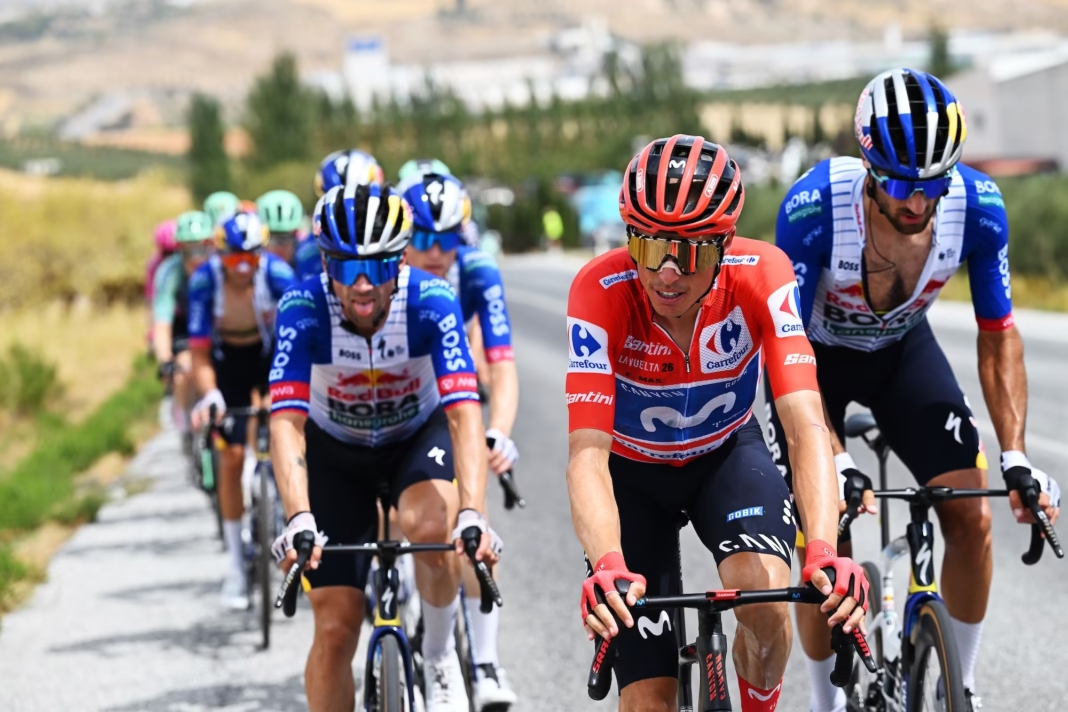
Stage 19 could become a waiting game between Roglič and Mas
For all the climbing, the most interesting tactical question may be whether Roglič attacks at all.
There is a strong argument for trying. He needs time and only two genuine opportunities remain. Waiting until Saturday places everything on one stage and allows Mas to arrive there without having been properly tested since Jerez.
There is also an argument for restraint. Collado del Alguacil is steeper and much more naturally selective. Spending heavily on Peñas Blancas only to discover that Mas can follow could leave Roglič weaker for the stage where the largest gaps are possible.
Mas knows that calculation works in his favour.
Movistar can set a controlled pace and effectively ask Roglič how badly he wants to change the race. If he attacks, Mas responds. If he does not, another mountain stage disappears from the calendar with the red jersey still securely on Spanish shoulders.
Gall and Carapaz are the riders most capable of disrupting that stalemate. Neither benefits from a procession behind Movistar. If one attacks early enough, Roglič may be forced to react even if his original plan was to wait.
That possibility is what gives Peñas Blancas its tactical edge.
Vuelta a España Stage 19 prediction
The stage win should favour the breakaway. Movistar have no reason to spend the day controlling for Mas, while Red Bull-Bora-hansgrohe need as many riders as possible available when Roglič reaches the final climb. A large escape containing several accomplished climbers could be given enough room to contest the victory independently of the GC battle.
Santiago Buitrago is the narrow pick. He has a clear reason to join the break because of the mountains competition, has already shown strong third-week climbing form and came within a second of winning on La Pandera. Sepp Kuss, João Almeida, Marco Brenner, Valentin Paret-Peintre and Mikel Landa are among the strongest alternatives.
Behind them, Friday is more important for what Roglič can discover about Mas than for any expectation that the Vuelta must be decided immediately.
Jerez was supposed to pull Roglič substantially closer. Mas prevented that. The state of the race before the final week was built around the idea that Mas had to accumulate enough time in the mountains to survive Roglič’s time trial. He has now done exactly that.
Peñas Blancas changes the question.
Roglič no longer needs to find out how much time he can take from Mas against the clock. He needs to find out whether he can take any meaningful time from him uphill.