
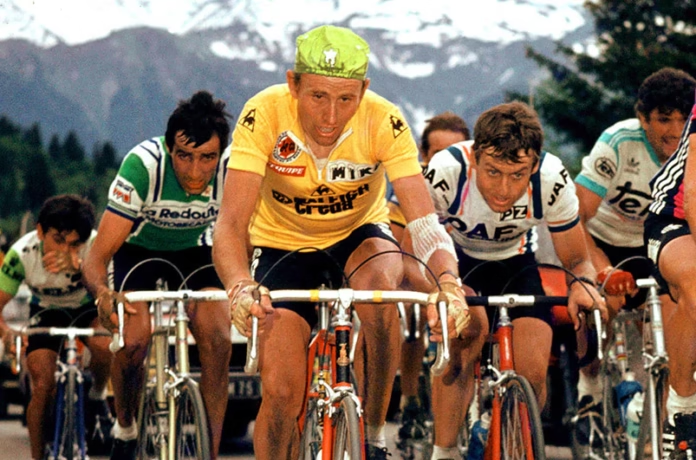
Joop Zoetemelk is still too often introduced through the races he did not win. Six second places at the Tour de France became the shorthand for an extraordinary career, turning one of the most durable and complete riders of his generation into the man who was always there behind somebody else. It is an easy story to tell, but it badly undersells a rider who won the Tour de France, Vuelta a España and world road race while remaining a major presence in the professional peloton for almost two decades.
Zoetemelk’s longevity is central to understanding him. He arrived at the Tour while Eddy Merckx was still at his most dominant, eventually beat Bernard Hinault to win the race in 1980 and became world champion in 1985 at the age of 38. Between those landmarks came Paris-Nice victories, major one-day wins, repeated Grand Tour podiums and a consistency that made him almost impossible to remove from the front of the sport.
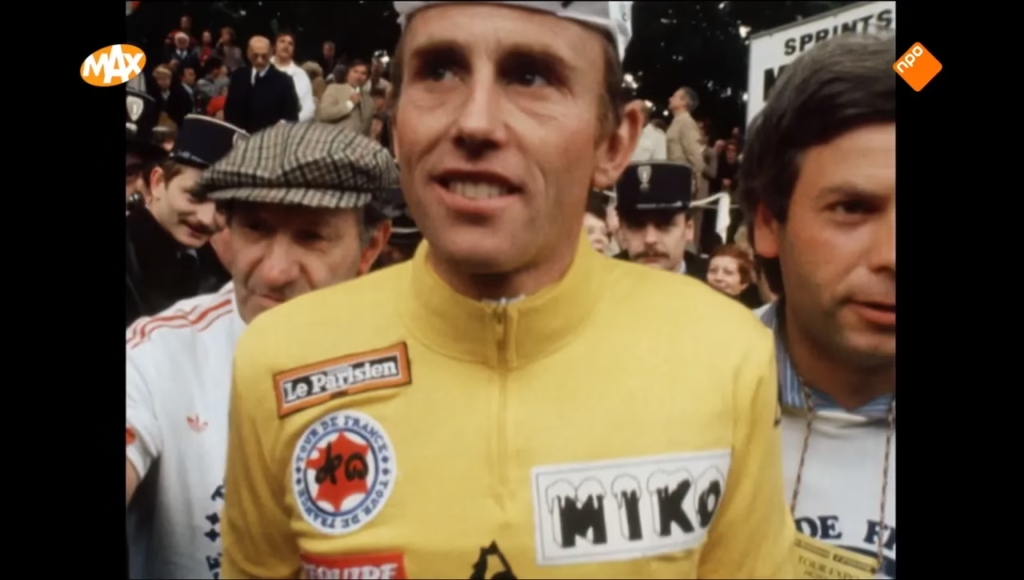
From Olympic champion to Merckx’s Tour de France rival
Born in Rijpwetering in the Netherlands in December 1946, Zoetemelk reached professional cycling with an Olympic gold medal already on his record. He had been part of the Dutch quartet that won the 100km team time trial at the 1968 Mexico City Games, a discipline that rewarded precisely the qualities that would define his road career: a large aerobic engine, controlled pacing and the ability to keep producing power long after others began to fade.
He turned professional with Mars-Flandria in 1970 and finished second in the Tour de France at his first attempt. The rider ahead of him was Merckx, already the dominant figure in the sport. Zoetemelk returned in 1971 and finished second again, another result that later fed the image of him as cycling’s perennial runner-up but which, in its proper context, showed how quickly he had established himself among the best stage racers in the world.
Those early Tours coincided with one of the hardest periods in which to build a Grand Tour palmarès. Merckx did not merely win. He collected stages, classifications and one-day races with a frequency that restricted the opportunities available to an entire generation. Zoetemelk nevertheless became one of the riders capable of making the Tour difficult for him. The 1971 race, including the famous day when Luis Ocaña attacked at Orcières-Merlette, demonstrated that Merckx could be put under pressure even if the final victory remained his.
Zoetemelk’s own path was less spectacular but remarkably persistent. He was not a pure climber, pure time triallist or explosive attacker. His strength was that he could do almost everything well enough to remain in contention over three weeks. He limited losses in the mountains, rode strongly against the clock and recovered consistently. In an era when one bad day could cost enormous amounts of time, simply remaining competitive deep into the Tour was a major weapon.
A career interrupted just as he was reaching his prime
The neat sequence of Tour results hides how close Zoetemelk came to losing his career. In 1974 he crashed heavily during the Midi Libre after colliding with a car. The injuries were severe enough to keep him out of the Tour and placed his future in doubt. He returned to racing in 1975 and was soon back among the leading Grand Tour riders, a recovery that says as much about his durability as the statistics from the later part of his career.
By then the Merckx era was beginning to loosen its grip and the Tour had become more open. Zoetemelk continued collecting high overall finishes, but his reputation as the rider who could not quite finish the job hardened. Second place in 1976 behind Lucien Van Impe and another runner-up finish in 1978 behind Bernard Hinault made the pattern impossible to ignore. The label was understandable, although it treated repeated Tour podiums as evidence of weakness rather than proof of exceptional consistency.
There was already a Grand Tour victory on his record by then. Zoetemelk won the 1979 Vuelta a España, taking the overall title ahead of Francisco Galdós. The victory matters when assessing the familiar claim that he lacked the instinct to win a three-week race. He had already done it before his Tour breakthrough, and he had done so after nearly a decade of racing at the highest level.
His wider stage-racing record was similarly strong. Zoetemelk won Paris-Nice three times and remained effective across races that demanded a combination of climbing, time trialling and consistency. These were not consolation prizes around the edges of a Tour-focused career. They were evidence that the qualities keeping him near the Tour podium year after year translated into victories whenever the balance of the race moved slightly in his favour.
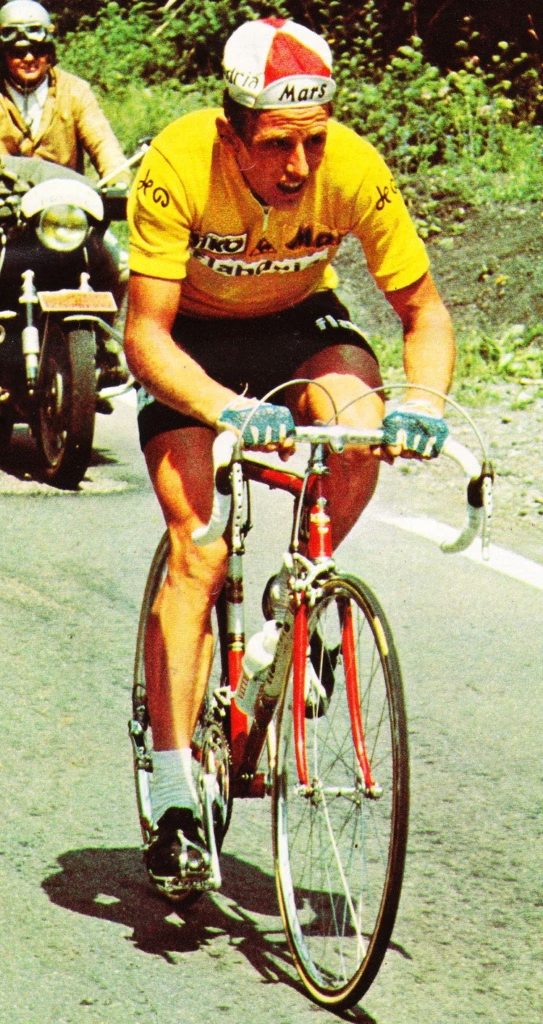
The 1980 Tour finally changed the story
Zoetemelk began the 1980 Tour at 33, an age at which the chance of finally winning could reasonably have been considered to be disappearing. He was riding for TI-Raleigh, the Dutch team managed by Peter Post, and the defending champion was Hinault. The Frenchman had won in 1978 and 1979 and appeared capable of controlling the Tour for years.
The race changed when Hinault, suffering from knee trouble, withdrew while wearing the yellow jersey. That fact has always complicated the way Zoetemelk’s victory is discussed. It is true that he did not have to defeat a healthy Hinault all the way to Paris, but Grand Tours are won by the rider who survives the entire race. Zoetemelk had spent a decade doing exactly that, and when the opportunity arrived he was strong enough to take it.
TI-Raleigh gave him a formidable structure. The team was one of the most organised forces in the peloton and won stages at an extraordinary rate during the 1980 Tour. Zoetemelk provided the general classification objective around which that collective strength could be used. Once in yellow, he defended the lead and reached Paris as Tour champion, ending the sequence of second places that had followed him through the 1970s.
His name therefore belongs on the complete list of Tour de France winners, but the victory becomes more impressive rather than less when viewed against the previous decade. Zoetemelk had finished second to different champions, survived a career-threatening crash and remained competitive long enough to capitalise when the race finally opened. Patience was not a passive trait in his career. It was one of his competitive advantages.
Why six second places distort his Tour record
The six runner-up finishes are extraordinary in their own right. Zoetemelk was second in 1970, 1971, 1976, 1978, 1979 and 1982, spanning the Merckx and Hinault eras. That is not the record of a rider who repeatedly arrived at one short peak and missed his chance. It is the record of somebody who remained close enough to win while the identity of the dominant champion changed around him.
His 1979 second place is a good example. Hinault was the rising power of the Tour and Zoetemelk was already in his thirties, yet the Dutchman remained his principal general classification rival. Three years later he was second again, by which point Hinault had developed into the defining Grand Tour rider of the period. Zoetemelk’s career therefore overlaps two different generations of dominance without being neatly contained by either.
The numbers also reflect a different attitude to racing schedules. Leading riders contested far more days and a broader range of events than many modern Grand Tour specialists. Zoetemelk’s Tour consistency sat alongside victories in races such as Paris-Tours and the Amstel Gold Race. He did not build an entire season around arriving at one event with every variable controlled.
That breadth makes the runner-up label particularly misleading. A rider capable of winning Grand Tours, week-long stage races and major one-day events should not be reduced to the fact that Merckx and Hinault beat him at the Tour. His defeats are memorable because he was good enough to be present at the decisive end of the race so often.
The world title at 38 completed the picture
If the 1980 Tour corrected one misunderstanding about Zoetemelk, the 1985 World Championships corrected another. By then he was 38 and well beyond the age at which most riders were expected to win the biggest one-day races. In Giavera del Montello, Italy, he attacked late and stayed clear to become world road champion.
The victory was perfectly suited to the second half of his career. Younger and more explosive riders had to account for a veteran whose experience allowed him to recognise the right moment and whose endurance remained good enough to make the move count. He did not need to be the fastest rider in the race when he could arrange not to sprint against them.
He continued racing after the world title and won the Amstel Gold Race in 1987, aged 40. By then the peloton he had entered alongside the Merckx generation had been transformed. Hinault had retired, new Dutch stars had emerged and professional cycling had moved into another era, yet Zoetemelk was still capable of winning one of his country’s biggest races.
-
 Photo Credit: Canyon SRAM (supplied media release)
 -
 Photo Credit: Park Tool


Zoetemelk’s real legacy is durability without mediocrity
Longevity can sometimes inflate a career record by allowing a rider to accumulate respectable results without remaining genuinely elite. That is not what happened with Zoetemelk. His career stretched from an Olympic title in 1968 to major professional victories deep into the 1980s, with the Tour win and world title arriving twelve and seventeen years after that Olympic success respectively.
He also occupied an unusual place in Dutch cycling history. The Netherlands has produced outstanding Classics riders, sprinters and time triallists, but Tour de France victory has remained rare. Zoetemelk’s 1980 win made him the country’s second Tour champion after Jan Janssen, and for decades he remained its most recent one. His world title added another layer to a record that was already far broader than his reputation as a Grand Tour nearly-man suggested.
The fairest way to read his career is therefore to reverse the familiar argument. Zoetemelk did not finish second at the Tour six times because he lacked the quality to win it. He finished second six times because he possessed the quality to remain a Tour contender across the reigns of some of cycling’s greatest champions. The fact that he eventually won in Paris, then became world champion five years later, turns persistence from a footnote into the defining strength of the career.

