
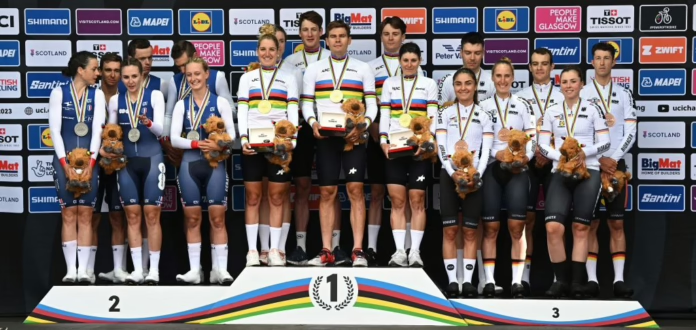
The mixed relay team time trial is one of the least familiar events at the UCI Road World Championships, but it has become one of the closest and most tactically interesting rainbow jersey races of Worlds week.
Six riders represent each nation: three men and three women. The men complete the opening half of the course before handing the race over to the women’s trio, with the final result decided by the combined time.
At Montréal 2026, the mixed relay takes place on Tuesday 22 September over 40.6km with 290 metres of climbing. Both halves use the same short Montréal time trial circuit, making it a very different challenge from the 39.2km individual time trials raced two days earlier.
Australia arrive as two-time defending champions, but the team that won in Kigali last September cannot simply be repeated. Jay Vine is absent through illness, Brodie Chapman declined selection for personal reasons and Luke Plapp is not part of the Montréal squad. That removes three riders from the six who won the 2025 title.
France have already named a formidable and balanced relay team, Italy have committed Filippo Ganna and Vittoria Guazzini to a powerful six, while Switzerland retain much of the group that won consecutive titles in 2022 and 2023.
For an overview of every event taking place during the week, the beginner’s guide to the 2026 UCI Road World Championships covers all 13 rainbow jersey races in Montréal.

World Championships 2026 mixed relay details
| Detail | Mixed relay team time trial |
|---|---|
| Date | Tuesday 22 September 2026 |
| Start | Avenue du Parc, Montréal |
| Finish | Parc Jeanne-Mance, Montréal |
| Start time | 08:30 EDT / 13:30 BST |
| Expected finish | Around 11:15 EDT / 16:15 BST |
| Distance | 40.6km |
| Climbing | 290 metres |
| Riders per nation | 3 men + 3 women |
| Men’s section | Approximately 20.3km |
| Women’s section | Approximately 20.3km |
| Defending champions | Australia |
The event opens Tuesday’s racing before the junior individual time trials later in the day.
UK television and streaming details for the mixed relay and every other event are included in the World Championships TV and live-stream guide.
How does the mixed relay work?
Each country selects three men and three women from its eligible elite and under-23 riders.
The men’s trio starts first.
They race together as a conventional team time trial, rotating through the wind and using one another’s slipstream rather than riding three separate efforts against the clock.
Once the men’s section is completed, the women’s trio is released onto the course.
There is no reset of the clock between the two groups. The women’s time is added directly onto whatever the men have already produced, so the entire nation effectively completes one continuous 40.6km relay.
The fastest combined time wins.
All six riders from the winning nation become world champions.
Why is the second rider so important?
A mixed relay does not require all three riders in each group to finish together.
The important rider is the second one.
The men’s relay time is taken when the second man reaches the changeover. The nation’s final time is then recorded when the second woman crosses the finish.
That means one rider from each trio can be dropped.
It also creates the most interesting tactical element of the race.
A team can use one rider extremely aggressively before allowing them to fall away, provided the remaining pair stay together.
That sounds straightforward, but the timing is difficult.
Drop the third rider too early and the final pair lose a valuable source of drafting and pacing. Keep somebody beyond the point where they can contribute properly and the two stronger riders may spend kilometres waiting rather than riding at their optimal speed.
The best teams usually remain as a trio for most of the course before deciding whether one rider should completely empty themselves near the end.
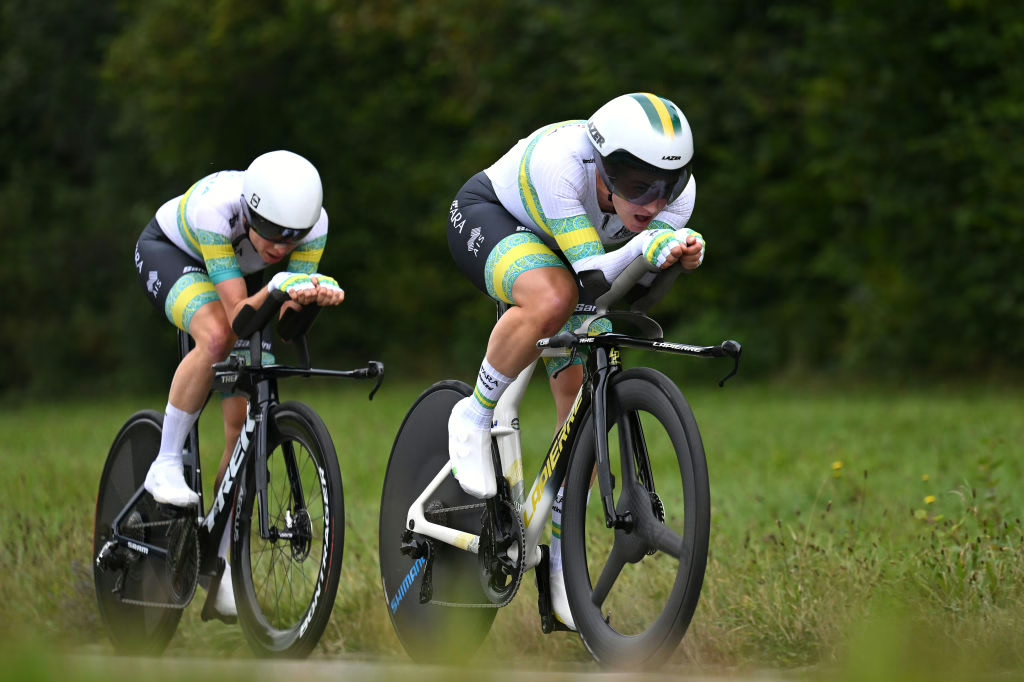
Why is team time trialling different from an individual TT?
Six brilliant individual time triallists do not automatically make the best mixed relay team.
A good team time trial depends on rhythm.
The rider on the front works hardest while the other two benefit from the draft. After completing a turn, the leader moves aside, drops to the back and recovers before eventually returning to the front.
Those changes need to be smooth.
A rider who accelerates several kilometres per hour every time they hit the front can make the team slower rather than faster. The riders behind repeatedly have to close small gaps, burning energy that could have been saved for later.
There is also a difference in how long each rider should lead.
The biggest engine in the group might take much longer turns than the third rider. Somebody technically excellent through corners can take greater responsibility on twisting sections. A lighter rider may be saved for a late rise rather than repeatedly exposed on fast open roads.
This is why track pursuit experience can be so valuable. Riders accustomed to high-speed team pursuiting already understand how to hold a wheel closely, change position without disrupting the group and distribute effort between teammates.
The Montréal mixed relay route
The mixed relay starts on Avenue du Parc and finishes alongside Parc Jeanne-Mance, using the shorter time trial circuit rather than the Mount Royal roads which dominate the road races later in the week.
The official total is 40.6km with 290 metres of climbing, with the men and women each completing essentially the same 20km circuit.
The route moves away from Avenue du Parc through Montréal before heading towards the river and the Pont de la Concorde area. It passes roads around Old Montréal, Avenue Pierre-Dupuy and Parc Jean-Drapeau before returning towards the city.
The profile is rolling rather than flat.
Each half contains around 145 metres of elevation, enough to interrupt the rhythm without turning the event into a climbing time trial.
The full 2026 World Championships course guide looks at how the relay fits alongside the longer individual time trial routes and the much hillier road race circuit.
The course rewards balance rather than one outstanding rider
The relatively short distance encourages aggressive pacing.
Around 20km is long enough for a poorly organised trio to unravel but short enough for a rider with a huge engine to take unusually long turns.
That could favour Italy with Ganna.
It should suit Switzerland with Reusser and Küng.
It also gives Australia reason to consider Conor Leahy, whose Olympic team pursuit background is almost tailor-made for this format.
But none of those riders can win the relay alone.
A national team gains little from having the fastest men’s trio if its women immediately lose the entire advantage. Likewise, three exceptional women can only recover so much if they begin their section half a minute behind.
The strongest relay is usually the nation with the smallest weakness across all six riders.
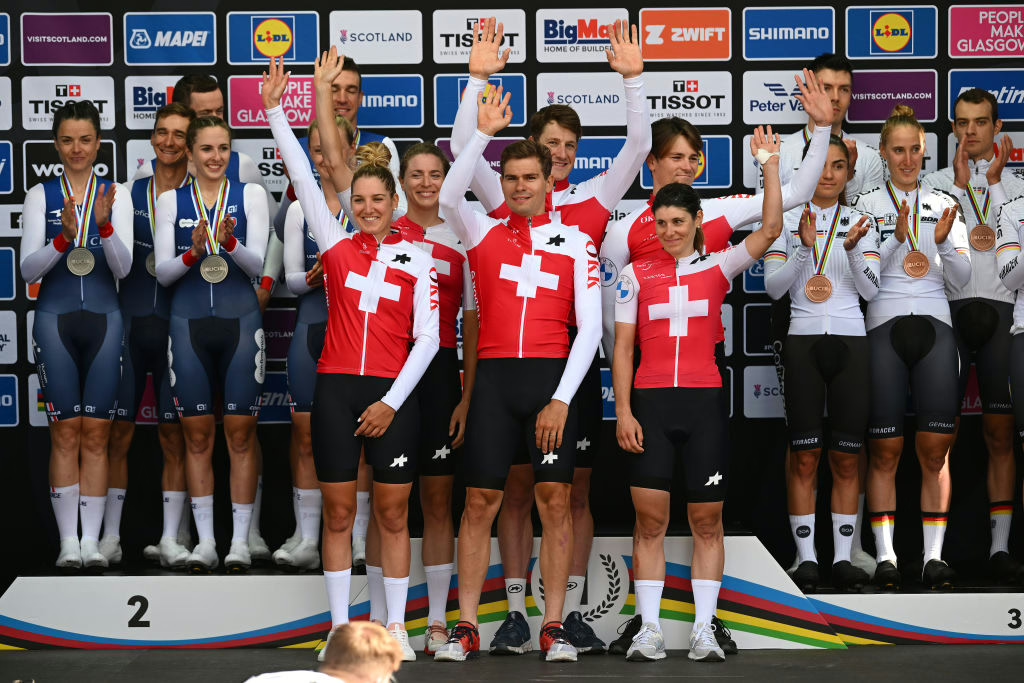
Previous mixed relay world champions
The mixed relay is still a relatively young World Championships event.
It was introduced in 2019 to replace the trade-team team time trial which had previously appeared on the Worlds programme.
| Year | World champion |
|---|---|
| 2019 | Netherlands |
| 2020 | No event |
| 2021 | Germany |
| 2022 | Switzerland |
| 2023 | Switzerland |
| 2024 | Australia |
| 2025 | Australia |
No nation has won three consecutive mixed relay world titles.
Australia can become the first in Montréal.
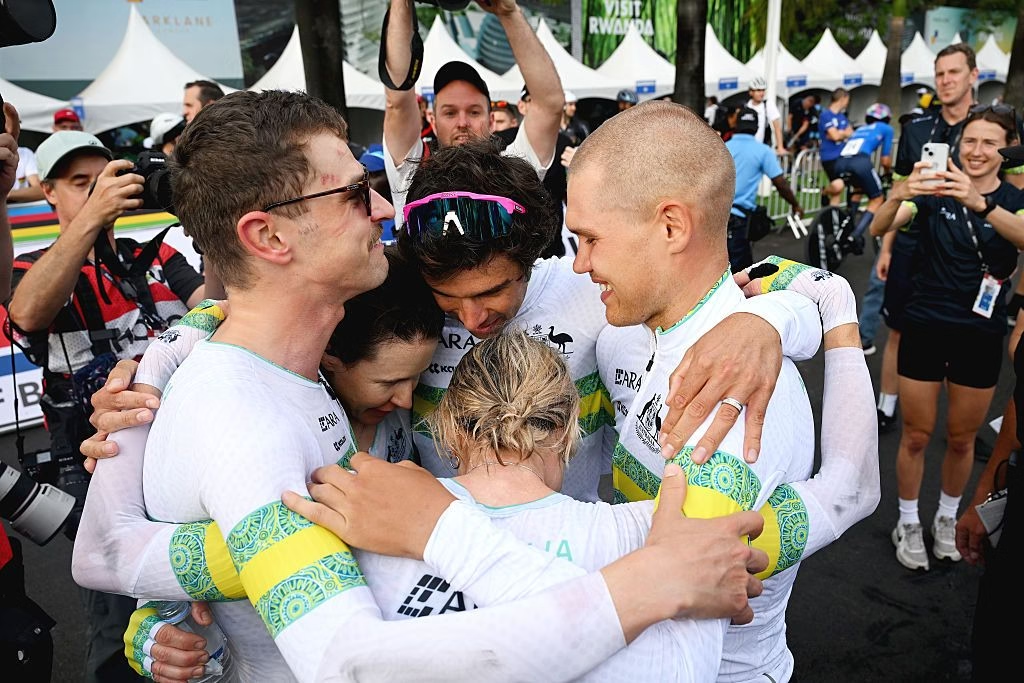
Australia are defending champions with a very different team
Australia have owned the event for the last two seasons.
Their first victory came in Zürich in 2024, when Michael Matthews, Jay Vine and Ben O’Connor combined with Grace Brown, Brodie Chapman and Ruby Roseman-Gannon.
The winning margin over Germany was only 0.85 seconds.
The 2024 Australian mixed relay victory showed how fine the margins can be when both halves of the team are evenly matched.
Australia changed the line-up substantially in Kigali last year and still defended the title.
Matthews, Luke Plapp and Vine produced the men’s effort before Chapman, Amanda Spratt and Felicity Wilson-Haffenden completed the women’s leg.
France finished only five seconds behind.
Switzerland were another five seconds back despite Marlen Reusser suffering a mechanical.
Our 2025 mixed relay race report covered a race that remained unresolved until the final kilometres.
The difficulty for Australia in 2026 is replacing half of that winning team.
Vine, Plapp and Chapman are all missing from the Australian six
Jay Vine will not race in Montréal because of illness.
Luke Plapp has not been selected for this World Championships.
Brodie Chapman opted out of selection for personal reasons.
That removes the two men who raced alongside Matthews last year and one of the women who helped defend the title.
Australia still have experience available.
Matthews and Spratt were part of the 2025 winning team, while Wilson-Haffenden returns after riding the women’s leg in Kigali.
The final six has not yet been confirmed, but Australia have several possible replacements within their wider Worlds selection.
Conor Leahy is particularly interesting.
The Olympic team pursuit champion has been selected for the elite individual time trial and is exactly the type of rider who can adapt quickly to a three-man team effort.
Georgia Baker offers similar track pedigree on the women’s side, while Lauretta Hanson is another possible option. Australia’s strong under-23 selection means riders such as Mackenzie Coupland and Sophia Sammons can also enter the discussion.
That still leaves a good team.
It does not leave the same settled team which entered Kigali as defending champions.
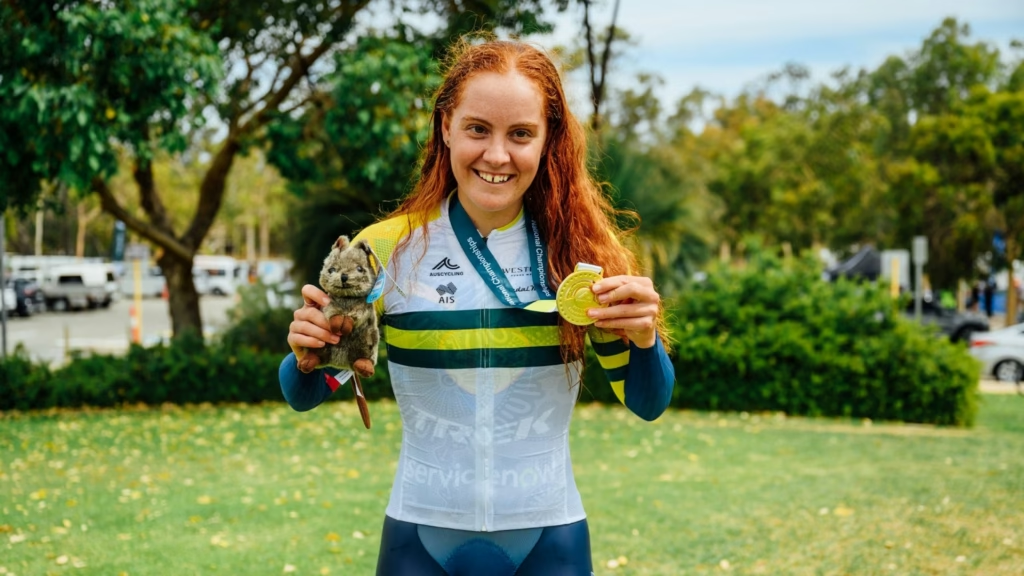 Photo Credit: AusCycling/Chris Auld
Felicity Wilson-Haffenden could become even more important for Australia
Wilson-Haffenden is one of the riders around whom Australia’s defence can be rebuilt.
She won the Australian elite individual time trial championship at the start of 2026 despite still being an under-23 rider and has backed that up with further strong performances against the clock.
She is already familiar with the relay after helping Australia win last year.
Her form can be assessed again immediately before Worlds at the Chrono Féminin de Gatineau, where she faces Reusser and several other Montréal-bound time trial riders.
Our Chrono Féminin de Gatineau contenders preview looks at why that race provides a particularly useful final benchmark before the championships.
Australia may be missing three members of last year’s team, but Wilson-Haffenden is a stronger rider now than she was in Kigali.
France have already committed to a balanced six
France finished second in Kigali and have left little ambiguity about their ambitions this year.
Their Montréal relay team has already been named.
| Men | Women |
|---|---|
| Bruno Armirail | Juliette Berthet |
| Rémi Cavagna | Marion Borras |
| Jordan Labrosse | Cédrine Kerbaol |
There is no obvious weak half of that team.
Armirail and Cavagna bring proven time trial power. Labrosse gives the trio another strong engine without creating the sort of mismatch that can make a team difficult to pace.
Borras has a strong track background, which is especially valuable in the relay format.
Kerbaol is an established time trial rider with the power to take long turns.
Berthet is the less obvious specialist but arrives in excellent road form after winning the Faun Tour Femmes and should cope comfortably with the modest climbing on the Montréal circuit.
France were only five seconds short last year.
Australia’s enforced changes make that result particularly relevant now.
Switzerland have the strongest mixed relay pedigree
Switzerland won in 2022 and successfully defended the title in 2023.
They were still only ten seconds behind Australia in Kigali last year despite Reusser losing time to a mechanical.
That history is why Switzerland remain central to the 2026 race regardless of the eventual combination selected.
The available pool includes Stefan Küng, Mauro Schmid and Jan Christen on the men’s side, with Reusser, Jasmin Liechti and Noemi Rüegg among the obvious women’s options.
Several of those riders already know exactly how to race together.
Reusser is the central figure.
She enters Worlds as defending individual time trial champion and has again been one of the strongest riders against the clock in 2026. She won the Tour de Suisse Women time trial in Aarburg before going on to take the overall victory.
The Tour de Suisse time trial report showed the size of the advantage she can create over a distance very similar to one half of the relay.
The challenge is using that power without breaking her own trio apart.
Switzerland have enough experience with Reusser to understand the problem better than most nations.
Italy have built a team around pure time trial strength
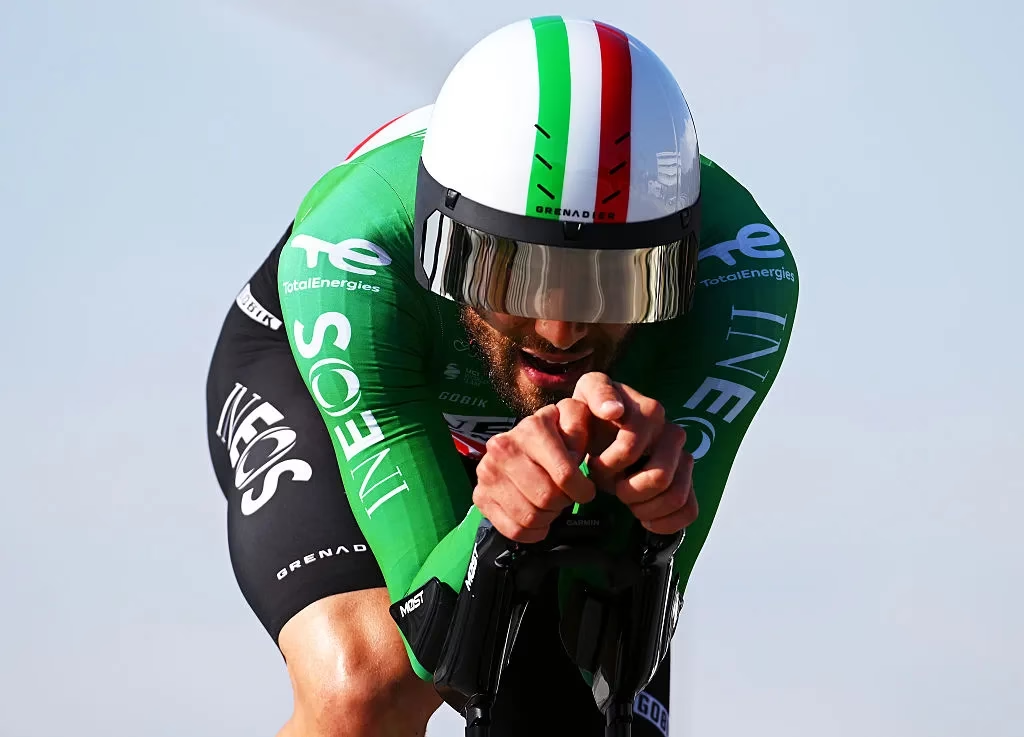
Italy’s confirmed line-up is arguably the most obviously powerful six in the race.
| Men | Women |
|---|---|
| Filippo Ganna | Vittoria Guazzini |
| Matteo Sobrero | Elisa Longo Borghini |
| Mattia Cattaneo | Monica Trinca Colonel |
The men’s trio immediately stands out.
Ganna remains one of the best pure time trial riders in the world. Sobrero and Cattaneo are strong enough against the clock that Italy should be able to maintain an extremely high speed without asking two weaker riders simply to hang onto Ganna.
The women’s trio is also well balanced.
Vittoria Guazzini brings world-class track pursuit experience alongside her road time trial ability.
Longo Borghini has years of experience in team events and remains a strong rider against the clock.
Trinca Colonel gives them another rider capable of handling the rolling sections rather than merely surviving them.
Italy finished fourth in Kigali, but their Montréal combination looks stronger on paper.
The question is whether the women’s trio can convert whatever advantage Ganna and the men are capable of creating.
Switzerland and Italy can both put Australia under pressure from the men’s start
This is where the structure of the race becomes interesting.
Australia’s 2025 victory was heavily influenced by an outstanding men’s leg.
Matthews, Plapp and Vine gave the women a significant cushion.
In Montréal, the replacement men’s trio may find itself racing against Ganna, Sobrero and Cattaneo for Italy, while Switzerland can call upon riders such as Küng and Schmid.
France have Armirail and Cavagna.
Australia no longer have any guarantee of reaching the handover with the fastest split.
That changes the task facing their women.
Spratt and Wilson-Haffenden were excellent in Kigali, but last year they were defending the advantage created by the men.
They may have to attack the course very differently if Australia begin the women’s leg behind.
Germany have enough history to remain a medal threat
Germany came within a second of beating Australia in Zürich.
That result alone is enough to keep them in the wider discussion.
The 2026 selection offers several riders well suited to a team time trial, particularly if Germany again prioritise balance rather than simply selecting the most famous individual names available.
Antonia Niedermaier and Franziska Koch give them strong potential on the women’s side, while Germany have enough experienced rouleurs among the men’s selection to build a competitive trio.
They do not have the obvious single engine of Italy with Ganna or Switzerland with Reusser.
The mixed relay does not require one.
Germany’s 2024 silver medal is proof of that.
The Netherlands have the talent to be dangerous
The Netherlands won the first mixed relay World Championship in Yorkshire in 2019.
They have not won it since.
That is slightly surprising for a nation with such depth in both men’s and women’s time trialling, but the event has repeatedly rewarded countries which treat the relay as a specialist discipline rather than simply assembling six strong names.
The current Dutch squads again contain the required ingredients.
Daan Hoole provides clear men’s time trial strength.
Lieke Nooijen and Demi Vollering are part of the women’s time trial selection, while Riejanne Markus gives the Netherlands another rider with extensive experience against the clock.
Their ceiling is high.
How much they prioritise the relay between the individual time trials and road races may determine how close they get to it.
 Photo Credit: Getty
Great Britain have intriguing options
Britain also have the pieces required to produce a strong relay.
The question is whether they fit them together.
Zoe Bäckstedt is one of the strongest young time trial riders in the world and has both road and track experience.
Ethan Hayter offers exactly the type of pursuit background which translates naturally into a three-rider time trial.
Britain’s wider men’s and women’s selections contain several more riders comfortable against the clock.
That gives the selectors possibilities.
It does not yet make Britain as established a mixed relay nation as Australia, Switzerland or France.
The final six and how seriously they target the discipline will determine whether Britain belong among the medal favourites or the next group behind.
Why having the fastest men does not guarantee anything
The split after the men’s leg attracts plenty of attention because it is the first time we can compare all the leading nations.
It is not the result.
A nation can lead comfortably and still lose.
The women’s trio has another complete lap to ride and can erase a sizeable deficit if the balance between the two halves is poor.
The opposite is also true. A country with an exceptional women’s group cannot afford to start half a minute down simply because its men were unable to stay together.
The mixed relay rewards complete national programmes.
That is why Australia, France and Switzerland have been so successful recently.
All three have been able to build strong trios on both sides of the handover.
The handover can change the race immediately
There is also a psychological element that does not exist in an individual time trial.
The women know where their nation stands when they start.
They can be released with a lead.
They can begin almost level with another country.
Or they can know immediately that they need to chase time.
That does not mean a trio should abandon its pacing plan, but it inevitably affects how the final leg feels.
A five-second deficit is manageable.
Twenty-five seconds may encourage a riskier strategy, longer turns and an earlier decision to sacrifice the third rider.
When margins at previous World Championships have been measured in fractions of a second, those decisions become significant.
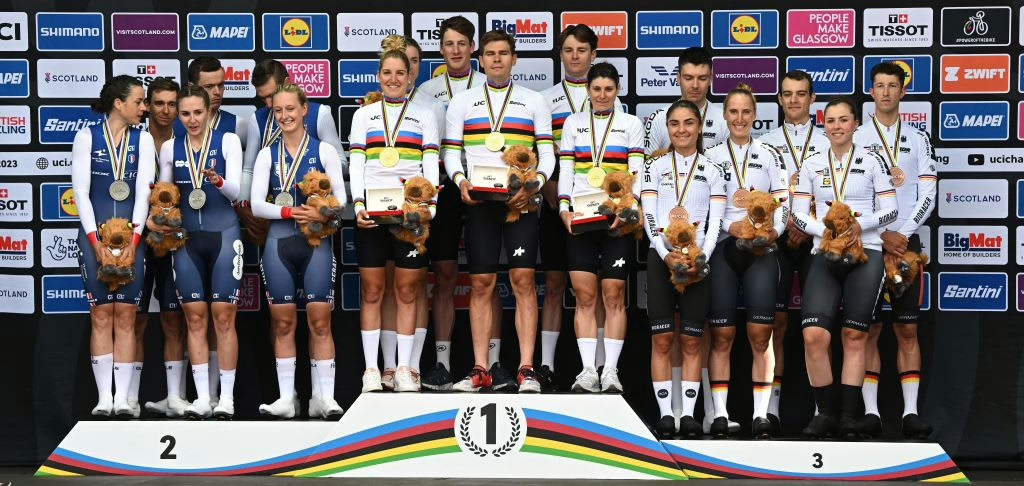
Who are the favourites for the 2026 mixed relay?
Australia retain the rainbow jerseys and enough of the previous winning structure to remain one of the main nations to watch.
The difference is that their 2026 team needs rebuilding.
France have arguably the most settled challenge. They were only five seconds away in Kigali and arrive with a confirmed six built specifically around the relay.
Switzerland have won the race twice and were close again last year despite Reusser’s mechanical. A clean run puts them straight back into the title contest.
Italy may have the highest theoretical ceiling. Ganna, Sobrero and Cattaneo can produce an exceptional men’s split, while Guazzini gives the women’s trio the technical background required to make the most of it.
Germany and the Netherlands belong in the next group, with Great Britain another nation capable of moving into medal contention if the final selection clicks.
This is also a race where small errors can completely change that hierarchy.
A poor corner.
One overenthusiastic turn.
A rider dropped two kilometres too early.
A mistimed changeover.
None costs much individually. Five seconds was the difference between gold and silver last year.
Australia are chasing something no nation has done before
The defending champions have the opportunity to win a third consecutive mixed relay title.
Switzerland reached two.
Australia have already matched them.
Doing it again in Montréal would be more impressive because this is not a continuation of the same six-rider group.
Half of last year’s winning team is missing.
The replacements have to rebuild the balance which made Australia so effective in Zürich and Kigali, and France, Switzerland and Italy all have reasons to believe the opportunity is there.
That makes the mixed relay one of the more open events of the opening half of Worlds week.
The first nation starts at 13:30 BST on Tuesday 22 September, with the rainbow jersey expected to be settled by around 16:15 BST.
The format may still be unfamiliar to plenty of viewers.
The racing should not need much explanation once six riders, two laps and a handful of seconds separate the best nations in the world.

