
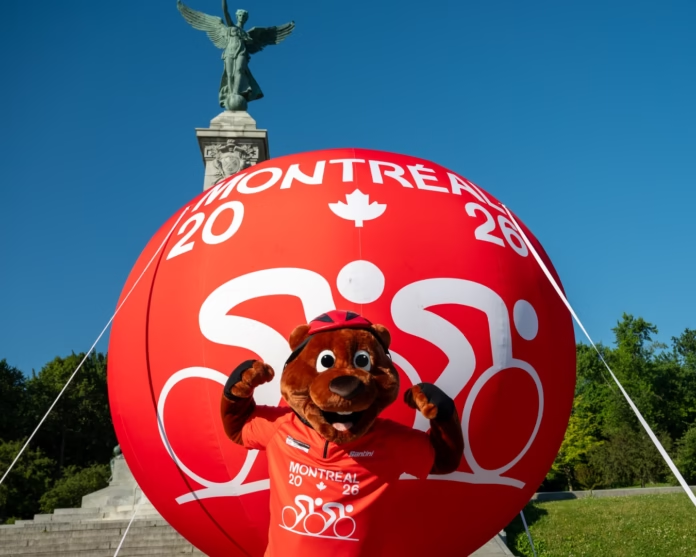
The UCI Road World Championships take place in Montréal from 20-27 September 2026, with 13 world titles decided across eight days of racing.
For one week, the structure of professional cycling changes completely. Riders leave their normal trade teams behind and compete for their countries. Belgium, France, Great Britain, Italy, the Netherlands, Australia, Canada and dozens of other nations assemble temporary squads with one objective: winning a rainbow jersey.
The championships cover individual time trials and road races for elite, under-23 and junior riders, together with the mixed relay team time trial. The elite women’s individual time trial provides the opening title on Sunday 20 September, while the elite men’s road race closes the championships on Sunday 27 September.
Montréal is not a new setting for major championship racing. The city hosted the Road World Championships in 1974, when Eddy Merckx completed his Giro d’Italia, Tour de France and World Championships treble on Mount Royal. Two years later, many of the same roads were used for the 1976 Olympic road race.
Exactly 50 years on from those Olympics, the rainbow jerseys return.
For a detailed look at every course, the 2026 UCI Road World Championships course guide covers the time trials, Mount Royal circuit and all of the key climbs.
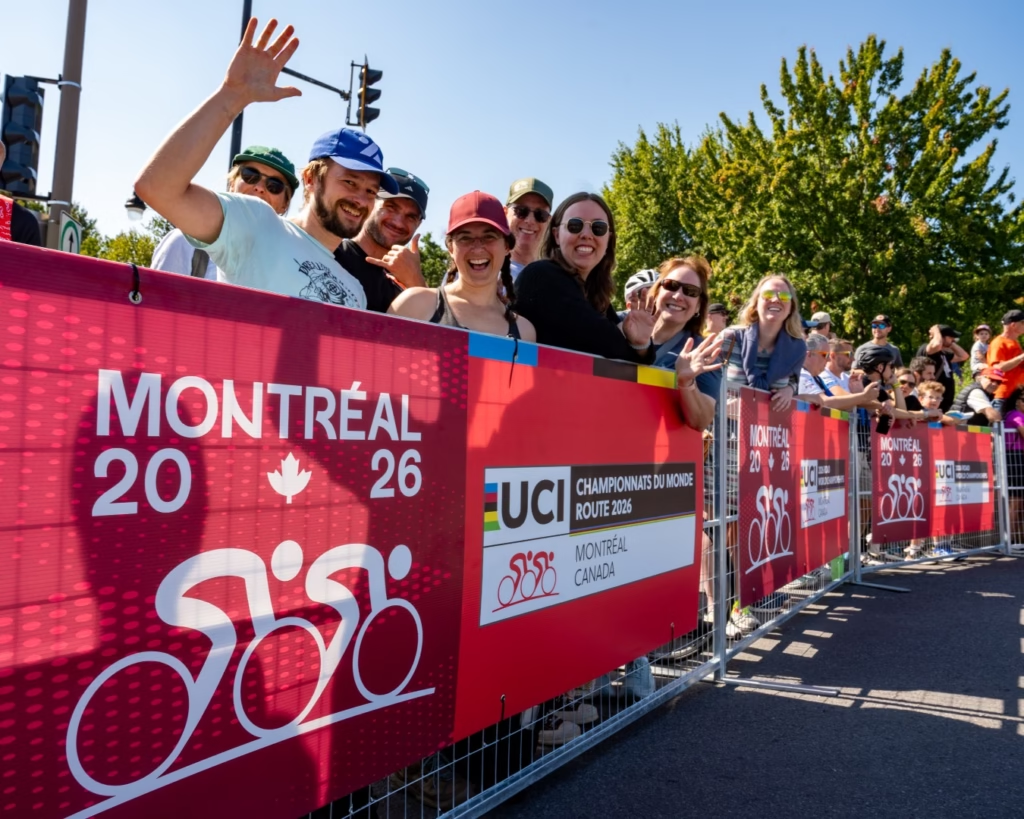 Photo Credit: Montreal2026
UCI Road World Championships 2026 at a glance
| Detail | Montréal 2026 |
|---|---|
| Dates | 20-27 September 2026 |
| Host city | Montréal, Québec, Canada |
| Number of title events | 13 |
| Categories | Elite, Under-23 and Junior |
| Disciplines | Road race, individual time trial, mixed relay team time trial |
| First championship | Elite women’s individual time trial |
| Elite women’s road race | Saturday 26 September |
| Elite men’s road race | Sunday 27 September |
| Elite ITT distance | 39.2km for women and men |
| Elite women’s road race | 180.4km, 2,570m climbing |
| Elite men’s road race | 273.7km, 3,803m climbing |
| Main road race feature | 13.4km Mount Royal circuit |
| UK time difference | Montréal is five hours behind BST |
There is no championship race on Wednesday 23 September, which is set aside for road race training and reconnaissance before the mass-start events begin the following day.
What are the UCI Road World Championships?
The Road World Championships are the annual UCI championships for road cycling.
Unlike the Tour de France, Giro d’Italia, Vuelta a España and the major Classics, riders do not compete for their professional teams. A Lidl-Trek rider becomes Belgian, French, Italian or British for the week. Someone who spends the season working for a teammate can suddenly find themselves racing against them.
That changes the tactics considerably.
Professional teams are constructed to race together for an entire season. National teams come together for only a handful of days. Riders use different teammates, different leadership structures and sometimes completely different roles.
A domestique at trade-team level might be the strongest rider their country possesses. A rider accustomed to being protected could instead spend Worlds working for somebody from a rival WorldTour team.
Team sizes are also uneven. Nations qualify places according to the UCI’s quota system, with the strongest countries able to field larger squads than smaller cycling nations. Defending champions can also receive a place outside their country’s standard quota.
That combination makes World Championship road races notoriously difficult to control.
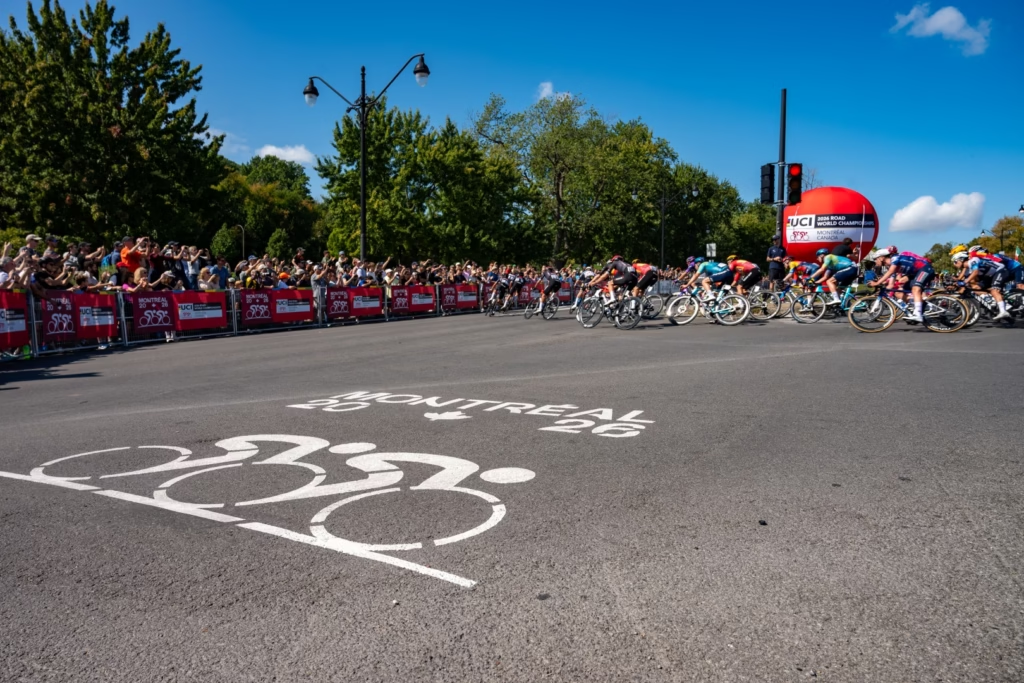 Photo Credit: Montreal2026
What are the 13 races at the 2026 World Championships?
Montréal awards six individual time trial titles, six road race titles and one mixed relay championship.
| Date | Event | Distance | Climbing | Defending champion |
|---|---|---|---|---|
| 20 Sept | Elite women’s individual time trial | 39.2km | 220m | Marlen Reusser |
| 20 Sept | Elite men’s individual time trial | 39.2km | 220m | Remco Evenepoel |
| 21 Sept | Women’s U23 individual time trial | 20.3km | 145m | Zoe Bäckstedt |
| 21 Sept | Men’s U23 individual time trial | 31.3km | 197m | Jakob Söderqvist |
| 22 Sept | Mixed relay team time trial | 40.6km | 290m | Australia |
| 22 Sept | Men’s junior individual time trial | 20.3km | 145m | Michiel Mouris |
| 22 Sept | Women’s junior individual time trial | 10.7km | 91m | Megan Arens |
| 24 Sept | Women’s U23 road race | 134km | 2,690m | Célia Gery |
| 24 Sept | Men’s junior road race | 134km | 2,690m | Harry Hudson |
| 25 Sept | Men’s U23 road race | 174.2km | 3,497m | Lorenzo Mark Finn |
| 25 Sept | Women’s junior road race | 80.4km | 1,614m | Paula Ostiz |
| 26 Sept | Elite women’s road race | 180.4km | 2,570m | Magdeleine Vallières Mill |
| 27 Sept | Elite men’s road race | 273.7km | 3,803m | Tadej Pogačar |
The two elite time trials therefore open the championships, while the two elite road races occupy the final weekend.
For television coverage, streaming links and UK start times for every one of those events, the full World Championships viewing guide covers the entire week.
What is an individual time trial?
The individual time trial is the simplest World Championships discipline to understand.
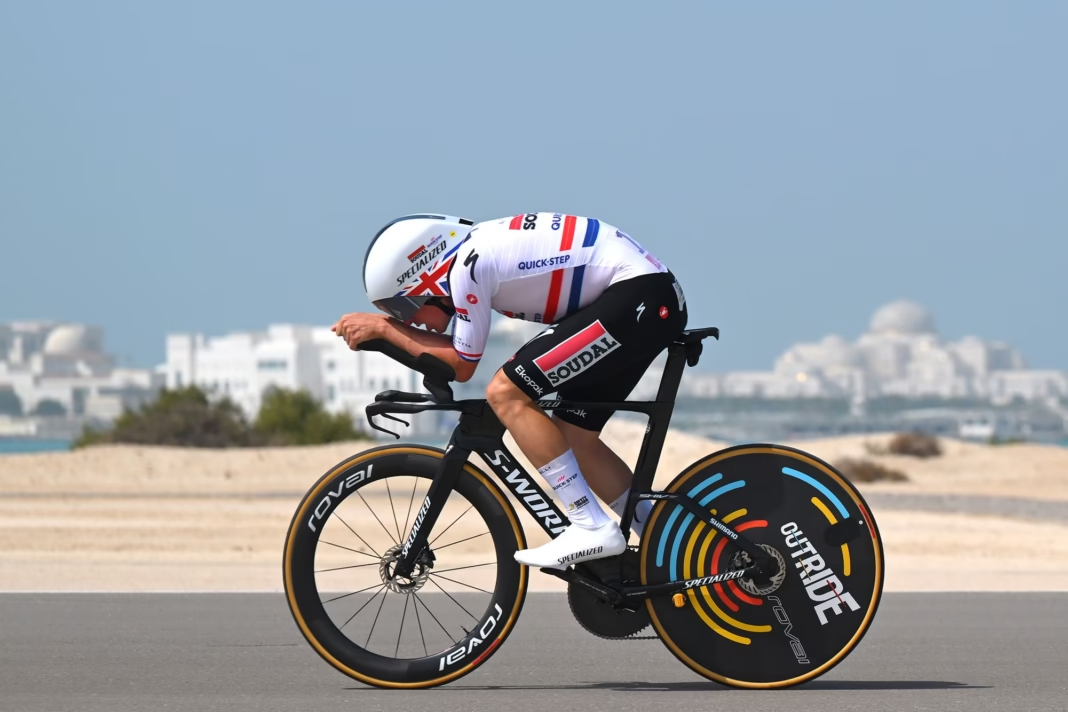
Each rider starts separately and races against the clock. Drafting behind another competitor is not permitted, so there is no peloton and very little conventional team tactics once a rider is on the course.
The fastest time wins.
Equipment, aerodynamics, pacing, cornering and the ability to sustain a very high power output all become important.
Montréal gives the elite women and elite men exactly the same test: 39.2km with 220 metres of climbing.
That is a major contrast with the road races.
The time trial largely avoids the repeated Mount Royal climbing and instead runs through Montréal towards the St Lawrence River. One of the most distinctive sections takes the riders onto the Circuit Gilles-Villeneuve, home of Formula 1’s Canadian Grand Prix.
The relatively modest elevation should favour genuine time trial specialists.
Marlen Reusser enters as the defending women’s champion after finally taking the individual rainbow jersey in Kigali in 2025. Remco Evenepoel is attempting to win a fourth consecutive elite men’s time trial title.
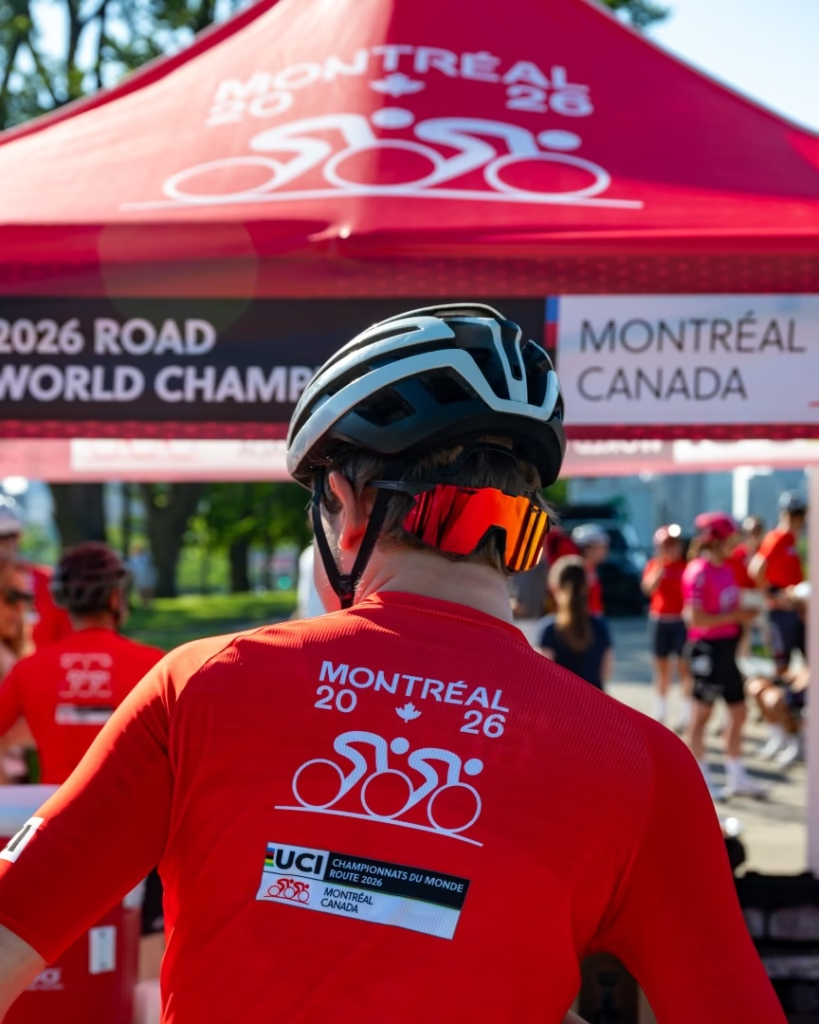 Photo Credit: Montreal2026
Why does the women’s time trial start the World Championships?
The first rider of Montréal 2026 rolls down the start ramp in the elite women’s time trial at 09:00 local time on Sunday 20 September, or 14:00 BST.
The elite men follow later that afternoon.
Opening Worlds with the elite categories means the championships begin immediately with some of the biggest names of the week rather than building towards them through the junior competitions.
After Sunday, the programme moves through under-23 and junior time trialling before the road races take over during the second half of the week.
How does the mixed relay team time trial work?
The mixed relay is the only event at the Road World Championships where the result comes directly from a team racing against the clock.
Each country fields three men and three women.
The men’s trio starts first and completes its section of the course. The women’s riders then take over, with the combined performance determining the final result.
That means depth is more important than having one exceptional time trial specialist. A nation needs a strong men’s group and a strong women’s group to contend.
Australia are the defending champions after winning in both 2024 and 2025.
The Montréal mixed relay covers 40.6km with 290 metres of climbing and takes place on Tuesday 22 September.
What changed with the women’s under-23 World Championships?
The women’s under-23 category is still relatively new in its current form.
Under-23 world titles were introduced earlier, but for several seasons the classification was taken from riders competing within the elite women’s event. There was no separate race.
That changed in Kigali in 2025.
Women under-23 riders received dedicated road race and individual time trial events for the first time, bringing the women’s programme closer to the structure already used for the men.
Célia Gery became the first winner of the standalone women’s U23 road race.
Zoe Bäckstedt won the first separate U23 women’s time trial and returns to Montréal as defending champion.
What are the junior World Championships?
Junior racing sits below the under-23 category and regularly provides the first international glimpse of riders who will appear in the professional peloton a few years later.
Four junior titles are decided in Montréal.
Megan Arens and Michiel Mouris defend the individual time trial rainbow jerseys, while Paula Ostiz and Britain’s Harry Hudson arrive as the reigning road race champions.
Hudson’s 2025 victory was particularly significant for Great Britain. He spent the final 36km alone in Kigali to become the first British rider to win the men’s junior road race world title.
The junior road races also provide an early opportunity to see the Mount Royal circuit raced seriously before the elite championships at the weekend.
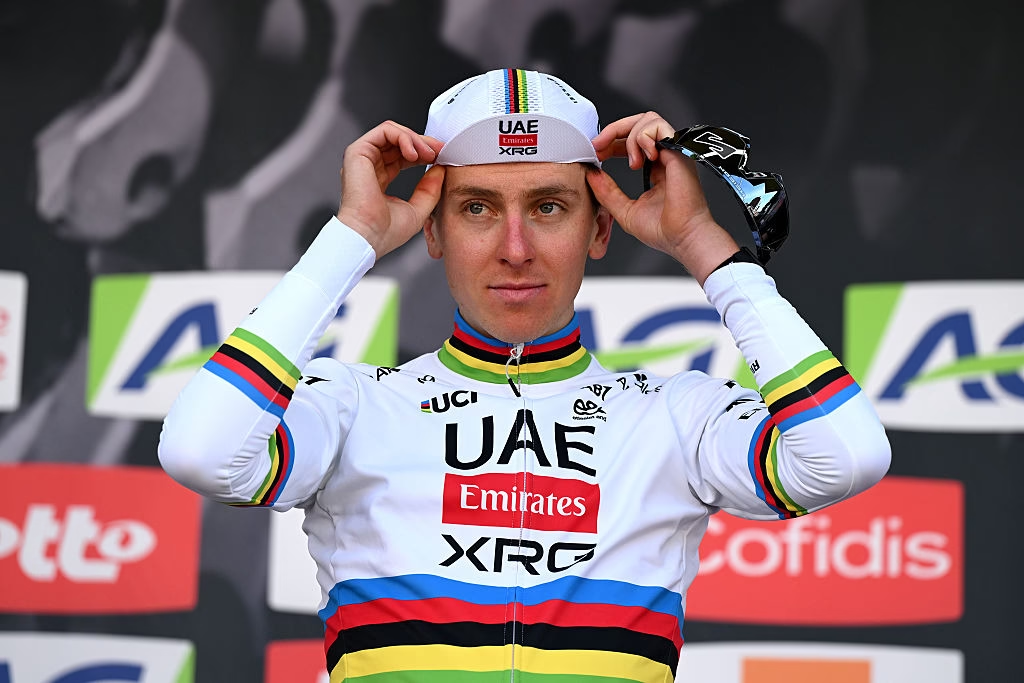 Photo Credit: Getty
What is the rainbow jersey?
The rainbow jersey is the prize that makes the World Championships different from almost every other race.
It is white with five horizontal bands in blue, red, black, yellow and green.
A rider who becomes world champion wears it for the following year whenever competing in the discipline and category in which the title was won.
The distinction between disciplines matters.
If Evenepoel wins the individual time trial, for example, he wears the rainbow jersey in time trials. Winning the time trial does not allow him to wear it in ordinary road races.
The road race world champion wears the rainbow jersey throughout the following road season.
Former world champions retain another privilege once their year in the jersey ends. Rainbow bands can be added to the sleeves of their normal team kit for the remainder of their career.
That is why riders such as Mathieu van der Poel, Julian Alaphilippe and Lizzie Deignan remain immediately identifiable as former road world champions even years after holding the title.
How are the road races different from normal professional races?
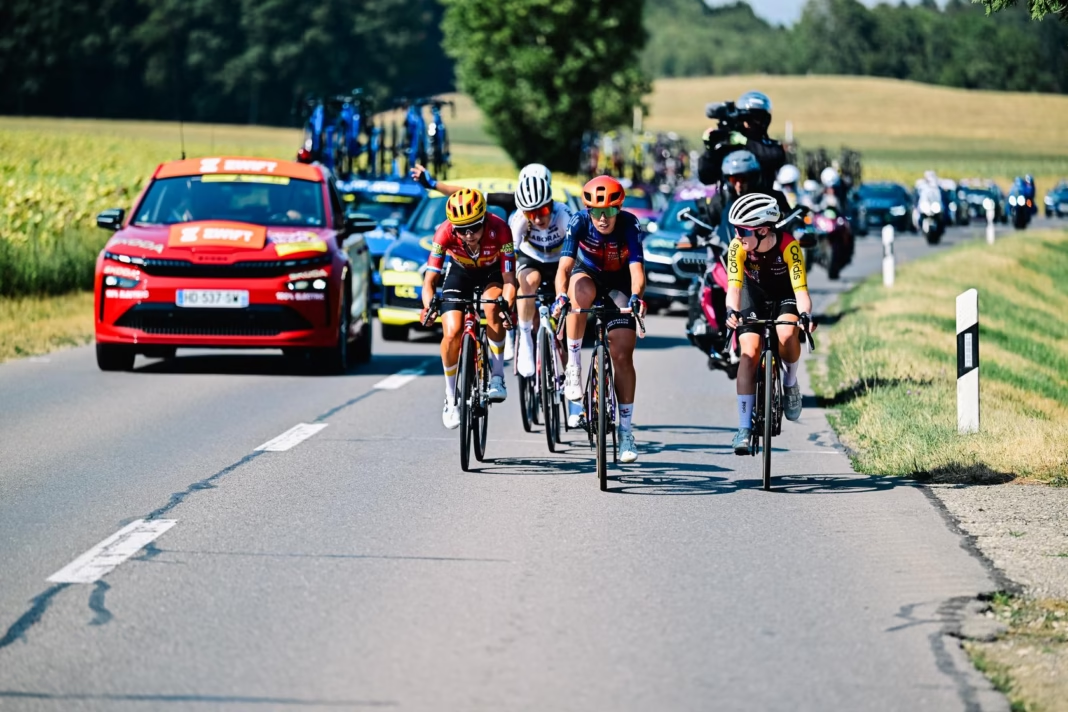
There are no trade teams.
That single change affects almost everything.
At GP Montréal, UAE Team Emirates-XRG were able to use Adam Yates, Brandon McNulty and Isaac del Toro together. Yates attacked, McNulty covered moves and Del Toro could choose his moment rather than chase every dangerous rider himself.
At the World Championships, those riders represent different countries.
Belgium might have Remco Evenepoel attacking while Wout van Aert waits behind. Britain can send Oscar Onley or Adam Yates up the road while Tom Pidcock remains protected. France have their own interests around Paul Seixas. Mexico cannot rely on UAE teammates to support Del Toro.
There are temporary alliances, but they exist only while two countries want the same thing.
That uncertainty is a fundamental part of World Championships racing.
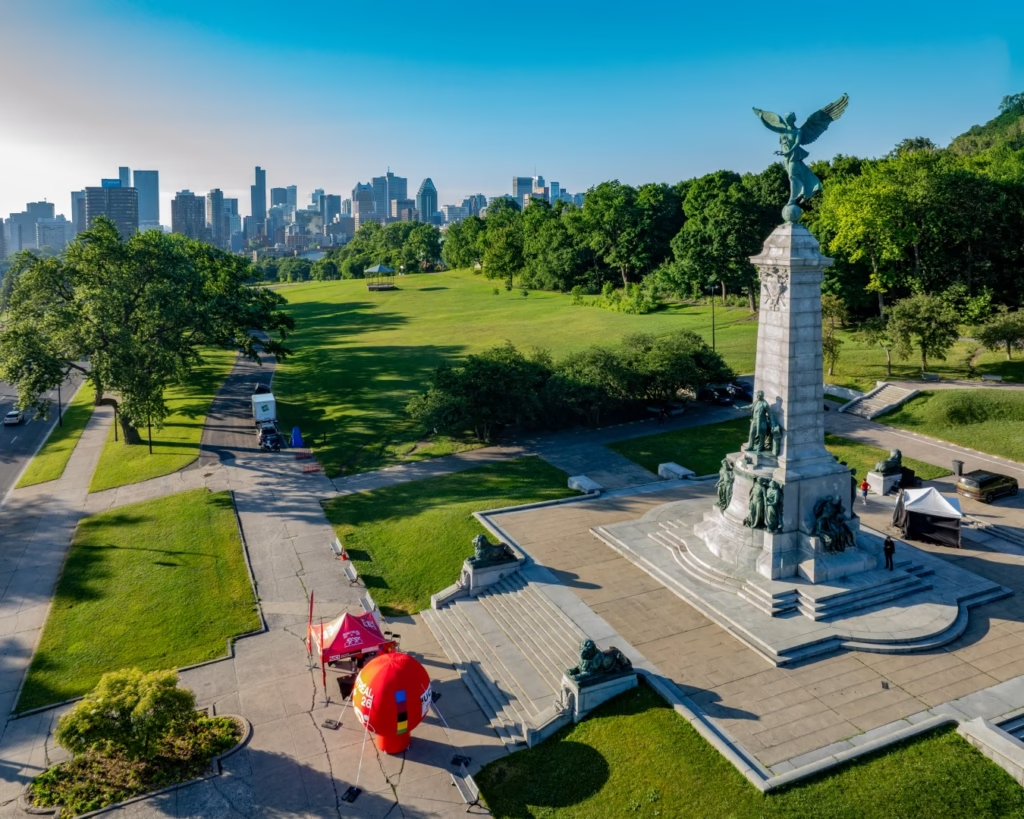 Photo Credit: Montreal2026
The road races are built around Mount Royal
The defining feature of Montréal 2026 is the 13.4km Mount Royal circuit.
Each lap contains approximately 269 metres of climbing.
The under-23 and junior road races are largely based around repeated laps of the circuit. The two elite events begin outside Montréal in Brossard before travelling through Montérégie and crossing towards the city.
Once they arrive at Mount Royal, the nature of the race changes.
The elite women complete eight circuits.
The elite men complete 12.
The individual climbs are not mountains by Grand Tour standards. The difficulty comes from riding them repeatedly until riders who were comfortable two hours earlier can no longer produce the same effort.
Camillien-Houde is the main sustained climb
Voie Camillien-Houde is the backbone of the circuit.
The hardest recognised section is around 1.8km at 8%, while the broader climb extends further at a lower average gradient.
One passage is manageable.
Eight or 12 are not.
Early in the race, Camillien-Houde will mostly remove weaker riders and force domestiques to work. By the final laps, it becomes somewhere the strongest contenders can attack and genuinely create separation.
The effect was already visible at the 2026 GP Montréal, which used the same redesigned Mount Royal circuit 16 times.
Côte de la Polytechnique brings the steepest gradients
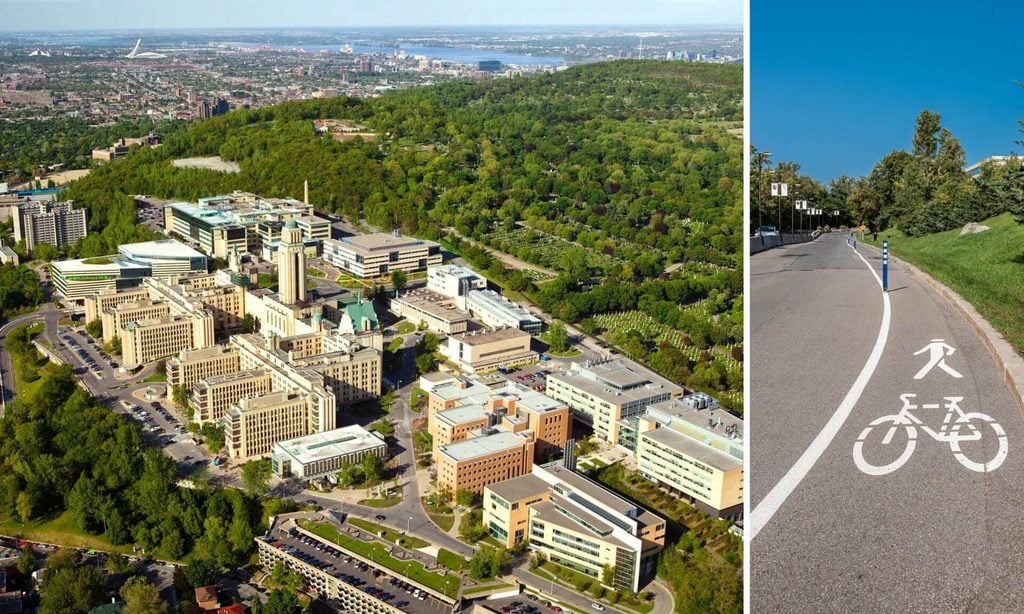
Camillien-Houde is followed later in the circuit by the Côte de la Polytechnique.
It is much shorter but contains a section above 11%.
That makes positioning important.
A rider starting the climb too far back may have to produce almost the same effort as the attackers simply to move towards the front. Once the group becomes smaller, Polytechnique also offers one of the clearest places for an explosive attack.
Avenue Pagnuelo adds another short rise before the riders begin the run towards the finish.
None of these climbs decides the championship on its own.
Together, repeated lap after lap, they can gradually dismantle the peloton.
Avenue du Parc gives the finish another sting
Any riders still together return towards the line on Avenue du Parc.
The finishing road itself rises at approximately 4%, so this is not a conventional flat sprint.
That widens the range of potential winners.
A climber can try to escape on Mount Royal and stay away. A small group can attack and cooperate. A faster rider can attempt to survive everything and back their sprint.
The strongest candidate is someone capable of climbing repeatedly while retaining enough power to accelerate after several hours of racing.
GP Montréal has already demonstrated how that can work.
Paul Seixas attacked on the final Camillien-Houde ascent on 13 September. Isaac del Toro bridged across, the pair built a decisive advantage and Del Toro eventually beat Seixas on Avenue du Parc.
It was about as useful a competitive course reconnaissance as the Worlds contenders could have asked for.
Elite women’s road race: Saturday 26 September
The elite women race 180.4km with 2,570 metres of climbing.
The opening 72.7km takes the race from Brossard towards Montréal before eight laps around Mount Royal provide more than 2,150 metres of the total elevation.
That concentration of climbing is important.
This is not a race where one major early mountain creates a selection and everyone spends the next two hours trying to stay away. The difficulty increases as the race progresses.
Our elite women’s road race route guide breaks down the complete 180.4km course and explains why the final Mount Royal laps should be so selective.
Magdeleine Vallières Mill starts as defending champion after her breakthrough victory in Kigali.
She also has the rare experience of defending a rainbow jersey at a home World Championships.
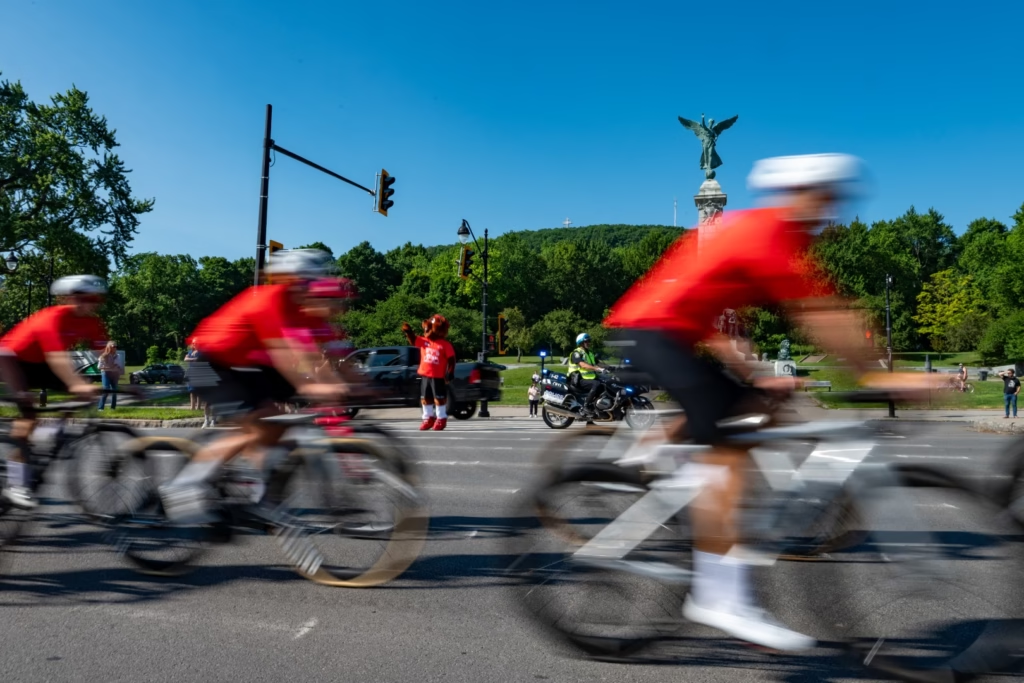 Photo Credit: Montreal2026
Elite men’s road race: Sunday 27 September
The men’s championship closes Montréal 2026 with 273.7km and 3,803 metres of climbing.
The first 112.4km comes before the riders enter the finishing circuit.
They then complete Mount Royal 12 times.
That makes the race an endurance contest as much as a climbing one. The eventual champion is likely to have spent close to seven hours racing by the time Avenue du Parc arrives for the final time.
Tadej Pogačar is the defending world champion after winning in Zürich in 2024 and Kigali in 2025, but his 2026 season has been ended by the injuries suffered when he crashed out of the Vuelta a España.
There will therefore be a new men’s road world champion.
Recent racing has provided plenty of clues without producing one obvious answer.
Evenepoel won GP Québec. Del Toro beat Seixas in Montréal. Tom Pidcock finished inside the top six of both Canadian WorldTour races.
Van Aert arrives by a completely different route after three weeks at the Vuelta a España. He won two stages, the green jersey and the overall combativity award, and our Wout van Aert form watch looks at whether those three weeks have built the ideal base for Montréal or left too much fatigue to shed.
Great Britain’s chances in Montréal
Great Britain have several genuine options rather than one rider around whom everything has to be built.
Pidcock has already tested himself on the circuit. Onley arrives from finishing sixth and winning the white jersey at the Vuelta. Adam Yates gives the men’s team another dangerous climber who can attack before the final lap.
The women’s options include Bäckstedt, whose profile has expanded considerably beyond time trialling as she has developed into a stronger road racer.
The Great Britain World Championships team preview looks at how both elite teams can approach the championships.
There is a significant historical angle too.
Britain’s last elite road race world champion was Deignan in Richmond in 2015. Cavendish remains the most recent British men’s winner after Copenhagen in 2011.
The history of Great Britain at the Road World Championships traces those victories back through Nicole Cooke, Mandy Jones, Tom Simpson and Beryl Burton.
Why Montréal matters historically
The World Championships first visited Montréal in 1974.
That alone was significant because it was the first Road World Championships staged outside Europe.
Mount Royal provided the centrepiece.
Merckx arrived having already won the Giro and Tour that year and completed the treble by taking the rainbow jersey ahead of Raymond Poulidor. Geneviève Gambillon won the women’s title.
Two years later, the 1976 Olympics returned championship road racing to the same area. Sweden’s Bernt Johansson won the men’s road race, which was still restricted to amateur riders.
The modern circuit is not an exact copy of either historic route, but the principle is recognisable.
Repeated climbing around Mount Royal gradually removes riders until someone is strong enough to turn the selection into victory.
The history of the Grand Prix Cycliste de Montréal explains how top-level racing subsequently returned to those roads and eventually produced the modern WorldTour race.
In 2026, the story comes full circle.
-
 Photo Credit: A.S.O./Billy Ceusters

How to watch the UCI Road World Championships 2026
The elite women’s time trial opens the championships at 14:00 BST on Sunday 20 September.
The elite men’s time trial follows at 17:45 BST.
Both elite road races begin at 14:00 BST on the final weekend, with the women racing on Saturday and the men on Sunday.
UK viewers can follow the championships through TNT Sports and HBO Max, while different free-to-air and streaming options are available internationally.
The World Championships TV and live-stream guide includes the full schedule together with direct viewing options for the UK, USA, Canada, Australia, Spain, Italy, France and Belgium.
ProCyclingUK’s Montréal 2026 coverage
This beginner’s guide is the starting point for ProCyclingUK’s World Championships coverage, with the detailed pages expanding each part of the week as the racing approaches.
Follow the opening day with our elite women’s time-trial preview and elite men’s time-trial preview. Our mixed relay explainer covers the format, route, teams and contenders for the team event.
For the final weekend, read our elite women’s road race preview and elite men’s road race preview for the favourites and national-team tactics on Mount Royal.
The full Montréal course guide covers all 13 events and the differences between the time trial and road routes. The elite women’s route guide goes deeper into the eight-lap Mount Royal finale.
For the men’s course, the GP Montréal route guide provides a climb-by-climb look at the same 13.4km circuit that will be used at Worlds, while the GP Montréal race report shows how those roads behaved when raced at WorldTour intensity.
The Great Britain team preview covers Pidcock, Onley, Bäckstedt and the wider British options, while the Van Aert form analysis follows one of the most important riders arriving directly from the Vuelta.
The first rainbow jersey will be awarded on 20 September.
Seven days later, after 13 championship races, Mount Royal will decide the last one.

