
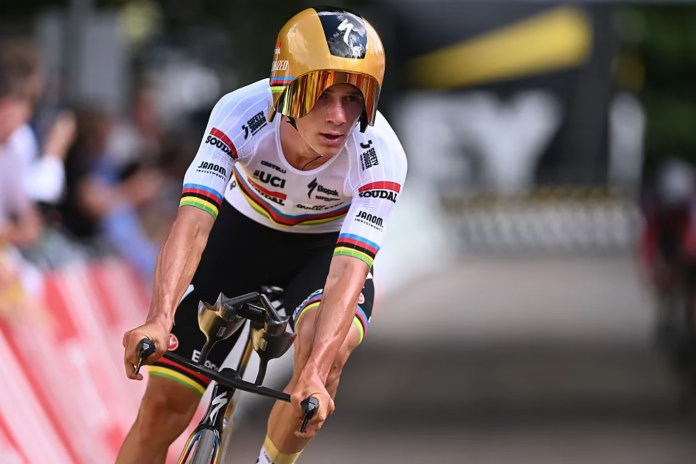
Remco Evenepoel can make World Championships history in Montréal on Sunday 20 September. Victory in the elite men’s individual time trial would give the Belgian a fourth consecutive rainbow jersey, taking him beyond Michael Rogers and Tony Martin as the first man to win the title four years in succession.
The course gives his rivals reason to believe the run can be stopped. Montréal provides 39.2km of racing with only 220 metres of elevation gain, taking the riders away from Mount Royal and onto much faster roads around the St Lawrence River and Circuit Gilles-Villeneuve. Sustained aerodynamic power will matter far more than climbing ability.
That brings Filippo Ganna firmly back into the picture. The Italian produced one of the strongest long-distance time trials of recent years at the Giro d’Italia in May, while Stefan Küng arrives in Canada having beaten Callum Thornley by three seconds in the final individual time trial of the Vuelta a España. Mathias Vacek, Tobias Foss, Brandon McNulty and Ethan Hayter add further depth behind the three most obvious contenders.
Evenepoel still sets the standard. He has won every elite Worlds time trial since 2023 and beat Tadej Pogačar by 28 seconds in the Tour de France’s only individual time trial this summer. Montréal gives Ganna and the larger specialists more suitable terrain, but it does not obviously expose a weakness in the defending champion.

Men’s World Championships time trial 2026 race details
Date: Sunday 20 September 2026
Start: Avenue du Parc, Montréal
Finish: Parc Jeanne-Mance, Montréal
Distance: 39.2km
Elevation gain: 220 metres
Start time: 12:45 local time / 17:45 BST
Expected finish: approximately 15:15 local time / 20:15 BST
The elite men race over exactly the same course as the women earlier on Sunday. ProCyclingUK’s 2026 UCI Road World Championships course guide covers the complete route and how the time trial differs from the much hillier road races later in the week.
UK viewers can watch the race through TNT Sports and HBO Max, with live coverage scheduled to begin shortly before the 17:45 BST start. The complete schedule is available in the World Championships TV and live-stream guide.
Previous winners
2025 – Remco Evenepoel
2024 – Remco Evenepoel
2023 – Remco Evenepoel
Evenepoel’s first two titles came directly at Ganna’s expense. He beat the Italian by 12 seconds in Stirling in 2023 before the margin fell to six seconds in Zürich the following year.
Kigali was completely different. Evenepoel dominated a 40.6km course containing around 680 metres of climbing, finishing 1:14 ahead of Jay Vine and catching Tadej Pogačar despite the Slovenian starting two and a half minutes before him.
That third victory put Evenepoel alongside Rogers and Martin, who also won three consecutive titles. Nobody has extended the sequence to four.
Why the Montréal course changes the contest
There is very little climbing for a World Championships time trial of this length.
The riders leave Avenue du Parc before travelling through central Montréal and Old Montréal towards the St Lawrence River. From there, the route reaches Île Notre-Dame and one of its most distinctive features, the Circuit Gilles-Villeneuve.
The Formula 1 circuit should produce some of the highest speeds of the race. Wide roads and flowing corners give the specialists long periods where they can stay in the extensions and hold a consistent effort rather than repeatedly braking, accelerating and climbing.
It does not remain completely straightforward. There are technical interruptions around the urban sections and bridges, while the return from Parc Jean-Drapeau becomes more broken before the final rise towards Parc Jeanne-Mance.
The key is likely to be managing the middle of the race. Ganna, Küng and the other large specialists can gain substantial time while the speeds are highest, but committing too much there leaves almost 40 kilometres in the legs by the time the road begins to rise towards the finish.
The full Montréal World Championships course guide looks more closely at that transition and why the Circuit Gilles-Villeneuve should be such an important part of the time trial.
Remco Evenepoel is one win from doing something nobody else has managed
There is no need to construct a complicated case for Evenepoel.
He has entered the last three World Championship time trials and won all three.
His 2026 season has also contained another reminder of the level he can reach against the clock. Stage 16 of the Tour de France covered 26.1km from Évian-les-Bains to Thonon-les-Bains, beginning with a long climb before becoming considerably faster towards the finish.
Evenepoel beat Pogačar by 28 seconds.
The route was much hillier than Montréal, but the performance mattered because it came deep into a Grand Tour and against one of the strongest stage racers in the world. The full ride is covered in ProCyclingUK’s Tour de France Stage 16 report.
His Canadian form also looks good. Evenepoel won GP Québec after attacking with 28km remaining and followed that with fifth at GP Montréal two days later. Those results do not tell us precisely what he can produce on a time trial bike, but they remove much of the uncertainty around his condition after a relatively quiet period following the Tour.
The flatter Montréal route probably reduces the advantage he enjoyed in Kigali. It does not follow that the course works against him. Evenepoel has already beaten Ganna on faster World Championships courses and won Olympic gold on the relatively flat Paris course in 2024.
His aerodynamic efficiency allows him to compete with riders producing considerably more absolute power.
That is what Ganna still has to solve.
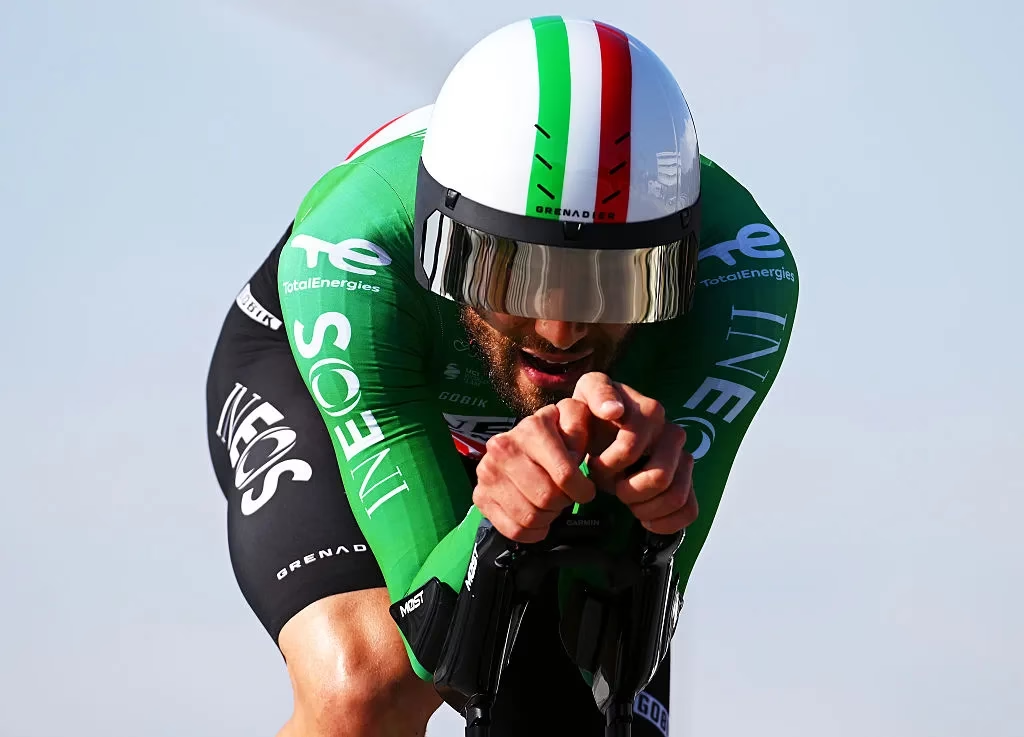
Filippo Ganna has the course and distance he wanted
Ganna’s Giro d’Italia time trial is the most relevant performance from any of Evenepoel’s challengers this season.
Stage 10 covered 42km from Viareggio to Massa, almost three kilometres longer than Sunday’s World Championship. Ganna completed it in 45:53 at an average of 54.921km/h and beat teammate Thymen Arensman by 1:54.
It was not simply another time trial victory. The margin over a strong field showed what Ganna can do when a race gives him more than 40 kilometres of predominantly fast roads.
ProCyclingUK’s Giro d’Italia Stage 10 report covers the scale of that performance and how quickly Ganna separated himself from everybody else.
Montréal is not identical. There are more changes of direction and a rising finish, while a World Championship brings a completely different level of pressure. The fundamental demands are nevertheless much closer to Viareggio-Massa than to a mountainous championship route.
Ganna also knows how small the gap to Evenepoel can become.
He lost by 12 seconds in 2023 and six seconds in 2024. Those are margins that can disappear through a slightly better corner, a change in wind conditions or a few watts maintained for longer in the final quarter.
The Giro ride showed that Ganna has not lost the capacity to produce extraordinary performances over this distance.
Sunday is his chance to turn that into another rainbow jersey.
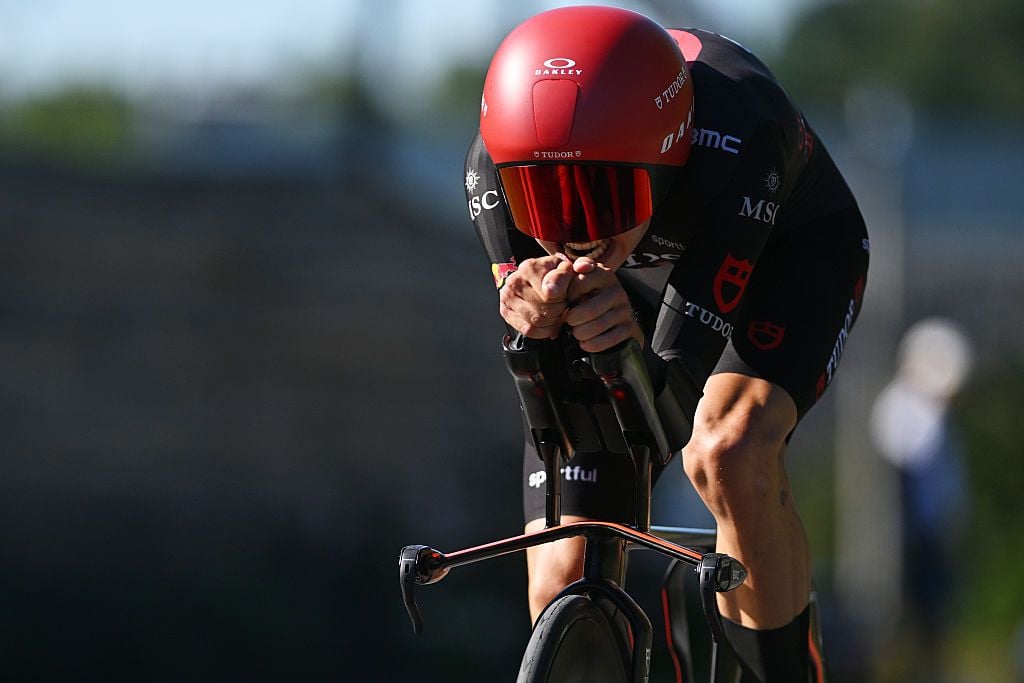 Photo Credit: Getty
Stefan Küng arrives with the best possible final preparation
Küng has already completed a high-level 32.1km time trial this month.
On Stage 18 of the Vuelta a España, the Swiss rider beat Callum Thornley by three seconds between El Puerto de Santa María and Jerez de la Frontera. João Almeida was nine seconds behind, with Primož Roglič at 19 seconds.
It was an ideal rehearsal for Montréal. The Jerez course rewarded sustained speed, the race lasted more than 35 minutes and Küng had to manage his effort deep into the third week of a Grand Tour.
The Vuelta Stage 18 race report shows how Thornley established the early benchmark before Küng gradually found the seconds needed to win.
Küng then left the Vuelta rather than continuing through the final weekend, giving himself additional recovery time before Montréal.
He has been close to a world title before. Küng took silver in Wollongong in 2022 and has spent much of his career among the most consistent championship time triallists without winning this particular race.
His task is considerably harder than simply repeating Jerez. Evenepoel and Ganna represent a different benchmark.
The evidence at least suggests he arrives ready to challenge them.
Callum Thornley has changed expectations quickly
Thornley’s second place in Jerez moved him into this conversation.
The 23-year-old finished only three seconds behind Küng over 32.1km and nine seconds ahead of Almeida. It was not a short prologue where a few good corners can transform the result. Thornley stayed close to one of the world’s best specialists for more than 35 minutes.
Montréal extends that effort by seven kilometres.
That makes pacing and endurance more important, but there is little about the course itself that should trouble him. Thornley has shown that he can ride quickly on flat roads and sustain an aerodynamic position for long periods.
The bigger question is recovery. He has completed an entire Vuelta immediately before travelling to Canada.
That can work both ways. Three weeks of racing can leave a rider carrying fatigue, but it can also produce the condition needed for one final prolonged effort.
Great Britain have another option in Ethan Hayter, making the British challenge more interesting than it appeared earlier in the season.
 Photo Credit: Getty
Ethan Hayter already has a major result over almost exactly this distance
The distance of the British national championship is difficult to ignore.
Hayter raced for 38.4km around Lampeter in June, only 800 metres shorter than the Montréal course. He won the elite title convincingly and demonstrated that the duration itself is unlikely to be a problem.
His track background helps too. Hayter has spent years developing the ability to hold high power in an aerodynamic position, and the fastest sections of Montréal reward precisely that.
He also showed his speed at the start of the Vuelta, coming close to victory in the opening time trial.
Hayter has generally been less consistent than Evenepoel, Ganna or Küng in the biggest championship time trials. That is why the gap between being a medal contender and winning remains substantial.
The underlying ingredients are there, though.
A long, predominantly flat World Championship is considerably better for him than a race packed with sustained climbing.
Mathias Vacek should not have a problem with the distance
Vacek has already gone significantly further against the clock this year.
The Czech championship covered 48.1km, almost nine kilometres longer than Montréal, and Vacek won by more than a minute and a half. He also finished fourth in the Tour de Suisse time trial during June.
That combination is useful.
Some riders arriving in Montréal have demonstrated exceptional speed over 20 or 25 kilometres but still need to prove they can maintain it for close to an hour. Vacek has already shown the necessary endurance.
His challenge is outright speed against the strongest specialists.
A national championship victory does not automatically translate into the numbers required to beat Evenepoel or Ganna. Yet this course gives Vacek a realistic opportunity to turn another strong season against the clock into his best elite World Championships result.
Tobias Foss has already shown why championship time trials can surprise
Foss remains the most obvious warning against treating the result as predetermined.
He won the World Championship in Wollongong in 2022 when Ganna, Evenepoel and several better-known specialists were expected to decide the medals.
The Norwegian produced his best performance on the day when it mattered.
His 2026 season has included another national time trial title, beating Andreas Leknessund in June. Montréal is much longer, but Foss has repeatedly shown that he can control a championship effort rather than starting too aggressively and fading.
His victory four years ago does not make him one of the two obvious riders to beat on Sunday.
It does mean nobody should dismiss him simply because his recent results are less striking than Ganna’s Giro ride or Küng’s Vuelta victory.
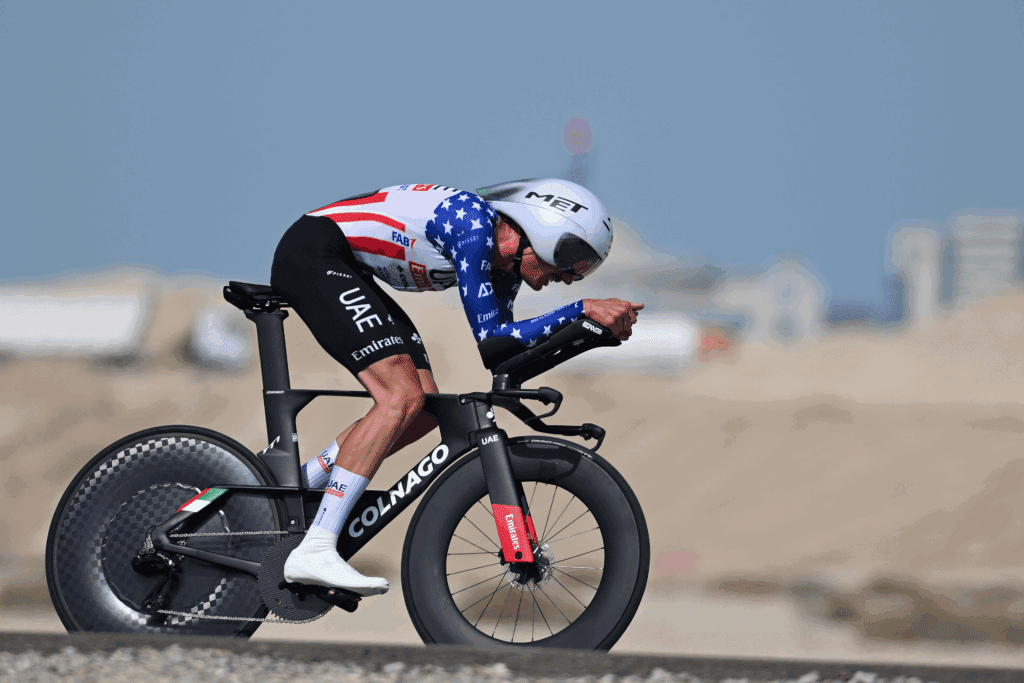
Brandon McNulty brings strong Canadian form
McNulty has already shown that he is in good condition in Montréal.
He finished third at GP Montréal last Sunday behind Isaac del Toro and Paul Seixas, staying involved through a race containing more than 4,000 metres of climbing.
The time trial could hardly be more different, but McNulty has a long history of strong performances against the clock. He is capable of climbing well enough to handle the final rise without giving away the aerodynamic qualities needed for the much faster middle portion.
The GP Montréal route guide shows just how different last weekend’s road race was from Sunday’s individual test, despite both finishing in the same part of the city.
McNulty probably needs his best time trial of the season to reach the podium.
His condition gives him a chance of producing it.
Söderqvist, Hoole, Bissegger and Seixas add depth behind the main challengers
Jakob Söderqvist is one of the younger riders worth watching closely. The Swede won the under-23 world time trial title in Kigali last year and has continued producing strong performances against the clock in 2026. Montréal provides his first opportunity to establish where he sits against the very best elite specialists over a substantial distance.
Daan Hoole is another rider who should welcome the flatter profile. The Dutchman is selected specifically for a discipline that suits his large engine and ability to carry speed, rather than having to compromise between time trial and road-race characteristics.
Stefan Bissegger gives Switzerland another route into the upper places behind Küng. His best performances come on fast courses where aerodynamic efficiency matters more than climbing, making Montréal a much better fit than many championship routes.
Paul Seixas is the opposite type of contender. The Frenchman has developed rapidly against the clock and finished fourth in the Tour de France time trial, but that race included considerably more climbing. Montréal gives the pure specialists more kilometres on which to exploit their absolute power.
Seixas still arrives with excellent form after finishing second at GP Montréal and remains capable of a high result. The course simply asks a different question from many of the time trials where he has already excelled.
Why Ganna has his clearest chance to stop Evenepoel since Zürich
This race should reveal a lot very early.
Ganna needs the fastest sections to matter.
If he can use the run towards and around Circuit Gilles-Villeneuve to establish an advantage, Evenepoel is forced into the unusual position of chasing through the final part of a championship time trial.
If they are level when the course starts to rise back towards Parc Jeanne-Mance, the balance may move towards Evenepoel.
Küng needs something similar. His route to the rainbow jersey is probably built on carrying enormous speed across the flat middle section before limiting any losses over the final kilometres.
Evenepoel has more flexibility.
He does not have to destroy Ganna on the faster roads. Staying close is enough if he can then reproduce the controlled pacing that has defined his last three World Championship victories.
That is why Montréal feels more open than Kigali without making Evenepoel any less formidable.
The course has brought his rivals closer to their ideal conditions.
Now they have to use them.
Top 3 prediction
1. Remco Evenepoel
Evenepoel has won three consecutive World Championship time trials and continues to produce his best performances against the clock when the stakes are highest. Montréal gives Ganna better terrain than Kigali, but it does not remove Evenepoel’s aerodynamic advantage or his ability to sustain power over a long championship distance.
2. Filippo Ganna
Ganna’s 42km Giro victory is the strongest argument for an upset. He demolished the field over a distance almost identical to Montréal and has twice finished within 12 seconds of Evenepoel at the World Championships. The course gives him the opportunity to make those margins count.
-
 Photo Credit: Getty
3. Stefan Küng
Küng arrives directly from victory in the Vuelta’s 32.1km Jerez time trial and has had additional recovery after leaving the race the following morning. He has both the form and the course to challenge for another World Championship medal.

