
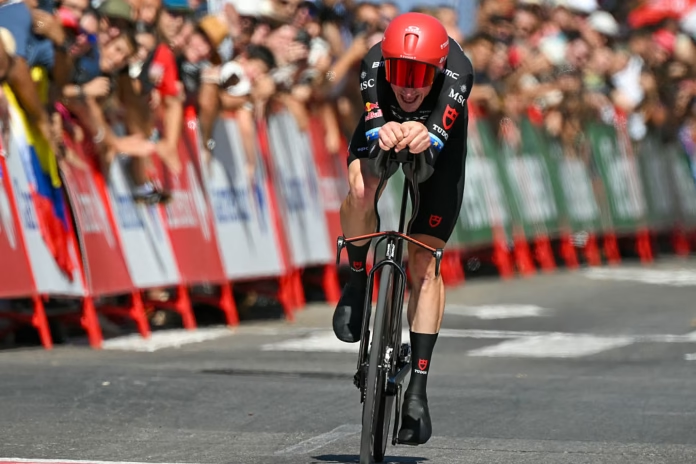
Stefan Küng won stage 18 of the 2026 Vuelta a España, beating Callum Thornley by three seconds in the 32.1km individual time trial from El Puerto de Santa María to Jerez de la Frontera.
The Tudor Pro Cycling Team rider completed the course in 35:22.82 at an average speed of 54.4km/h, taking his second Vuelta stage victory after winning the final time trial in Madrid in 2024. João Almeida finished third at nine seconds, with Primož Roglič fourth at 19 seconds and Wout van Aert fifth at 20.
Roglič made the expected gains in the general classification but nowhere near enough to threaten Enric Mas’s red jersey. He took 33 seconds from the Spaniard and moved above Felix Gall into second overall, but Mas still leads by 1:37 with the final mountain stages to come.
Thornley sets the early benchmark
The stage 18 time trial from El Puerto de Santa María to Jerez was a very different test from the short Monaco opener. There was little significant climbing across the 32.1km, giving the specialists more than half an hour of sustained work before a slightly more technical run into Jerez.
Ethan Hayter provided the first serious benchmark with 35:54, but Thornley quickly showed that his fourth place in Monaco had not been a one-off. The 23-year-old Scot was 19 seconds quicker than Hayter after 11.7km and extended that advantage to 23 seconds at the second checkpoint.
Thornley reached the finish in 35:25, taking another six seconds out of Hayter over the final section and putting himself 29 seconds clear. With several recognised specialists still to start, it was difficult to judge how long the time would survive, but it immediately looked good enough to contend for the stage.
Almeida was the first rider to threaten it. He went almost three seconds faster at the opening checkpoint and the pair were virtually level after 22.1km, only for Thornley to finish the course better. Almeida crossed the line six seconds slower.
 Photo Credit: Getty
Küng makes the difference in the middle section
Küng started just two minutes after Bruno Armirail and was immediately close to the fastest pace.
He was one second behind Almeida and one second ahead of Thornley at the first intermediate check. The Swiss rider then produced the decisive part of his ride between 11.7km and 22.1km, reaching the second checkpoint 11 seconds faster than Thornley.
That gave Küng enough margin to survive a more difficult final 10 kilometres. The roads became increasingly technical approaching Jerez and some corners were slippery, forcing him to be more cautious than he would have wanted.
His advantage came down quickly but did not disappear. Küng stopped the clock at 35:22.82, just over two seconds faster than Thornley before the official classification rounded the gap to three.
After several near misses against the clock throughout his career, Küng now has two Grand Tour stage victories and both have come in Vuelta time trials.
Van Aert fades after staying close to Küng
Van Aert was one of the last riders with a realistic chance of dislodging Küng before the GC contenders took over the course.
He was six seconds behind the quickest opening time at 11.7km and had moved to within a little over seven seconds of Küng at the second checkpoint. That left him close enough to challenge if he could produce a strong final section.
Instead, he lost more ground.
Van Aert finished 20 seconds behind Küng, initially placing fourth before Roglič later pushed him down to fifth. It was still another strong result during a Vuelta in which he has combined two stage victories of his own with repeated lead-out work for Matthew Brennan.
By the time the final GC riders rolled down the start ramp, Küng’s stage win increasingly depended on whether Roglič could produce something exceptional.
Roglič starts taking time immediately
Roglič began the afternoon third overall, 2:10 behind Mas and only four seconds behind Gall.
The arithmetic had been clear before the stage. As our analysis of how much time Roglič needed to take from Mas set out, simply moving into second was not enough. A gain around 90 seconds would have left the Vuelta leader within range of one successful mountain attack, while anything around 30 or 40 seconds would leave Mas with most of his advantage intact.
Roglič started quickly. He was already 22 seconds faster than Mas at the first checkpoint and had put the same amount into Gall, immediately making his move into second overall look inevitable.
The gap to Mas continued to increase through the middle section. At 22.1km, Roglič was 36 seconds ahead of the red jersey and nearly a minute faster than Gall.
For Mas, that was the most uncomfortable point of the afternoon. Roglič was taking time at a rate that, if sustained, would have pushed the overall gap towards the one-minute mark.
Mas responded over the final 10 kilometres.
Mas recovers ground in the final section
Roglič completed the course in 35:42, 19 seconds behind Küng and good enough for fourth place.
Mas followed as the final rider on the road and finished with the 12th-best time. His final deficit to Roglič was 33 seconds, meaning he had actually recovered three seconds relative to the Slovenian after the second checkpoint.
That left the overall advantage at 1:37.
It was a strong result for Mas because this was the stage where he was expected to be most vulnerable. Roglič has consistently been the superior time triallist throughout their careers and the long, predominantly flat course in Jerez gave him a clear opportunity to turn the Vuelta back in his favour.
Instead, Mas surrendered less than a quarter of his 2:10 cushion.
The state of the race heading into the final week had been shaped around three different strengths. Roglič had the time trial, Gall had the mountains and Mas had spent the previous two weeks building enough of a lead to cover both.
Jerez suggests he judged that calculation well.
-
 Photo Credit: A.S.O./Billy Ceusters
Gall drops from second to third
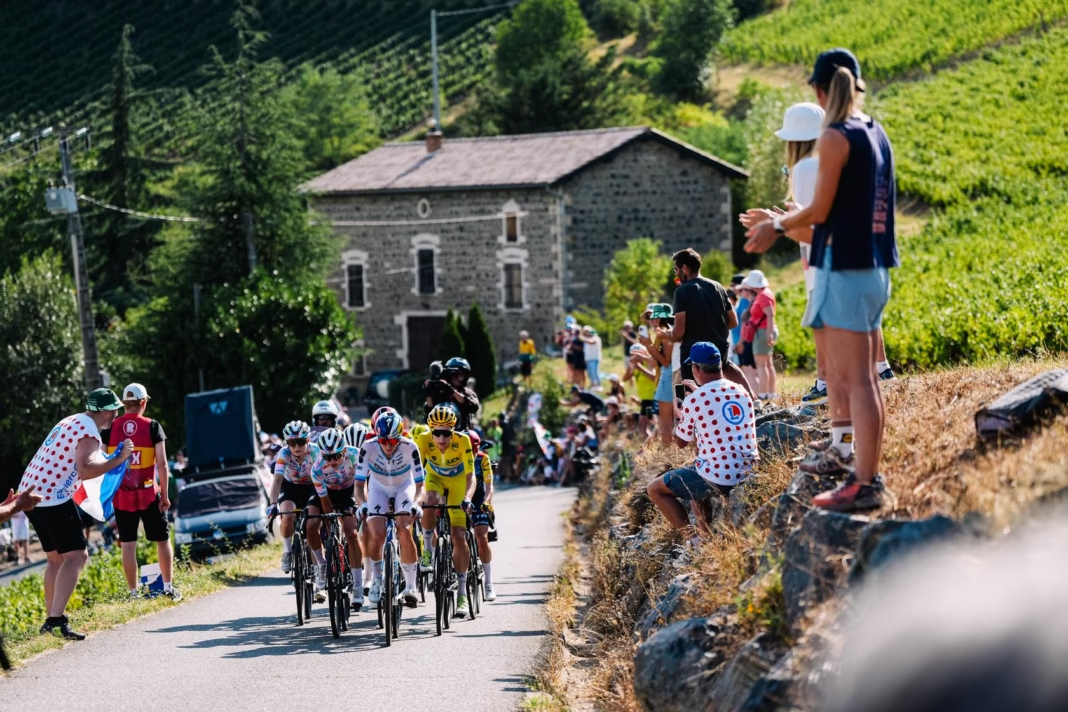
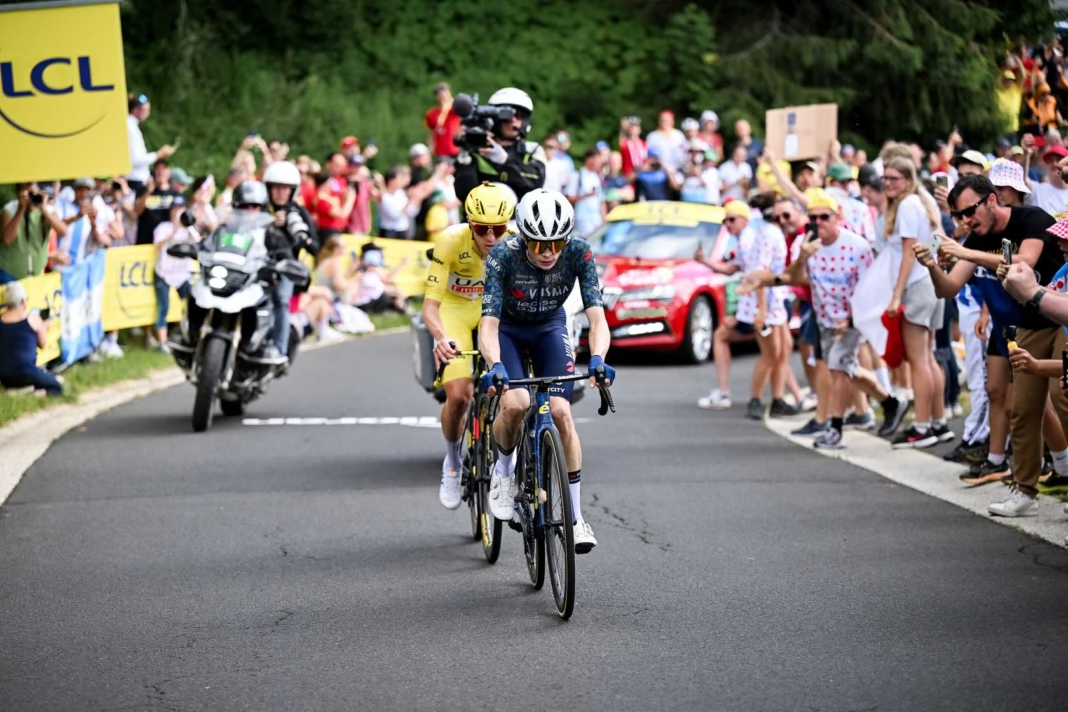
Gall’s task was different. He entered the stage second overall but held only four seconds over Roglič, making that position extremely difficult to defend on a 32km flat time trial.
The Austrian was 22 seconds slower than Roglič at the first checkpoint and the gap was close to a minute after 22.1km. By the finish he had conceded 1:28 to the Slovenian.
That drops Gall to third overall at 3:01, while Roglič moves into second at 1:37.
Gall did at least limit his losses sufficiently to remain firmly on the podium and he now returns to terrain that should suit him much better. The difficulty is that he is almost a minute and a half further away from Mas than he was before the time trial.
Oscar Onley also produced a useful ride in defence of the white jersey, finishing 27 seconds faster than Jakob Omrzel and strengthening his advantage over the Bahrain Victorious rider.
Mas takes most of his advantage into the mountains
Roglič achieved two things in Jerez. He moved into second place and reduced Mas’s lead. What he failed to do was change the basic shape of the Vuelta.
A 1:37 deficit is still substantial when the rider ahead has repeatedly matched or bettered Roglič in the mountains. Mas gained time at Aitana, Calar Alto and Sierra de La Pandera specifically to protect himself against this time trial, and 97 seconds of that cushion remain.
The 2026 Vuelta route now turns immediately back towards climbing. Peñas Blancas comes first before Saturday’s decisive stage to Collado del Alguacil, where the final 8.3km averages 9.8%.
Roglič therefore needs a mountain performance unlike anything he has produced against Mas so far in this race. Gall has even more time to recover, although the Austrian has already shown that he can distance Roglič uphill.
Küng had a much simpler objective in Jerez. He needed to be faster than every rider over 32.1km, and despite Thornley’s breakthrough ride, Almeida’s strong challenge and Roglič’s GC effort, nobody could match him.
Vuelta a España 2026 stage 18 result
| Position | Rider | Team | Time/gap |
|---|---|---|---|
| 1 | Stefan Küng | Tudor Pro Cycling Team | 35:22 |
| 2 | Callum Thornley | Red Bull-BORA-hansgrohe | +0:03 |
| 3 | João Almeida | UAE Team Emirates-XRG | +0:09 |
| 4 | Primož Roglič | Red Bull-BORA-hansgrohe | +0:19 |
| 5 | Wout van Aert | Visma | Lease a Bike | +0:20 |
| 6 | Finn Fisher-Black | Red Bull-BORA-hansgrohe | +0:21 |
| 7 | Bruno Armirail | Visma | Lease a Bike | +0:26 |
| 8 | Ivo Oliveira | UAE Team Emirates-XRG | +0:30 |
| 9 | Ethan Hayter | Soudal Quick-Step | +0:32 |
| 10 | Xabier Azparren | Pinarello-Q36.5 Pro Cycling Team | +0:33 |
Main photo credit: Getty

