
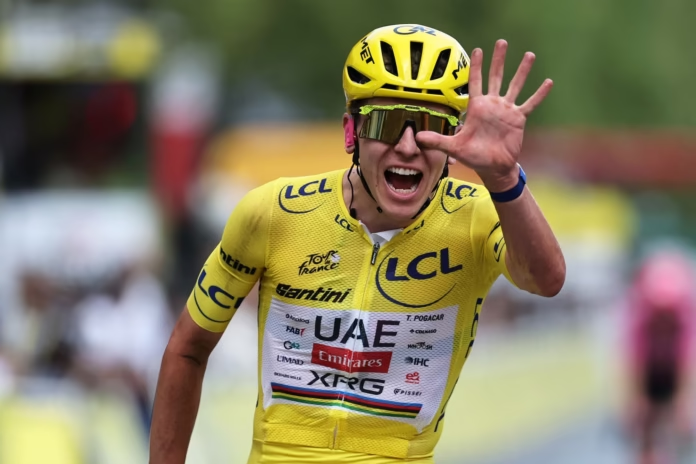
A Grand Tour is one of cycling’s three biggest men’s stage races: the Giro d’Italia, Tour de France and Vuelta a España. Each lasts around three weeks, usually includes 21 stages and tests riders across flat sprint days, mountain stages, time trials and long transitional days. Unlike a one-day Classic, the winner is decided by the lowest cumulative time across the entire race.
What are men’s cycling’s three Grand Tours?
The three Grand Tours are the Giro d’Italia in Italy, the Tour de France in France and the Vuelta a España in Spain. They sit at the top of men’s stage racing, with each race lasting roughly three weeks and combining very different types of terrain.
- Giro d’Italia: normally held in May, with the race leader wearing the pink jersey.
- Tour de France: normally held in July, with the race leader wearing the yellow jersey.
- Vuelta a España: normally held from late August into September, with the race leader wearing the red jersey.
The Tour de France is the best-known of the three, but winning any Grand Tour is one of the biggest achievements in professional road cycling. Riders who win all three during their careers join a very short list, while winning two or even all three in the same season is much rarer still.
How does a Grand Tour work?
A Grand Tour is made up of individual stages. Every rider starts each stage and receives a finishing time. Those times are added together across the race, and the rider with the lowest total time leads the general classification, usually shortened to GC.
This means a rider does not need to win many stages to win the race overall. A GC contender can finish close to the front every day, avoid losing time in crosswinds or crashes, climb with the strongest riders and gain time in the time trials. Conversely, a rider can win several stages without being anywhere near the overall lead.
Grand Tours also include rest days, usually two across the three weeks. Those breaks are important for recovery, but they do not reset the standings. Time gained or lost in the opening week still counts in the final classification.
How many stages are in a Grand Tour?
A modern Grand Tour normally has 21 stages spread across 23 or 24 days, including rest days. Race organisers can vary the route from year to year, but the basic structure remains similar.
- Flat stages give sprinters their best opportunities.
- Hilly and medium-mountain stages suit breakaways, puncheurs and aggressive GC racing.
- High-mountain stages are where the biggest general classification gaps are often created.
- Individual time trials race riders against the clock rather than directly against one another.
- Team time trials occasionally appear and require teams to race together against the clock.
The balance between these stage types can completely change who starts as favourite. A route with several long time trials may favour a different rider from one built around repeated summit finishes.
What classifications can riders win?
The general classification is the main prize, but it is not the only competition running through a Grand Tour. Each race awards several jerseys and classifications at the same time.
The GC jersey goes to the rider with the lowest cumulative time. The Giro uses pink, the Tour uses yellow and the Vuelta uses red. There is also normally a points classification rewarding consistent high finishes, a mountains classification for collecting points over categorised climbs and a young rider classification for eligible younger riders.
There is also a team classification based on the combined times of selected riders from each squad. Individual stages remain important in their own right, so teams often arrive with several separate objectives rather than putting everything behind one GC leader.
Why are Grand Tours so difficult?
The difficulty is not just the mountains. Grand Tour riders have to repeat high-level efforts for three weeks while dealing with travel, changing weather, crashes, illness, heat, cold, altitude and limited recovery time. A rider can survive the hardest mountain stage and still lose the race through a badly timed puncture, crosswind split or crash on what looked like an easier day.
Consistency therefore matters as much as one exceptional performance. GC riders have to protect their position every day, while teammates spend huge amounts of energy controlling breakaways, collecting bottles, positioning leaders before climbs and sheltering them from the wind.
What is a time cut in a Grand Tour?
Riders cannot simply finish as slowly as they like. Each stage has a time limit calculated from the winner’s time and the difficulty or speed of the stage. Anyone finishing outside that limit can be eliminated from the race, although commissaires can occasionally apply exceptions when a very large group is affected.
This is especially important for sprinters in the mountains. They may have no interest in the GC, but they still need to climb quickly enough to stay inside the time cut and reach later sprint opportunities.
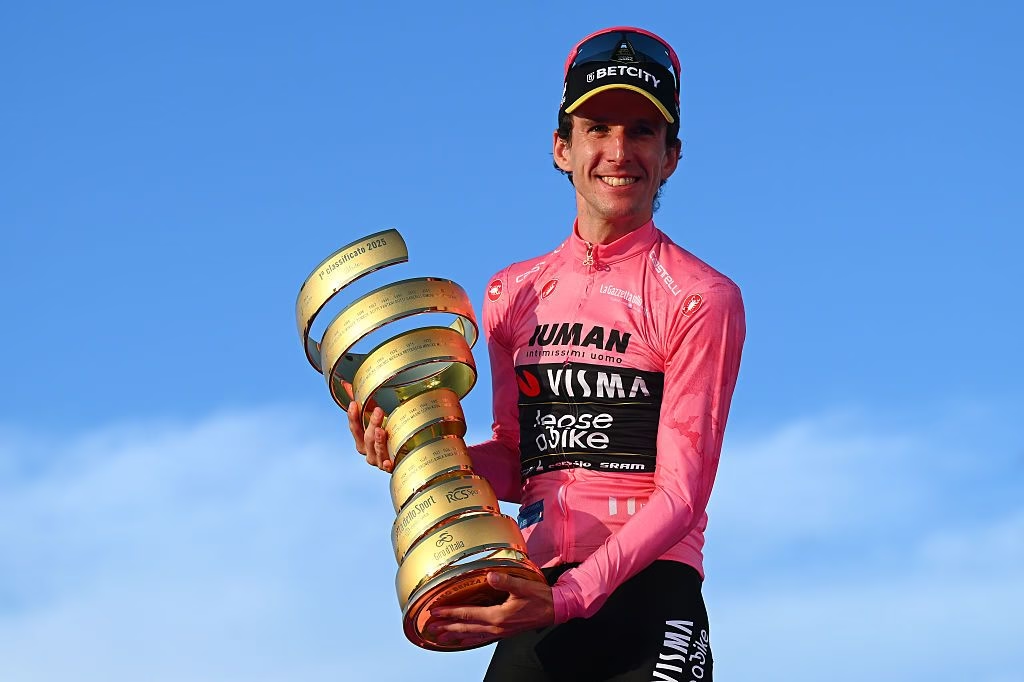 Photo Credit: Getty
What is the difference between the Giro, Tour and Vuelta?
All three races use the same basic stage-race format, but each has its own character. The Giro is strongly associated with steep Italian climbs, unpredictable spring weather and the pink jersey. The Tour de France carries the greatest global attention and usually attracts the deepest concentration of teams and GC leaders. The Vuelta a España is known for steep summit finishes, hot late-summer conditions and aggressive racing after the Tour.
The Giro d’Italia and Vuelta can sometimes offer more freedom for breakaways and younger riders, but that varies from edition to edition. All three remain races where route design, weather, team strength and form can shape the result as much as reputation.
Can a rider race all three Grand Tours in one year?
Yes, but completing all three is demanding and trying to win all three is much harder. The Giro, Tour and Vuelta together amount to more than 60 race days in a single season, with only limited recovery between them.
Some riders deliberately race two Grand Tours in the same year, while others use one race to support a teammate or chase stages rather than target the overall. Attempting the Giro-Tour double or Tour-Vuelta double is a major test even for the strongest stage racers.
Do women race Grand Tours?
Women’s professional cycling has major stage races including the Tour de France Femmes, Giro d’Italia Women and La Vuelta Femenina, but they are shorter than the men’s three-week Grand Tours. The term “Grand Tour” is still most commonly used for the men’s Giro, Tour and Vuelta.
The women’s biggest stage races have expanded significantly in recent years, however, and now form the centre of the Women’s WorldTour stage-racing calendar. ProCyclingUK covers them with dedicated guides, previews and race analysis throughout the season.
Which Grand Tour is the biggest?

The Tour de France is the biggest in terms of global profile, media attention and commercial reach. That does not make the Giro or Vuelta minor races. Both are among the most important events in professional cycling, and winning either can define a rider’s career.
For new fans, the easiest way to understand Grand Tours is to think of them as three-week championships of consistency. Riders need climbing, time-trialling, positioning, recovery and a strong team around them. One bad day can undo two weeks of good racing, which is why the final winner is rarely decided by a single stage.

