
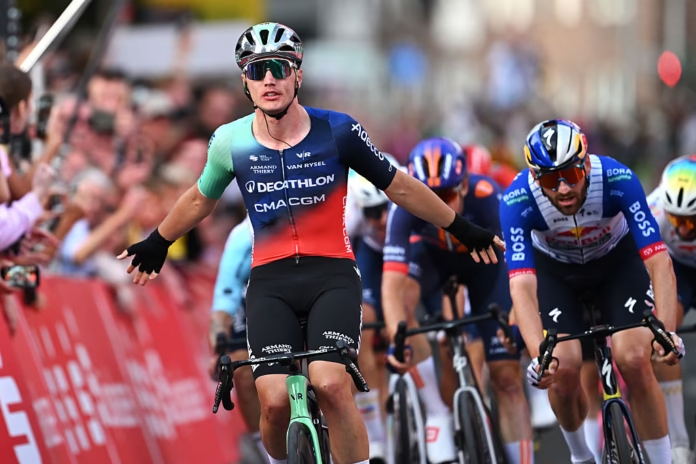
Olav Kooij won the 2026 Sparkassen Münsterland Giro for Decathlon CMA CGM Team, finishing in 4:08:32. Jordi Meeus and Frits Biesterbos completed the podium on the same time, with the result decided from a group that came back together in the closing kilometres.
The race was shaped by a long attempt to establish a break, a second move that survived deep into the afternoon, and a late chase that only completed its work with 5.5km remaining. Kooij’s team then appeared at the front in the final three kilometres, while the last remnants of the break and a late move from within the peloton were neutralised.
How it unfolded
Luke Durbridge was the first named rider to accelerate, going clear with 197km still to race. A further move came from REMBE | rad-net at 188km, before five riders gained a small advantage by the 179km point. That early sequence showed the race had not settled immediately, with several attempts required before a break could establish itself.
The first break did not build an enduring advantage. By 172km remaining, the gap to the peloton was already decreasing, and three riders attacked from the bunch four kilometres later. Six riders were then reported to have a small gap at 164km, indicating that the early race was still being reshaped rather than controlled by one fixed escape.
At 153km remaining, Siebe Roesems was pulling in the peloton for Alpecin – Premier Tech. That was the first named evidence of organised work behind the break, and it helped define the broad pattern of the race: the escape could form, but the bunch retained the means to reduce its advantage.
The early break never secured control
The decreasing gap at 172km was important because it prevented the first move from becoming the race’s defining feature. Although a group of five had opened a small advantage, the peloton was already bringing it back towards reach. The attack by three riders at 166km then changed the composition of the escape rather than freeing it entirely from the bunch.
With six riders clear at 164km, the race entered a more stable phase, but the wording of the event evidence remains significant: the group had only a small gap. That meant the break was present without being decisive, and the later result would depend on whether a larger move could survive the renewed pressure from the bunch.
Roesems’ turn on the front at 153km was followed by a long period without a named catch or decisive split. That chronology points to a race in which the peloton was managing the escape rather than allowing it to disappear up the road. The early attacks created movement, but not the separation needed to carry the race to the finish.
A second move changes the shape of the race
The next clearly identified acceleration came from Loe van Belle, who attacked in the peloton with 100km remaining. Mads Pedersen followed with another acceleration at 79km, and by 78km nine riders had a small gap. This was the largest named breakaway in the event sequence and represented a fresh attempt to turn the race from a controlled escape into a genuine late threat.
The response was immediate. Soudal Quick-Step was pulling in the peloton at 75km, only three kilometres after the nine-rider move had been recorded. The chase therefore had a visible organisation behind it, and the gap remained vulnerable despite the increased size of the group ahead.
The consequence was a race divided into two linked contests. The nine-rider move had to preserve its advantage, while the peloton had to decide how much pressure was needed to bring it back. The later events show that the chase gradually prevailed, but it did not erase the break until the final six kilometres.
No rider from the break is identified as having made the decisive move that carried through to the finish. Instead, the escape was reduced progressively. Noé Ury was dropped from the break with 57km remaining, removing one rider from the group well before the final phase and leaving the remaining escapees with less depth as the peloton continued to close.
The peloton keeps the late break within reach
Jonas Rutsch accelerated from the peloton with 20km left. His move came while the established break was still alive, adding another layer to the chase rather than producing a confirmed new front group. At 13km, Lidl – Trek was pulling in the peloton, a further sign that the bunch was committing resources to the pursuit.
The late pressure finally brought the break to the edge of capture. Kelland O’Brien accelerated within the break at 7km, but the move did not survive. Arno Wallenborn was dropped from the escape at 6.6km, and Pinarello Q36.5 Pro Cycling Team was pulling in the peloton at 6km.
Those events narrowed the race from both directions. O’Brien’s acceleration was the final recorded attempt from inside the break, while Wallenborn’s drop showed the group was losing riders just before its advantage disappeared. The peloton then caught the break with 5.5km remaining, removing the last established escape before the finish.
The catch did not come early enough to make the closing phase routine. The break had survived deep into the final part of the race, and the peloton still had to organise its approach after the escape was absorbed. The result, however, confirms that the final selection was made from the returning group rather than by a rider who remained clear from the earlier move.
Decathlon take responsibility in the final kilometres
Once the break was caught, Daan Hoole was pulling for Decathlon CMA CGM Team with 3km left. That was a direct contribution from Kooij’s team at the point when the race had returned to the bunch, linking the team’s work in the closing kilometres to the eventual victory without requiring any assumption about the exact finishing tactic.
At 2.3km, Niklas Behrens was pulling for Team Visma | Lease a Bike. Hoole was then caught at 1.7km, ending his recorded turn at the front. Together, those events show a final phase in which more than one team was still working to shape the approach, with Decathlon having already helped close the last move and Visma also contributing near the finish.
The final incident came with 300 metres remaining, when Tom Van Asbroeck crashed. The event identifies the rider and the crash, but does not establish that it determined his result or altered the outcome for the leaders. It occurred after the break had been caught and during the closing approach, leaving the podium contest to be settled among the riders who reached the finish on the same time.
Kooij wins as the front group stays together
Kooij’s winning time of 4:08:32 came after a race in which the decisive advantage was not created by a successful solo escape. The break was caught at 5.5km, and the final named events concern pulls by Decathlon and Visma rather than a surviving attack. The strongest conclusion supported by the chronology is that Kooij’s victory came from the group that remained together after the late break was neutralised.
Meeus finished second and Biesterbos third, both on Kooij’s time. Their positions make the medal fight extremely close in time, but the official order still separates the three riders. The result gives Kooij the victory while confirming that neither of the two closest challengers was able to finish ahead once the race had returned to the bunch.
The outcome also reflects the different paths taken by the main contenders. Kooij’s team was involved directly in the final chase through Hoole’s pull at 3km. Meeus and Biesterbos were not named in the event sequence, so no additional attack or chase role can be assigned to them. Their final positions are nevertheless clear: both reached the decisive finishing group and completed the podium.
Anthony Turgis finished fourth, followed by Hugo Hofstetter and Florian Dauphin. Milan Fretin was seventh, Jasper Philipsen eighth, Arvid de Kleijn ninth and Søren Wærenskjold tenth. The top ten therefore remained tightly concentrated around the winning time, while the next confirmed separation in the result came at 1 second behind, where Rayan Boulahoite and Tim Merlier were placed 17th and 18th.
Why the winning margin held
The race was ultimately about control rather than one unanswerable attack. Early moves were joined and reshaped, the first break’s gap decreased, and the larger nine-rider move was chased by Soudal Quick-Step and later by other teams. Even after surviving to the final kilometres, the break was caught before it could contest the finish.
That left Kooij with the clearest verified advantage in the closing sequence: Decathlon CMA CGM Team was active at the front after the catch, with Hoole pulling at 3km and being caught at 1.7km. The result cannot establish every detail of the finish, but it does show that the winning team was still shaping the race after the last break had gone.
Meeus and Biesterbos were the closest finishers, yet neither displaced Kooij. The late catch, the final pulls and the same-time podium together explain the result’s structure: the escape made the peloton work until deep into the finale, but the decisive order was settled only after the race had closed back around the leading group.
Sparkassen Münsterland Giro 2026 Result
| Pos. | Rider | Team / nation | Time / gap |
|---|---|---|---|
| 1 | Olav Kooij | Decathlon CMA CGM Team | 4:08:32 |
| 2 | Jordi Meeus | Red Bull – BORA – hansgrohe | Same time |
| 3 | Frits Biesterbos | Team Picnic PostNL | Same time |
| 4 | Anthony Turgis | TotalEnergies | Same time |
| 5 | Hugo Hofstetter | NSN Cycling Team | Same time |
| 6 | Florian Dauphin | TotalEnergies | Same time |
| 7 | Milan Fretin | Cofidis | Same time |
| 8 | Jasper Philipsen | Alpecin – Premier Tech | Same time |
| 9 | Arvid de Kleijn | EF Education – EasyPost | Same time |
| 10 | Søren Wærenskjold | Uno-X Mobility | Same time |

