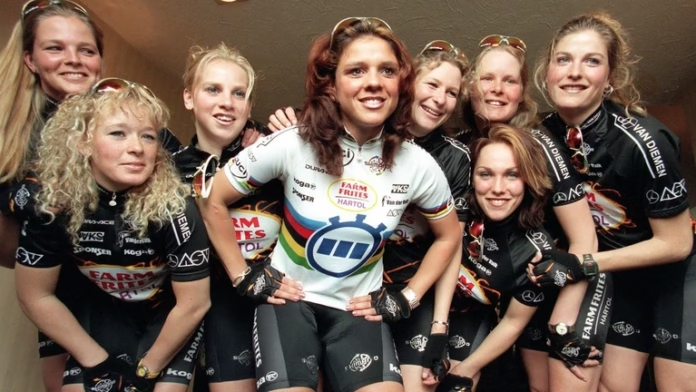
Farm Frites-Hartol existed for only six seasons, from 1999 to 2004, but its place in women’s cycling history is larger than that short lifespan suggests. The Dutch team combined one of the era’s defining riders, Leontien Zijlaard-van Moorsel, with a roster that increasingly became a home for Classics specialists, track riders and multi-discipline talent. By the final years, Mirjam Melchers had become another central figure and the team remained among the strongest formations in the women’s peloton.
The team began as Hartol-Farm Frites in 1999 before the sponsors reversed order from 2000. Farm Frites, the Dutch potato-products company also familiar from men’s professional cycling, became the headline name. Hartol, a construction company, remained the second sponsor, while Koga supplied the bikes through the 2000-2004 period.
Its story belongs to a very different structure of women’s professional cycling. Budgets were smaller, teams were less stable and riders commonly combined road programmes with track, cyclocross or mountain biking. Farm Frites-Hartol did not merely tolerate that environment. Several of its best riders were successful precisely because they could move between disciplines.
A team built around Leontien van Moorsel
Michael Zijlaard managed the team throughout its existence, with Jean-Paul van Poppel also involved in the sporting staff. The defining rider was Zijlaard’s wife, Leontien van Moorsel, whose career had already included world titles before the team was created. Her presence immediately gave the new formation status beyond what would normally be expected from a first-year squad.
Van Moorsel’s value was unusually broad. She could win major road races and time trials, but she was also one of the leading track riders of her generation. That mattered commercially and competitively. A women’s team in this period could gain visibility from championships and Olympic competition as well as the comparatively limited road calendar.
The 2000 Sydney Olympics became the clearest expression of that range. Van Moorsel won the road race, the individual time trial and the individual pursuit, adding silver in the points race. Those medals were won for the Netherlands rather than Farm Frites-Hartol, but the association inevitably strengthened the team’s profile. Few trade teams of the era could claim a rider who dominated an Olympic programme across road and track.
 Photo Credit: Cor Vos
Dutch depth and a multi-discipline identity
Farm Frites-Hartol was never simply a one-rider project. The roster reflected the depth of Dutch women’s cycling around the turn of the century. Daphny van den Brand, later best known for cyclocross, won the Dutch road title in 2001 while riding for the team. Elsbeth van Rooy-Vink brought mountain-bike strength, while riders such as Sissy van Alebeek, Anouska van der Zee and Yvonne Hijgenaar added further road and track depth.
That crossover now looks striking because modern elite teams are usually more specialised, even as riders such as Marianne Vos and Pauline Ferrand-Prévot have kept multi-discipline careers visible. Around 2000 it was much less unusual. The calendar and economics encouraged riders to compete wherever strong opportunities existed, and Dutch cycling had a particularly deep pool of athletes comfortable on different surfaces.
The team also recruited internationally. Hanka Kupfernagel, whose career stretched across road, cyclocross and time trialling, is one of the clearest examples. Her wider career is covered in our Hanka Kupfernagel profile. Susanne Ljungskog, another rider associated with the team, later became a double world road champion and one of Sweden’s leading cyclists.
Mirjam Melchers changes the team’s Classics profile
Mirjam Melchers joined in 2002 and gave Farm Frites-Hartol a second leader with a different emphasis. She was particularly effective in one-day races and immediately delivered at World Cup level, winning Primavera Rosa in 2002. She followed with victory at the GP Castilla y León in 2003 and remained among the strongest riders in the World Cup standings.
Melchers’ arrival mattered because van Moorsel was moving towards the later phase of her career. Rather than allowing the team to become entirely dependent on its established star, Farm Frites-Hartol could attack major road races with another rider capable of winning outright. That also made the team harder to control tactically, especially in races where Dutch numbers could be used aggressively.
The strength of that period is visible in the World Cup standings. In 2004, two Farm Frites-Hartol riders finished inside the top four overall. The team could score across very different events rather than relying on a single race type. That breadth was one of its strongest characteristics in its final seasons.
The 2004 season and a strong final roster
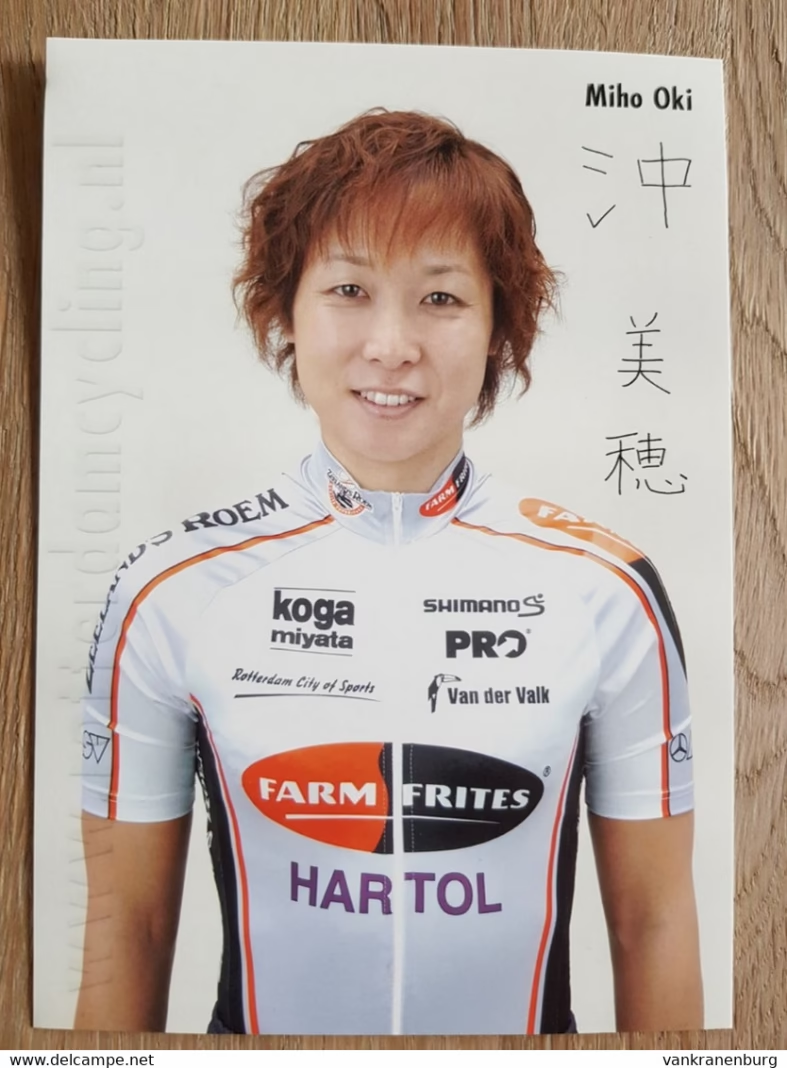
The final 2004 roster included van Moorsel, Melchers, Rachel Heal, Yvonne Hijgenaar, Miho Oki, Sissy van Alebeek, Esther van der Helm, Anouska van der Zee, Elsbeth Vink and the young Adrie Visser. It was a group with road, track and off-road ability rather than a narrowly constructed stage-racing squad.
Melchers won the Dutch road championship that year. Angela Hennig delivered a stage victory at the Giro d’Italia Femminile and also won the GP Castilla y León World Cup round. Those results showed that the team still had competitive depth even as the van Moorsel era approached its end.
Van Moorsel’s own 2004 season again centred on the Olympics. In Athens she won the individual time trial and took bronze in the individual pursuit. Her retirement at the end of the season removed the rider around whom the project had originally been built, and Farm Frites-Hartol itself did not continue into 2005.
Why Farm Frites-Hartol mattered
The team’s significance is partly statistical. Across six years it repeatedly ranked among the strongest women’s teams in the world and collected national titles, World Cup victories and Giro success. But the roster is more revealing than a simple win count. Van Moorsel, Melchers, Kupfernagel and Ljungskog all had careers that reached well beyond ordinary trade-team success.
There was also a recognisably Dutch development thread. Riders could move through a strong domestic scene into an international team without abandoning track or cyclocross ambitions. Adrie Visser, for example, was still early in her career when she joined the 2004 roster and later became an important road and track rider. The team’s structure made room for that type of athlete.
For a fuller example of the international talent that passed through the squad, our Susanne Ljungskog profile follows the Swedish rider’s wider career. Farm Frites-Hartol was one chapter in those careers, but the number of significant riders who wore its colours explains why the team remains worth remembering.
A snapshot of women’s cycling before the modern team era
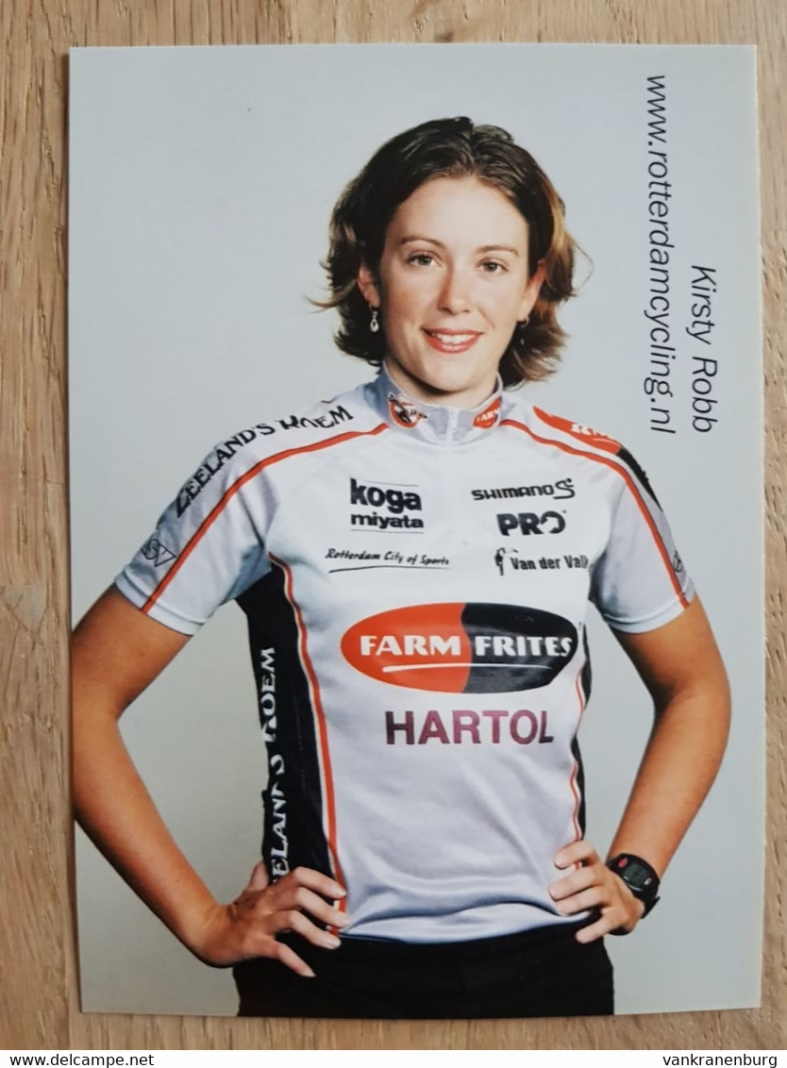
Looking back at Farm Frites-Hartol also shows how much the sport has changed. Modern Women’s WorldTour teams have larger staffs, longer contracts, extensive performance departments and calendars built around specialist objectives. The Dutch team operated before that infrastructure became normal, when a leading rider might target Olympic track medals, road World Cups and national championships within the same programme.
That does not make the earlier era less sophisticated. It required a different kind of flexibility. Farm Frites-Hartol built a successful team around one exceptional leader, added a second major road threat in Melchers and maintained enough depth to stay competitive as women’s cycling changed around it.
Its disappearance after 2004 was typical of an era in which sponsorship cycles could quickly reshape the peloton. The name vanished, but many of its riders continued to define European women’s cycling for years afterwards. That legacy gives Farm Frites-Hartol a clearer place in the sport’s history than its six-season lifespan might initially suggest.