On a cold Sunday morning, four hours in the saddle can feel like proof that winter training is going well. There is the distance on Strava, the satisfaction of getting out when the roads are wet and the reassurance that the spring fitness is being earned. What the ride does not show is whether it was the best use of those four hours.
For an amateur cyclist balancing a job and the ordinary demands of life, winter is not simply a contest to accumulate mileage. The test is whether Sunday’s ride leaves enough in the legs for Tuesday, Thursday and the following weekend. A long ride that empties the tank may be less useful than a shorter one you can recover from, particularly when bad weather makes every hour more demanding.
That does not make long, steady riding obsolete. It means the old instruction to put in as many winter miles as possible needs a qualification: mileage is a tool, not the objective. The most useful winter plan is one that fits the rider, the event they are preparing for and the conditions on the road.
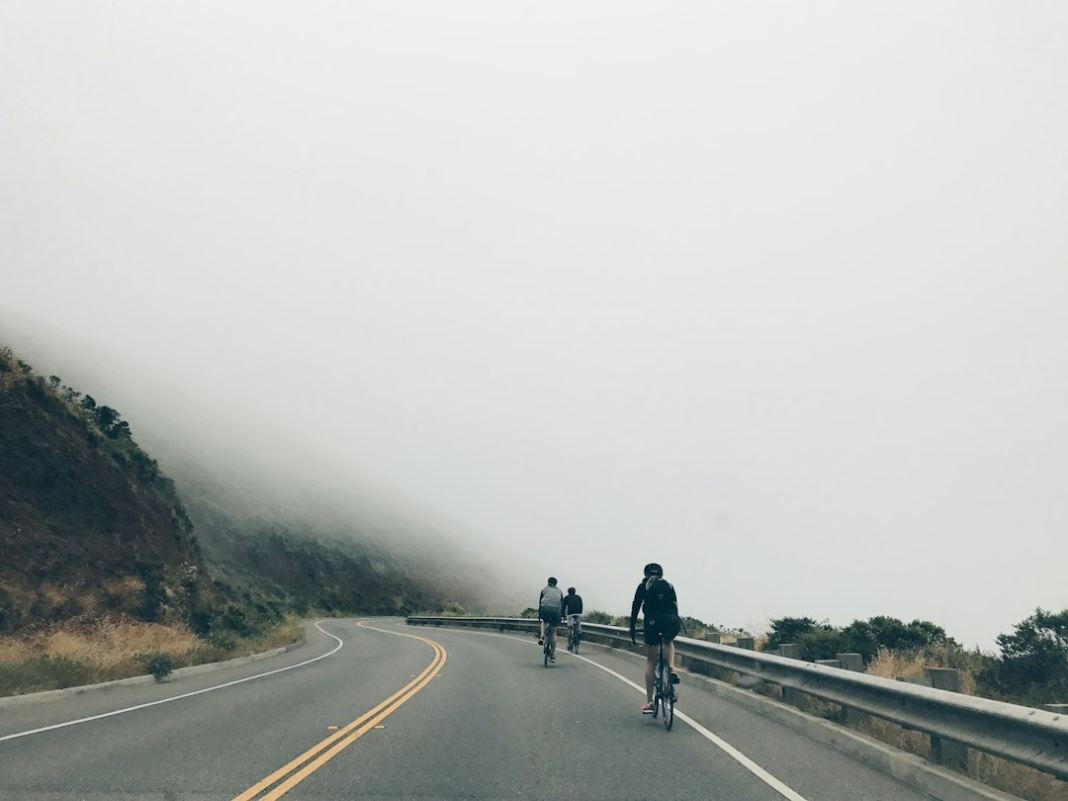
Photo: Tessa Rampersad / Unsplash.
The professional’s winter is not your winter
The idea of a winter base came from a sensible place. Sustained riding develops the ability to keep producing work for hours, and endurance is indispensable whether the target is a hilly sportive, a road race or a faster club ride. The mistake is to assume that a training method suited to a professional’s schedule should be copied at a fraction of the volume.
British Cycling makes that distinction in its guidance on winter training intensity. It notes that extensive low-intensity riding can work for professionals whose training weeks reach 30 hours or more. For amateurs who have perhaps five to 15 hours available, it argues that restricting training to long, easy rides is not necessarily the most effective way to improve.
The difference is not just fitness. Professional riders have room to organise food, rest and their daily schedule around training. An amateur may start a three-hour Sunday ride after a busy week and then go straight back to work on Monday. The physiological stimulus matters, but so does the practical cost of obtaining it.
There is also a distinction between riding to finish an event and riding to perform better in it. Someone preparing for their first 100 km sportive needs time on the bike, confidence over the distance and a chance to practise eating and drinking while moving. A rider hoping to stay with a faster group over the same distance also needs the ability to cope with repeated changes of pace. Neither objective is well served by copying somebody else’s weekly kilometre total.
That is why the better question for a winter ride is not how far can I go? but what should this session improve?
Give each ride a purpose before choosing a distance
A useful week need not be complicated. Consider an amateur with roughly six hours available and a goal in late spring. One midweek session might contain a properly warmed-up block of sustained, challenging efforts on an indoor trainer or a safe, familiar route. A second ride could be easier, focused on maintaining aerobic work without carrying unnecessary fatigue. The longer weekend ride then builds endurance, tests clothing and fuelling, and provides the pleasure of riding outside.
For that rider, a 60- to 75-minute quality session, another hour of relatively comfortable riding and a two- to three-hour weekend ride could form a workable core. The remaining time might be used for an optional recovery spin or left completely free. Those durations are an illustration, not a prescription: experience, current fitness, recovery and the goal event should determine the actual load.
The important point is that the sessions do different jobs. Making every ride moderately hard because the group is moving quickly can leave little space for either genuinely controlled endurance or purposeful intensity. Equally, making every ride easy because it is November can neglect the demands of a fast sportive or a spring race.
British Cycling’s winter-training material challenges the assumption that the off-season must be entirely slow mileage, while Cycling UK’s training advice also recognises that shorter, more demanding sessions have a place alongside steady rides. The disagreement is often exaggerated. Endurance volume is valuable, but it has to be proportionate to the time and recovery the rider actually possesses.
For riders who want to build from a modest schedule, ProCyclingUK’s guide on getting faster on three rides a week provides a useful starting point. The number of sessions matters less than their suitability and whether they can be repeated.
The long club ride still has a job to do
There are good reasons not to replace the entire winter with an indoor training plan. Riding for several hours exposes weaknesses that a controlled 45-minute session may never reveal: poor pacing on rolling roads, hands that go numb after two hours, clothing that cannot cope with a stop, or a fuelling strategy that works until the final hour and then falls apart.
Group riding adds its own demands. Following wheels smoothly, anticipating potholes, communicating hazards and riding predictably all require practice. A steady club ride can develop judgement as well as endurance, provided the pace remains appropriate and the group responds sensibly to the weather.
The trick is to stop treating the advertised route as a contract. If the forecast deteriorates or fatigue accumulates, a shorter loop with an easy route home can still serve the purpose. A 70 km ride that goes to plan may be worth more than forcing the final 30 km of an arbitrary 100 km target when the day has become a struggle.
And if the goal is a long event, there will eventually need to be rides long enough to test event-specific endurance. Winter is a good opportunity to build towards them, not a reason to ride maximum distances every weekend from November onwards. Our guide to building winter base fitness examines that longer-term foundation.
The turbo is not an admission of defeat
Indoor training has a reputation problem in some club circles. Outdoor mileage looks more committed; riding indoors can feel like an inferior substitute. Yet on a dark Tuesday evening, a smart trainer can offer something the road cannot: uninterrupted control of the session.
British Cycling’s winter cycling myth-buster puts it plainly: “Using an indoor trainer isn’t a soft option”. There are no traffic lights, icy bends or lengthy descents disrupting an effort. A rider can warm up, complete the intended work and cool down without having to turn a potentially hazardous evening into an exercise in bravado.
That does not make indoor training physiologically identical to a road ride or automatically better. It is simply a practical way to put a suitable session in the right place. Longer outdoor rides can retain the handling, pacing and social elements that are difficult to reproduce in a spare room.
For some cyclists, particularly those who spend much of the working week indoors already, getting outside is the chief reason they ride. Enjoyment is a legitimate part of a sustainable training plan. The better choice is the one that preserves both the purpose of the session and the desire to ride again.
Bad weather changes more than your average speed
A winter forecast should affect route choice as well as clothing. Rain, cold and strong winds make a familiar ride more demanding to organise, but ice is a different category of risk. The Met Office’s winter cycling guidance, drawing on British Cycling advice, warns that wet or icy surfaces reduce available grip and recommends smooth braking and cornering, with extra stopping distance.
In practice, that means identifying the parts of a route where the road is likely to remain colder or less predictable: shaded lanes, exposed bridges, untreated minor roads and downhill bends. A main road that has been gritted may be a better option than a quiet lane that has not, but the Met Office also cautions against assuming any route has been treated.
If there is a credible risk of black ice, postponing an outdoor ride or moving the session indoors is a sound decision, not a failure of commitment. No ordinary road tyre, however wide or carefully inflated, guarantees grip on ice. The same applies when severe winds or flooding make a route unacceptably risky.
Low winter sun can be awkward too. A driver looking into glare may have difficulty seeing a rider, even when the cyclist feels conditions are bright enough. Darkness carries clearer legal requirements. Under Rule 60 of the Highway Code, a bicycle ridden at night must have an illuminated white front light and red rear light, as well as the required reflectors. Fluorescent clothing in poor daylight and reflective details in darkness are recommendations for visibility, not substitutes for the lights.
Good judgement also involves the group. A club ride should not turn into an improvised race on dirty, unfamiliar roads simply because riders are eager to keep warm. More distance between wheels, earlier communication of hazards and gentler acceleration matter when traction and stopping distances are less forgiving.
Fuel the session you are actually riding
One of the more avoidable winter mistakes is treating cold weather as a reason to neglect food and drink. Riders may not feel as thirsty, bottles are less appealing and a café stop can make it easy to underestimate how much work has already been done. None of that removes the energy cost of riding.
For an easy spin of under an hour, normal meals may be enough. For longer or harder sessions, take food that can be opened and eaten with gloves on, start fuelling before fatigue becomes obvious and match what you carry to the ride’s length and intensity. That may mean a carbohydrate drink, an accessible bar or another familiar option you already tolerate. Winter is not the best time to discover that your chosen packaging cannot be opened with cold fingers.
Practising this on the club ride has a direct benefit for spring sportives. Riders who repeatedly finish endurance sessions underfuelled can confuse a preventable drop in energy with an inability to manage the distance. ProCyclingUK’s guide to fuelling rides covers the fundamentals in more detail.
Clothing deserves the same functional approach. A windproof outer layer, a suitable base layer and the ability to adjust ventilation are often more useful than simply wearing the thickest jacket available. Cycling UK recommends layering because the temperature and the rider’s workload can change substantially over one ride. Gloves and overshoes have an outsized effect on comfort, particularly when a long descent follows a sweaty climb.
Carry an extra layer for unexpected stops. There is an important difference between being comfortable while generating heat and standing beside a punctured tyre for 20 minutes in a crosswind.
The best winter bike is the one that stays reliable
The performance of a winter bike is measured partly by the rides it allows you to complete without interruption. Wet roads, grit and salt accelerate wear on the chain, gears and braking components. British Cycling recommends regular cleaning, suitable lubrication, checks of wear-prone parts and mudguards to limit spray.
For many amateur road riders, this is a stronger argument for reliability than for any particular frame material or groupset. Tyres with sensible puncture protection and enough clearance for the conditions can reduce the chance of an unpleasant roadside repair. Appropriate pressure can improve control on rough or wet surfaces, but changes must remain within the tyre and rim manufacturers’ limits, and a wet-weather road set-up should never be mistaken for ice protection.
Full-length mudguards, where they can be fitted safely with sufficient clearance, benefit the rider behind as well as the one using them. That matters on winter club rides: road spray can turn an otherwise manageable morning into several hours of being soaked by the wheel in front.
A quick post-ride wash, inspection of the brake pads and a clean, lubricated drivetrain are less glamorous than buying a new piece of kit, but they help preserve the equipment that has to survive the rest of the season. Our guide to common bike maintenance problems is a useful companion.
Build a plan that can survive a British winter
A good winter schedule should have alternatives before they are needed. An outdoor endurance session may become a shorter ride if the temperature drops, an indoor session if the roads freeze, or a rest day if the rider is already exhausted. None of those choices requires rewriting the entire season.
The most revealing measure is often not the single biggest ride of November or December, but the amount of useful training accumulated over several weeks. That calls for enough intensity to match the goal, enough endurance to support it and enough flexibility to account for ordinary life.
There will still be mornings when a long, cold club ride is exactly what the rider needs. The coffee, the company, the empty lanes and the satisfaction of coming home after several hours all have their place. They just do not become better training merely because the number on the computer is larger.