
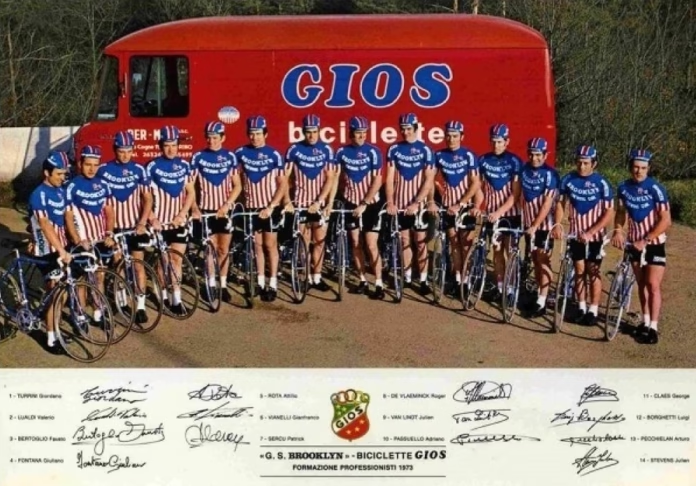
Brooklyn lasted only five seasons under the name that made it famous, but few teams from the 1970s are as instantly recognisable. The stars-and-stripes jersey, blue Gios bikes and Roger De Vlaeminck’s success on the cobbles turned an Italian trade team sponsored by chewing gum into one of cycling’s enduring visual references.
The image can sometimes overwhelm the substance. Brooklyn was not simply a stylish Classics team built around one rider. It won Monuments, stage races, Tour de France stages and classifications, collected dozens of Giro d’Italia stage wins across its wider Dreher-Brooklyn lineage and gave De Vlaeminck the platform for some of the finest seasons of his career.
Its history is also a useful snapshot of professional cycling in the 1970s: a relatively compact team, a charismatic commercial sponsor, riders moving between road and track, and a calendar where the same leaders could chase Milan-San Remo in March, the Giro in May and Paris-Roubaix glory in between.

Brooklyn team history at a glance
Country: Italy
Team lineage: Dreher, then Brooklyn
Years active: 1970-1977
Brooklyn sponsorship: 1973-1977
Manager: Franco Cribiori
Bike sponsor in the Brooklyn years: Gios
Defining rider: Roger De Vlaeminck
Major identity: Classics racing, especially Paris-Roubaix
From Dreher to Brooklyn
The team began in 1970 under the sponsorship of Dreher, the Italian beer brand. Franco Cribiori managed the structure throughout its eight-season existence, giving the project an unusual degree of continuity even as the title sponsor changed.
Roger De Vlaeminck joined the team during the Dreher period and immediately changed its ceiling. His 1972 season included victory at Paris-Roubaix and another overall win at Tirreno-Adriatico. By then the basic sporting identity was already clear: this was a team capable of building around one of the best one-day racers of the generation while still taking serious results in stage races.
For 1973, Brooklyn Chewing Gum became the title sponsor. The switch gave the team the name and look remembered today. Gios supplied the bikes, while the jersey leaned heavily into an American visual identity despite the squad being Italian-registered and managed.
Roger De Vlaeminck becomes the centre of the team
Brooklyn’s history cannot be separated from Roger De Vlaeminck. He had the sprint to finish races, the cyclocross-bred bike handling to make the cobbles look less chaotic than they were, and enough endurance to win across a much wider range of terrain.
His first season in Brooklyn colours produced Milan-San Remo and another Tirreno-Adriatico title. In 1974 he won Paris-Roubaix and the Giro di Lombardia. He repeated at Roubaix in 1975, added another Lombardia in 1976 and then completed the Brooklyn era with a remarkable 1977 spring in which he won both the Tour of Flanders and Paris-Roubaix.
Three of De Vlaeminck’s four Paris-Roubaix victories came with Brooklyn, in 1974, 1975 and 1977. The first had arrived in 1972 under the Dreher name. That wider continuity matters because the rider-team relationship was already established before the chewing-gum branding appeared.
ProCyclingUK’s history of Paris-Roubaix places those wins in the wider story of a race where De Vlaeminck remains one of the defining figures.
Why Brooklyn was more than a one-man Classics team
De Vlaeminck dominated the headlines, but Brooklyn’s roster had depth. Patrick Sercu brought world-class track speed to the road and was a major weapon in stage finishes. At the 1974 Tour de France he won three stages and the points classification, beating Eddy Merckx to the green jersey. Ercole Gualazzini also won a Tour stage for Brooklyn that year.
Wladimiro Panizza finished fourth overall at the same Tour, showing that the squad could place a rider high in a Grand Tour as well as chase sprint and Classics success. Two years later Giancarlo Bellini won the Tour’s mountains classification, while Aldo Parecchini supplied Brooklyn’s only stage victory of the 1976 race.
There were significant results away from the Tour too. Ronald De Witte won Paris-Tours in 1976, and Johan De Muynck won the Tour de Romandie that same season. The team’s Giro record was especially deep, with De Vlaeminck, Sercu and others repeatedly winning stages and classifications. Brooklyn won the Giro team classification in 1975 and 1976.
The 1974 season: Brooklyn at full strength
The 1974 season probably gives the clearest picture of what Brooklyn could be when its different strengths aligned. De Vlaeminck won Paris-Roubaix and Lombardia, Sercu won the Tour de France green jersey and three Tour stages, Panizza finished fourth overall in France, and the team collected stage wins at both the Giro and Tour.
It was not a Grand Tour machine in the way some later superteams would be. Brooklyn was more opportunistic. It had riders capable of winning almost any kind of race short of consistently controlling a three-week general classification. That made its results list unusually varied.
The Gios bikes and one of cycling’s most famous kits
Results explain why Brooklyn mattered competitively, but the equipment and kit explain why the team remains so visible decades later. From 1973 the squad raced on Gios bikes, most famously in the rich blue associated with the Turin manufacturer. The combination with Brooklyn’s red, white and blue jersey created an identity that still stands out in archive footage.
The branding was unusually coherent for its era. Brooklyn chewing gum had an American-styled product identity, and the team translated that directly into its jersey. The result looked less like a conventional Italian trade-team kit and more like a moving advertisement designed to be recognised instantly.
That visibility was reinforced by the riders. De Vlaeminck was already one of the most distinctive racers in the peloton, while Sercu’s track pedigree and sprinting reputation gave the team another major personality. Style mattered because the sporting results kept putting the jersey at the front of the biggest races.
A Sunday in Hell preserved Brooklyn on film
Brooklyn also occupies a particular place in cycling culture because the team appears throughout A Sunday in Hell, Jørgen Leth’s documentary of the 1976 Paris-Roubaix. The film captured professional cycling with an intimacy that was rare at the time, from preparation and roadside crowds to the physical damage inflicted by the cobbles.
For later generations, that film became one of the main visual gateways into 1970s cycling. Brooklyn’s kit and Gios bikes are therefore not remembered only through still photographs and collectors’ jerseys. They are embedded in one of the sport’s most influential documentaries.
1977: one last Classics peak
Brooklyn’s final season produced a fitting final flourish. De Vlaeminck won the Tour of Flanders for the first time, then added his fourth Paris-Roubaix. The two victories confirmed that the team’s central sporting idea still worked right up to the end.
The project stopped after 1977 rather than gradually fading through a long sequence of sponsor changes. De Vlaeminck moved on, Gios continued to build its reputation far beyond the team, and the Brooklyn name disappeared from the professional peloton.
Brooklyn’s most important victories
Under the Brooklyn name from 1973 to 1977, the headline wins included:
Milan-San Remo: Roger De Vlaeminck, 1973
Paris-Roubaix: Roger De Vlaeminck, 1974, 1975 and 1977
Giro di Lombardia: Roger De Vlaeminck, 1974 and 1976
Tour of Flanders: Roger De Vlaeminck, 1977
Tour de Suisse: Roger De Vlaeminck, 1975
Paris-Tours: Ronald De Witte, 1976
Tour de Romandie: Johan De Muynck, 1976
Tour de France points classification: Patrick Sercu, 1974
-
 Photo Credit: A.S.O./Billy Ceusters
Why Brooklyn still matters
Brooklyn is remembered because three things came together at once: a rider perfectly suited to the biggest one-day races, a team capable of supporting him while winning elsewhere, and branding that was impossible to confuse with anyone else.
The results prevent the nostalgia becoming superficial. De Vlaeminck’s Monument wins, Sercu’s green jersey and the team’s Giro depth would make Brooklyn historically important even if the jersey had been forgettable. The fact that the team also looked unlike almost anything around it is why its five-season run still feels larger than its lifespan.
Brooklyn team history FAQ
When did the Brooklyn cycling team exist?
The wider team existed from 1970 to 1977. It raced as Dreher from 1970 to 1972 and as Brooklyn from 1973 to 1977.
Who was Brooklyn’s most famous rider?
Roger De Vlaeminck was the defining rider. He won three Paris-Roubaix editions in Brooklyn colours as well as Milan-San Remo, the Tour of Flanders and two editions of the Giro di Lombardia.
What bikes did Brooklyn use?
Gios supplied the team during the Brooklyn sponsorship years from 1973 to 1977, creating the famous combination of blue bikes and the team’s red, white and blue kit.
Did Brooklyn ever win the Tour de France?
No Brooklyn rider won the Tour overall. The team did win stages and classifications, most notably Patrick Sercu’s green jersey in 1974 and Giancarlo Bellini’s mountains classification in 1976.

