
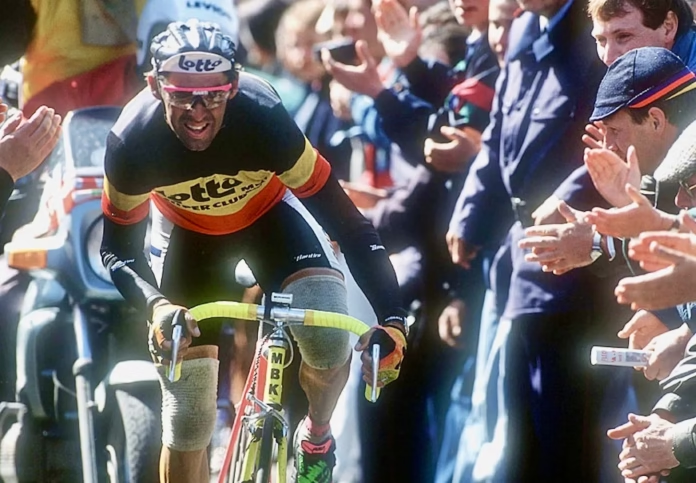
Claude Criquielion won a world title, the Tour of Flanders, two editions of La Flèche Wallonne, the Clásica de San Sebastián and the Tour de Romandie. He finished on a Grand Tour podium, became Belgian champion and spent more than a decade among the best one-day riders in the sport.
Yet his career is still unusually easy to discuss through the races he did not win.
There was the 1987 Liège-Bastogne-Liège, when Criquielion and Stephen Roche appeared to have the race between them before their hesitation allowed Moreno Argentin back into contention. There was the 1988 World Championship in Ronse, where Criquielion hit the barriers in the sprint as Steve Bauer moved across and Maurizio Fondriest rode through to take the rainbow jersey.
Those moments became part of cycling folklore. They should not overwhelm what came before and around them.
Criquielion was one of Belgium’s finest all-rounders of the 1980s, a rider capable of winning over cobbles, on Ardennes climbs and across demanding stage races. His record belongs comfortably within the wider history of men’s professional cycling.

Criquielion could win far beyond the Ardennes
Criquielion turned professional in 1979 and quickly established that he was more than a specialist for the short climbs of Wallonia.
That first season already produced overall victory at the Setmana Catalana, while his Grand Tour potential became clear in 1980 when he finished third overall at the Vuelta a España.
It was an important result because it established the breadth of his ability early. Criquielion could climb, recover across a stage race and perform well enough against the clock to remain competitive over several weeks.
His Tour de France record was also much stronger than the occasional suggestion that he was simply a Classics rider.
Criquielion finished inside the Tour’s top 10 five times, with his best result coming in 1986, when he placed fifth overall behind Greg LeMond, Bernard Hinault, Urs Zimmermann and Andrew Hampsten.
He was never a Tour de France podium finisher, but fifth in that 1986 field was still a substantial result. Three years later he finished seventh overall at the Giro d’Italia, providing another reminder that difficult one-day races were only one part of his range.
San Sebastián was the first major Classic
The first of Criquielion’s biggest one-day victories came at the 1983 Clásica de San Sebastián.
The Basque race was still young, having first been held in 1981, but its identity already suited him. Long distance, repeated climbing and a finale where tactical judgement mattered played directly to Criquielion’s strengths.
That win came before the rainbow jersey and before his greatest Belgian Classics successes, but it established a pattern.
Criquielion was most dangerous when a race became selective without becoming purely a climbing contest. He could survive enough difficulty to remove faster riders, then use his own acceleration or attack before the finish.
That versatility made him particularly awkward to race against.
Barcelona 1984 gave Criquielion the rainbow jersey
The defining victory of his career came at the 1984 World Championships in Barcelona.
Criquielion attacked during the closing part of a demanding road race and finished alone, becoming world champion at 27.
The result placed him in a run of champions that included Greg LeMond in 1983, Joop Zoetemelk in 1985 and Moreno Argentin in 1986. ProCyclingUK’s complete list of road cycling world champions shows the company Criquielion joined that afternoon.
This was not a surprise winner taking advantage of one strange championship race.
Criquielion had already built enough evidence to show that the terrain suited him. Barcelona simply gave him the biggest possible result.
He was named Belgian Sportsman of the Year in 1984, and the rainbow jersey immediately changed his place within the peloton. From then on, he was not merely one of several strong Belgian Classics riders. He was a world champion expected to contend whenever the road became difficult.

Flèche Wallonne became one of his races
Criquielion won La Flèche Wallonne in 1985 and 1989, while also finishing second in 1987 and 1991 and third in 1986.
That record makes the race one of the clearest expressions of his abilities.
The modern Flèche is overwhelmingly associated with the Mur de Huy, but the event of Criquielion’s era was tactically broader. It still rewarded the same fundamental qualities: repeated climbing strength, positioning and the ability to produce something decisive after a hard day.
Criquielion possessed all of them.
His two victories place him firmly within the lineage explored in ProCyclingUK’s history of the men’s Flèche Wallonne.
It was also the race where his rivalry with Argentin repeatedly surfaced. The Italian was perhaps the defining Ardennes specialist of that period, but Criquielion was close enough to make many of their encounters feel unresolved until late in the race.
Liège-Bastogne-Liège became the great missing victory
If there is one race that explains why Criquielion’s career is discussed through near misses, it is Liège-Bastogne-Liège.
He never won it.
He came extraordinarily close several times.
Criquielion was second in 1985, fourth in 1986, third in 1987 and second again in 1991. There was also another fourth place earlier in his career.
The 1987 edition remains the most painful.
Criquielion and Stephen Roche had escaped and reached the closing kilometres with what appeared to be enough time to decide the race between themselves. Instead, they began watching one another.
Behind, Argentin kept coming.
The gap collapsed in the final metres and the Italian swept past to win for the third consecutive year, with Roche second and Criquielion third.
ProCyclingUK’s history of men’s Liège-Bastogne-Liège places the result inside an era dominated by Argentin, Sean Kelly and some of the finest Ardennes riders the race has seen.
The episode also features prominently in our profile of Moreno Argentin, because the victory captured both sides of the race perfectly: Argentin’s refusal to believe the win had gone and the fatal hesitation ahead of him.
For Criquielion, it became another one of those days.
Strong enough to win. Close enough to expect it. Left without the race.

Tour of Flanders 1987 showed how complete he really was
Criquielion’s Tour of Flanders victory deserves more attention precisely because it does not fit the narrower image of him as an Ardennes rider.
He won the 1987 Ronde van Vlaanderen with a solo attack during the final part of the race, finishing ahead of Sean Kelly and Eric Vanderaerden.
It was a major statement.
Walloon riders have never dominated the Tour of Flanders winner’s list, and Criquielion’s ability to win the Monument underlined how broad his Classics range had become.
He could handle the positioning and attrition of Flanders, survive the cobbled climbs and still have enough left to decide the race himself.
For a rider frequently remembered for defeats caused by hesitation or circumstance, the 1987 Ronde was the opposite. Criquielion attacked and finished the job alone.
His best stage-racing year also came in 1986
The same breadth was visible away from the Classics.
Criquielion won the Tour de Romandie in 1986, one of the most important stage-race victories of his career.
He also won the Grand Prix du Midi Libre that season and returned to win it again in 1988.
These were not minor additions to a Classics palmarès. They showed that Criquielion could manage repeated climbing and time-trial demands across several days against riders preparing for the Grand Tours.
Combined with fifth in the Tour de France that summer, 1986 may have been the clearest demonstration of how complete he was.
The world title was bigger.
The Classics victories were more memorable.
But few seasons showed more of his full range.

Ronse 1988 became the image he could never escape
Then came the race that followed Criquielion for the rest of his career.
The 1988 World Championships were held in Ronse, in Belgium, giving Criquielion the opportunity to win a second rainbow jersey on home roads.
He reached the final sprint with Steve Bauer and Maurizio Fondriest.
Criquielion tried to come past Bauer along the barriers. Bauer moved across as the Belgian attempted to use the available space, contact followed and Criquielion crashed heavily into the barriers.
Fondriest rode through to become world champion.
Bauer crossed second but was subsequently disqualified.
Criquielion was left on the ground with the finish only metres away.
The incident became one of the most disputed World Championship finales in cycling history. Criquielion later pursued legal action against Bauer, without success, and the argument over blame survived long after the race itself.
What is beyond dispute is that Criquielion had been in position to fight for a second world title.
Four years after Barcelona, he was again one of the strongest riders in the championship.
This time there was no rainbow jersey.
Ronse should not be mistaken for the Tour of Flanders
The 1988 incident is sometimes incorrectly attached to the Tour of Flanders when Criquielion’s career is retold.
It happened at the World Championships in Ronse, not the Ronde.
Criquielion’s Tour of Flanders story had reached its high point a year earlier, when he won the 1987 race outright.
That distinction matters because merging the two stories distorts his career.
The Ronde was one of his greatest successes.
Ronse was one of his most painful defeats.
Both deserve to stand separately.
Even his defeats at Liège were evidence of quality
Criquielion continued competing at the highest level into the early 1990s.
He became Belgian road champion in 1990, finally adding the national jersey to his world title.
A year later, at 34, he returned to Liège-Bastogne-Liège and finished second again, this time behind Moreno Argentin.
That 1991 podium was another example of his longevity. Six years had passed since his first second place at Liège, yet Criquielion was still capable of fighting for one of cycling’s oldest Monuments.
He retired after the 1991 season with around 60 victories across a professional career that had lasted more than a decade.
-
 Photo Credit: Getty


Claude Criquielion’s major career results
Among the results that best explain his career were:
- 1984 World road champion
- 1987 Tour of Flanders winner
- 1985 and 1989 La Flèche Wallonne winner
- 1983 Clásica de San Sebastián winner
- 1986 Tour de Romandie winner
- 1986 and 1988 Grand Prix du Midi Libre winner
- 1990 Belgian road champion
- Third overall at the 1980 Vuelta a España
- Fifth overall at the 1986 Tour de France
- Seventh overall at the 1989 Giro d’Italia
- Second at Liège-Bastogne-Liège in 1985 and 1991
- Third at Liège-Bastogne-Liège in 1987
That is not the palmarès of a rider whose career should be reduced to misfortune.
A career with more victories than regret
Criquielion later returned to professional cycling as a directeur sportif, working with Lotto and Landbouwkrediet after his racing career had ended.
He died in 2015 at the age of 58 after suffering a stroke.
By then, the image from Ronse had become inseparable from his name. So had the lost Liège of 1987.
Both belong in the story, but neither should own it.
Criquielion won a Monument, two Flèches Wallonne, San Sebastián, the Tour de Romandie and a world championship. He finished on a Grand Tour podium and inside the top five of the Tour de France. He could compete on cobbles, in the Ardennes, in the mountains and against the clock.
The bad luck was real.
So were some tactical mistakes.
But Claude Criquielion’s career does not need hypothetical victories to make it great.

