
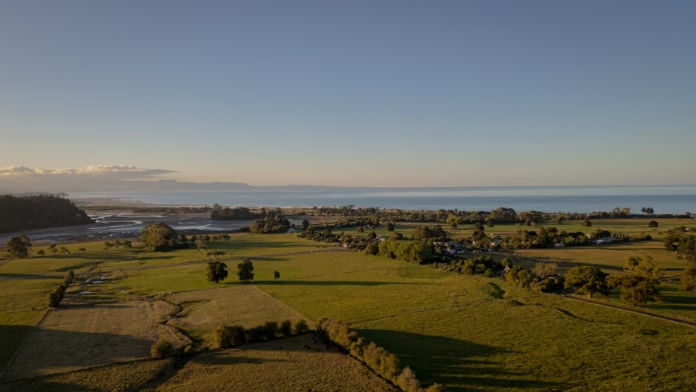
Nelson and Tasman are easy to underestimate if you arrive expecting New Zealand cycling to mean one thing: enormous alpine roads, remote gravel or full-gas mountain biking. The top of the South Island is much broader than that. You can spend one day rolling beside the Waimea Estuary and crossing to Māpua, another climbing into the mineral belt above Nelson on a proper mountain bike, and another heading west towards Motueka and Kaiteriteri with the sea rarely far away.
That variety is what makes the region work so well for a cycling trip. The riding can be genuinely relaxed without being dull, while stronger riders have enough harder options to avoid feeling as though they have booked a leisure trail holiday by mistake. It is also unusually easy to build the trip around towns, cafés, wineries, beaches and accommodation rather than spending half the day in a car getting to the start of a ride.
For British riders travelling this far, Nelson Tasman makes most sense as part of a wider New Zealand itinerary rather than a one-off cycling weekend. ProCyclingUK’s cycling in Australia and New Zealand hub is the natural place to start if you are comparing it with other destinations around the country.
The Great Taste Trail gives the region its cycling backbone
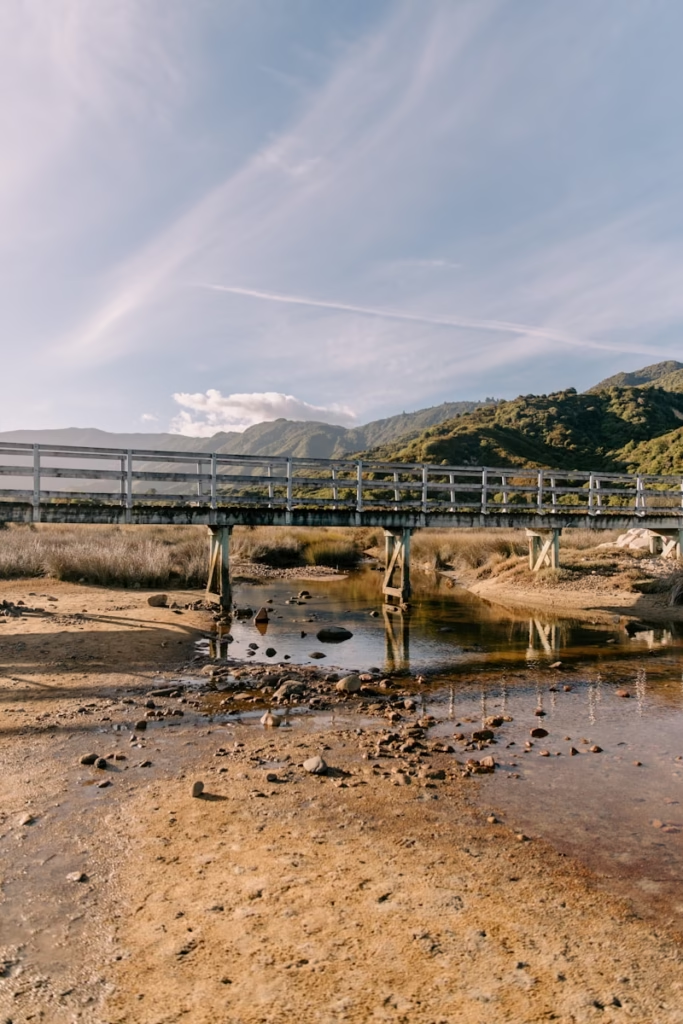
Tasman’s Great Taste Trail is the route that gives the whole region shape. It is one of New Zealand’s Great Rides and links Nelson with Richmond, Brightwater, Wakefield, Māpua, Motueka, Kaiteriteri and the inland valleys. Official route information currently describes a network of around 200 kilometres, although the exact total depends on which completed sections and connections are counted. The important point is that it is not one out-and-back cycle path. It is a network you can use to build anything from a two-hour spin to a multi-day tour.
The coastal side is the obvious introduction. Nelson to Richmond is around 11km, Richmond to Māpua around 15km, Māpua to Motueka around 33km and Motueka to Kaiteriteri around 16km. Those distances are useful because they make the route modular. A rider who wants an easy day can stop early, while someone with better legs can join two or three sections without suddenly finding themselves committed to a huge ride.
The surface and difficulty change as the trail moves inland. The easiest parts are Grade 1, while other sections rise through Grade 2 to Grade 3, with steeper pinches, narrower trail and more technical riding in places. That distinction matters. It is easy to look at the Great Taste Trail as a completely flat family route, but the inland loop towards Tapawera, Baton River and Riwaka is a different proposition from the gentle riding around Nelson and Māpua.
Nelson to Māpua is the ride most visitors should do first
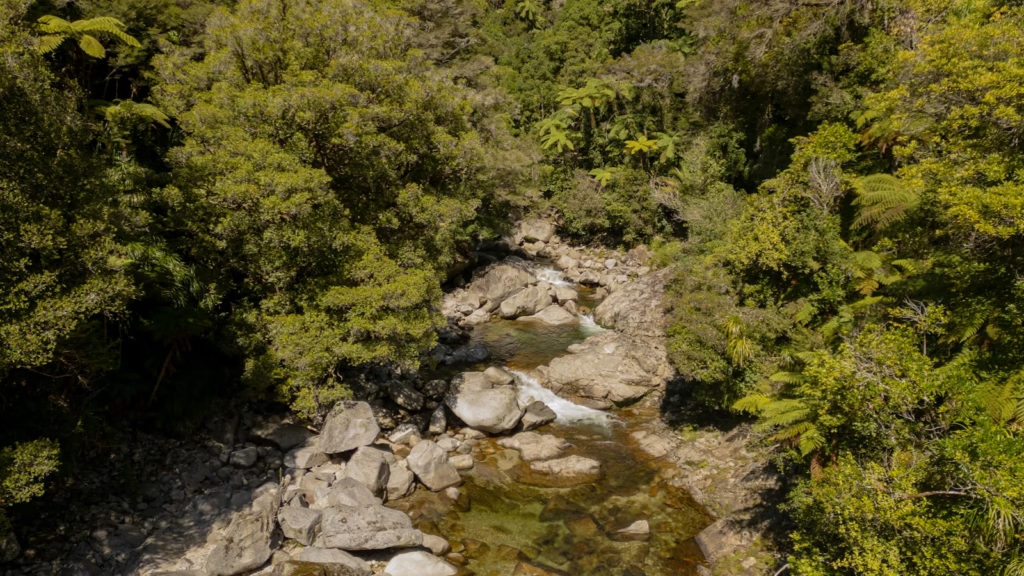
If you only have one day, the ride from Nelson through Richmond and across towards Māpua is the best introduction. It shows why the region has built such a strong cycling-tourism identity without requiring a huge amount of fitness. The riding moves quickly from city paths into estuary scenery, open views and rural sections, while Māpua gives the day a proper destination rather than an arbitrary turnaround point.
This is the side of Nelson Tasman that works particularly well for couples or groups with mixed abilities. One rider can treat it as an easy recovery day and another can make it the main event. E-bikes are common and make sense here because the attraction is as much about stopping at the coast, food producers, breweries and cafés as it is about collecting kilometres.
It is also a good first-day test for a bike brought from home. You can check tyre pressure, luggage, brakes and fit without discovering a mechanical problem halfway across a mountain pass. That sounds mundane, but on a long-haul cycling holiday it is useful to have a ride where a small setup problem does not wreck the day.
The inland trail is where the Great Taste Trail becomes more serious
The inland side changes the character of the trip. From Richmond the trail runs through Brightwater and Wakefield before continuing towards Tapawera. Official trail information gives the Richmond to Brightwater section as roughly 10km, Brightwater to Wakefield as 8km and Wakefield to Tapawera as around 34km. Beyond Tapawera, the route uses rural gravel roads and climbs towards Baton Saddle before dropping into the Motueka Valley.
This is where the word ‘trail’ can hide the amount of work involved. The backcountry sections are more exposed, phone reception can be limited and rural roads can still carry working traffic, including large vehicles. It is no longer the sort of ride where you can assume there will be a café every half hour. Carry food, water, basic tools and an extra layer, and check the live trail notices before leaving.
The official trail site is particularly worth checking because closures and temporary diversions do happen. In August 2026, for example, parts of the Motueka Valley section were affected by temporary access restrictions. The detail will change, but the lesson does not: plan from the live trail information rather than relying on an old GPX file saved months earlier.
Coppermine Trail is the harder day hiding on Nelson’s doorstep
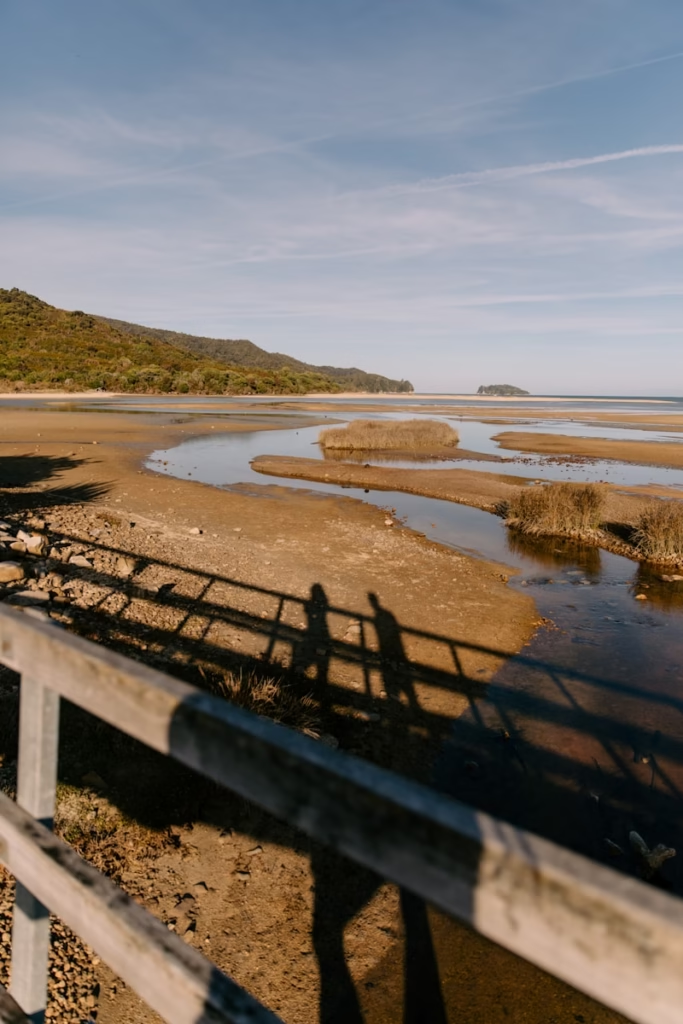
Anyone worried that Nelson Tasman sounds too gentle should put the Coppermine Trail into the plan. The full loop from Nelson is around 43km, or roughly 40km if you start and finish at the Brook Street trailhead. It follows the historic Dun Mountain Railway route out of the city, climbs through native forest to Coppermine Saddle and then drops towards Maitai Dam before returning to Nelson.
The numbers are not enormous by alpine standards, but the riding is properly technical. The climb to Coppermine Saddle is graded as Grade 3, while the descent from the saddle to Maitai Dam is Grade 4. The high point is around 878 metres, reached after a long steady rise from near sea level. That is a very different day from the Great Taste Trail and one that rewards a proper mountain bike, good handling and some respect for the terrain.
The appealing part is how close it sits to the city. You can start among Nelson’s cafés, ride into backcountry terrain and finish back in town without arranging a major transfer. If your group contains road or gravel riders and someone who wants a harder mountain-bike day, that proximity makes the logistics much easier.
Kaiteriteri is more than the end of a coastal trail
Kaiteriteri is often treated as the western destination on the Great Taste Trail and the gateway to Abel Tasman National Park, but cyclists should give it more time than a quick photo at the beach. The Kaiteriteri Mountain Bike Park adds purpose-built off-road riding to the trip and gives the area another reason to stay overnight rather than immediately turning back towards Nelson.
It also works well as a point where a mixed holiday can split for a day. One person can ride, another can head into Abel Tasman, and both can still use the same accommodation. That sounds more like travel planning than cycling analysis, but it is exactly the sort of detail that makes one destination easier to live with for a week than another.
Road riders should look beyond the cycle trail
The Great Taste Trail dominates the marketing, but a road bike is not wasted here. Rural roads south and west of Nelson allow rolling endurance rides without needing to commit to the main state highways for the entire day. The terrain gets hillier quickly once you move inland, and the road network gives enough options to turn a flat spin into a much harder day.
Tākaka Hill is the obvious road climb for experienced riders wanting something more substantial. State Highway 60 rises for more than 800 metres across the 30km corridor between Riwaka and Upper Tākaka and includes several hairpins. It is also the only road connection into Golden Bay, so this is not a quiet closed-road climb. Trucks, campervans, tourist traffic and changing road conditions all matter. Treat it as a serious road ride, check the current NZTA conditions and use strong lights rather than approaching it like a European mountain pass where the bike traffic is expected.
If that sounds more stressful than appealing, there is no shortage of quieter riding closer to Nelson and the Waimea plains. The region does not need Tākaka Hill to justify a road bike. It is simply there for riders who want a bigger challenge and are comfortable sharing a working state highway.
What bike works best in Nelson and Tasman?
A gravel bike is the best one-bike answer for most experienced riders. Something with 35-45mm tyres will handle the easier Great Taste Trail sections comfortably, remain efficient on sealed roads and cope with the rougher rural connections far better than a race bike on narrow tyres. It also leaves room for racks or bikepacking bags if you want to ride point to point.
A hybrid or trekking bike is entirely adequate if the trip is built around the Great Taste Trail and cafés rather than harder off-road sections. An e-bike is arguably even better for a mixed-ability holiday because it lets everyone ride the same distances without turning the day into a fitness test.
A mountain bike becomes worthwhile if the Coppermine Trail and Kaiteriteri are priorities. The Grade 4 descent on Coppermine is not where you want to discover the limits of a lightly built gravel setup. Road riders, meanwhile, should bring lower gearing than they might use at home. The region’s climbs are not always famous, but the roads can pitch up sharply and repeatedly.
When is the best time to cycle Nelson Tasman?
Nelson has a reputation for sunshine by New Zealand standards, and the lower trails can be ridden through much of the year, but summer remains the easiest period for a dedicated cycling holiday. Longer daylight, warmer temperatures and the full range of visitor services make December through February the simplest option, particularly if this is your first trip to the South Island.
Spring and autumn are arguably better for riders who dislike heat and crowds. The trade-off is less predictable weather, while winter makes the higher and more exposed routes a different proposition. Conditions on the Coppermine Trail and inland Great Taste Trail sections deserve their own check regardless of what the forecast says in Nelson itself.
New Zealand’s sun is also stronger than many UK visitors expect. Even on a cool day, sunscreen and plenty of fluid should be routine rather than something saved for obviously hot rides.
Where should you stay?
Nelson is the easiest base if you want variety. It gives immediate access to the city-end trail network, the Coppermine Trail and road riding, while bike hire and repairs are easier to organise. It also works best if cycling is only part of the holiday.
Māpua is better if the priority is a slower trip centred on the coastal trail, food and shorter rides. Motueka makes sense if Abel Tasman and Kaiteriteri are equally important, and it positions you closer to Tākaka Hill if Golden Bay is part of the plan. A point-to-point itinerary can use all three rather than forcing every ride to return to the same hotel.
-
 Photo Credit: Canyon SRAM (supplied media release)
 -
 Photo Credit: Park Tool



A four-day cycling plan that shows the region properly
On day one, ride from Nelson towards Māpua. Keep it deliberately easy, stop along the way and use the ride to learn the trail signs and check the bike. If you have flown long-haul, there is no prize for turning the first afternoon into a threshold session.
Day two is the time to head further west, linking Māpua, Motueka and Kaiteriteri. Depending on fitness and accommodation, this can be a point-to-point day or a longer return ride. The route has enough interest that doubling back does not feel completely wasted, but a shuttle or luggage transfer makes the trip more relaxed.
Day three should change the rhythm. Strong mountain bikers can take on the Coppermine Trail, while road riders can build a hillier loop south of Nelson. Anyone wanting a recovery day can simply use another short section of the Great Taste Trail. That choice is one of the region’s strengths.
On day four, either take the inland trail towards Wakefield and Tapawera or, for experienced road riders, make Tākaka Hill the main objective if traffic and weather conditions are suitable. By then you will have seen the coastal, rural and hill-country versions of Nelson Tasman rather than treating the area as one long cycle path.
How Nelson Tasman compares with other New Zealand cycling bases
Nelson Tasman is less dramatic than Queenstown if your idea of a cycling trip starts with alpine scenery, but it is easier to build around different levels of rider. ProCyclingUK’s guide to cycling in Queenstown and Central Otago is the better comparison if you want bigger landscapes, famous trail networks and a more obviously mountainous holiday.
It also feels different from cycling in Christchurch and Canterbury, where the city, Banks Peninsula and wider plains create a broader road-riding canvas. Nelson’s advantage is compactness. The sea, trail network, mountain biking and food stops fit together unusually neatly.
That is the reason to put it on a New Zealand itinerary. Nelson Tasman does not ask every rider to want the same thing. It gives you an easy coastal ride when you want one, a difficult backcountry day when you do not, and enough places to stop that the cycling never has to consume the whole holiday. More destination ideas are available in ProCyclingUK’s Travel and Riding Abroad hub.

