
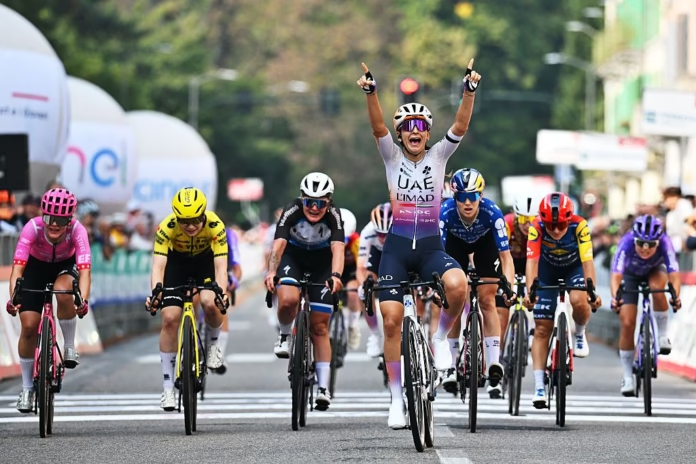
Eleonora Camilla Gasparrini won the 2026 Tre Valli Varesine Women’s Race for UAE Team L’IMAD, with Sarah Van Dam taking second and Noemi Rüegg completing the podium. The result came from a race shaped by repeated attacks, a large late reshaping of the race and a closing split that was still being contested inside the final three kilometres.
There was no single early move that settled the race. Katharina Palm and Fariba Hashimi attacked together at 126 kilometres remaining, Linda Zanetti then went clear from the peloton, and further attempts followed through the middle phase. The decisive pattern was cumulative: groups formed, were absorbed, and were replaced by fresh attacks as the race moved towards its closing sequence.
UAE Team L’IMAD remained central to the final phase. Silvia Persico attacked with 33 kilometres to go and Karlijn Swinkels made another move inside the final two kilometres, while Gasparrini finished the race as the winner. Van Dam secured second and Rüegg third after the late groups were still changing shape behind the front.
How it unfolded
The first meaningful attacks arrived well before the finish. Palm and Hashimi moved together with 126 kilometres remaining, followed four kilometres later by Zanetti’s attack from the peloton. Those efforts established an active opening without producing a confirmed winning break in the available race sequence.
The race settled into another attacking phase at 74 kilometres to go, when Maya Kingma and Sara Luccon moved out of the peloton. Their attempt lasted only briefly in race terms: both were caught with 72 kilometres remaining. The quick return underlined the difficulty of making an early move stick.
Aude Biannic attacked at 56 kilometres, and two kilometres later the race registered an attack involving 10 riders. Team Visma | Lease a Bike was then pulling in the peloton at 47 kilometres, bringing a more organised response to the changing front of the race.
Early moves fail to settle the race
The early story was one of pressure without permanence. Palm and Hashimi were the first named attackers, Zanetti followed from the peloton, and Kingma and Luccon tried again later. Yet the latter pair were caught almost immediately, leaving no evidence that any of those early moves had carried a decisive advantage through the race.
Biannic’s move at 56 kilometres came as the race entered a more consequential section. The subsequent attack by 10 riders was the largest explicitly identified move of the day, but the packet does not establish its complete composition or confirm that it became the final front group.
Visma’s presence on the front at 47 kilometres changed the emphasis from isolated attacks to a chase involving a major contender’s team. That work was followed by Nikola Nosková’s attack at 45 kilometres, another attempt to alter the race before the leading selection had fully stabilised.
By 38 kilometres, both EF Education-Oatly and Visma were pulling in the peloton. The response was therefore shared between teams that would ultimately place riders on the podium, although the decisive result was still more than half an hour of race distance away in terms of the remaining kilometres.
A wider selection takes shape
Silvia Persico attacked for UAE Team L’IMAD at 33 kilometres to go, while Henrietta Christie attacked for EF Education-Oatly one kilometre later. The two moves placed the eventual winner’s and third-placed rider’s teams directly into the most important attacking sequence of the race.
At 31 kilometres, five riders were caught by the peloton: Solbjørk Minke Anderson, Jeanne Korevaar, Linda Zanetti, Katharina Palm and Fariba Hashimi. The catch brought several earlier attackers back into the main race and showed that the front was still being reabsorbed rather than running clear to the finish.
EF then took responsibility for pulling in the peloton at 29 kilometres. Two kilometres later, Maud Oudeman and Maud Rijnbeek were also caught. The repeated catches reduced the number of riders able to remain ahead, but they did not stop the attacks from continuing.
The significance of this phase was not a confirmed winning break but the steady removal of attempted escapees. The early names were being brought back, while the teams of Van Dam and Rüegg remained active in controlling the race. That left the final result open for a later move rather than allowing the race to be decided by the first serious attack.
Visma controls the approach
With 14 kilometres remaining, Amber Kraak, Loes Adegeest and Biannic were caught by the peloton. Biannic’s earlier attempt had therefore ended before the finish, and the catch further compressed the race ahead of the final sequence.
Femke De Vries attacked for Visma at 13 kilometres to go. One kilometre later she was pulling in the peloton, giving the team a clearly documented presence at the head of the race during the approach to the finish.
De Vries’ move and subsequent pull did not produce a confirmed solo leader in the event sequence. Instead, it formed part of the continuing pressure that kept the front of the race unsettled while the peloton absorbed earlier attempts.
That mattered for Van Dam’s eventual result. Visma was active both in the chase and in the final approach, and Van Dam emerged from the closing contest in second place. The race was still not decided at 13 kilometres, but the nature of the contest had narrowed from long-range attacks to short-range moves and the management of the groups behind them.
The closing split becomes decisive
At three kilometres to go, the gap between group one and group two was decreasing. That was the clearest late indication that the result remained vulnerable to a catch or a reshuffle, with the second group still closing on the front in the final kilometres.
Swinkels attacked for UAE Team L’IMAD with two kilometres remaining. The move added another UAE presence to the finish after Persico’s earlier attack, but the available race evidence does not say that Swinkels’ move was the winning action or that it created the final winning gap.
Behind, Nosková was struggling to hold on at the same point. Ricarda Bauernfeind had finished pulling in group two, while Silke Smulders was pulling in that group. Those details show the pressure at the back of the late chase, as the groups fought both to close the gap and to preserve their positions.
Malou Eisen also attacked with two kilometres left, adding one more late move to a closing phase already marked by Swinkels’ attack and the shrinking gap between the groups. The final kilometres therefore contained several attempts rather than a single uncontested escape.
Gasparrini nevertheless crossed the finish as winner. The race sequence does not identify the precise action that separated her from the opposition, but the final result confirms that she emerged ahead of Van Dam and Rüegg from that unsettled closing group.
What decided the podium
Gasparrini’s victory was built within a race that repeatedly rejected early moves. Palm and Hashimi, Kingma and Luccon, Biannic, the 10-rider attack and Nosková’s effort all formed part of the pressure, but none is confirmed as the move that decided the race.
The most important change came through the accumulation of late selection and chase activity. UAE had Persico attacking at 33 kilometres and Swinkels moving inside the final two kilometres, while Visma and EF both contributed to the work that kept the race controlled and then contested.
Van Dam finished second after Visma had been visible in the chase and closing approach. Rüegg took third after EF’s pulling at 38 and 29 kilometres, as well as Christie’s attack at 32 kilometres. Their teams were therefore involved in the main late developments, but Gasparrini was the rider who converted that complex sequence into the one-day victory.
The closing gap between group one and group two was still decreasing with three kilometres remaining, so the podium was not protected by a settled race far from the finish. Swinkels and Eisen attacked at two kilometres, Nosková was losing contact, and riders in group two were still pulling. Gasparrini’s win came from surviving that late contest in front, rather than from a result established by an early break.
Kate Courtney finished fourth, with Malou Eisen fifth, Fleur Moors sixth and Julie Bego seventh. Giada Silo was eighth, Silke Smulders ninth and Ema Comte tenth, completing the leading ten after the late attacks and group changes had defined the final order.
Tre Valli Varesine Women’s Race 2026 Result
| Pos. | Rider | Team / nation | Time / gap |
|---|---|---|---|
| 1 | Eleonora Camilla Gasparrini | UAE Team ADQ (WTW) | — |
| 2 | Sarah Van Dam | Team Visma | Lease a Bike (WTW) | — |
| 3 | Noemi Rüegg | EF Education-Oatly (WTW) | — |
| 4 | Kate Courtney | FDJ United – SUEZ (WTW) | — |
| 5 | Malou Eisen | VolkerWessels Cycling Team (PRW) | — |
| 6 | Fleur Moors | Lidl – Trek (WTW) | — |
| 7 | Julie Bego | Cofidis Women Team (PRW) | — |
| 8 | Giada Silo | UAE Team ADQ (WTW) | — |
| 9 | Silke Smulders | Liv AlUla Jayco (WTW) | — |
| 10 | Ema Comte | Cofidis Women Team (PRW) | — |

